
Energy gives physics a way to compare states without narrating every instant between them. A falling object speeds up, a compressed spring launches a cart, a battery drives a motor, and friction warms surfaces, yet one accounting framework can connect all of those changes. The power of energy is not that it is a visible material flowing like water. Energy is a conserved scalar property assigned to a defined system and its interactions. Careful bookkeeping reveals which forms change and which transfers cross the system boundary.
This article develops energy as a reasoning method rather than a list of formulas. We will distinguish translational and rotational kinetic energy, gravitational and elastic potential energy, internal thermal and chemical energy, and transfer by work or heating. Every equation will define its symbols and carry units. We will also show how system boundaries change ledger entries without changing the physical event. The goal is to make “conservation” an auditable statement about a chosen system.
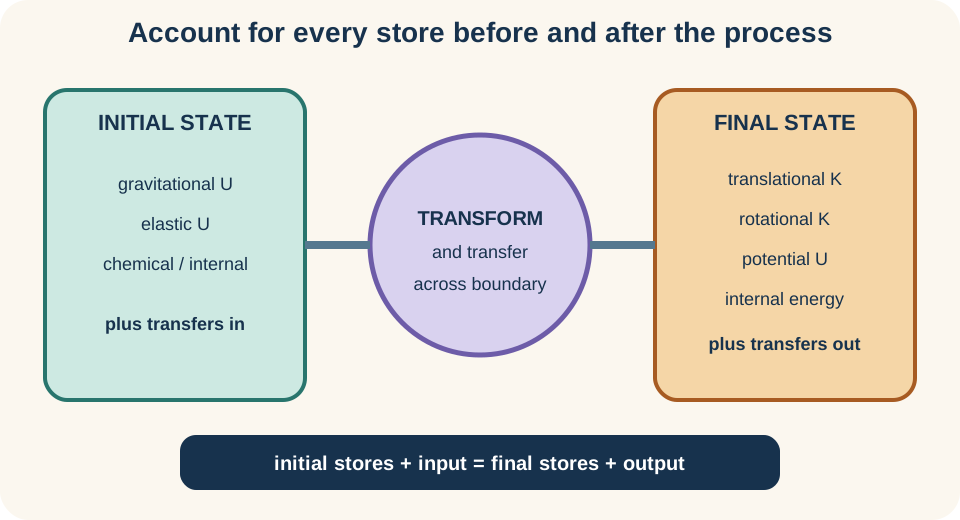
Begin any energy problem by naming the system and two states. Inventory energy stored in each state, then identify transfers across the boundary during the interval. Decide which terms are negligible only after estimating them or reading the model assumptions. Use a signed ledger instead of saying energy was “lost.” Finish by checking units, magnitude, and whether omitted rotational or internal energy could matter.
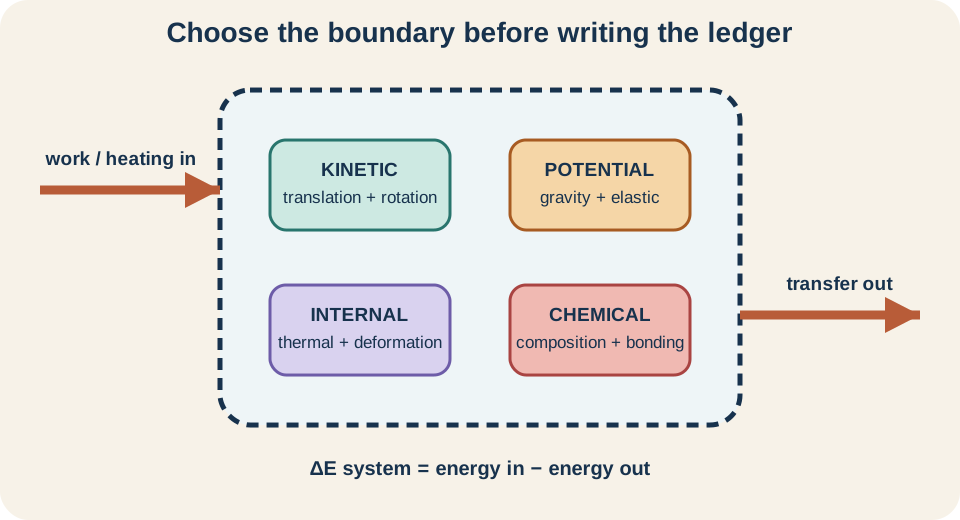
Conservation requires a defined system
A system is the object or collection of objects chosen for analysis. Everything else is the surroundings. The boundary may be physical, such as the wall of a container, or conceptual, such as an imaginary surface around a block and ramp. Energy can be stored within the system and transferred across its boundary. Conservation applies to the complete accounting, not to one preferred form.
For an isolated system, no energy crosses the boundary, so total energy remains constant. A closed system can exchange energy but not matter, while an open system can exchange both under common thermodynamic definitions. Mechanics problems often use “system” more flexibly, so state exactly what it includes. A block alone and a block-plus-ramp system produce different ledger terms. Both can describe the same event correctly.
Changing the boundary changes whether an interaction is internal or external. If Earth and a falling ball are both inside the system, their gravitational interaction changes internal potential and kinetic energy. If only the ball is inside, gravity is an external interaction that transfers energy by work. The measured motion is unchanged. The bookkeeping vocabulary changes because ownership changes.
Energy is a scalar measured in joules
Energy is a scalar, so it has magnitude but no direction in space. Individual energy changes can be positive or negative relative to a chosen reference or transfer convention. The SI unit is the joule, written . One joule equals one newton-meter and one . Dimensional equivalence links work, motion, and energy formulas.
A scalar ledger differs from a vector force balance. Forces must be added with directions and components, while energy terms are added algebraically as scalar quantities. Direction still enters through work because the angle between force and displacement matters. Velocity direction disappears from in kinetic energy, though direction remains essential to momentum. Choosing energy or momentum depends on the question.
Energy values often depend on reference choice, but energy differences produce physical predictions. Gravitational potential near Earth can be assigned zero at a floor, tabletop, or another convenient height. Adding the same constant to all potential values does not change . Kinetic energy has a natural zero in the chosen reference frame when speed is zero. Always state references when an absolute numerical value might otherwise appear meaningful.
Translational kinetic energy is energy of motion
Translational kinetic energy describes motion of an object’s center of mass. For an object of mass moving with center-of-mass speed , it is . Mass uses kilograms and speed uses , giving . The squared speed makes kinetic energy nonnegative in classical mechanics. Reversing velocity direction does not change this energy.
Doubling speed multiplies translational kinetic energy by four because of the square. Doubling mass at fixed speed doubles kinetic energy. Therefore a small speed increase at high speed can require substantial energy. This nonlinear dependence matters for braking distance, collision severity, and launch requirements. A verbal claim about “twice as fast” should not be translated into “twice the energy.” The equation itself should guide the scaling claim.
Kinetic energy depends on reference frame because speed does. A passenger seated in a moving train has zero translational kinetic energy relative to the train but nonzero energy relative to the ground. Energy conservation remains consistent when all terms and transfers use one frame. Switching frames midway invalidates the ledger. State the reference frame when ambiguity matters.
Rotational kinetic energy is also energy of motion
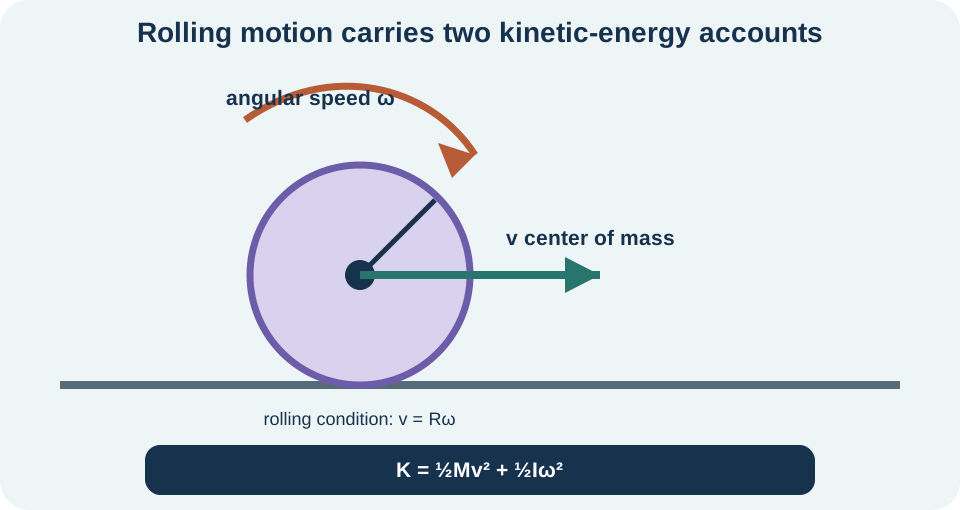
A rotating object stores kinetic energy even if its center of mass does not translate. For a rigid body rotating about a fixed axis, . The symbol is rotational inertia in and is angular speed in . Radians are dimensionless in SI, so the product has joule units. Rotational inertia depends on how mass is distributed relative to the axis.
For rolling without slipping, an object can have both forms simultaneously. Total macroscopic kinetic energy is . The subscript “cm” refers to the center of mass. The rolling constraint is , where is rolling radius. A rolling ball cannot generally be modeled as a sliding point mass without losing the rotational share.
Introductory problems often ignore rotational kinetic energy because objects are modeled as particles, wheels are declared massless, rotation is absent, or the term is small relative to others. This omission is a modeling choice, not a statement that rotation contains no energy. It is valid only when the problem’s assumptions justify it. If a wheel, pulley, spool, rolling sphere, or flywheel has appreciable rotational inertia, neglecting rotation can produce the wrong speed or acceleration. A quick energy estimate can test whether the rotational share is negligible.
Gravitational potential energy stores configuration
Potential energy belongs to an interacting system and depends on configuration. Near Earth’s surface, a convenient model is , where is mass, is gravitational field magnitude, and is height relative to the chosen zero. Using , kilograms, and meters produces joules. A higher Earth–object configuration has greater potential energy under this near-surface convention. The mass is not a container holding a substance called height energy.
The expression assumes the gravitational field is approximately uniform over the height change. For large astronomical distances, use with zero chosen at infinite separation. Here is the gravitational constant, and are interacting masses, and is center-to-center separation. The negative sign reflects the chosen zero and attractive bound configurations. Both formulas describe gravitational configuration under different domains.
Potential-energy changes are reference independent even when values are not. Near Earth, . The subscripts and mean initial and final. Raising an object increases the Earth–object system’s gravitational potential energy. Lowering it decreases that energy and can increase kinetic or another form.
Elastic potential energy stores deformation
An ideal spring displaced from equilibrium stores elastic potential energy . The spring constant has units , and is compression or extension in meters relative to equilibrium. The squared displacement makes stored energy positive for either direction. Multiplying units gives newton-meters or joules. The formula follows from integrating a linear spring force.
Hooke’s law is , where the negative sign means the spring force points toward equilibrium. The elastic potential relation assumes is constant across the deformation. Real springs can become nonlinear, plastically deform, or dissipate energy internally. The ideal formula is accurate only inside the elastic linear regime. A force-displacement graph reveals the stored work as area.
Chemical energy can also be understood as energy associated with microscopic configurations and interactions, though it is not described by the simple spring formula. Changes in bonding and electron arrangements alter internal energy. Batteries, fuels, and metabolism release or absorb energy through reactions coupled to their surroundings. Saying chemical energy is “stored in bonds” can mislead because breaking an isolated bond requires energy, while net reaction energy depends on bonds broken and formed plus the environment. The complete initial-to-final state comparison matters.
Internal energy includes microscopic motion and interaction
Internal energy includes microscopic kinetic and potential contributions within a system. Molecular translation, rotation, vibration, intermolecular interactions, electronic states, and chemical composition can contribute. Macroscopic center-of-mass kinetic energy is usually tracked separately. A warming object gains internal energy as microscopic energy distributions change. Temperature is related to those distributions but is not identical to total internal energy.
Friction often converts organized mechanical energy into internal energy. When a block slides on a rough ramp, surface deformation, molecular vibration, and microscopic rearrangement warm the block and ramp. Mechanical energy can decrease while total energy of a sufficiently inclusive system remains conserved. The energy is not destroyed. It has become less concentrated in the macroscopic mechanical degrees of freedom.
The phrase “thermal energy” is used informally for temperature-related internal energy. Heat, however, is energy transfer caused by a temperature difference, not energy stored as heat inside an object. Once transferred, the energy contributes to internal states. Precise language uses heating for the transfer process and internal energy for storage. This distinction keeps process and state separate.
Work transfers energy mechanically
Work by a force is an energy transfer associated with displacement. For a constant force, , where is force magnitude, is displacement magnitude, and is the angle between them. The cosine selects the component of force parallel to displacement. Positive work transfers energy into the object’s kinetic account under the simple particle model. Negative work transfers energy out of that account.
For a varying force along one dimension, . The integral accumulates infinitesimal force-displacement products. On a force-versus-position graph, work is signed area under the curve. The units are newtons times meters, equal to joules. This general form produces the spring-energy expression and supports nonconstant interactions.
Work is not a substance stored in the system. It names transfer across a chosen boundary or between defined subsystems. After the transfer, the energy appears in kinetic, potential, internal, or another account. Different boundaries can move a force from an external-work term into an internal potential-energy change. The event remains the same while the ledger organization changes.
The work–energy theorem connects net work to motion
The work–energy theorem states for a particle or center-of-mass model under appropriate definitions. In one dimension, start with and use . Then . Evaluating gives . The right side is the change in kinetic energy.
The theorem is not the same as total energy conservation, though it is compatible with it. Net work tracks how forces change kinetic energy. Conservative-force work can be represented as a negative potential-energy change, . Nonconservative external work or internal-energy changes may require additional terms. The chosen system determines the most useful form.
For rotational motion, net torque does rotational work and changes rotational kinetic energy. A constant torque through angular displacement does work when aligned with the rotation convention. More generally, . The rotational theorem parallels the translational one. Ignoring it in a massive pulley problem omits an energy destination.
Conservative forces allow potential-energy bookkeeping
A force is conservative when its work between two configurations is path independent and can be represented by a potential energy. Gravity and ideal spring forces are standard examples. Define , where is work by the conservative force. If only conservative forces exchange energy internally, then . This is conservation of mechanical energy.
Mechanical energy is for the chosen macroscopic terms. It is not universally equal to total system energy. Friction, deformation, sound, chemical change, and heating can move energy into or out of mechanical accounts. A decrease in does not contradict total conservation. The missing ledger terms must be identified.
Path independence makes energy methods efficient. A gravitational potential change depends only on initial and final heights in the uniform model, not on the winding path between them. Forces and accelerations along the path may vary, but the state comparison can bypass those details. Energy solves for speeds and configurations without automatically providing elapsed time or trajectory. Method power and method limits coexist.
A general energy ledger tracks storage and transfer
A useful general statement is . The system energy change includes every relevant storage form inside the boundary. Transfers can occur through work, heating, radiation, electrical processes, or matter flow depending on the model. Signs must follow one declared convention. The ledger closes when every significant term is represented once.
For a mechanics system, one might write . Here represents net external work transferred into the chosen system under a stated sign convention. Internal energy increase can represent frictional warming or deformation. The exact arrangement can be algebraically moved, but the physical meaning of each sign must remain. There is no universal one-line formula without system definitions.
Energy “loss” usually means loss from a restricted account or transfer out of a system. A pendulum’s mechanical amplitude decreases because air drag and pivot friction transfer organized energy into internal energy and surroundings. Total accounting remains conserved when the environment is included. Use “transformed” or “transferred” and name the destination. This language forces the physics to be complete.
A falling object illustrates direct state comparison
Consider a ball dropped from rest through height near Earth, neglecting air resistance and rotation. Choose the ball–Earth system, set gravitational potential zero at the lower state, and take initial kinetic energy as zero. Conservation gives . Mass cancels because both relevant terms scale with . Solving gives .
Use and . Then . Taking the square root gives . The units remain visible through every line. The positive value is speed magnitude.
Air resistance would transfer some mechanical energy into air and internal energy. A spinning ball would also have rotational kinetic energy if torque produced or maintained rotation, though a perfectly spherical ball spinning independently can retain that rotation without drawing from the fall’s translational account under ideal conditions. The simplified result depends on declared omissions. Energy analysis should state them rather than hide them. Different assumptions define different but internally consistent models.
Rolling motion reveals why rotation cannot always be ignored
Consider a rigid object rolling without slipping down a vertical drop . Conservation gives . Use to express both kinetic terms through center-of-mass speed. Then . The rotational inertia determines how energy is partitioned.
For a solid sphere, . Substitution gives . Therefore . This is smaller than the sliding point-mass result because some gravitational energy becomes rotational kinetic energy. Mass and radius cancel for this ideal model.
If rotation were ignored, the predicted speed would be too high. Textbooks sometimes ignore wheel or pulley rotation by declaring them massless or assigning negligible inertia. That approximation reduces algebra and may be appropriate when rotational energy is small. It is not appropriate merely because rotational motion is less visually obvious. Ask where angular speed and inertia appear in the real system.
Friction can conserve or transform mechanical energy
Static friction in ideal rolling can provide torque without dissipating mechanical energy when the point of contact has no relative slipping. It redirects energy into rotational motion. Kinetic friction during sliding typically increases internal energy and decreases macroscopic mechanical energy. The word friction therefore does not automatically determine an energy loss. The type of contact and relative motion matter.
For a sliding block and ramp treated together as the system, kinetic friction is internal. A ledger can write . The increase in internal energy represents warming and microscopic deformation. If only the block is the system, friction is external work and energy leaves the block account. Both descriptions must predict the same measurable motion when complete.
Rolling resistance, deformation, bearing friction, and air drag can dissipate mechanical energy even when the geometric rolling constraint approximately holds. Real tires and surfaces deform and recover imperfectly. An ideal no-loss rolling model omits those effects. Experimental data determine whether the omission is acceptable. “Rolling” alone does not guarantee mechanical-energy conservation.
Power describes the rate of energy transfer
Power is the rate at which energy is transferred or transformed. Average power is , while instantaneous mechanical power can be . The dot product selects the force component along velocity. The SI unit is the watt, . Energy and power are not synonyms.
Two machines can perform the same work while having different power. Lifting a load by transfers regardless of whether it takes one second or ten in an ideal model. One second corresponds to average power, while ten seconds corresponds to . The energy transfer matches and the rates differ. Device ratings often emphasize power because timescale matters.
Efficiency compares desired output energy or power with input. An efficiency is dimensionless and usually reported as a percent. The remainder is not destroyed; it appears in other forms such as internal energy, sound, or unwanted motion. Defining “useful” depends on the engineering goal. Conservation and efficiency answer different questions.
Energy methods have limits
Energy is a scalar state-comparison tool, so it may not reveal direction of motion. A known kinetic energy gives speed magnitude but not whether velocity points left or right. Momentum or force analysis may supply direction. Energy also does not automatically give elapsed time. Kinematics or dynamics may be needed after speed is known.
Conservation equations can contain fewer constraints than unknowns. If a collision converts energy among translation, rotation, deformation, and sound, total energy alone may not determine every outcome. Momentum, angular momentum, geometry, material laws, or empirical coefficients may be required. A valid conservation law is not always a complete solution. Count unknowns and independent equations.
Potential energy exists only for interactions modeled conservatively within the stated configuration variables. A velocity-dependent drag force does not generally have a simple scalar potential in elementary mechanics. Time-dependent external driving can inject or remove energy. Reference frames can change kinetic terms. State assumptions before applying a simplified ledger.
Common errors and corrective habits
One common error says potential energy belongs to one isolated object. Gravitational potential belongs to the Earth–object configuration, and elastic potential belongs to the deformed interacting system. Name the interaction. Another error calls frictional energy destroyed. Include internal energy or transfer to surroundings. Conservation becomes visible when the boundary is wide enough.
A second error omits rotational kinetic energy without justification. Look for rolling bodies, pulleys, rotors, and wheels with nonnegligible inertia. Another treats as unitless . Write and carry units. A third mixes mass in grams with SI energy formulas. Convert to kilograms.
A sign error often comes from switching reference or work conventions. Draw initial and final states, choose potential zero, and label transfer direction. Write an energy bar chart or ledger before algebra. Then verify every term has joule units. A result should also respect limiting cases, such as zero height giving zero gained speed in the drop model.
A complete mixed-energy example
Imagine a block compressing an ideal spring by with , then launching across a horizontal frictionless surface. Initial elastic energy is . If the block begins from rest and spring mass is negligible, this becomes translational kinetic energy. Thus . Solving gives .
If the launched object instead rolls and has rotational inertia , total kinetic energy is . The same spring energy produces a lower center-of-mass speed. The dimensionless shape factor determines the rotational share. Rotation cannot be added after the fact without changing the predicted speed. The rolling constraint couples the two kinetic terms.
If the surface is rough and the block slides, some spring energy becomes internal energy. The ledger is . Measuring final speed could infer the internal-energy increase under the model. The energy method connects states but still would not by itself give travel time. Additional dynamics would be needed.
Retrieval and connection forward
Without looking back, define system, surroundings, energy store, transfer, and reference. Explain translational and rotational kinetic energy, and state when rotation is often ignored and why that approximation can fail. Describe gravitational, elastic, internal thermal, and chemical energy without treating them as substances. Then write a complete ledger for a rough-ramp problem under two different boundaries. If a term changes location, explain why the physical event does not.
The conservation-of-energy lesson will formalize ledgers for larger classes of systems. Work, power, and nonconservative interactions will refine transfer descriptions. Momentum will solve questions involving direction and impulsive interaction that energy alone cannot. Rotational dynamics will connect torque, angular momentum, and rotational work. Thermodynamics will extend internal energy, heating, and work to macroscopic matter.
The enduring insight is disciplined accounting. Energy can move among translation, rotation, gravitational and elastic configuration, microscopic thermal motion, and chemical structure while the total remains conserved for an isolated whole. A system boundary determines whether a change appears as storage or transfer. Approximations decide which accounts are kept, but omitted terms require justification. Energy methods become trustworthy when every joule has a defined origin, destination, and unit.