
Begin with amount as a countable physical quantity
Chemistry connects events involving atoms and molecules with measurements made on laboratory balances. Individual entities are far too small and numerous to count one at a time in an ordinary sample. The SI quantity amount of substance solves this scale problem by counting specified entities in units called moles. A mole is therefore a counting unit, not a synonym for mass, volume, or number of atoms. The entity must always be named because one mole of molecules and one mole of atoms contain equal entity counts but represent different objects.
One mole contains exactly specified elementary entities. This number is the numerical value of the Avogadro constant, . The symbol uses a capital for count and a subscript honoring Amedeo Avogadro, while inverse moles mean entities per mole. The exact definition connects the mole to a fixed entity count rather than to a particular substance. Scientific notation is essential because writing all twenty-four digits as an ordinary integer hides the scale and makes arithmetic error-prone.
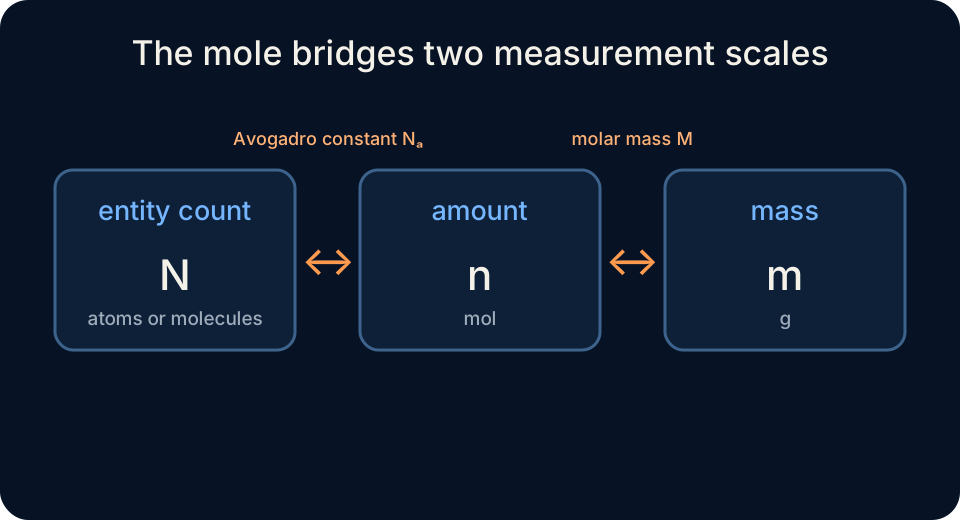
This lesson builds a three-level model. Particle count describes discrete entities, amount describes those entities in moles, and mass describes a measurable bulk sample. Avogadro’s constant connects with , while molar mass connects with . We will derive and use both relationships, calculate molar mass from formulas, handle ionic and molecular entities, and interpret isotopic averages. By the end, you should be able to design a conversion chain and explain what every symbol, subscript, unit, and numerical factor means.
Read Avogadro’s constant as a conversion factor
Particle count and amount are related by . The symbol is a pure count of specified entities, is amount measured in moles, and is entities per mole. Multiplying by cancels moles and leaves an entity count. Rearranging gives when a count is known and amount is requested. These are algebraic forms of one defined relationship rather than separate formulas to memorize.
For helium atoms, the count is . Moles cancel and atoms remain, so the unit chain matches the requested count. The Avogadro constant is exact, but the measured amount has three significant figures, so the result is reported with three significant figures. Writing “particles” would be less informative than writing “helium atoms.” Chemical identity remains part of a complete quantitative answer. The magnitude is also sensible because two moles must contain twice Avogadro’s entity count.
To convert water molecules to amount, divide by the constant. The calculation is . Molecules cancel through the compound fraction and moles move to the numerator. The count is approximately half the entities in one mole, so the result passes an immediate magnitude check. Estimating before calculating helps detect inverted factors and exponent mistakes.
Distinguish entities within chemical formulas
A chemical formula specifies the composition of one entity or formula unit. In , the subscript two means each water molecule contains two hydrogen atoms, while the absent subscript on oxygen implies one oxygen atom. One mole of water molecules therefore contains two moles of hydrogen atoms and one mole of oxygen atoms. Formula subscripts create within-entity ratios that scale directly to mole ratios. They do not state how many water molecules participate in a reaction, which requires an equation coefficient.
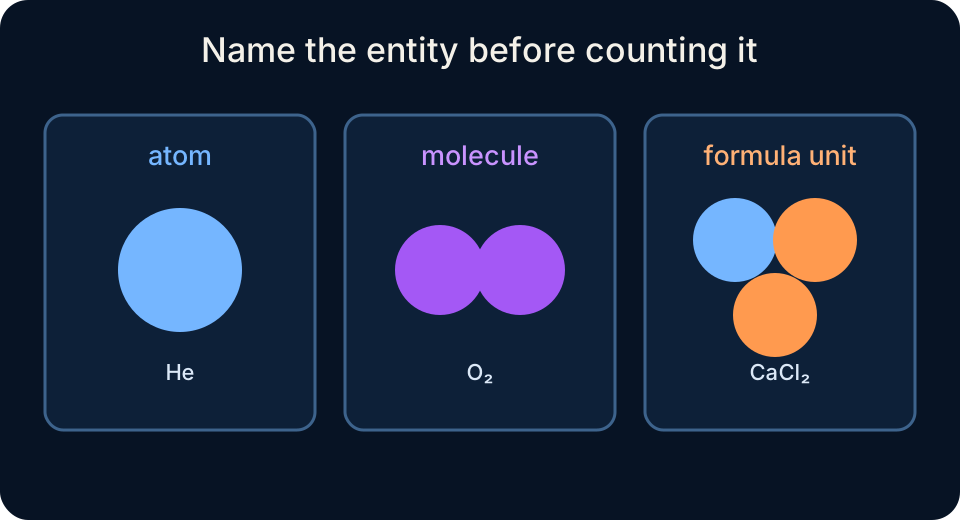
Ionic solids are described by formula units rather than independent molecules in the usual introductory model. One mole of formula units contains one mole of sodium ions and one mole of chloride ions. One mole of formula units contains one mole of calcium ions and two moles of chloride ions. The total ion amount after idealized complete dissociation is therefore three moles of ions per mole of calcium chloride formula units. Naming “formula units” preserves the extended lattice picture better than calling them calcium chloride molecules.
Elements may also require careful entity naming. One mole of helium gas contains one mole of helium atoms because helium is monatomic under ordinary conditions. One mole of oxygen gas contains one mole of molecules but two moles of oxygen atoms. A request for oxygen “particles” is ambiguous unless context specifies atoms or molecules. Clarifying the entity before choosing a conversion factor prevents an exact calculation from answering the wrong question.
Define molar mass and keep symbols distinct
Molar mass is mass per amount, written . The uppercase italic represents molar mass, lowercase represents sample mass, and lowercase represents amount. A common unit is , although the coherent SI unit is . Rearrangement gives and . The units show which form produces grams or moles.
Molar mass and molecular mass are related but not identical quantities. Molecular mass describes the mass of one molecule, often in unified atomic mass units , while molar mass describes the mass of one mole of entities in . Their numerical values are often equal because the mole and atomic-mass scales are defined consistently. The units and physical meanings still differ. Saying “water weighs ” is incomplete unless the amount of water is stated.
For a water sample with , amount is . Grams cancel and moles remain through division by a compound unit. Multiplying by Avogadro’s constant gives water molecules. The two-step chain moves from a balance measurement to a microscopic count. Each step uses a distinct physical definition.
Calculate molar mass from a formula
The periodic table reports standard atomic weights that represent abundance-weighted averages for naturally occurring isotopic compositions. To find a compound’s molar mass, multiply each element’s atomic molar mass by its formula subscript and add the contributions. For water, . Parentheses group each atomic contribution, and the leading integers come from the chemical formula. The result applies per mole of water molecules.
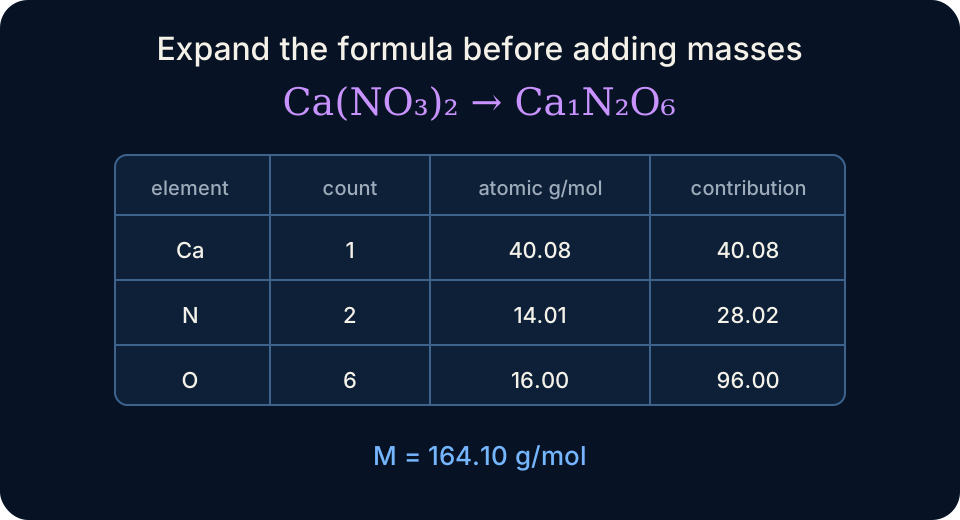
For calcium nitrate, , the outside subscript two multiplies every atom inside the parentheses. One formula unit contains one calcium, two nitrogen, and six oxygen atoms. Using , , and gives . Expanding the atom inventory before arithmetic prevents the outside subscript from being applied only to oxygen. A formula sketch or table makes complex compositions easier to audit.
Hydrates include a specified number of water molecules per formula unit, such as . The centered dot means association in the crystal rather than multiplication of two independent numerical values. Molar mass includes one copper sulfate unit plus five water molecules. Heating may remove the water and change sample mass while leaving the amount of anhydrous salt related by the hydrate formula. Reading notation chemically must precede entering atomic weights into a calculator.
Understand why atomic weights are averages
Most elements occur as mixtures of isotopes with the same proton count and different neutron counts. A mass spectrometer can measure isotope masses and relative abundances, and the periodic-table value reflects a weighted average for a reference natural composition. For two isotopes, an average has the form . Here is the fractional abundance of isotope , is its isotopic mass, and the fractions sum to one. More isotopes add more terms to the same weighted structure.
Suppose an element has isotope X with mass and isotope Y with mass . Convert percentages to fractions and calculate . The average lies between the isotope masses and closer to the more abundant isotope, which provides a reasonableness check. No individual atom has mass exactly in this simplified mixture. The average characterizes a large population.
An enriched or depleted isotopic sample can have a molar mass different from the standard periodic-table value. High-precision work must therefore use the isotopic composition appropriate to the actual material. Introductory calculations generally assume standard atomic weights and ordinary natural abundance unless stated otherwise. This assumption is usually adequate but should be recognized as a model choice. Molar mass connects composition with mass only as accurately as the composition is known.
Design multistep conversion chains
A conversion chain should begin with the given quantity and end with the requested quantity. To convert grams to entities, divide by molar mass to obtain moles and then multiply by Avogadro’s constant. Symbolically, . To convert entities to grams, reverse the path by dividing by and multiplying by . Unit cancellation determines factor orientation more reliably than a memorized triangle.
Consider the number of carbon dioxide molecules in . With , the amount is . Multiplying gives molecules. Grams cancel in the first step and moles cancel in the second. The result is close to half Avogadro’s number because the sample is close to half a molar mass.
If the requested count is oxygen atoms rather than carbon dioxide molecules, one more formula ratio is required. Each molecule contains two oxygen atoms, so multiply by . The sample then contains oxygen atoms. Molecules cancel and oxygen atoms remain. This final identity conversion demonstrates why entity labels function as units.
Connect the mole with experiments
A balance does not measure moles directly; it measures mass and relies on molar mass to infer amount. The balance must be selected and calibrated for the required uncertainty, and the sample must be transferred without unrecorded loss. Hygroscopic substances can absorb water and change measured mass relative to the assumed pure formula. Volatile samples can lose material during handling. Quantitative chemistry therefore depends on both definitions and controlled procedure.
Gas measurements can infer moles through an equation of state such as . Solution measurements can infer moles through . Reaction stoichiometry then uses balanced coefficients to relate those moles to other species. These routes do not replace the mole; they are different experimental bridges to amount. Recognizing the common middle quantity unifies mass, gas, solution, and reaction calculations.
The mole also explains why macroscopic samples show reproducible bulk properties. A sample contains so many entities that random molecular behavior averages into stable pressure, temperature, concentration, and mass relationships. The count is enormous but finite, allowing microscopic conservation to scale into measurable stoichiometric ratios. Statistical averaging does not make every particle identical, especially in isotope mixtures. It makes population-level quantities predictable enough for quantitative science.
Diagnose conversion and notation errors
The most common error is using Avogadro’s constant in the wrong direction. If a small mole amount produces an even smaller ordinary entity count, the factor was likely inverted because every mole contains about entities. Another error is multiplying grams directly by Avogadro’s constant without first converting mass to amount. Grams do not cancel against entities per mole. Writing every unit exposes the missing molar-mass step.
Formula interpretation creates a second cluster of errors. Students may ignore parentheses, forget implied subscripts of one, or call ionic formula units molecules. A written element inventory separates formula reading from arithmetic. The entity label should remain attached through every conversion. Correct numbers with incorrect entity names are not fully correct chemical answers.
Significant figures and scientific notation require deliberate handling. Exact defined constants and integer formula subscripts do not limit precision, but measured sample masses and tabulated values do. Intermediate results should retain guard digits and be rounded once at the end. Exponents should be estimated so that multiplying by Avogadro’s constant visibly increases a mole-scale count by roughly twenty-three powers of ten. A result should pass unit, scale, identity, and precision checks before being accepted.
Practice the complete bridge
First, calculate the number of atoms in helium. Use to obtain . Moles cancel and atoms remain. Three significant figures come from the measured amount. Helium is monatomic, so no additional formula factor is required.
Second, calculate the molar mass of carbon dioxide. One carbon contributes and two oxygens contribute . Their sum is . The subscript two multiplies oxygen’s contribution, not carbon’s. The result applies to one mole of carbon dioxide molecules.
Third, find the mass of sodium chloride formula units. Amount is . Using gives . Entity labels cancel first and mole units cancel second. The two-stage solution connects a microscopic count to a macroscopic balance reading.