
A chemical formula is a compact description of composition. Its element symbols identify the kinds of atoms present, and its subscripts encode whole-number ratios among those atoms. Those ratios apply at several scales: atoms within a molecule, ions within a formula unit, and moles of constituent atoms within a mole of substance. Because atomic masses are known, the same formula also predicts mass fractions. This lesson develops a careful path from symbolic notation to quantitative composition and back again.
You will learn to read subscripts, parentheses, coefficients, ionic charges, and hydrate dots without confusing their roles. You will calculate formula mass, molar mass, and elemental mass percent with units shown throughout. You will then use experimental composition to determine empirical formulas and use molar-mass evidence to determine molecular formulas. Every calculation will preserve substance labels as well as units. The goal is to make a formula feel like a structured data record rather than a string of letters.
Three habits guide the lesson. First, expand the formula into an explicit atom inventory before calculating. Second, convert mass information to moles because formulas represent particle-number ratios rather than mass ratios. Third, test whether the resulting subscripts reproduce both the measured composition and any stated molar mass. These checks turn a procedural answer into a defensible chemical interpretation.
Read every part of a chemical formula
An element symbol begins with a capital letter and may contain a lowercase second letter. Thus represents cobalt, whereas represents a composition containing carbon and oxygen. A subscript applies to the element or parenthesized group immediately before it. An omitted subscript means one, not zero. Reading capitalization and scope correctly is the first quantitative step.
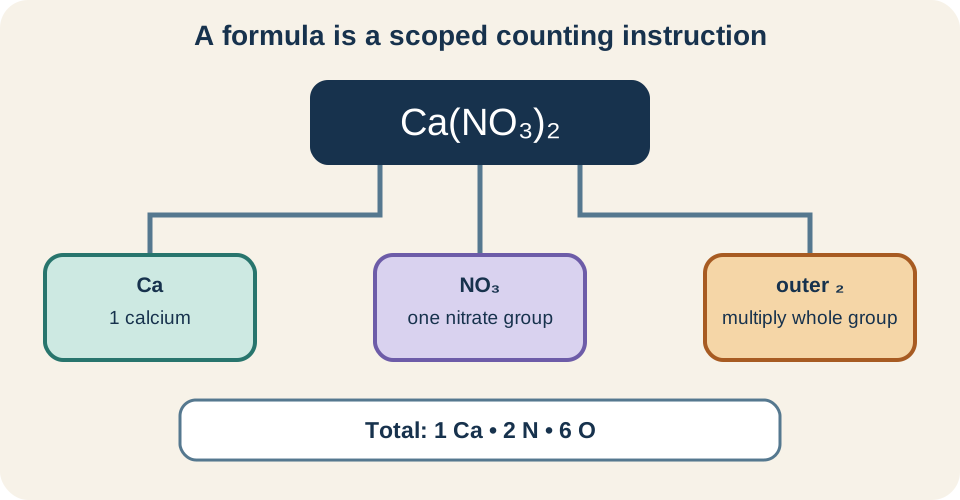
Consider . The formula contains one calcium atom because no subscript follows . The outer subscript multiplies the entire nitrate group, producing two nitrogen atoms and six oxygen atoms. One formula unit therefore contains a total of nine atoms: one calcium, two nitrogen, and six oxygen. The parentheses preserve nitrate as a repeated compositional group.
Now compare a subscript with a coefficient. In , the coefficient multiplies the entire formula, so the represented collection contains three calcium atoms, six nitrogen atoms, and eighteen oxygen atoms. Changing the coefficient changes the amount of substance but not its chemical identity. Changing a subscript changes the internal ratio and therefore usually creates a different substance. This distinction becomes essential when balancing equations.
Molecules, formula units, and ionic charge
A molecular formula gives the actual atom count in one molecule of a covalent substance. Water is because each molecule contains two hydrogen atoms and one oxygen atom. Ionic solids do not ordinarily exist as discrete molecules, so their formulas represent the lowest electrically neutral ratio of ions in an extended lattice. Sodium chloride is described by the formula unit , not by a claim that isolated sodium–chloride pairs fill the crystal. Particle language should match the bonding model.
Ionic formulas must be electrically neutral unless the formula explicitly represents an ion. Calcium is commonly and chloride is , so one calcium ion requires two chloride ions, giving . The subscript records the ratio needed for total charge . Subscripts are written as positive counts rather than as charges. Charge symbols appear at the upper right of an ion or polyatomic species.
Polyatomic ions must remain intact when parentheses are needed. Aluminum sulfate is because two ions contribute and three ions contribute . The formula contains two aluminum, three sulfur, and twelve oxygen atoms. Removing the parentheses would change which symbol the subscript multiplies. Charge neutrality and atom inventory provide independent checks on the written formula.
Formula mass and molar mass connect particles to grams
Formula mass is the sum of the average atomic masses associated with one formula’s atom inventory. For molecular substances the related phrase molecular mass is often used, while ionic compounds are commonly described by formula mass. The numerical sum in atomic mass units corresponds to the molar mass in grams per mole. A molar mass written answers how many grams correspond to one mole of the specified entities. Always include the chemical identity with the value.
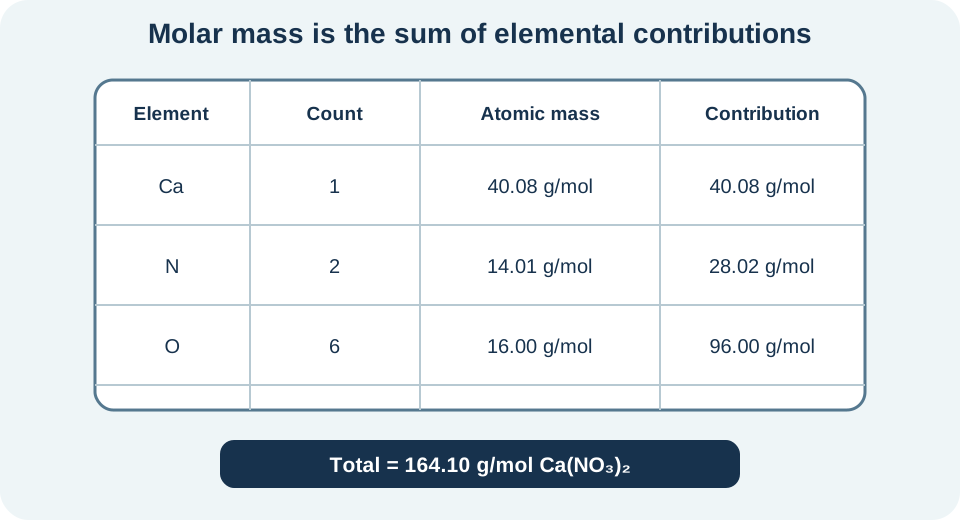
Calculate the molar mass of using representative atomic masses for calcium, for nitrogen, and for oxygen. The expression is . The coefficients inside this sum are atom counts derived from the formula, not reaction coefficients. Evaluation gives . The explicit sum makes every elemental contribution auditable.
Unit meaning can be made explicit with a conversion factor. The molar mass relation is . Its reciprocal converts grams to moles, while the written orientation converts moles to grams. A value such as would correspond to using appropriate significant figures. Substance labels prevent the calcium nitrate molar mass from being applied to another compound.
Mass percent is a part-to-whole comparison
Mass percent reports the fraction of a compound’s mass contributed by a chosen component, multiplied by one hundred percent. For element , the relationship is . Here is the number of atoms of in the formula, is that element’s molar mass, and is the compound molar mass. The numerator and denominator both have units of grams per mole, so those units cancel. Percent is dimensionless but retains the meaning “parts per hundred by mass.” The symbol therefore names the chosen reporting scale rather than a new physical dimension.
For water, oxygen contributes to approximately total. Therefore . Hydrogen supplies the remaining mass percentage, approximately . Their sum is within rounding. The sum check tests whether every component was included.
Mass percent does not equal atom percent because atoms have different masses. Water contains two of its three atoms as hydrogen, so hydrogen represents about of the atom count. Yet those light atoms provide only about of the mass. Oxygen provides one-third of the atoms but nearly nine-tenths of the mass. Stating the denominator—atoms or mass—prevents these different percentages from being confused.
Composition determines an empirical formula
An empirical formula gives the simplest whole-number ratio of atoms in a compound. Experimental composition is often supplied as masses or mass percentages, but those numbers cannot become subscripts directly. Formula subscripts compare counts of particles, and moles are proportional to particle counts. Therefore each elemental mass must first be converted to moles. Only then can the mole amounts be normalized into a ratio.
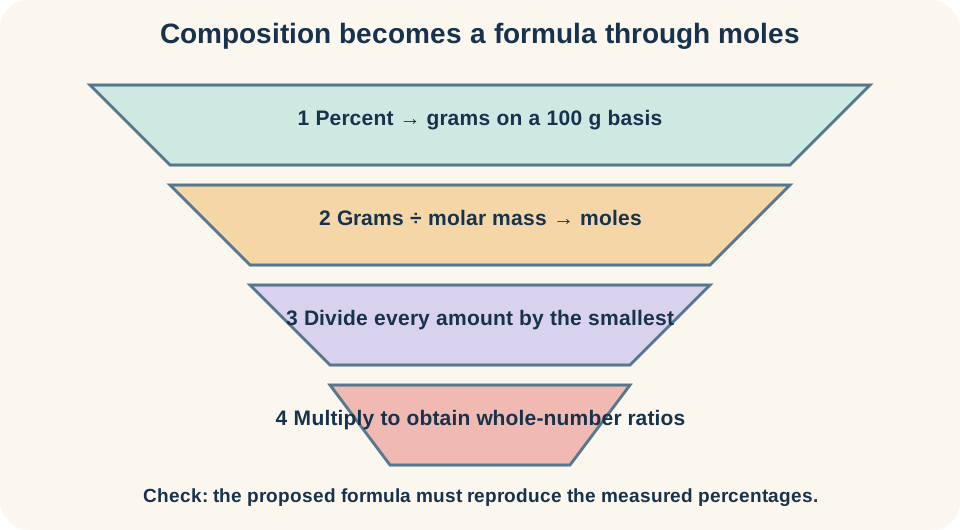
The standard workflow has four stages. Convert each element’s mass to moles using its molar mass, divide every mole amount by the smallest value, inspect how close the ratios are to whole numbers, and multiply all ratios by a small common integer if necessary. Multiplication must apply to every ratio so relative composition is preserved. Round only when experimental uncertainty makes a ratio convincingly close to an integer or familiar fraction. A ratio of suggests multiplication by two, whereas should not be forced casually to one.
If data are given as percentages, assume a convenient sample. Then each numerical percent becomes the same numerical number of grams, such as becoming . This assumption does not claim the actual sample mass was one hundred grams; it exploits the scale independence of a ratio. Any sample with the same composition produces the same normalized mole ratios. The device removes an unnecessary algebraic variable while preserving chemistry.
Worked example: empirical formula from percent composition
Suppose a compound contains carbon, hydrogen, and oxygen by mass. For a basis, use C, H, and O. Convert carbon using . Similar calculations give approximately and . Keeping element labels prevents unlike mole amounts from being merged accidentally.
Divide all three values by the smallest, . Carbon becomes , hydrogen becomes approximately , and oxygen becomes . The simplest whole-number ratio is therefore . Writing element symbols in the stated order gives the empirical formula . The subscripts represent mole and particle ratios, not the original gram values.
Check the formula against the data. The empirical-formula mass is . Carbon’s predicted mass percent is , with analogous calculations reproducing hydrogen and oxygen. Agreement within rounding supports the result. A formula should always be tested against the evidence that produced it.
Handle fractional ratios with evidence rather than guesswork
Experimental ratios are rarely perfect integers because measurements contain uncertainty and atomic masses are averaged values. A normalized ratio such as indicates multiplication of all values by two, yielding . A ratio near suggests four-thirds and therefore multiplication by three. A ratio near suggests five-fourths and therefore multiplication by four. These patterns are hypotheses that should be checked against data quality.
Do not round a value such as down to merely because formula subscripts must be whole numbers. That changes the ratio substantially and predicts the wrong composition. Also do not multiply only the fractional entry, because a ratio changes if one component is scaled alone. The same common multiplier must act on every entry. After multiplication, reduce the resulting whole-number set if all values share a common factor.
Measurement uncertainty determines how close is close enough. A high-precision analysis that gives is unlikely to mean exactly one, while a classroom dataset rounded to two significant figures may justify modest tolerance. When no small-integer multiplier produces a convincing ratio, revisit the arithmetic, sample purity, element list, and experimental assumptions. Chemistry does not guarantee that every noisy dataset collapses neatly. Reporting uncertainty is better than inventing certainty.
Molecular formulas add molar-mass evidence
An empirical formula gives the simplest ratio, while a molecular formula gives the actual atom count in one molecule. The molecular formula must be an integer multiple of the empirical formula. If the empirical formula is , possible molecular formulas include , , and . Composition percentages alone cannot distinguish these because every multiple has the same element ratios. An independently measured molecular molar mass supplies the missing scale.
Let denote the measured molecular molar mass and denote the empirical-formula mass. Their ratio should be a positive integer within experimental uncertainty. If a compound with empirical formula has molar mass , then . Multiply every empirical subscript by six to obtain . The multiplier applies to omitted subscripts of one as well as visible subscripts.
The integer is dimensionless because grams per mole cancel in the fraction. Its chemical meaning is the number of empirical units contained in one molecule. A value such as may reasonably indicate two given experimental uncertainty, but signals a problem. Check the empirical formula, molar mass, and sample assumptions before rounding. Integer consistency is a powerful diagnostic rather than a license for arbitrary adjustment.
Hydrates include a stoichiometric amount of water
A hydrate is an ionic compound whose crystal structure includes a fixed ratio of water molecules. Its formula uses a centered dot, as in . The dot does not mean ordinary multiplication and does not describe a liquid solution. It separates the anhydrous salt formula from the number of waters of hydration per formula unit. The prefix in the name, such as pentahydrate, reports that water count.
Heating can remove the water while leaving the anhydrous salt, permitting experimental determination of the hydrate number. Subtract the final anhydrous mass from the initial hydrate mass to find water mass. Convert water mass to moles of and anhydrous salt mass to moles of salt. Divide both by the smaller amount to obtain their ratio. The whole-number water-to-salt ratio becomes the coefficient after the dot.
Suppose of a hydrate leaves of anhydrous salt. The water mass is . Determining the final hydrate formula also requires the salt identity and its molar mass, so the mass difference alone is insufficient. This observation illustrates a general rule: composition calculations require both quantitative data and a chemical model. Never infer a unique formula from incomplete relationships.
Common errors and corrective checks
One frequent error is failing to distribute an outer subscript through parentheses. In , the subscript three multiplies both sulfur and oxygen within sulfate, giving three sulfur and twelve oxygen atoms. Write an explicit inventory before summing masses. Another error is multiplying a coefficient into only the first element of a formula. A coefficient always multiplies every atom count in the complete formula that follows.
A second error is dividing mass percentages directly by the smallest percentage. That creates a mass ratio, not the atom-count ratio required for a chemical formula. Convert each mass to moles first because equal mole amounts contain equal numbers of entities. A third error is confusing empirical and molecular formulas. Use composition to find the simplest ratio, then use molar mass to determine its integer multiple.
A final error is dropping units and identities during intermediate work. Write rather than only , and write molar mass with a horizontal fraction such as . These labels show which factors may cancel. Check predicted percentages and molar mass after proposing a formula. Independent reconstruction makes transcription and rounding mistakes easier to catch.
Guided practice and retrieval
Count each element in . One formula unit contains two aluminum, three sulfur, and twelve oxygen atoms. The coefficient two produces four aluminum, six sulfur, and twenty-four oxygen atoms. State why the coefficient affects represented amount while the internal subscripts preserve compound identity. Then verify that the ionic charges inside one formula unit sum to zero.
Find the sulfur mass percent in using for sulfur and for oxygen. The compound molar mass is . The fraction is . Oxygen supplies the complementary percentage within rounding. Explain why equal numbers of sulfur and oxygen atoms would still not imply equal mass contributions.
A substance has empirical formula and molar mass . The empirical-formula mass is approximately . Their ratio is , so each subscript is multiplied by two. The molecular formula is . Recalculate its molar mass as a final check.
Connection forward
Close the lesson by reconstructing the full path from formula to mass percent and from mass percent back to formula. Explain the distinct jobs of an element symbol, subscript, coefficient, ionic charge, parenthesis, and hydrate dot. State why mole conversion must precede ratio normalization. Describe what extra datum converts an empirical formula into a molecular formula. If any step is only a memorized instruction, connect it back to particles or conservation.
Chemical formulas serve as the fixed identities used in balanced equations. In the next stoichiometry work, coefficients will relate moles of different species while subscripts remain unchanged. Composition analysis will help verify purity, identify unknown compounds, and calculate reactant mass fractions. Ionic formulas will support net ionic equations and precipitation predictions. Hydrate analysis will connect mass change to crystal composition.
The unifying idea is scale consistency. A formula’s atom ratio becomes a mole ratio because a mole is a counting unit, and atomic masses then convert that count ratio into a mass ratio. Experimental masses reverse the path by passing through moles before becoming subscripts. Parentheses and coefficients control the scope of multiplication, while charges constrain ionic neutrality. Reading and checking each layer makes chemical notation quantitatively transparent.