
Begin with the balanced equation as a quantitative model
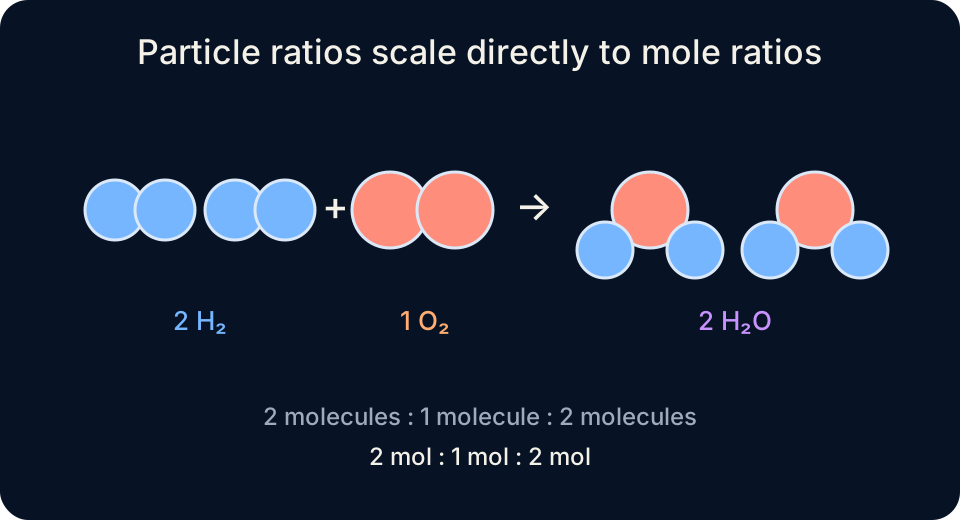
A chemical equation does more than name reactants and products. Once balanced, it states the smallest whole-number ratio in which chemical entities can participate while conserving every element. For , two hydrogen molecules react with one oxygen molecule to form two water molecules in the idealized event. Multiplying every count by Avogadro’s constant preserves the ratio, so two moles of hydrogen react with one mole of oxygen to form two moles of water. Stoichiometry is the disciplined use of those ratios to connect a known amount with an unknown amount.
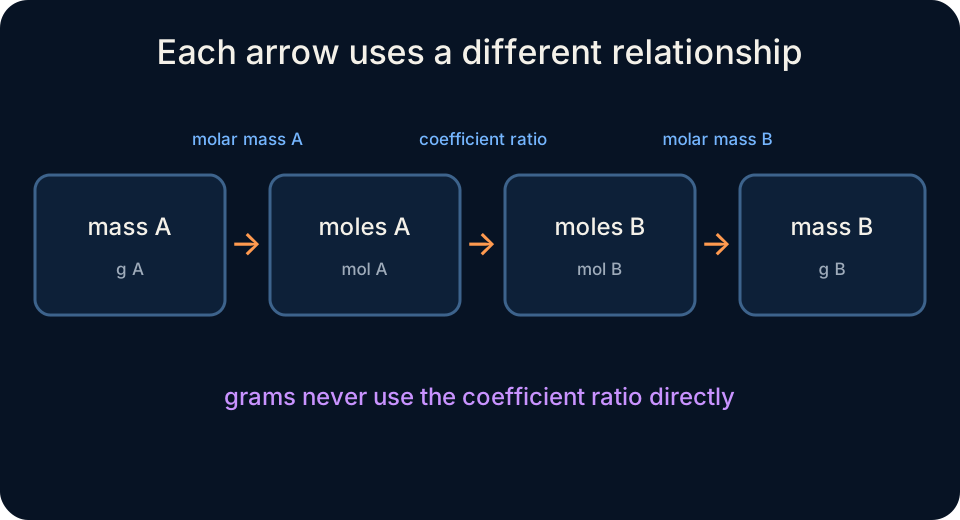
The large numbers used in laboratory chemistry make direct particle counting impractical. The mole packages specified entities into one amount unit, allowing a balance to connect mass with particle-level reaction ratios. Molar mass converts grams to moles, balanced coefficients convert moles of one species to moles of another, and molar mass may then convert product moles back to grams. Each conversion answers a different question and carries its own units. Keeping those roles separate is the foundation of reliable reaction calculations.
This lesson emphasizes meaning before arithmetic. First verify the equation is balanced, then identify the known and requested chemical species, and then convert the known quantity to moles if necessary. Use a coefficient ratio that cancels the known species and produces moles of the requested species. Finally convert to any requested measurement and check whether the magnitude, units, and reaction story agree. By the end, you should be able to interpret coefficients, build unit chains, solve mass and particle problems, reason about reaction extent, and recognize when a limiting-reactant analysis is required.
Distinguish coefficients from subscripts
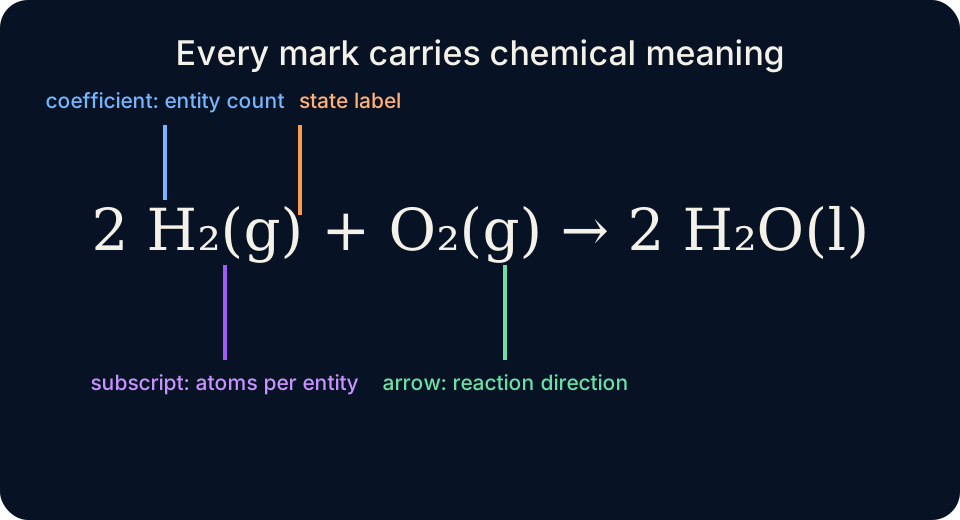
Coefficients count complete chemical entities or amounts of those entities. In , the coefficient two means two hydrogen molecules or two moles of hydrogen molecules, while the subscript two means each molecule contains two hydrogen atoms. Changing a coefficient changes the amount represented without changing molecular identity. Changing a subscript changes the substance itself and therefore cannot be done merely to balance an equation. This distinction protects both conservation and chemical meaning.
For , atom counting verifies balance. The reactant side contains two nitrogen atoms and six hydrogen atoms, while the product side contains two nitrogen atoms and six hydrogen atoms. The coefficient ratio is for nitrogen, hydrogen, and ammonia. It supports conversion factors such as or its reciprocal, depending on the desired cancellation. A valid factor equals one in the stoichiometric sense because numerator and denominator describe corresponding reaction amounts.
Physical states and charge may also be part of the model. The equation conserves silver atoms, chlorine atoms, and net charge while showing dissolved ions forming a solid. The one-to-one coefficients connect moles of silver ion, chloride ion, and silver chloride precipitate. State labels do not directly change the coefficient ratio, but they communicate the phase and help identify the reaction process. A complete interpretation reads symbols, subscripts, coefficients, charges, and states rather than extracting numbers alone.
Build conversion factors that cancel identities and units
Dimensional analysis is a written argument about equivalence. If the balanced equation gives two moles of water for every two moles of hydrogen, then converts hydrogen amount to water amount. The denominator contains the known species so that cancels. The numerator contains the desired species so that remains. Chemical labels are part of the unit because a mole of hydrogen is not interchangeable with a mole of water.
For hydrogen with excess oxygen, the calculation is . The factor happens to have equal numerical coefficients, but its chemical identities still perform the essential conversion. The answer equals the starting numerical amount because hydrogen and water have a one-to-one mole relationship in the balanced equation. This equality would change if the requested species or equation coefficients changed. Reading the ratio before calculating prevents accidental inversion.
Molar mass connects amount and mass through , where is mass, is amount, and is molar mass. Water’s molar mass is approximately , so the product mass is . Moles cancel and grams remain, confirming that the final conversion matches the requested quantity. The coefficient ratio never uses grams because balanced equations describe entity and mole ratios rather than mass ratios. Mass is conserved overall, but individual species generally have different molar masses.
Solve mass-to-mass problems as a sequence of meanings
Consider combustion of methane, . Suppose methane burns with excess oxygen and the mass of carbon dioxide is requested. Methane’s molar mass is , so the available amount is . The one-to-one coefficients give . Multiplying by gives .
The product mass is larger than the starting methane mass because oxygen atoms from the excess reactant become part of carbon dioxide. This does not violate mass conservation because methane was not the entire reactant system. A reasonableness check must therefore include every material crossing the chosen boundary. Carbon balance gives another check: each methane contains one carbon and each carbon dioxide contains one carbon, supporting the one-to-one amount ratio. Multiple representations reinforce the result more strongly than repeating the same arithmetic.
The full chain can be written in one line, but conceptual stages should remain visible. Grams of methane convert to moles of methane using methane molar mass, moles of methane convert to moles of carbon dioxide using coefficients, and moles of carbon dioxide convert to grams using carbon-dioxide molar mass. Every unwanted unit and chemical identity cancels in sequence. If grams were converted directly with the coefficient ratio, the resulting cancellation would fail because coefficients do not carry gram equivalence. A well-structured chain is therefore both a calculation and a diagnostic proof.
Connect reaction extent to coefficients
Reaction extent provides a compact way to describe how far a reaction proceeds. If the balanced equation is written , each names a species and each stoichiometric number is negative for reactants and positive for products. A small change obeys , where is species amount and is reaction extent in moles. Introductory problems do not require this formal notation, but it explains why every species amount changes in coefficient proportion. One reaction progress variable coordinates all participants.
For , an extent increase of consumes nitrogen and hydrogen while producing ammonia. An extent of produces ammonia and consumes half the listed reactant amounts. This scaling is the same operation performed by ordinary coefficient conversion factors. Extent simply makes the shared scale explicit. It becomes especially helpful when several reactions or equilibrium composition changes must be tracked.
Coefficient ratios are exact within the chosen balanced equation, while measured amounts carry uncertainty. Reporting more significant figures than the measured data support does not make the stoichiometric model more accurate. If hydrogen is given to two significant figures, the predicted ammonia amount should be rather than an unsupported . Exact integer coefficients do not limit significant figures. Measurement quality and model assumptions do.
Recognize when one conversion is not enough
A single known reactant amount determines theoretical product only when other reactants are available in excess. If amounts of two or more reactants are specified, either may run out first relative to the required coefficient ratio. The limiting reactant is the reactant that supports the smaller reaction extent. Product prediction must be based on that reactant because the reaction cannot continue after it is exhausted. Treating both reactants as independently producing product would count the same reaction capacity twice.
For , suppose nitrogen and hydrogen are available. Consuming all nitrogen would require hydrogen, which is unavailable, so hydrogen limits. Converting hydrogen gives . The used nitrogen amount is , leaving nitrogen in excess. This accounting checks that no reactant amount becomes negative.
Actual yield may be lower than theoretical yield because reactions may not go to completion, competing processes may occur, and material can be lost during separation. Percent yield is . The fraction bar compares quantities in the same unit, so those units cancel and a percentage remains. Theoretical yield comes from limiting-reactant stoichiometry, not from choosing the larger starting mass. A percent yield calculation cannot repair an incorrectly identified limiting reactant.
Translate between particles, moles, and macroscopic measurements
Avogadro’s constant connects particle count and amount through . The constant is , where inverse moles indicate entities per mole. If oxygen molecules react, the sample contains molecules. The equation coefficients apply identically to molecules or moles because both count the same entity ratio. The mole is simply the practical scale for macroscopic work.
Entity naming is essential when formulas contain several atoms. One mole of water means one mole of water molecules, but it contains two moles of hydrogen atoms and one mole of oxygen atoms. The equation coefficient operates on complete water molecules unless the calculation explicitly asks for constituent atoms. Thus contains hydrogen atoms. Subscripts provide within-entity ratios while coefficients provide between-entity reaction ratios.
Gas volume and solution volume can also connect to stoichiometric amount when appropriate models are supplied. An ideal gas uses , while a solution uses . Neither volume should be inserted directly into a coefficient ratio because coefficients relate moles, not liters under arbitrary conditions. Convert the measured volume to moles using the relevant state or concentration model first. This principle unifies apparently different stoichiometry problems around the same mole-based core.
Use tables and diagrams to verify the equation story
A before-change-after table can organize reactant consumption and product formation. Initial amounts occupy the first row, coefficient-scaled changes occupy the second row, and final amounts occupy the third row. Every change is tied to a single reaction extent, so reactant entries decrease while product entries increase. The table makes excess material visible and prevents a reactant from being consumed beyond its available amount. It is especially valuable when the problem asks for both product and leftover reactant.
A particle diagram offers a complementary check using representative entities. For the ammonia equation, groups should be arranged in packets containing one nitrogen molecule and three hydrogen molecules, each capable of forming two ammonia molecules. Unpaired particles after all complete packets are formed represent excess reactant. The number of complete packets represents reaction extent at the diagram’s chosen scale. Although the picture is not drawn with Avogadro-scale counts, it preserves the exact stoichiometric ratios.
A reaction-progress graph can plot species amount against extent . Each line has slope equal to its stoichiometric number , so reactant lines slope downward and product lines slope upward. The first reactant line to reach zero identifies the maximum permissible extent and therefore the limiting reactant. This graphical interpretation makes the limiting condition a boundary on physically possible progress. Tables, particle diagrams, graphs, and unit chains should tell the same conservation story when the model is applied correctly.
Diagnose common errors through cancellation
The first common error is using an unbalanced equation. Coefficients from an unbalanced equation do not conserve atoms and therefore cannot represent a physically possible reaction ratio. The second is taking a ratio from formula subscripts rather than balanced coefficients. The third is inverting a conversion factor so the starting species remains instead of canceling. Writing chemical identities beside every mole unit exposes all three errors before a final number is produced.
Another error is rounding intermediate amounts too aggressively. A rounded mole value then propagates through coefficient and molar-mass conversions, shifting the final result unnecessarily. Retain extra digits during intermediate steps and round once at the end according to measured precision. Exact coefficients and the defined Avogadro constant do not reduce significant figures. A final answer should include units, species identity, and an appropriate number of significant figures.
Reasonableness checks should be chemical as well as numerical. Product amount cannot exceed what the limiting reactant coefficients allow, leftover reactant cannot be negative, and atom counts must balance across the reaction. Product mass may exceed the mass of one named reactant because other reactants contribute atoms, but it cannot exceed the total mass supplied in a closed system. An answer that violates those constraints should be investigated even if calculator operations were entered correctly. Stoichiometry is conservation expressed quantitatively.
Practice and narrate the conversion pathway
First, use to find ammonia from hydrogen with excess nitrogen. The coefficient factor is . Multiplication gives . Hydrogen moles cancel and ammonia moles remain. The result assumes nitrogen is sufficiently abundant and reaction proceeds to the theoretical extent.
Second, determine oxygen required to burn methane using . The equation requires two moles oxygen per mole methane. Calculation gives . The answer is twice the methane amount, matching the coefficient prediction. If only oxygen were available, oxygen would limit complete combustion under this model.
Third, find the water mass produced from oxygen with excess hydrogen. The equation ratio gives . Molar-mass conversion gives water. Moles cancel, grams remain, and three significant figures match the given oxygen amount. The full explanation identifies the balanced ratio, excess condition, unit conversions, and requested substance.