
Begin with what concentration actually compares
A solution is a homogeneous mixture, but the fact that it looks uniform does not tell us how much solute it contains. Chemists therefore describe composition with concentration quantities that compare an amount of solute with a defined amount of solution. Molarity, more precisely called amount concentration, compares moles of a specified solute with the total volume of the finished solution. It is useful because laboratory glassware measures volume while balanced chemical equations relate reacting amounts in moles. The bridge between those two worlds is what makes molarity central to aqueous stoichiometry.
The definition is , where denotes amount concentration, denotes the amount of the named solute, and denotes total solution volume. The numerator is measured in moles, the denominator is commonly measured in liters, and the resulting unit is . A horizontal fraction bar means division and groups the entire numerator over the entire denominator. The subscripts identify what each variable describes, preventing the common mistake of using solvent volume in place of final solution volume. Every numerical substitution should carry these units so cancellation remains visible.
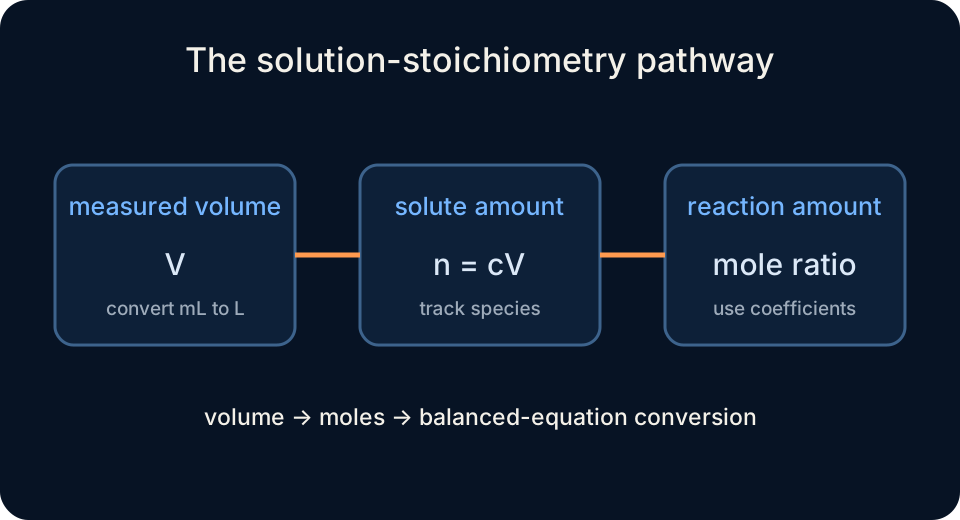
This lesson develops a single reasoning chain that works for preparation, dilution, and reaction problems. First identify the dissolved species and translate measured volume into liters, then use to determine the available moles. If a reaction occurs, use the balanced equation to convert between reacting species, and only afterward convert to the requested mass, concentration, or volume. At each stage, ask whether solute amount is conserved or changed by a chemical reaction. By the end, you should be able to prepare a target solution, analyze a dilution, solve aqueous stoichiometry, identify a limiting reactant, and explain every symbol and unit used.
Read and rearrange the molarity equation
Starting from , multiplying both sides by gives . This rearranged form is especially useful when a concentration and sample volume are known because it returns the amount present in the sample. Dividing both sides of by gives , which determines the solution volume needed to contain a chosen amount at a target concentration. These are not three unrelated formulas; they are algebraic views of one definition. Understanding that relationship reduces memorization and makes it easier to reconstruct a needed expression.
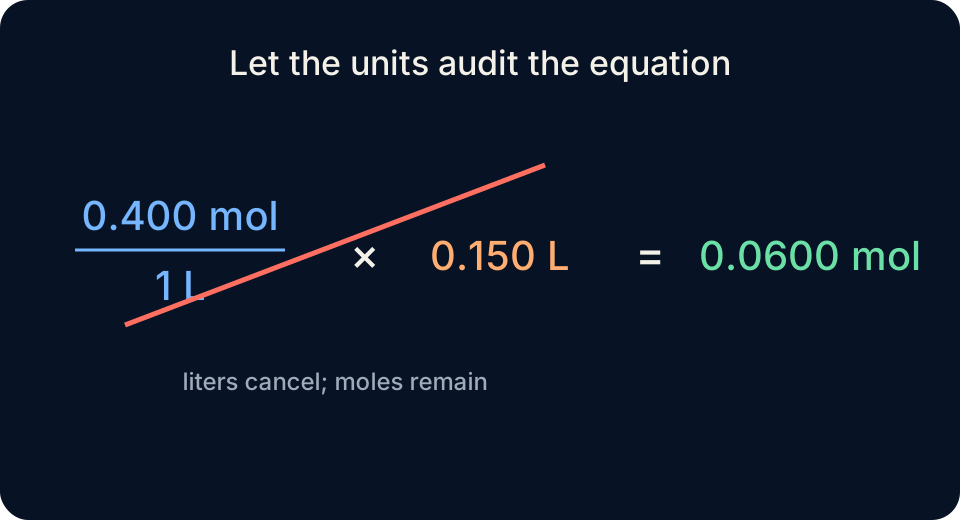
Units provide an independent check on the algebra. If and , then . Liters cancel horizontally because one factor contains liters in the denominator and the other contains liters in the numerator. The remaining unit is moles, exactly what the variable represents. If milliliters had been substituted without conversion, the units would not cancel correctly and the numerical answer would be too large by a factor of one thousand.
Molarity always refers to a named species, and ionic dissociation can make that naming important. A solution of idealized contains formula units before dissociation is interpreted. Because , the same model predicts and . Square brackets indicate equilibrium molar concentration of the enclosed species, while the coefficient two becomes a particle and mole ratio. Stating the species prevents an apparently precise number from remaining chemically ambiguous.
Prepare a solution from a solid solute
Preparing a solution from a solid begins by converting the desired solution composition into a measurable solute mass. Suppose of sodium chloride is required. Converting volume gives , and gives . Using the sodium chloride molar mass gives . The symbol denotes mass and denotes molar mass, so their different typefaces and units keep their roles distinct.
The laboratory procedure must match the definition of molarity. The measured sample is transferred quantitatively to a volumetric flask and dissolved in less than the final volume of solvent. Additional solvent is then added until the bottom of the meniscus reaches the calibration mark at eye level. Filling a beaker with of water and then adding solute would produce more than of solution. The distinction between solvent volume and solution volume is therefore not merely verbal; it changes the prepared concentration.
Quantitative transfer means ensuring that the calculated amount actually enters the flask. Rinsing the weighing vessel and funnel into the volumetric flask moves adhering solute into the solution. Stoppering and inverting the flask several times distributes the dissolved material uniformly throughout the calibrated volume. Temperature matters because glassware is calibrated at a specified temperature and liquid volume changes with thermal expansion. A defensible preparation record includes solute identity, purity if relevant, measured mass, flask capacity, temperature conditions, and the justified significant figures of the final concentration.
Understand dilution as conservation of solute
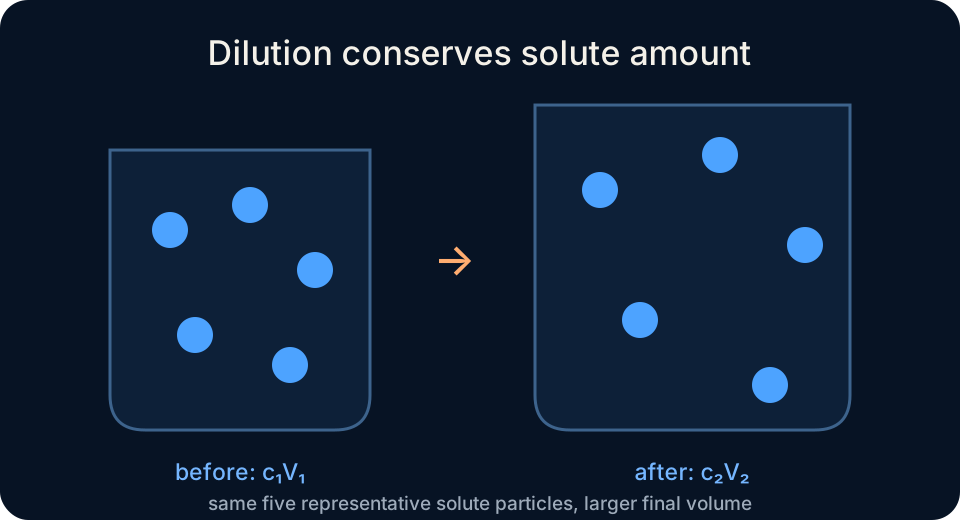
Dilution lowers concentration by adding solvent without adding, removing, or reacting the solute. The initial solute amount is , and the final solute amount is . Solute conservation requires , so substitution produces . The subscripts one and two label initial and final states rather than exponents or multiplication factors. This derivation explains both when the relationship works and when it must not be used.
Suppose a technician needs of solution from a stock. Solving for the stock volume gives . Substitution yields . The concentration units cancel, leaving milliliters, and the result is smaller than the final volume because the stock is more concentrated. The measured aliquot is transferred to a volumetric flask and diluted to the mark rather than mixed with exactly of solvent.
The dilution equation is not a universal mixing formula. If two solutions react, the amount of a named reactant after mixing is not generally equal to the amount before mixing. If the same nonreacting solute is present in both solutions, total solute moles must be added before dividing by total solution volume. If volumes are not additive because of strong intermolecular effects, the final volume must be measured or otherwise supplied. The governing question is always “what amount is conserved across this process,” and the equation should be derived from that answer rather than applied by visual pattern matching.
Combine concentration with reaction stoichiometry
Solution stoichiometry inserts the molarity conversion before the familiar balanced-equation ratio. Consider of silver nitrate mixed with excess chloride. The silver nitrate amount is . The net ionic equation gives a one-to-one mole ratio between silver ion and silver chloride. Therefore silver chloride can form when chloride is genuinely in excess.
Mass follows from the product molar mass rather than from the solution concentration directly. Silver chloride has molar mass . Multiplication gives . The mole unit cancels and grams remain, while three significant figures reflect the limiting measurements. This sequence keeps concentration, stoichiometric ratio, and molar mass in their proper roles.
When amounts of both reactants are specified, each must be converted to moles and tested against the balanced ratio. Suppose of silver nitrate is mixed with of sodium chloride. The solutions supply silver ion and chloride ion, so chloride is limiting for the one-to-one reaction. The reaction forms precipitate and leaves silver ion unreacted. Dividing that excess amount by the final solution volume, if volumes are assumed additive, determines the remaining silver-ion concentration.
Diagnose mistakes by tracing meaning and units
The most common arithmetic error is substituting milliliters into a concentration expressed per liter. A result in “mole-milliliters per liter” signals that the conversion is incomplete, even if a calculator returns a plausible-looking decimal. Another common error is using solvent volume rather than total solution volume in the molarity definition. A third is treating a formula subscript as though it automatically changed the molarity of the undissociated solute. Writing the named species, the conversion factor , and the dissociation or reaction equation prevents these mistakes from remaining invisible.
Stoichiometric errors usually come from skipping the mole stage. Balanced coefficients describe ratios of entities and moles, not ratios of grams or milliliters. Molar masses convert between grams and moles, while molarity converts between liters of a particular solution and moles of a particular solute. These conversion factors may appear in the same dimensional-analysis chain, but they arise from different physical relationships. Labeling every factor with both a unit and a chemical identity makes an invalid cancellation much harder to perform.
Precision and assumptions also require attention. Volumes delivered by calibrated pipets justify different uncertainty than approximate beaker markings, so the weakest measurement constrains the final significant figures. The equation assumes conserved solute amount, while adding solution volumes assumes their mixture volume is adequately additive. A precipitation calculation may assume complete reaction and negligible product solubility, conditions that real equilibrium can modify. A strong solution reports not only a number but also the model and assumptions that make the number meaningful.
Connect concentration to graphs and proportional reasoning
A graph can reveal whether volume and amount are being related under a fixed concentration. If moles are plotted vertically against solution volume horizontally for one homogeneous solution, predicts a straight line through the origin. The slope is and has units , so the slope is the solution molarity. A steeper line represents a more concentrated solution because each additional liter contains more moles of solute. This visual interpretation turns concentration from a static ratio into a rate of accumulation with volume.
A dilution graph asks a different question because the solute amount stays fixed while volume changes. Rearranging the conservation relationship gives , so final concentration is inversely proportional to final volume. Doubling halves , but adding a fixed volume repeatedly does not subtract a fixed concentration each time. A plot of concentration against final volume is therefore a decreasing curve rather than a straight line. Recognizing the inverse shape helps learners reject linear guesses that contradict solute conservation.
Proportional reasoning also provides quick estimates before exact calculation. If a stock is five times more concentrated than the target, the stock aliquot must occupy one fifth of the final volume when only dilution occurs. If a reaction coefficient requires two moles of reactant for every one mole of product, the maximum product amount must be half the available reactant amount when that reactant limits. These estimates establish the expected scale and direction of a result before decimal arithmetic begins. An exact answer that strongly disagrees with the proportional estimate deserves investigation rather than immediate acceptance.
Design and evaluate an aqueous procedure
A calculation becomes experimentally useful only when it is translated into operations that preserve the modeled quantities. Preparing a standard solution requires an appropriate balance, clean transfer tools, and volumetric glassware selected for the target uncertainty. Delivering a reaction aliquot usually calls for a volumetric pipet or buret rather than a graduated beaker. Mixing must be sufficient to make the sampled solution homogeneous before any portion is withdrawn. The method should state which vessel defines the final volume and which measurement determines each reported significant figure.
Contamination changes both chemical identity and amount, so rinsing decisions have a quantitative basis. A buret is conditioned with the solution it will deliver because residual water would dilute that solution inside the calibrated barrel. A volumetric flask used to make a solution can remain wet with pure solvent because that solvent is already part of the final mixture and the flask defines final volume. A pipet should be rinsed with the sample solution to prevent dilution of the transferred aliquot. These choices are applications of conservation and concentration, not arbitrary laboratory customs.
Evaluating a procedure means asking how each plausible error changes the calculated result. Overfilling a volumetric flask increases final volume while leaving solute amount nearly unchanged, so the actual concentration becomes lower than intended. Failing to transfer all weighed solute also lowers the actual concentration, whereas evaporation after preparation raises it by reducing solvent and solution volume. Reading a meniscus from above or below introduces parallax and can bias the recorded volume. Predicting the direction of each effect demonstrates deeper understanding than merely listing “human error” without a mechanism.
Practice the full pathway and explain the result
First determine the amount of solute in of a solution. The direct relationship is , so . Liters cancel and the remaining unit matches amount of substance. Three significant figures are justified because both measured values contain three significant figures. The result means the stated solution sample contains of the named solute, not necessarily of every dissolved ion.
Next calculate the stock volume needed to prepare of solution from stock. Conservation gives . Concentration units cancel and milliliters remain, so the unit structure supports the algebra. The aliquot is diluted until the total solution volume reaches . Saying “add water” would describe a different and less concentrated preparation.
Finally, find the moles of barium sulfate formed when of barium chloride reacts with excess sulfate. The sample contains barium chloride and therefore the same amount of barium ion. The net ionic equation supplies a one-to-one ratio. Consequently, barium sulfate forms under the complete-precipitation and excess-sulfate assumptions. The reasoning is transferable because it identifies the amount source, reaction ratio, limiting condition, and requested product rather than relying on a memorized arrangement of numbers.