
When sugar disappears into tea, its particles have not vanished. Sugar molecules leave the crystal, become surrounded by water molecules, and spread throughout the liquid. This process is dissolution, a redistribution of particles driven by competing energetic and statistical effects. Solubility describes how much solute can be present at equilibrium under specified conditions. Keeping dissolution and solubility distinct is the first step toward explaining solutions rather than merely naming them.
Every solution contains a solvent and at least one solute. The solvent is the component that provides the dissolving medium, while a solute is a component dispersed within that medium. Those labels describe roles and need not always identify the most abundant component, though amount is often a useful convention. Aqueous means that water is the solvent. A homogeneous solution has uniform macroscopic composition even though its particles remain in constant microscopic motion.
This lesson will move between three representations. Particle diagrams will show what separates and what forms during mixing. Energy and free-energy equations will organize the competing contributions. Macroscopic observations such as crystals, concentration, and gas bubbles will then be interpreted through those models. Connecting representations is more durable than memorizing a list of “soluble” substances.
Learning objectives and an opening prediction
After this lesson, you should distinguish dissolution from melting, dissociation, ionization, and chemical reaction. You should explain why solute–solute and solvent–solvent attractions must be disrupted before solute–solvent attractions form. You should connect enthalpy, entropy, and Gibbs free energy to thermodynamic favorability. You should classify solutions as unsaturated, saturated, or supersaturated using dynamic equilibrium. You should also predict temperature and pressure effects without applying oversimplified rules outside their conditions.
Predict what happens when equal spoonfuls of table salt and cooking oil are added to separate cups of water. Salt disperses because water can stabilize its separated ions through ion–dipole attractions. Oil forms a separate phase because mixing disrupts favorable water–water interactions without providing equally favorable compensation. The phrase “like dissolves like” summarizes this contrast but does not explain it. A complete explanation identifies particles, interactions, and the balance of free-energy contributions.
Now predict whether stirring changes the equilibrium solubility of salt at fixed temperature. Stirring usually makes dissolution faster by transporting fresh solvent to the crystal surface. It does not ordinarily change the final equilibrium amount that can dissolve under the same conditions. This distinction between rate and equilibrium will recur throughout chemistry. A process can approach the same endpoint by faster or slower pathways.
Dissolution is a particle-level process
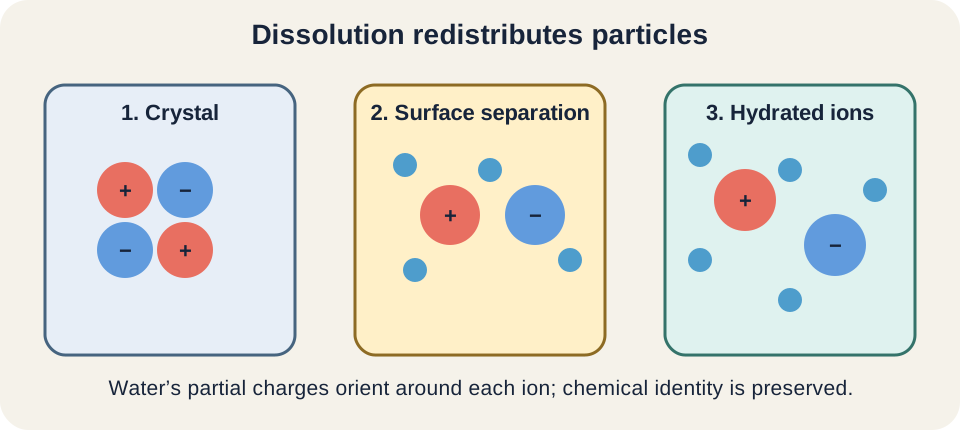
For a molecular solid such as sucrose, individual molecules separate from the crystal and become solvated. Solvation means surrounding and stabilizing a solute particle with solvent particles. When water is the solvent, the more specific word is hydration. The sucrose molecules retain their covalent identities during ordinary dissolution. Because no new molecular substance is required, dissolution is not automatically a chemical reaction.
For an ionic solid such as sodium chloride, the crystal contains ions rather than neutral sodium chloride molecules. Water molecules orient their partially negative oxygen ends toward and their partially positive hydrogen ends toward . These ion–dipole attractions stabilize separated hydrated ions. The symbolic equation records dissociation. The coefficient relationship shows one sodium ion and one chloride ion per formula unit. The state symbol means hydrated in aqueous solution, not merely “liquid.”
Dissociation differs from ionization. Dissociation separates ions that already existed in an ionic substance, while ionization forms ions from neutral particles through reaction with the solvent or another species. Hydrogen chloride, for example, reacts with water to form hydronium and chloride. Melting also differs because it converts a pure solid into its liquid without adding a solvent. Precise vocabulary preserves the mechanism implied by each description.
Three interaction changes govern enthalpy
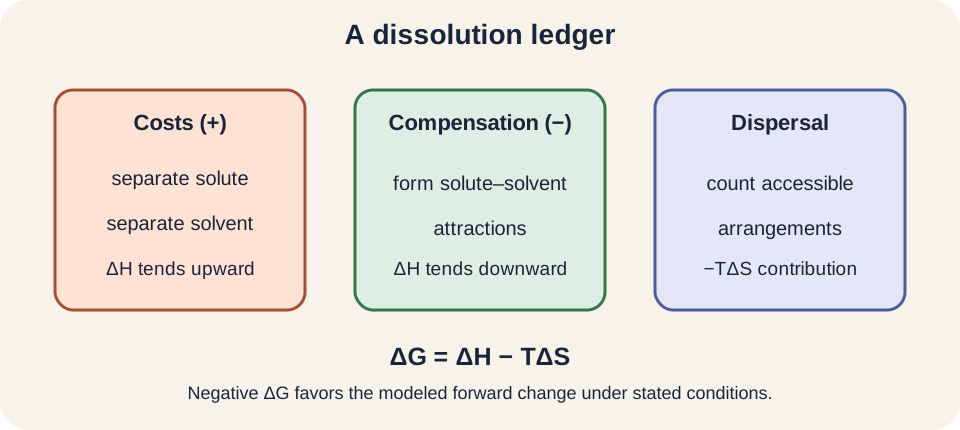
A useful conceptual cycle divides dissolution into three interaction changes. First, solute particles must be separated from one another, which generally requires energy. Second, some solvent–solvent attractions must be disrupted to create space, which also generally requires energy. Third, solute–solvent attractions form, which generally releases energy. The actual process occurs together, but the imagined steps make the accounting clear.
Represent the molar enthalpy of solution as . The capital Greek delta, , means final value minus initial value. denotes enthalpy, and the subscripts label the conceptual contribution. The first two terms are commonly positive because separation requires input. The mixing term is commonly negative because attraction formation releases energy.
If the released energy exceeds the separation costs, is negative and dissolution is exothermic. If separation costs exceed the released energy, is positive and dissolution is endothermic. A temperature increase in the immediate surroundings suggests an exothermic process, while cooling suggests an endothermic one. These observations concern heat transfer under the measurement conditions. They do not alone determine whether much solute dissolves.
Entropy and free energy complete the model
Enthalpy is only one contribution to thermodynamic favorability. Entropy, represented by , measures the dispersal of energy among accessible microscopic arrangements. Dispersing solute particles often increases the number of possible arrangements, producing a positive entropy contribution. Solvent organization around certain solutes can oppose that increase. Therefore dissolution does not guarantee a positive total entropy change.
At constant temperature and pressure, Gibbs free-energy change organizes the competition: . The symbol denotes Gibbs free energy, is absolute temperature in kelvins, and is entropy. The product has energy units when entropy uses and temperature uses kelvins. A negative means the modeled forward change is thermodynamically favorable under the stated conditions. A positive value means the reverse direction is favored from that composition.
Suppose and at . Convert entropy to before combining units. Then . The endothermic dissolution can still be favorable because the entropy term is sufficiently positive. This calculation disproves the rule that only exothermic dissolutions occur.
“Like dissolves like” is a starting heuristic
Polar solvents tend to dissolve polar molecular solutes and many ionic compounds because their electrostatic interactions can compensate for attractions disrupted during mixing. Nonpolar solvents tend to dissolve nonpolar solutes because neither component sacrifices exceptionally strong attractions. This pattern motivates the phrase “like dissolves like.” The phrase compares interaction types rather than appearance, density, or chemical family names. Similarity makes favorable compensation more plausible but does not guarantee a large equilibrium concentration. It remains qualitative unless supported by measured thermodynamic or equilibrium data.
Water has strong hydrogen-bonding interactions with itself. A nonpolar hydrocarbon cannot replace those disrupted interactions with comparable water–solute attractions. Water molecules may also become more constrained around exposed nonpolar surfaces, producing an unfavorable entropy contribution. Separate phases can therefore have lower free energy than a uniform mixture. Saying oil is “repelled” by water hides these competing effects.
Exceptions reveal why the heuristic is incomplete. A molecule may contain both polar and nonpolar regions, and solubility then depends on their relative sizes and structures. Temperature changes the entropy term and can change interaction strengths or phase behavior. Crystal lattice strength can make a polar ionic compound only sparingly soluble despite strong hydration. Quantitative solubility is an equilibrium property, not a label assigned by one structural feature.
Solubility has conditions and units
Solubility is the equilibrium amount of solute that can dissolve in a specified quantity of solvent or solution at stated temperature and pressure. It may be reported as grams solute per solvent, moles per liter of solution, mole fraction, or another concentration measure. A number without units and conditions is incomplete. Comparing values reported on different bases requires conversion. Gas solubility additionally requires a specified gas partial pressure.
The word soluble is often used qualitatively, while solubility is quantitative. “Insoluble” rarely means literally zero dissolved particles. It usually means the equilibrium amount is very small relative to the context or detection limit. Slightly soluble solids can still produce chemically important ion concentrations. Equilibrium constants will later provide a more precise description for sparingly soluble ionic compounds.
Suppose of a solid dissolves in water at . A mixture containing solid and water has the same ratio, . It is at the stated solubility limit if equilibrium has been reached. The horizontal fraction bar groups the entire solute mass over the entire solvent mass. Doubling both amounts does not change the ratio, though it doubles total material.
Saturation is dynamic equilibrium
An unsaturated solution contains less dissolved solute than the equilibrium maximum under the stated conditions. More solute can dissolve if added and if sufficient time and mixing allow the system to approach equilibrium. A saturated solution is in equilibrium with respect to dissolution and crystallization. It need not visibly contain excess solid if it was prepared exactly at the saturation composition. Saturation describes thermodynamic state, not simply the presence of crystals.
In a saturated solution touching undissolved solid, particles continue to leave and rejoin the solid surface. At equilibrium, the forward dissolution rate equals the reverse crystallization rate. Equal rates produce no net macroscopic concentration change. The particles do not stop moving, and the two opposing processes do not cease. This is dynamic rather than static equilibrium.
Adding more solid to an already saturated solution does not ordinarily increase the equilibrium dissolved concentration at fixed conditions. It increases the reservoir of undissolved material and may provide additional surface area. Removing some solution without changing temperature likewise leaves the concentration of the remaining saturated liquid unchanged if solid remains and equilibrium re-establishes. Amount and concentration are different quantities. The equilibrium constraint sets concentration, while sample size sets total dissolved amount.
Supersaturation is a metastable state
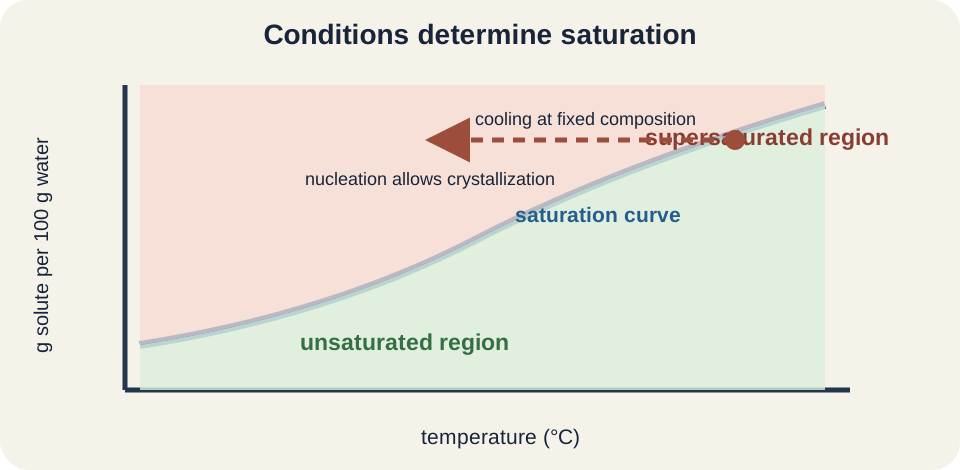
A supersaturated solution contains more dissolved solute than the stable equilibrium concentration under its current conditions. It can be prepared by dissolving solute at a condition where solubility is higher and then changing conditions carefully. Cooling a hot saturated solution is a common method when solid solubility increases with temperature. If crystallization does not begin immediately, excess solute remains temporarily dispersed. The state is metastable rather than fully stable.
Crystallization requires formation of a sufficiently organized nucleus. A seed crystal, scratch, dust particle, or mechanical disturbance can lower the barrier to nucleation. Once a stable nucleus forms, additional solute can deposit rapidly. The solution concentration then moves toward its equilibrium saturation value. The dramatic crystallization does not mean a new equilibrium law suddenly began operating; it means a kinetic barrier was overcome.
Unsaturated, saturated, and supersaturated labels require the same temperature, pressure, solvent, and solute definition. A composition saturated at one temperature may become unsaturated after warming or supersaturated after cooling. Dilution can move a solution below saturation without changing the identity of any particles. Evaporation can raise concentration until crystallization begins. State labels are meaningful only when conditions accompany them.
Temperature effects require the dissolution enthalpy
For many solids whose dissolution is endothermic, increasing temperature increases equilibrium solubility. Heat can be treated as a reactant-side contribution in a qualitative equilibrium model, so warming favors additional dissolution. For an exothermic dissolution, warming can instead decrease solubility. These are thermodynamic trends, not universal rules about solids. Measured solubility curves are the authoritative evidence for a particular substance.
Solubility curves commonly plot grams of solute per water on the vertical axis against temperature on the horizontal axis. A point on the curve represents saturation. A point below represents an unsaturated composition if the axes and basis match. A point above represents a supersaturated solution or a mixture containing undissolved solute, depending on history and observed phases. The graph alone cannot distinguish metastable dissolved excess from excess solid without additional information.
Temperature also changes dissolution rate, often by increasing molecular motion and transport. A solid may dissolve faster when warmed even if its equilibrium solubility changes only slightly. Rate answers how quickly concentration changes, while solubility answers the equilibrium endpoint. Confusing these questions leads to false conclusions from short observations. Allowing sufficient equilibration time is part of a valid solubility experiment.
Gas solubility depends strongly on pressure
For a dilute gas dissolved without chemical reaction, Henry’s law is often written . Here is dissolved-gas concentration, is the gas’s partial pressure above the solution, and is a temperature-dependent proportionality constant. Different conventions define Henry constants differently, so units and equation form must be checked together. In this form, larger partial pressure produces larger equilibrium concentration. Total atmospheric pressure is not a substitute when several gases are present.
A sealed carbonated drink has high carbon dioxide partial pressure above the liquid. Opening it lowers that pressure toward the surrounding atmospheric carbon dioxide partial pressure. The liquid then contains more dissolved carbon dioxide than the new equilibrium supports, so gas escapes as bubbles. Nucleation sites on scratches or particles help bubbles form. Shaking creates or distributes nucleation opportunities and can accelerate the visible release.
Gas dissolution is often exothermic, so increasing temperature commonly lowers gas solubility. A warm carbonated drink therefore loses carbon dioxide more readily than a cold one. This trend matters in aquatic environments because warmer water can hold less dissolved oxygen. Pressure and temperature effects must be stated together. Henry’s law also becomes inaccurate at high pressures, concentrated solutions, or when the gas reacts strongly with the solvent.
Dissolution rate is not equilibrium solubility
Crushing a solid increases surface area exposed to solvent. Stirring reduces stagnant concentration gradients near the surface. Heating often accelerates particle motion and diffusion. Each change may shorten the time required to approach equilibrium. None guarantees a different equilibrium solubility unless it also changes an equilibrium condition such as temperature, pressure, or composition.
Consider equal masses of coarse and powdered sugar placed in identical water samples at the same temperature. Powdered sugar normally dissolves faster because more crystal surface contacts water. After sufficient time, both samples can reach the same equilibrium concentration if neither has excess limitations or degradation. The faster sample does not have a greater solubility merely because it disappears first. Rate observations require time data, while solubility measurements require equilibrium data.
A chemical reaction can increase apparent dissolution by consuming dissolved solute and pulling more material from the solid. Acid dissolving a carbonate is more than physical dispersion because new species form and gas may evolve. Complex formation can likewise stabilize dissolved ions and change total dissolved amount. In such cases, a reaction-coupled equilibrium model is needed. The simple interaction picture remains useful but no longer describes the whole system.
A quantitative preparation example
At , suppose a solute’s measured solubility is . A beaker contains water. The maximum equilibrium dissolved mass is solute. Water units cancel across the horizontal fraction bar, leaving grams solute. This calculation assumes the empirical solubility basis applies and temperature remains fixed.
If solute is added and equilibrium is reached, dissolves and remains undissolved. The liquid phase is saturated. The entire beaker contains both saturated solution and excess solid. Calling all “dissolved solute” would violate the equilibrium limit. Filtration at the same temperature could separate the excess solid from the saturated liquid.
If solute is added instead, the composition is unsaturated because it lies below . All may dissolve if kinetics permit and no reaction intervenes. Adding another would still remain below the calculated maximum. Adding more would produce excess solid at equilibrium. A clear material ledger prevents concentration and total-mass errors.
Common misconceptions and repairs
The statement “water dissolves everything” is false. Water dissolves many ionic and polar substances because of its polarity and hydrogen-bonding ability, but it poorly dissolves many nonpolar substances. Even among ionic solids, lattice energy and hydration vary greatly. Solubility is a balance rather than a property of water alone. Identify both solute and solvent whenever explaining a solution.
The statement “an exothermic substance is soluble” is also false. A negative enthalpy contribution favors dissolution, but entropy and composition-dependent equilibrium still matter. Conversely, an endothermic process can be favorable when entropy provides sufficient compensation. The sign of , not alone, determines direction under constant temperature and pressure. Even then, kinetics may make the favorable change slow.
The statement “no solid is visible, so the solution is unsaturated” is unreliable. A saturated solution can contain exactly the equilibrium dissolved amount without an excess solid phase. A supersaturated solution may also appear clear until nucleation begins. Testing with a small seed crystal can provide evidence, though it may disturb the state. Classification should use composition, conditions, history, and equilibrium evidence together.
Practice and guided feedback
First, explain why separating solvent molecules costs energy even though no covalent bonds need break. Second, classify a clear solution containing less than the equilibrium maximum. Third, explain why a seed crystal can trigger a supersaturated solution without changing its temperature. Fourth, predict what opening a carbonated bottle does to carbon dioxide partial pressure and equilibrium solubility. Write a particle-level statement for every answer.
Separating solvent particles works against their intermolecular attractions, so potential energy generally rises. A solution below the equilibrium maximum is unsaturated, assuming its amount basis and conditions are known. A seed provides an ordered surface that lowers the kinetic barrier to crystal nucleation, allowing excess dissolved solute to leave solution. Opening a bottle lowers carbon dioxide partial pressure, which lowers its equilibrium dissolved concentration in the Henry-law regime. Escaping bubbles are the macroscopic evidence of that adjustment.
For a calculation check, suppose solubility is and the sample contains water. The maximum dissolved mass is . If is added at equilibrium, remains undissolved. The answer uses a horizontal fraction bar and carries substance-specific units through cancellation. Its scale is reasonable because the water sample is smaller than the tabulated basis.
Retrieval and connection forward
Without looking back, draw the three interaction changes in dissolution and label which usually require or release energy. Then explain why the sign of dissolution enthalpy alone cannot determine favorability. Define unsaturated, saturated, and supersaturated using equilibrium rather than visual appearance. Explain why stirring can change rate without changing solubility. Finish by writing Henry’s law and defining every symbol with units appropriate to one stated convention.
The next lesson on concentration will quantify how much solute is present using molarity and related measures. Colligative properties will show how dispersed-particle number changes boiling, freezing, vapor pressure, and osmotic behavior. Dynamic equilibrium will formalize equal forward and reverse rates at saturation. Solubility equilibria will introduce equilibrium constants for sparingly soluble ionic solids. These topics all depend on distinguishing microscopic process, macroscopic composition, and equilibrium constraint.
Use one final synthesis sentence: dissolution is the particle-level process of dispersing solute through solvent, while solubility is the equilibrium limit under specified conditions. That sentence keeps rate separate from endpoint. Interaction energies explain important tendencies, entropy completes the thermodynamic account, and kinetic barriers explain delayed change. Conditions and units make quantitative statements reproducible. With those habits, solution chemistry becomes a connected model rather than a collection of exceptions.