
Intermolecular forces are attractive and repulsive interactions among separate particles. The particles may be neutral molecules, monatomic noble-gas atoms, or ions surrounded by solvent molecules. These interactions are usually weaker than the covalent or ionic connections that define a particle’s internal structure. They nevertheless act across enormous numbers of neighboring particles in a sample. Their collective effect helps determine whether matter is gaseous, liquid, solid, soluble, viscous, or surface-active.
The phrase “intermolecular force” is sometimes used too narrowly. London dispersion acts between every atom and molecule, including nonpolar ones. Permanent dipoles add orientation-dependent interactions when molecular charge distribution is uneven. Hydrogen bonding is a particularly organized and often strong dipole-based interaction, not a covalent bond between ordinary neighboring molecules. Ion–dipole interaction becomes central when salts dissolve in polar solvents.
This article develops a cause-and-evidence framework instead of a list to memorize. First identify which particles interact and how charge is distributed within them. Then identify which attractions are possible and compare their combined strength across similar substances. Finally connect those interactions to an observable property while separating intermolecular changes from intramolecular bond changes. That sequence prevents many common errors in boiling-point and solubility reasoning.
Separate intramolecular bonds from intermolecular attractions
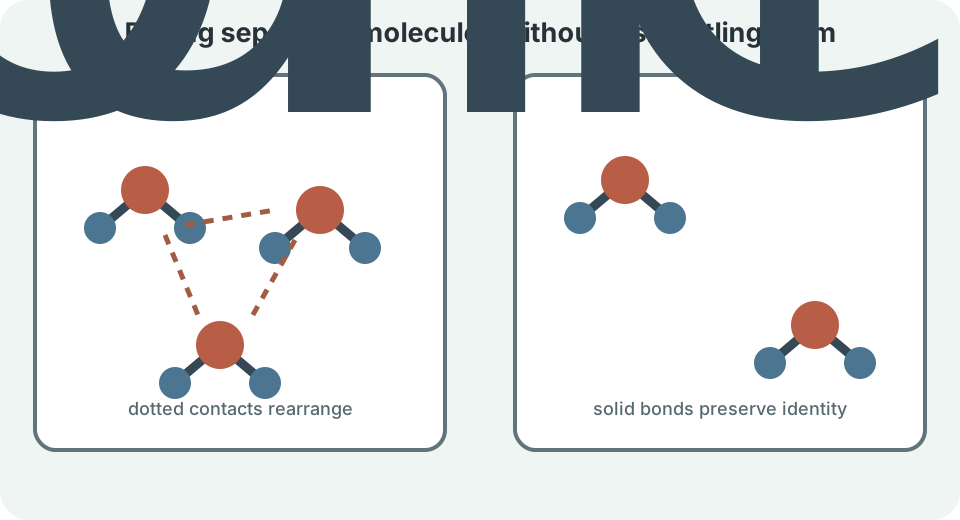
Intramolecular bonds connect atoms within a defined particle or extended network. The prefix “intra-” means within, so an oxygen–hydrogen covalent bond inside one water molecule is intramolecular. Intermolecular attractions act between one water molecule and another. The prefix “inter-” means between. A phase change usually rearranges intermolecular contacts without changing the molecule’s covalent identity.
When liquid water boils, water molecules separate from neighboring water molecules. The process does not ordinarily split each molecule into hydrogen and oxygen atoms. Energy is supplied mainly to overcome enough intermolecular attraction for molecules to enter the gas phase. Breaking an oxygen–hydrogen covalent bond would be a chemical change with a different energy scale. A correct particle diagram must preserve molecular connectivity during ordinary boiling.
Network solids require extra care because their bonding does not divide cleanly into discrete molecules. Diamond consists of covalent connections extending through a three-dimensional carbon network. Melting or vaporizing such a material cannot be described as merely separating intact diamond molecules. Ionic crystals likewise consist of extended arrays rather than isolated ion pairs. Always identify the actual structural unit before labeling an interaction.
Charge distribution is the common origin
Electrons and nuclei produce electric fields that extend beyond a particle’s nominal boundary. A neighboring particle responds to that field. If positive and negative charge centers do not coincide, the particle has an electric dipole moment. Even when the average distribution is symmetric, instantaneous electron motion creates temporary unevenness. Intermolecular-force categories describe different patterns of this underlying electrostatic interaction.
For two ideal point charges, the interaction energy follows . The symbol is electric potential energy, is Coulomb’s constant, and are charges, and is their separation. Real molecular interactions involve distributed partial charges rather than isolated points. Their energy also depends on orientation and how electron clouds deform. The point-charge equation is therefore a conceptual starting point rather than a complete molecular calculation.
At very short distance, repulsion rises steeply. Overlapping electron clouds are constrained by quantum rules, and nuclei also repel one another. At moderate separation, attractive contributions can dominate and create an energy minimum. The equilibrium separation balances attraction and short-range repulsion. Condensed matter therefore has finite spacing rather than collapsing into a point.
London dispersion acts between all particles
Electrons move continually within atoms and molecules. At an instant, random fluctuation can place slightly more electron density on one side of a particle. That temporary dipole produces an electric field. The field distorts a neighboring electron cloud and induces a correlated dipole. The correlated arrangement lowers interaction energy and creates London dispersion attraction.
Dispersion does not require a permanent polar bond. It acts between helium atoms, hydrocarbon molecules, water molecules, and every other polarizable particle. Other interactions may be added when permanent charges or dipoles exist. Saying a nonpolar substance has “no intermolecular forces” is therefore incorrect. Nonpolar substances can condense precisely because dispersion provides attraction.
Polarizability measures how readily an electron distribution is distorted. Larger, more diffuse electron clouds are generally more polarizable than smaller, tightly held clouds. Down a noble-gas group, increasing electron count and size strengthen dispersion and raise boiling points. Among similarly shaped molecules, molar mass can serve as a rough proxy for polarizability. It is not the cause by itself, because electron-cloud response is the relevant mechanism.
Shape and contact area modify dispersion
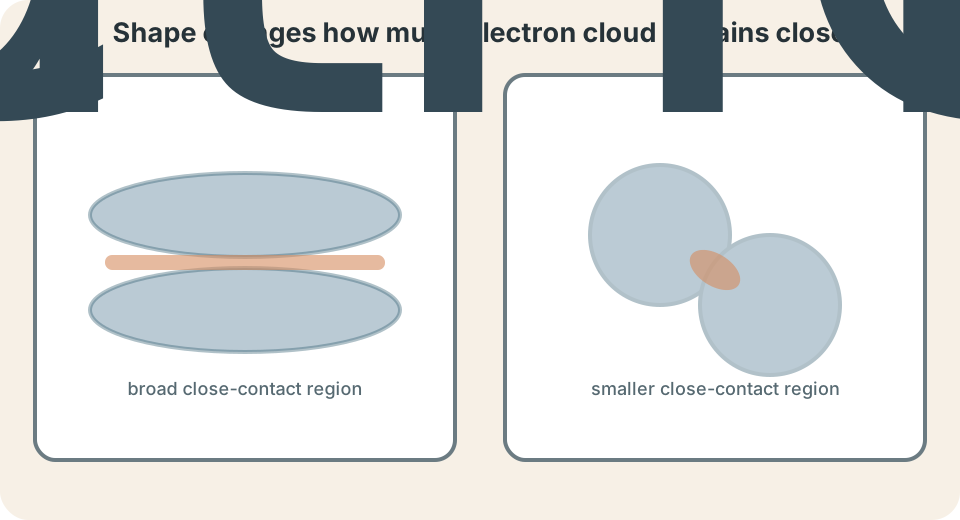
Molecules with similar formulas can have different shapes and therefore different contact areas. An elongated molecule can approach neighbors along a broader surface than a compact, highly branched isomer. More points of close contact can strengthen the combined dispersion attraction. This helps explain why some less-branched hydrocarbons boil at higher temperatures than their more compact isomers. Shape matters even when electron count is identical.
The phrase “surface area” at molecular scale is a model, not a miniature macroscopic skin. It summarizes how much of one fluctuating electron cloud can remain near another. Distance is especially important because dispersion decays rapidly as particles separate. A conformation that increases close contact can gain stabilization. Biomolecular folding and molecular recognition use this collective effect alongside other interactions.
Comparisons should change one feature at a time when possible. Comparing molecules with different masses, shapes, polarities, and hydrogen-bonding sites all at once produces an ambiguous conclusion. Begin with electron-cloud size and polarizability. Then examine molecular shape and accessible contact. Finally add permanent-dipole and hydrogen-bonding effects.
Permanent dipoles add directional attraction
A polar molecule has a permanent separation of partial positive and partial negative charge. Its dipole moment is commonly represented by vector . In a simple two-charge model, magnitude is , where is the separated charge magnitude and is the distance between charge centers. Molecular dipole moment depends on both bond polarities and three-dimensional geometry. Polar bonds can cancel vectorially in a symmetric molecule.
Two polar molecules can orient so a partially positive region approaches a partially negative region. This favorable alignment lowers potential energy and is called dipole–dipole attraction. Other orientations are less favorable or repulsive. Thermal motion continually changes molecular orientation. The observed bulk interaction is an average over many configurations rather than a fixed row of perfectly aligned dipoles.
Dipole moment alone does not rank all boiling points. A larger molecule may have stronger dispersion even if its permanent dipole is smaller. Molecular shape, polarizability, symmetry, and hydrogen-bonding capacity also matter. Useful comparisons hold most factors similar before emphasizing one. Chemical explanations should present multiple contributing interactions rather than declare a single “strongest force” without context.
Hydrogen bonding is a specific structural interaction
Hydrogen bonding commonly occurs when hydrogen is covalently attached to nitrogen, oxygen, or fluorine and approaches an electron-rich site on another particle. The covalent attachment strongly polarizes the hydrogen. Because hydrogen has no inner electron shell, its partially positive region can approach a lone-pair region closely. The resulting interaction has pronounced electrostatic and quantum-mechanical character. Introductory chemistry identifies it through donor and acceptor roles.
A hydrogen-bond donor contains the polarized bond that supplies hydrogen. A hydrogen-bond acceptor supplies an available electron-rich region, often a lone pair. In the notation , is the donor atom, is hydrogen, the dots mark the intermolecular interaction, and is the acceptor. The dots should not be mistaken for an ordinary covalent bond line. Geometry matters because the interaction is strongest for favorable donor–hydrogen–acceptor alignment.
Not every molecule containing hydrogen can hydrogen-bond with itself. Methane contains carbon–hydrogen bonds but lacks the strongly polarized donor pattern used in the foundational rule. An ether oxygen can accept hydrogen bonds but the ether may lack an oxygen–hydrogen donor. Water can both donate and accept, enabling an extended fluctuating network. Counting donor and acceptor sites is more reliable than searching for the letter H.

Ion–dipole interactions support dissolution
An ion produces an electric field that can orient polar solvent molecules. Around a cation, the partially negative region of a solvent tends to point inward. Around an anion, the partially positive region tends to point inward. These ion–dipole attractions help stabilize separated ions in solution. The organized collection of nearby solvent molecules is called a solvation shell.
For water as solvent, the process is called hydration. Oxygen’s partially negative region tends to face a cation, while hydrogen’s partially positive regions tend to face an anion. Particle diagrams must preserve water’s bent geometry and partial-charge orientation. They should also show multiple solvent molecules around each ion. One water molecule is not an adequate model of a bulk hydration environment.
Dissolution requires more than attractive ion–dipole interaction. Separating ions from a lattice costs energy, and separating solvent particles also disrupts attractions. Forming solute–solvent contacts releases energy. Entropy changes contribute to thermodynamic favorability as well. “Like dissolves like” is a useful initial pattern, but a complete explanation compares all major energy and dispersal effects.
Intermolecular forces influence phase changes
Vaporization moves particles from a condensed liquid into a more separated gas state. Stronger collective attractions generally require more energy to overcome, increasing enthalpy of vaporization among comparable substances. A higher temperature may then be needed for vapor pressure to reach external pressure. This often produces a higher normal boiling point. The word “normal” specifies a boiling point at a pressure of one atmosphere.
Vapor pressure measures the pressure exerted by vapor in equilibrium with its condensed phase at a stated temperature. Stronger attractions tend to reduce the rate at which molecules escape and lower equilibrium vapor pressure under comparable conditions. Raising temperature increases the fraction of molecules able to enter the vapor. Boiling begins when vapor pressure equals surrounding pressure. Boiling point is therefore not an intrinsic number independent of pressure.
Melting behavior is more complicated because crystal packing matters. Strong attractions can raise melting point, but molecular symmetry and packing efficiency can change the ordering. A compact symmetric molecule may form a particularly stable crystal. Irregular shapes can frustrate packing even when pairwise attractions are substantial. Boiling-point trends are often easier to rationalize from intermolecular attraction than melting-point trends.
Viscosity, surface tension, and capillary behavior
Viscosity measures resistance to flow. Molecules must move past neighbors for a liquid to deform. Stronger attractions, long entangled shapes, and network-forming interactions can increase that resistance. Temperature usually lowers liquid viscosity because thermal motion helps particles rearrange. A viscosity comparison must therefore specify temperature.
Surface molecules have fewer neighboring attractions above them than molecules in the bulk. This imbalance gives the surface an energetic cost. Surface tension quantifies the tendency to minimize surface area and can be expressed as force per length or energy per area. Stronger cohesive interactions often increase surface tension. Droplet shape reflects the competition among surface tension, gravity, and contact with another material.
Capillary rise depends on cohesive attraction within the liquid and adhesive attraction between liquid and surface. Water rises in clean glass when adhesion to the polar surface and surface-tension effects support an upward curved meniscus. Mercury behaves differently because its cohesion and interaction with glass produce a convex meniscus and capillary depression. “The liquid climbs because molecules attract” is incomplete. Direction and magnitude depend on both interfaces and tube geometry.
Translate structure into a property prediction
Begin by drawing or identifying the full molecular geometry. Mark polar bonds and combine their dipole vectors to decide whether the whole molecule is polar. Inventory hydrogen-bond donors and acceptors. Remember that dispersion is always present. Estimate relative polarizability from electron-cloud size and accessibility.
Next, compare the candidate substances systematically. If sizes and shapes are similar, additional dipole attraction or hydrogen bonding may dominate the difference. If polarities are similar, size and contact area may dominate. If the substances differ in many ways, rank the competing effects and acknowledge uncertainty. A defensible explanation identifies the comparison that supports each inference.
Finally, name the property mechanism. A boiling-point claim should discuss separation into the vapor and vapor-pressure equilibrium. A solubility claim should compare solute–solute, solvent–solvent, and solute–solvent interactions. A viscosity claim should discuss resistance to molecular rearrangement. Connecting structure directly to a property without the middle mechanism produces a slogan rather than an explanation.
Worked comparisons
Compare methane, , and chloromethane, . Both substances experience London dispersion. Chloromethane has more electrons and a more polarizable cloud, and its molecular geometry leaves a permanent dipole. It therefore has both stronger dispersion and dipole–dipole contributions. The combined attractions support its higher boiling point relative to methane.
Compare ethanol, , and dimethyl ether, . They have the same molecular formula and similar molar mass, so their electron counts are comparable. Both contain polar carbon–oxygen bonds and can accept hydrogen bonds. Ethanol also contains an oxygen–hydrogen donor, allowing ethanol molecules to build stronger self-associated hydrogen-bond networks. That structural distinction helps explain ethanol’s higher boiling point.
Compare pentane and neopentane. They share the formula and therefore have the same electron count. Pentane’s extended shape provides more accessible contact between neighboring clouds. Neopentane is compact and has less effective contact area. Stronger combined dispersion in the less compact isomer helps raise its boiling point.
Common mistakes and repairs
The statement “hydrogen bonds are the strongest intermolecular force” is too broad. An ion interacting with a strongly polar solvent can exceed an individual hydrogen bond, and a large polarizable particle can accumulate substantial dispersion. Bulk properties reflect many simultaneous contacts. Strength rankings depend on particles, distances, orientation, and environment. Replace universal ladders with a comparison of actual systems.
The statement “polar molecules dissolve in water” is also incomplete. Solubility depends on whether new solute–water interactions compensate for disrupted solute–solute and water–water interactions and on the entropy change. Large nonpolar regions can limit solubility even when a molecule contains one polar group. Temperature can change the balance. Replace the slogan with a three-interaction energy inventory.
Another error is claiming that boiling breaks hydrogen and oxygen bonds in water. Ordinary vaporization preserves the covalent structure of each water molecule. It disrupts and rearranges hydrogen bonds among different molecules. The molecular formula remains in both liquid and vapor. Particle identity is the diagnostic distinction between physical and chemical change.
Retrieval practice and synthesis
Explain why argon can become a liquid even though each atom has no permanent dipole. Your explanation should describe instantaneous fluctuation, induced dipoles, and correlated attraction. Then explain why xenon has a higher boiling point than argon. Use polarizability rather than molar mass as the causal mechanism. Molar mass is useful here only because it accompanies a larger, more deformable electron cloud.
Predict the dominant interactions among pure samples of water, carbon dioxide, and hexane. All three have dispersion. Water adds permanent dipoles and hydrogen-bond donor–acceptor networks. Carbon dioxide contains polar bonds but has a linear symmetric geometry, so their dipole vectors cancel. Hexane is nonpolar but large enough for appreciable dispersion over extended contact.
Construct a comparison between two substances and write a complete claim–evidence–reasoning response. The claim should name the expected property ordering. The evidence should identify geometry, polarity, polarizability, and donor–acceptor structure. The reasoning should explain how those features change the energy required for particle separation or rearrangement. End by naming any uncontrolled structural difference that limits confidence.