
The ideal gas law summarizes how pressure, volume, amount, and temperature relate, but it does not by itself explain why those relationships occur. Kinetic molecular theory supplies a particle-level model. It imagines an enormous population of moving particles whose collisions transfer momentum while obeying a small set of idealized assumptions. Statistical averages connect that microscopic motion to macroscopic measurements. The theory succeeds because predictable collective behavior emerges from many individually unpredictable trajectories.
You will state and interpret the ideal assumptions, connect wall collisions to pressure, relate absolute temperature to mean translational kinetic energy, calculate root-mean-square speed, read Maxwell–Boltzmann distributions, and compare diffusion or effusion rates. You will distinguish kinetic energy from speed and temperature from total thermal energy. You will also explain when finite molecular volume and intermolecular forces cause deviations from ideal behavior. Every symbol and unit in the governing equations will be unpacked. The goal is to use the model both for prediction and for diagnosing its own limits.
Begin with scale separation. A container holds far too many particles to track individually, so the theory asks about distributions and averages. Identify which ideal assumption supports each macroscopic conclusion. Keep temperature in kelvins and molar mass in units compatible with the gas constant. Finish by checking whether pressure, temperature, and density conditions make ideal behavior plausible.
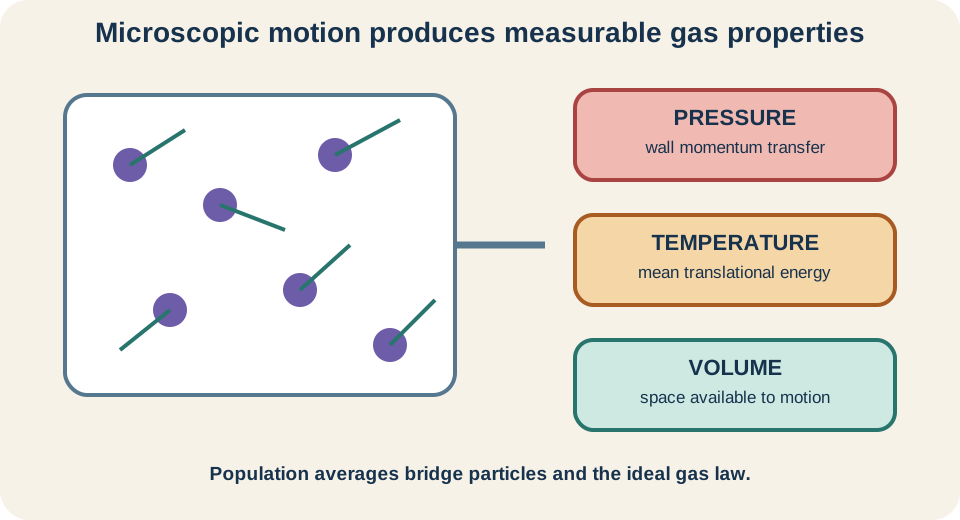
The ideal model rests on explicit assumptions
An ideal gas contains a very large number of particles moving continuously and randomly. “Random” means no persistent preferred direction exists in an equilibrium sample without external directional forcing. Particles travel in straight lines between collisions according to classical mechanics. Collisions interrupt and redirect those trajectories. Statistical isotropy makes average motion equivalent in all directions.
Ideal particles occupy negligible volume compared with the container volume. This does not claim real molecules have zero size. It claims their excluded volume is small enough to ignore under the chosen conditions. The approximation works best at low density, where mean separations are large relative to molecular dimensions. High pressure compresses those separations and exposes the limitation.
Ideal particles exert no attractive or repulsive forces on one another except during collisions. Their collisions with one another and with walls are perfectly elastic, meaning total translational kinetic energy is conserved through a collision. Momentum is also conserved. Real molecules have intermolecular attractions and short-range repulsions, but these can be negligible in dilute, sufficiently warm gases. Each assumption is a controlled simplification rather than a literal description of all matter.
Pressure arises from momentum transfer at walls
A moving particle carries momentum , where is particle mass and is velocity. Velocity is a vector, so direction matters. When a particle rebounds from a wall, the component of momentum perpendicular to that wall changes. The wall receives an equal and opposite momentum impulse. Repeated impulses create an average force.
Pressure is force divided by area, . The horizontal fraction bar indicates that a fixed force spread over a larger area produces smaller pressure. Gas pressure therefore reflects the rate of momentum transferred to each unit wall area. More frequent collisions, larger momentum changes, or both can increase pressure. A gauge measures the collective average rather than individual impacts.
For an ideal gas, kinetic theory leads to . Here is pressure, is volume, is particle count, is mass per particle, and is the mean squared speed. Angle brackets denote an average over the particle population. The factor one-third arises because random motion distributes squared velocity equally among three spatial directions. This equation is a microscopic bridge to the ideal gas law.
Volume changes collision frequency
Compress a fixed amount of gas at constant temperature. The same particles occupy less volume and travel a shorter average distance between wall encounters. Collision frequency per unit wall area rises, so pressure rises. This particle picture supports Boyle’s inverse relationship under fixed amount and temperature. The proportionality symbol means one variable scales with the reciprocal of another under stated constraints.
Expansion produces the opposite effect. Particles travel farther between wall collisions, reducing the rate of momentum transfer per area. Their mean kinetic energy remains fixed if temperature remains fixed. Pressure falls because collisions become less frequent, not because every particle necessarily slows. Distinguishing speed effects from spacing effects improves causal explanations.
The ideal gas law expresses the same fixed-temperature result. With amount , gas constant , and temperature fixed, the product is constant. Kinetic theory explains the proportionality through wall impacts. The algebra summarizes the macrostate, while the particle model supplies mechanism. Both descriptions should agree within the ideal domain.
Temperature measures mean translational kinetic energy
For an ideal monatomic gas, the mean translational kinetic energy per particle is . The subscript “trans” denotes motion of the particle’s center of mass through space. Boltzmann’s constant has units , and is absolute temperature in kelvins. Their product has joule units. The factor reflects three translational degrees of freedom.
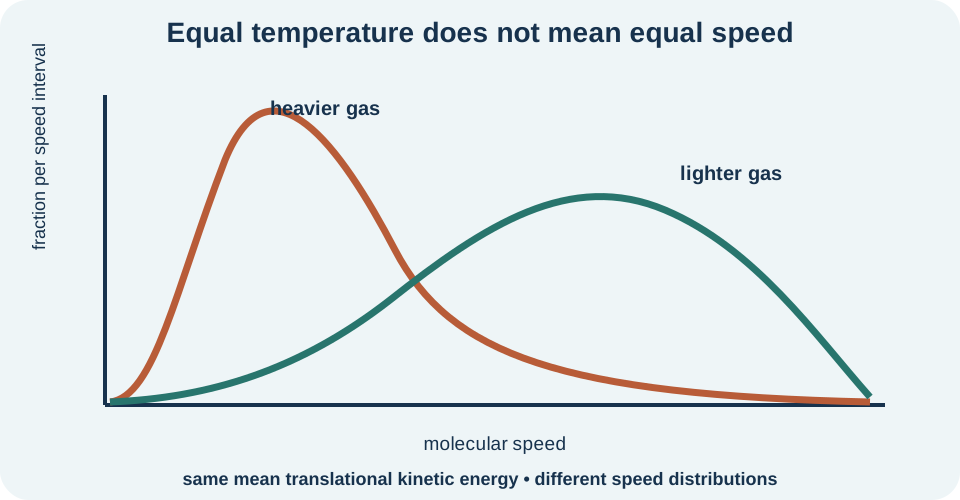
At the same temperature, different ideal gases have the same mean translational kinetic energy per particle. Heavier molecules do not have greater mean translational kinetic energy merely because their mass is greater. Since translational kinetic energy is , greater mass is compensated by lower typical squared speed. Lighter particles move faster on average at the same temperature. Energy equality and speed equality are different claims.
Temperature must be in kelvins because the proportionality is anchored to absolute zero. A Celsius value can be negative and has an offset origin, so direct substitution would break the physical proportionality. A temperature increase raises the distribution’s mean translational kinetic energy. Individual particles still possess a range of energies. Temperature describes the population average, not a uniform energy assigned to every molecule.
Temperature is not total thermal energy
Two gas samples can have the same temperature but different total internal energies because they contain different numbers of particles. Mean translational energy is an intensive property tied to temperature, while total energy is extensive and grows with amount. Doubling the number of monatomic ideal-gas particles at fixed temperature doubles total translational internal energy. It does not double temperature. Amount and average must remain separate.
Polyatomic molecules can store energy in rotational and vibrational modes in addition to translation. The simple relation still describes mean translational kinetic energy per particle, not the entire molecular internal energy. Which rotational and vibrational modes are active depends on temperature and quantum energy spacing. Heat capacity therefore varies with molecular structure. Kinetic molecular theory’s simple translational result should not be overextended.
Heat is energy transferred because of a temperature difference, not energy contained as a substance. When a warmer gas contacts a cooler object, collisions exchange energy until thermal equilibrium is approached. Temperature tracks the direction of spontaneous thermal transfer. The word “hotter” refers to temperature, while “contains more thermal energy” also depends on amount and internal degrees of freedom. Precise language prevents common conceptual errors.
Root-mean-square speed quantifies a distribution
Particles in a gas do not all move at one speed. A useful statistic is root-mean-square speed, defined as . First square each particle speed, then average those squares, then take the square root. This procedure weights higher speeds through squaring. It is not generally equal to the ordinary mean speed.
For an ideal gas, . Here , is kelvin temperature, and is molar mass in when SI units are used. Since one joule equals one , the units inside the radical reduce to . Taking the square root yields . The unit reduction confirms that the expression returns a speed.
Using molar mass in without converting to introduces a factor-of-one-thousand error inside the radical. For nitrogen, about becomes . At , the model gives a root-mean-square speed near . The magnitude is molecular speed, not the speed at which a smell crosses a room. Bulk spreading involves many collisions and a random walk.
Compare gases through proportional reasoning
At fixed temperature, is proportional to . For two gases 1 and 2, . The molar mass of the faster gas appears in the denominator of its own speed formula, which reverses order in the ratio. This reciprocal square-root dependence means a sixteenfold mass difference gives a fourfold speed difference. It does not produce a sixteenfold speed difference.
Hydrogen gas has molar mass about , while oxygen gas has about . Their mass ratio is approximately sixteen. At equal temperature, . Hydrogen molecules have about four times the rms speed. Both gases still have equal mean translational kinetic energy per molecule.
At fixed molar mass, is proportional to . Raising absolute temperature by a factor of four doubles rms speed. Doubling temperature increases rms speed only by , not by two. Kinetic energy is proportional to , while speed is proportional to its square root. Identifying which variable is squared explains the different scalings.
Maxwell–Boltzmann curves describe ranges of speed
A Maxwell–Boltzmann speed distribution plots the fraction or probability density of particles against speed. The curve begins at zero speed, rises to a most probable speed, and has a long high-speed tail. The area under a normalized curve represents the entire particle population. A point’s height is not itself the number of particles at exactly one mathematical speed. Intervals of speed correspond to areas under portions of the curve.
Increasing temperature broadens the distribution, lowers its peak, and shifts characteristic speeds to the right. Total normalized area stays the same because particle count fraction remains one. More particles occupy high-speed regions, while a range of lower speeds remains populated. No single particle is guaranteed to speed up. Collisions continually redistribute energy across the population.
At the same temperature, a lighter gas has a broader distribution shifted toward higher speeds relative to a heavier gas. Their mean kinetic energies match because the mass difference compensates for speed differences. Most probable speed, mean speed, and rms speed are three distinct statistics, with rms typically the largest. A curve should state which statistic is marked. Treating them as identical erases distribution structure.
Effusion and diffusion reflect molecular motion
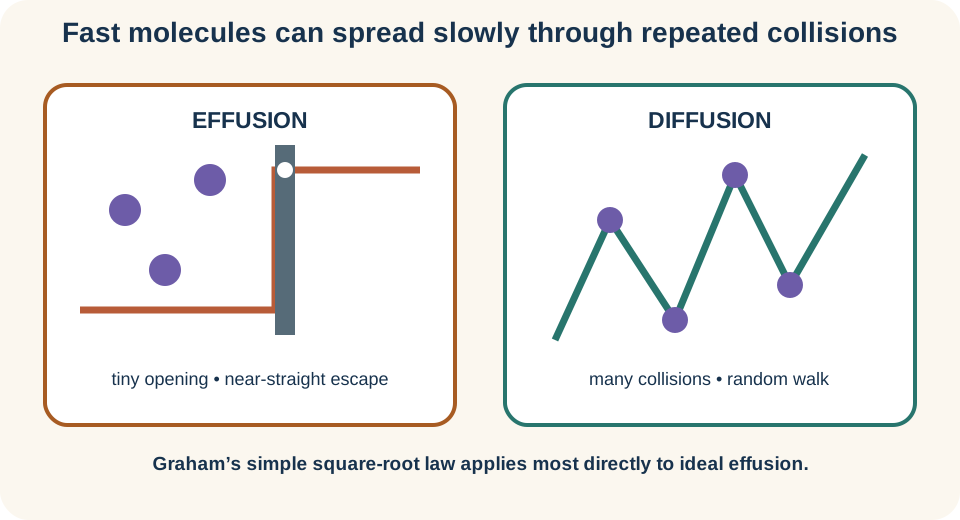
Effusion is escape of gas particles through a very small opening into a lower-pressure region without bulk collisions in the opening. Graham’s law states that effusion rate is inversely proportional to the square root of molar mass under comparable conditions. For gases 1 and 2, . The symbol here denotes an effusion rate, not the gas constant. Lighter gases effuse faster.
Diffusion is spontaneous mixing driven by molecular motion and concentration gradients. Lighter particles often diffuse more rapidly, but diffusion through a real medium depends on collisions, geometry, temperature, and interactions. A perfume odor does not travel across a room at hundreds of meters per second because molecules collide repeatedly with air particles. Their path is a random walk rather than a straight flight. Convection can also dominate ordinary room-scale transport.
Graham’s simple square-root law is most directly justified for effusion in the ideal regime. Applying it to every diffusion scenario can be misleading. State the physical process and constraints before using the ratio. If the opening is not small relative to mean free path, bulk flow may replace molecular effusion. The equation’s elegance does not remove its domain assumptions.
Mean free path and collision frequency add scale
The mean free path is the average distance a particle travels between intermolecular collisions. It increases when particle number density decreases because collision partners are farther apart. It decreases when effective molecular size or density increases. Individual paths vary widely around the mean. The concept supplies a length scale for deciding whether an opening or apparatus dimension is microscopically small.
Collision frequency depends on particle density, relative speed, and collision cross section. Heating increases typical speed, while compression increases number density. Both changes can increase collision frequency, though their combined effects depend on conditions. Reaction kinetics further requires suitable orientation and energy, so not every collision causes reaction. Kinetic gas theory supplies encounter statistics, not a complete chemical mechanism.
At ordinary pressure, molecular mean free paths are tiny compared with room dimensions. A molecule undergoes enormous numbers of collisions during macroscopic travel. This explains why microscopic high speeds coexist with slow net diffusion. At very low pressure, mean free paths grow and wall interactions can dominate. Vacuum technology operates across these different flow regimes.
Ideal gas laws emerge from kinetic relationships
Combining with gives . The first equation connects pressure to momentum transfer, while the second connects mean translational kinetic energy to temperature. Particle count satisfies , where is moles and is Avogadro’s constant. Since , the result becomes . The macroscopic law emerges from particle statistics.
This derivation explains several proportionalities at once. Increasing particle count at fixed volume and temperature raises collision frequency and pressure. Increasing temperature raises typical squared speed and momentum transfer, raising pressure at fixed volume. Increasing volume at fixed amount and temperature lowers wall-collision frequency, lowering pressure. Each algebraic relation has a microscopic story.
The derivation also identifies where ideal assumptions enter. Negligible particle volume lets particles access essentially the whole container. Negligible intermolecular forces lets kinetic energy and wall momentum transfer dominate without potential-energy corrections. Elastic collisions preserve the equilibrium distribution. When those assumptions fail, the ideal gas law becomes approximate.
Real gases deviate through attractions and finite volume
Intermolecular attractions can reduce measured pressure relative to an ideal prediction because particles approaching a wall may be pulled back by neighbors. Attractive potential energy also changes how energy is partitioned. These effects become more important at lower temperature, where kinetic energy is less able to overwhelm attractions, and at higher density, where particles are closer. Condensation is an extreme sign that the no-attraction model has failed. A gas near a phase transition is not strongly ideal.
Finite molecular volume becomes important at high pressure. Real particles exclude one another from space, so the volume available to centers of motion is less than the container volume. Short-range repulsion becomes significant when molecules are forced close together. This can raise pressure relative to simple ideal prediction. Attraction and excluded-volume effects can partially oppose each other under some conditions.
A real-gas equation such as van der Waals adds correction parameters for attraction and excluded volume. Those parameters depend on molecular identity, showing that real gases are not interchangeable at the same , , , and when nonideality matters. The compressibility factor measures deviation, with for ideal behavior. Values below or above one indicate different net effects. A correction model extends rather than invalidates the ideal baseline.
Common errors and corrective habits
One common error states that all particles in a gas at one temperature have the same speed. Replace that picture with a distribution whose mean kinetic energy is temperature-dependent. Another error says heavier molecules have more kinetic energy at equal temperature. Their typical speeds are lower so the mean translational kinetic energies match. Compare equations before making verbal claims.
A numerical error uses molar mass in with an SI value of . Convert to before evaluating rms speed. Another error doubles speed when temperature doubles. The square-root dependence gives a factor of . Write the proportionality before inserting values.
A conceptual error treats ideal assumptions as facts about real molecules. Real particles occupy volume and interact. The ideal model becomes accurate when those effects are small relative to available space and kinetic energy. State why conditions favor or violate the approximation. A model’s limits are part of understanding the model.
Guided practice and retrieval
Explain why pressure rises when a fixed gas sample is heated at constant volume. Kelvin temperature rises, so mean translational kinetic energy and typical squared speed rise. Wall collisions transfer more momentum and may occur more frequently. Force per area therefore rises. The particle explanation and agree.
Compare helium and argon at the same temperature. Their mean translational kinetic energies per particle are equal. Helium’s lower molar mass gives a higher rms speed through . Argon particles move more slowly on average but carry greater mass. Equal energy does not imply equal momentum or speed distributions.
Predict when nitrogen behaves more ideally: low pressure and high temperature, or high pressure and low temperature. Low pressure gives large molecular separations, making finite volume and attractions less important. High temperature gives greater kinetic energy relative to attractive interactions. Therefore low pressure and high temperature favor ideal behavior. This conclusion follows directly from the assumptions.
Connection forward
Reconstruct the kinetic model from memory. State each ideal assumption, explain pressure through momentum transfer, connect kelvin temperature to mean translational kinetic energy, and distinguish energy from speed. Derive the mass and temperature dependence of rms speed. Then explain why diffusion is slower than raw molecular speeds suggest. End by naming the two principal sources of real-gas deviation.
Reaction kinetics will use collision frequency, orientation, and activation energy to explain chemical rates. Thermodynamics will expand the energy picture beyond translation and connect molecular states to entropy. Statistical mechanics will derive distributions and macroscopic equations more generally. Transport theory will quantify viscosity, diffusion, and thermal conductivity. Real-gas thermodynamics will replace ideal pressure and activity approximations when needed.
The enduring insight is emergence. No single particle possesses the gas’s pressure or temperature, but large populations produce stable averages through motion and collision. Temperature sets a distribution of kinetic energies, mass shapes the corresponding speed distribution, and wall momentum transfer produces pressure. Ideal assumptions make the mathematics transparent, while deviations reveal real molecular size and forces. Moving between particle and macroscopic views is the central skill of kinetic molecular theory.