
Begin with one equation connecting a gas state
A gas sample at equilibrium can be described macroscopically by pressure, volume, temperature, and amount. The ideal gas law combines those variables as . The symbol is absolute pressure, is gas volume, is amount in moles, is absolute temperature in kelvins, and is the gas constant. The equation is an equation of state because it constrains which combinations of state variables can coexist. It does not describe the detailed path taken between states. Path behavior requires an additional process model and constraints.
The ideal model treats particles as negligibly small compared with container volume and assumes no intermolecular forces except during elastic collisions. Particles move randomly, collisions conserve kinetic energy, and average translational kinetic energy depends on absolute temperature. These assumptions are approximations rather than literal descriptions of real molecules. They work best for dilute gases at relatively low pressure and sufficiently high temperature. Understanding the assumptions makes model limitations predictable.
This lesson connects algebra, units, particle reasoning, and measurement. We will select a compatible value of , solve for each state variable, derive density and molar-mass forms, apply the law to reaction stoichiometry and mixtures, and assess nonideal behavior. Every example will use absolute temperature and explicit fractional units. We will also distinguish absolute from gauge pressure and identify experimental assumptions. By the end, you should be able to justify both a numerical answer and the model that produced it.
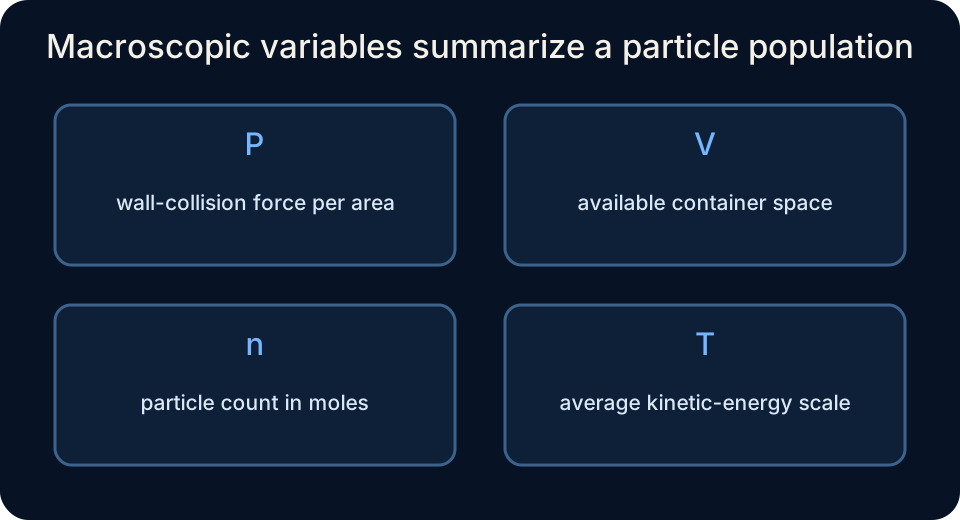
See how the empirical gas laws combine
Boyle’s law gives when temperature and amount are fixed. Charles’s law gives when pressure and amount are fixed. Avogadro’s law gives when pressure and temperature are fixed. Combining the proportionalities gives . Replacing proportionality with equality introduces the constant and yields .
This derivation explains the controlled-variable laws as slices of one state equation. Holding and fixed reduces to . Holding and fixed reduces it to . Holding and fixed gives . The ideal law organizes rather than replaces those relationships.
The combined gas law follows by comparing two states of the same fixed amount. Since , constant gives . If amount changes, cannot be canceled and the full ideal law must be used for each state. A leaking vessel or gas-producing reaction therefore falls outside the fixed-amount combined form. Derivation reveals applicability more reliably than keyword matching.
Choose a gas constant that matches the units
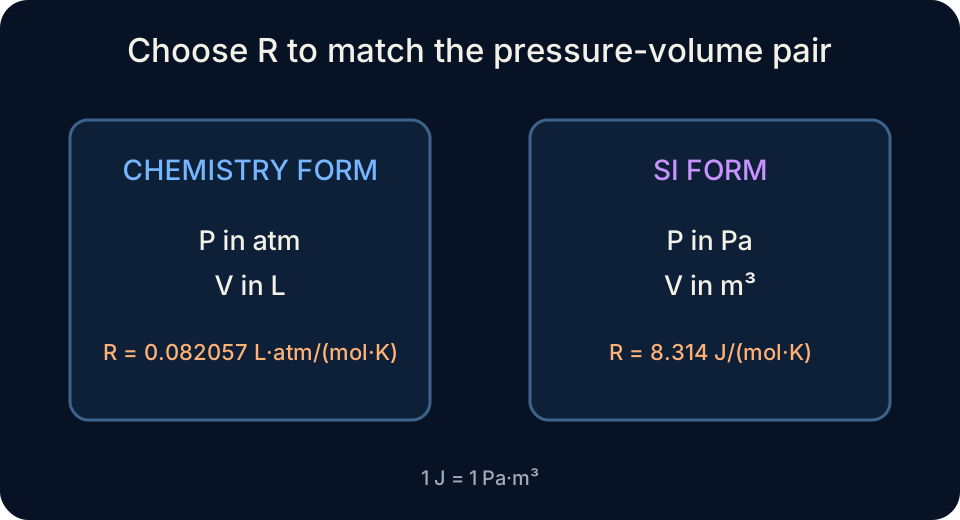
The gas constant has several numerical forms because pressure and volume can be expressed in different units. A common chemistry value is . The SI value is , and . Another convenient form is . Choose the form whose pressure and volume units match the data.
Units in must cancel consistently. Using liter-atmosphere with pressure in kilopascals without conversion mixes incompatible scales. Temperature must be kelvins because it is an absolute proportional variable. Amount must be moles for the listed molar constants. Dimensional substitution should be written before numerical cancellation.
Suppose , , and . With liter-atmosphere , . Moles, kelvins, and liters cancel, leaving atmospheres. The magnitude is sensible because half a mole near room temperature occupies roughly twelve liters near one atmosphere. This estimate independently supports the calculator result.
Solve for each variable with meaning
Solving for pressure gives . Pressure increases with amount and temperature but decreases with volume. The particle model supports these directions through collision frequency and momentum transfer. Doubling particle amount at fixed volume and temperature doubles collision frequency and pressure. Doubling volume at fixed amount and temperature halves collision frequency per wall area and pressure.
Solving for volume gives . Volume increases with amount and absolute temperature and decreases with external equilibrium pressure. A flexible balloon can expand until internal and external pressures balance, making this form useful under a controlled pressure. A rigid tank does not adjust volume, so temperature or amount changes appear as pressure changes instead. Apparatus constraints decide which variable responds.
Solving for amount gives , and solving for temperature gives . The amount form connects measurable gas state variables with moles for stoichiometry. The temperature form produces kelvins and should not be converted to Celsius until after calculation if Celsius is requested. Each rearrangement can be reconstructed algebraically. Unit cancellation verifies the desired variable remains.
Use absolute pressure and absolute temperature
Absolute pressure is measured relative to vacuum, while gauge pressure is measured relative to atmospheric pressure. The ideal gas law requires absolute pressure. If a tire gauge reads while atmospheric pressure is , absolute pressure is approximately . Substituting gauge pressure would underestimate the gas state pressure. The reference zero must be identified from the instrument description.
Temperature must use kelvins through . A gas at is . Celsius ratios fail because Celsius zero is not zero thermal energy. Heating from to does not double absolute temperature. A proportional equation requires the absolute scale.
Pressure conversions must also be explicit. under common definitions. A conversion factor is oriented so the starting unit cancels. Defined conversion factors usually do not limit significant figures. Measured pressure precision does.
Derive gas density and molar mass
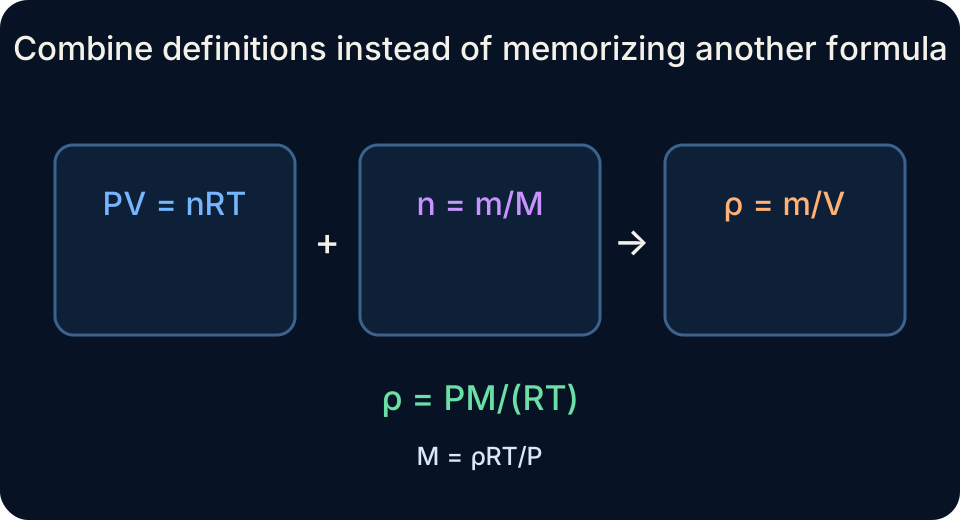
Gas density is , where is mass and is volume. Amount relates to mass by , where is molar mass. Substituting into gives . Dividing by volume and rearranging yields . Gas density increases with pressure and molar mass and decreases with temperature.
Solving the same relationship for molar mass gives . This form can identify an unknown gas from measured density, temperature, and pressure. Units must be chosen so the result is or another intended mass-per-mole unit. If density is in , liter-atmosphere is convenient with pressure in atmospheres. A unit mismatch can change the result by orders of magnitude.
At and , oxygen with has ideal density . Atmospheres, moles, and kelvins cancel. The result is plausible for a gas near ambient conditions. Greater molar mass would raise density under the same state. Higher temperature would lower density by expanding the ideal gas at fixed pressure.
Connect gas states with stoichiometry
Gas stoichiometry uses to convert a measured gas state to moles. Balanced coefficients then relate those moles to reactants or products. Volume ratios equal coefficient ratios only when gases are compared at the same temperature and pressure under ideal behavior. If conditions differ, each volume must first be converted to moles. The mole remains the central reaction quantity.
Suppose oxygen is collected at and . Amount is . Pressure and volume units cancel those in , while kelvins cancel. This amount can enter a balanced-equation ratio. Reporting liters directly as a stoichiometric amount would ignore state dependence.
Gas collected over water contains water vapor in addition to the target gas. Dalton’s law gives . Subtract water vapor pressure at the collection temperature before using the target-gas pressure. Failing to subtract it overestimates target gas moles. The measurement method determines the correction.
Analyze mixtures with partial pressures
For an ideal gas mixture, each component obeys in the common volume and temperature. Total pressure is . Mole fraction is , and partial pressure is . The summation sign means add every component pressure. Mole fractions sum to one.
Partial pressure is the pressure a component would exert alone at the mixture’s volume and temperature under ideal behavior. It is not a separate physical layer of pressure in the container. All particles collide with walls, and their independent ideal contributions add. A component with twice the mole fraction contributes twice the partial pressure. Chemical identity influences ideal pressure only through particle count at fixed temperature and volume.
If a mixture contains nitrogen and oxygen at total pressure , nitrogen mole fraction is and its partial pressure is . Oxygen mole fraction is and its partial pressure is . Partial pressures sum to total pressure. The calculation uses mole ratios rather than mass fractions. Both components share the mixture temperature and volume.
Understand microscopic meaning
Kinetic theory connects pressure with molecular motion. For an ideal gas, , where is particle count and is Boltzmann’s constant. Since and , this microscopic form is equivalent to . The molar and particle descriptions differ only in counting scale. Both connect collisions with state variables.
Average translational kinetic energy per particle is . It depends on temperature but not molecular mass. At the same temperature, lighter molecules move faster on average than heavier molecules while having the same average translational kinetic energy. Speed distributions are broad rather than assigning one speed to every particle. Temperature summarizes an average energy population.
Pressure emerges from momentum transfer during wall collisions. Increasing temperature raises typical particle speeds and collision impulse. Increasing amount raises collision frequency. Decreasing volume shortens travel distances and raises collision frequency per area. The macroscopic proportionalities in follow these microscopic trends.
Predict departures from ideal behavior
Real molecules occupy finite volume, so available free volume is smaller than container volume at high density. Attractive intermolecular forces reduce wall-collision momentum transfer and can lower pressure relative to ideal prediction under some conditions. Repulsive effects become important at very short separations. Deviations grow at high pressure because molecules are crowded. Low temperature strengthens the relative importance of attractions because kinetic energy is smaller.
The compressibility factor measures deviation. An ideal gas has . Values below one often indicate attractive effects dominate, while values above one often indicate repulsive and excluded-volume effects dominate. depends on gas identity, pressure, and temperature. It provides a quantitative model check rather than a simple ideal-or-not label.
Near condensation, the ideal model becomes poor because intermolecular forces drive phase change. Polar gases and easily polarizable large molecules can deviate more strongly than small weakly interacting gases. Raising temperature and lowering pressure generally improve ideal behavior. The correct response to nonideality is to use a better equation of state or data, not to force ideal calculations into every regime. A model-domain statement should accompany any high-pressure prediction.
Diagnose common ideal-gas errors
The first error is using Celsius instead of kelvins. The second is using gauge pressure rather than absolute pressure. The third is mixing a gas constant with incompatible pressure-volume units. Writing converted values and units before substitution prevents these errors. A state-variable table provides a compact pre-calculation audit.
Another error is treating per mole as universal. That approximate molar volume applies only near specified standard temperature and pressure under ideal behavior. At room temperature or different pressure, molar volume changes according to . The full ideal law is safer when conditions are provided. “Standard conditions” must be defined because conventions can differ.
A final error is using the ideal law without assessing phase or density. A high-pressure gas near its condensation temperature may deviate substantially. A calculated negative amount or implausible density signals algebra or unit failure, not exotic chemistry. State variables, model domain, units, and magnitude all require checking. The equation is powerful because its assumptions are clear.
Practice the complete state analysis
First, find pressure for gas in at . Using , . Moles, liters, and kelvins cancel correctly. The value is absolute pressure. The result is plausible because a quarter mole at room temperature occupies about six liters near one atmosphere.
Second, find moles in at and . Use . Then . Kilopascals, liters, and kelvins cancel. The moles can now enter a reaction coefficient ratio.
Third, evaluate ideality for a gas at very high pressure just above its boiling temperature. Molecules are crowded, finite volume matters, and attractions are significant near condensation. The ideal law may provide only a rough estimate. A compressibility factor or real-gas equation should be consulted. Stating this limitation is part of solving the physical problem rather than refusing to calculate.