
Begin with a particle model of gas pressure
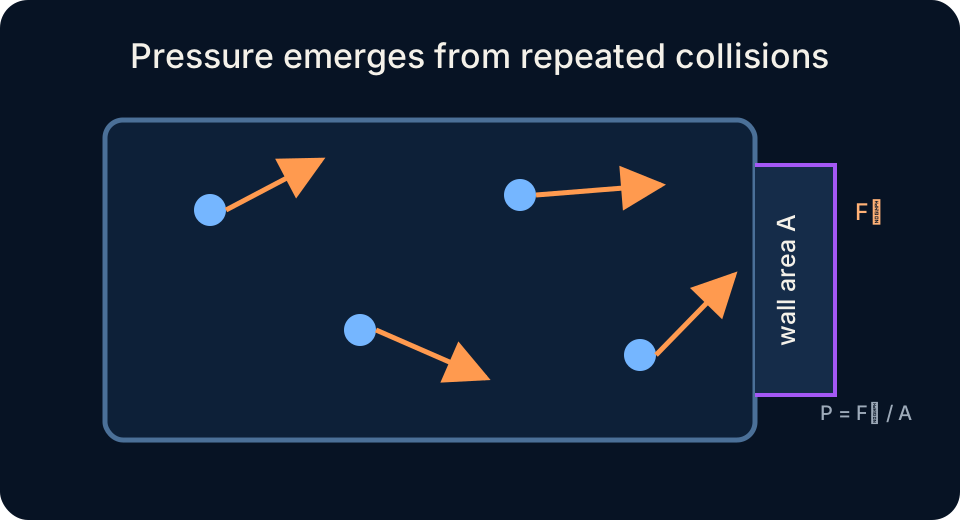
A gas fills its container because its particles move continually and spread through the available space. When those particles collide with a wall, their momentum changes and the wall experiences an equal and opposite impulse. The enormous number of microscopic collisions produces a stable macroscopic force when averaged over time. Pressure is defined as force per area, , where is the force component perpendicular to the surface and is the surface area. This particle-to-system connection explains why changing particle speed, container size, or particle count can change pressure.
The SI pressure unit is the pascal, with . The symbol represents pressure, represents volume, represents absolute temperature, and represents amount of gas in moles. Useful conversions include . These equalities are conversion relationships, so a unit factor must be oriented to cancel the starting unit and leave the desired unit. Carrying units through every step is essential because several gas-law forms accept different pressure or volume units only when the same unit is used consistently on both sides.
The classical gas laws are controlled-variable models rather than unrelated formulas. Each law examines how two state variables change while specified remaining variables are held fixed. Before choosing an equation, identify the gas sample, its initial and final states, and which quantities remain constant throughout the process. Then predict the direction of change from the particle model before substituting values. By the end, you should be able to interpret pressure microscopically, use absolute temperature, apply Boyle’s, Charles’s, Gay-Lussac’s, and Avogadro’s relationships, and justify a combined-gas-law calculation.
Treat temperature as an absolute energy scale
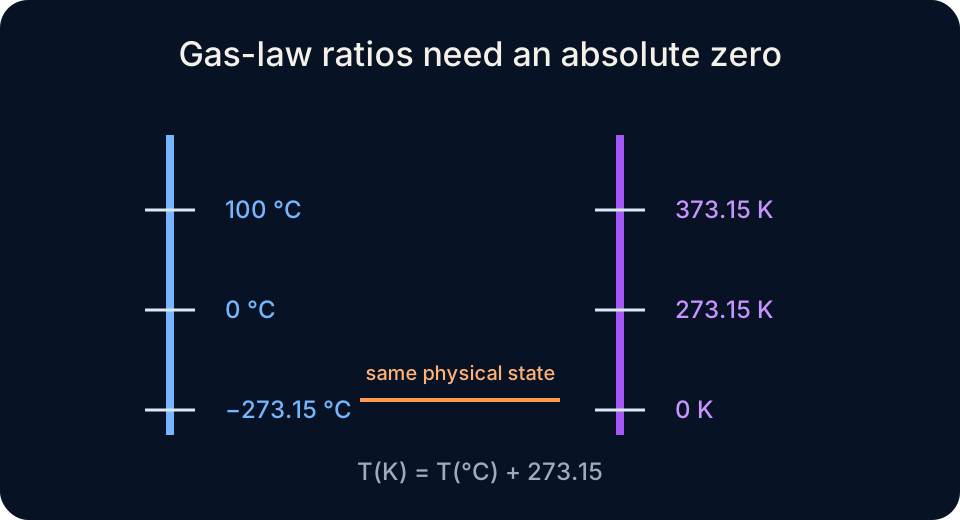
Gas-law temperature must be expressed in kelvins because proportional relationships require a scale whose zero corresponds to the physical extrapolation of vanishing thermal motion in the idealized model. Celsius zero is an arbitrary reference tied to water’s freezing point rather than the absence of thermal energy. The conversion is , where the subscripts identify the temperature scale. A temperature of is therefore , not . Kelvin values are written without a degree symbol because kelvin is an absolute SI base unit.
Absolute temperature is proportional to average translational kinetic energy for an ideal gas. The molecular relation is , where is average translational kinetic energy per particle, is the Boltzmann constant, and is absolute temperature. Doubling kelvin temperature doubles this average energy, while doubling a Celsius number does not generally describe a doubling of energy. Faster particles strike walls more frequently and transfer more momentum per collision when volume and amount remain fixed. This microscopic reasoning predicts that pressure rises with absolute temperature in a rigid container.
Temperature ratios make the Celsius error especially visible. Heating a gas from to does not double its absolute temperature because the kelvin values change from to . The ratio is approximately , so a directly proportional gas variable changes by about , not . A quick magnitude estimate therefore exposes an invalid Celsius substitution before detailed calculation. Whenever temperature appears in multiplication, division, or proportionality, convert to kelvins first.
Use Boyle’s law for isothermal volume changes
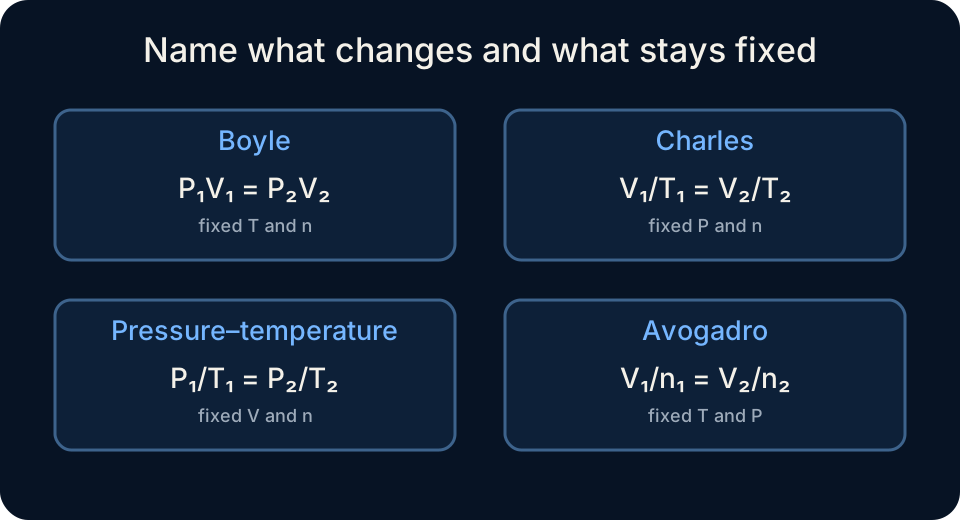
Boyle’s law applies to a fixed amount of gas at constant temperature. Its proportional statement is , meaning pressure varies inversely with volume. Multiplying by volume gives for the modeled process, and comparing two states gives . The subscripts one and two label initial and final states rather than powers. The equation is valid only when the same gas amount remains enclosed and temperature is effectively unchanged.
The particle model explains the inverse relationship. Compressing a gas into a smaller volume shortens the average distance particles travel between wall collisions. At unchanged temperature, average particle kinetic energy and collision impulse remain comparable, but collisions with each unit area occur more frequently. Pressure therefore increases as volume decreases. Doubling volume at fixed temperature and amount halves pressure, while reducing volume to one third raises pressure by a factor of three.
Consider of gas at compressed isothermally to . Solving for final pressure gives . Substitution yields . Liters cancel, atmospheres remain, and the pressure increase agrees with the compression prediction. The word isothermally is not background description; it supplies the constant-temperature condition that authorizes Boyle’s law.
Use direct-proportion laws with their controls
Charles’s law describes volume and absolute temperature for a fixed amount of gas at constant pressure. Its statement is , which becomes and . Heating makes particles move faster, so an adjustable boundary must move outward to keep the collision rate per area and pressure unchanged. Cooling produces the opposite response as long as the gas remains in the same phase and behaves approximately ideally. The model fails near condensation because intermolecular attractions and phase change become important.
Gay-Lussac’s pressure-temperature law applies to a fixed amount in a rigid container. Because volume cannot change, the relationship is , or . Heating raises molecular kinetic energy and strengthens and increases wall collisions, so pressure increases. This relationship explains why sealed pressurized containers must be protected from excessive heating. It does not apply to an open container that can exchange gas with its surroundings because amount would not remain fixed.
Avogadro’s law relates volume and amount at fixed temperature and pressure. It states , or , where is amount in moles. Adding gas particles would increase collision frequency if the volume stayed fixed, so a movable boundary expands until pressure returns to the controlled value. Doubling the mole amount therefore doubles volume under the stated conditions. Formula coefficients and gas moles can connect this law to reaction stoichiometry, but only when temperature and pressure conditions are known.
Combine state changes without losing the conditions
For a fixed amount of ideal gas, pressure, volume, and temperature changes can be combined as . This expression follows from the ideal-gas equation because and the gas constant are unchanged between states. The fraction bar groups each pressure-volume product over its absolute temperature. Any consistent pressure unit may be used on both sides, and any consistent volume unit may be used on both sides, because matching units cancel during rearrangement. Temperature must still be in kelvins because it appears in a physical proportionality.
Suppose a gas occupies at and , then reaches and . Solving for final volume gives . Substitution gives . Atmospheres and kelvins cancel, leaving liters, while competing effects explain the modest decrease. Heating tends to expand the gas, but the larger final pressure tends to compress it.
The combined law should not be used when gas amount changes. A leaking container, a reaction that produces gas, or a syringe that draws in outside air violates the fixed- derivation. In those situations, the ideal gas law or a stoichiometric model must explicitly include the changing amount. The equation also assumes equilibrium states, so it does not describe every transient pressure difference during a rapid process. Naming the system boundary and controlled quantities is therefore part of solving the problem rather than an optional preface.
Read gas-law graphs as evidence
A pressure-versus-volume graph for an isothermal gas is a decreasing hyperbola because for positive constant . Equal increases in volume do not produce equal decreases in pressure, so connecting endpoints with a straight line would misrepresent the law. Plotting pressure against reciprocal volume, , instead produces a straight line through the origin with slope . This transformed graph allows experimental data to test inverse proportionality. Axis labels must include both variable and unit so the slope has an interpretable physical dimension.
A volume-versus-kelvin-temperature graph at constant pressure should be linear in the idealized range. Its extrapolated intercept approaches zero volume near absolute zero, although real gases condense before reaching that point and prevent the extrapolation from being physically followed all the way. A volume-versus-Celsius-temperature graph is also linear but does not pass through the origin because Celsius zero is offset. Comparing those graphs makes the need for an absolute scale visible. An extrapolated model should always be distinguished from a directly observed state.
Experimental scatter does not automatically disprove a gas law. Measurement uncertainty, temperature equilibration time, friction in a syringe, small leaks, and nonideal behavior can all move points away from the ideal curve. Repeated measurements help reveal random variability, while systematic offsets require calibration and procedural analysis. A best-fit relationship should be evaluated against residual patterns rather than judged only by how smooth the drawn line appears. Gas laws are models supported within domains, not declarations that every measurement must land exactly on a mathematical curve.
Diagnose errors with predictions and dimensions
Using Celsius in a ratio is the most damaging routine error because it changes the physical zero of the scale. Another error is rearranging symbols before identifying which state each value belongs to, leading to swapped initial and final quantities. Students also sometimes mix pressure units across the two sides, such as atmospheres on one side and kilopascals on the other, without conversion. Writing a state table with rows for , , , and organizes the information before algebra begins. A directional prediction then checks whether the calculated response matches the modeled change.
The phrase “constant” must be treated as a physical condition, not ignored as prose. Boyle’s law cannot be used merely because pressure and volume appear in a problem if temperature or amount also changes. Charles’s law cannot be used in a rigid container because constant pressure would not be maintained. The combined gas law cannot repair a changing gas amount because its derivation cancels between states. Choosing a law means matching all its controls to the described process.
Significant figures and units communicate measurement quality. A conversion factor such as is defined precisely enough that it usually does not limit significant figures, while measured pressures and volumes do. Absolute temperatures calculated from Celsius measurements retain the measurement’s decimal-place uncertainty after adding . A final answer should name the gas variable and state, not present an isolated number such as “2.50.” Combining a sensible magnitude, correct unit, and physical explanation creates a stronger validation than calculator agreement alone. These reporting habits make the solution independently interpretable.
Apply the model to devices and safety
A bicycle pump demonstrates compression, heating, and pressure change in one familiar system. Pushing the handle reduces gas volume, and rapid compression can also raise temperature because energy is transferred to the gas by work. Boyle’s law alone describes only the limiting case in which temperature remains constant, so a quickly operated pump may deviate from that prediction. After waiting, thermal energy moves to the surroundings and the gas approaches room temperature, making an isothermal comparison more reasonable. The example shows why the speed and thermal boundary of a process affect which model applies.
Pressure vessels require safety margins because temperature changes can raise pressure even when no additional gas is added. In a sealed rigid cylinder, remains approximately constant for an ideal gas, so heating from sunlight or fire increases internal pressure. Relief devices are engineered to prevent pressure from exceeding structural limits, but they do not make careless heating safe. Aerosol cans and compressed-gas cylinders therefore carry temperature and handling restrictions grounded in gas behavior. Connecting equations to these mechanisms turns a warning into an understandable physical constraint.
Atmospheric pressure also explains why suction devices operate through pressure differences rather than an attractive “pull.” A drinking straw lowers pressure inside the tube, and the greater atmospheric pressure on the liquid surface pushes liquid upward. A syringe plunger similarly changes enclosed volume and pressure, allowing external pressure or a connected fluid to drive motion. The maximum lift is limited because atmospheric pressure can support only a finite column weight. These applications reinforce that pressure acts through forces on surfaces and that gas-law state changes create the differences responsible for motion. Describing both sides of the pressure difference replaces vague suction language with a testable mechanism.
Practice by explaining each controlled process
First, an isothermal gas expands from to while its initial pressure is . Boyle’s law gives . The volume doubles, so the pressure halves, matching inverse proportionality. Liters cancel and atmosphere remains as the pressure unit. This conclusion depends on constant temperature and fixed gas amount.
Second, a flexible balloon occupies at and is heated to at approximately constant external pressure. Charles’s law gives . Kelvin units cancel within the ratio and liters remain. The ten-percent absolute-temperature increase produces a ten-percent volume increase. If the balloon were rigid, the pressure-temperature law would be the appropriate model instead.
Third, a sealed rigid vessel has pressure at and warms to . The absolute temperatures are and , so . The result is an eleven-percent increase rather than the much larger change a Celsius ratio would predict. Kilopascals remain because the temperature units cancel. The solution is complete when it states that fixed amount and rigid volume permit the pressure-temperature relationship.