
Dimensional analysis is a method for carrying meaning through a calculation. Instead of treating a number as detached from its measurement, the method treats each unit as an algebraic factor that must transform correctly. A conversion factor then becomes a statement of equality written as a fraction equal to one. Multiplying by that fraction changes the unit representation without changing the physical amount. This idea supports nearly every quantitative topic in chemistry, from density and molar mass to gas laws and reaction stoichiometry.
You will learn to build and orient conversion factors, chain several factors, handle squared and cubed units, distinguish exact definitions from measured quantities, and use dimensions to diagnose equations. You will also see why temperature conversions require special care. Every example will retain units on numerical values and will write compound units with horizontal fraction bars. The goal is not to imitate a cancellation pattern, but to plan a route between meanings. By the end, you should be able to explain why every factor is present and what relationship authorizes it.
Begin a problem by writing the given quantity and the requested unit before reaching for a calculator. Build a path in which each unwanted unit appears once in a numerator and once in a denominator. Cancel only identical units, never merely similar words. Evaluate the numbers after the unit path is complete, and then apply appropriate significant figures. A correct numerical answer with an impossible unit is not a correct scientific answer.
A measured quantity is a number multiplied by a unit
A physical quantity can be represented schematically as , where is the quantity, is its numerical value, and denotes the chosen unit. A length of contains both the number and the unit meter. Changing to centimeters changes the numerical value to while describing the same length. The quantity remains fixed even though its representation changes. Units are therefore part of the mathematics, not labels added after calculation.
Dimensions describe broad physical kinds such as length, mass, time, temperature, and amount of substance. Units are particular standards used to express those dimensions, such as meters for length, kilograms for mass, seconds for time, kelvins for temperature, and moles for amount. Centimeters and miles are different units of the same length dimension. Kilograms and moles, however, represent different dimensions and cannot convert directly without a substance-specific relation. This distinction explains why some unit cancellations are universal and others require chemical information.
Compound dimensions arise by multiplication or division. Speed has length divided by time, density has mass divided by volume, and molar mass has mass divided by amount of substance. The expression should be read “grams per milliliter,” where the horizontal bar indicates division. If an equation adds two terms, those terms must have compatible dimensions. If it sets two expressions equal, both sides must represent the same dimension.
Conversion factors are multiplicative identities
An equality such as produces two ratios: and . Each ratio equals one because its numerator and denominator describe the same volume. Multiplying a quantity by either ratio therefore preserves the physical quantity. The two orientations are mathematically reciprocal but operationally different. Choose the orientation that places the unwanted unit opposite its location in the given quantity.
To convert to liters, write . Milliliters appear in the original numerator and the factor denominator, so they cancel. The remaining unit is liters, and the numerical calculation gives . The factor did not approximate the volume or change it physically. It changed the language used to report that volume.
Orientation should be decided from units before numbers are multiplied. If the reciprocal factor were used, milliliters would appear twice rather than cancel, producing . That compound unit is not the requested liter and exposes the mistake before a calculator is involved. Unit cancellation is therefore a built-in logic check. A memorized instruction such as “move the decimal three places” lacks this protection and becomes unreliable in multistep work.
Chain factors as a planned route
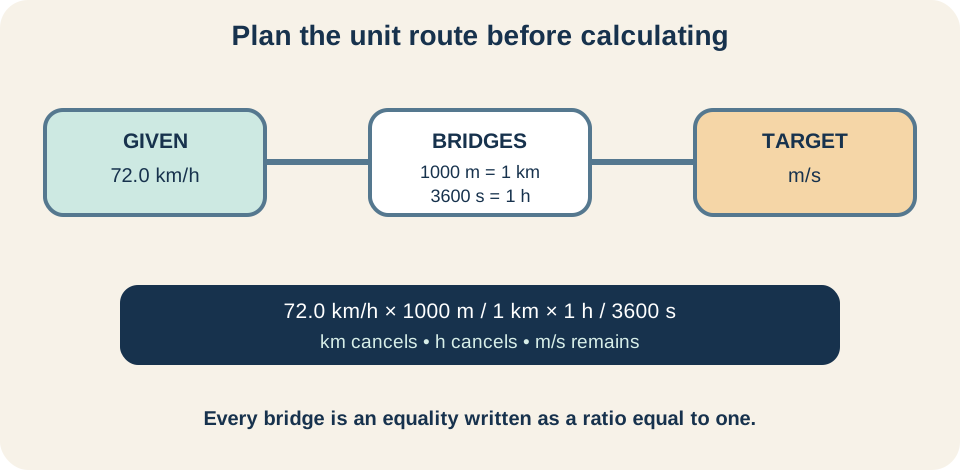
Many problems require more than one relation. Convert to meters per second by building a factor for length and another for time. One valid chain is . Kilometers cancel between a numerator and denominator, and hours cancel between a denominator and numerator. The remaining unit is , exactly as requested.
Numerically, the expression becomes . The complete result is , reported with three significant figures because the measured starting value has three and the definitions are exact. Notice that the hour-to-second factor is oriented with hours in the numerator because hours began in a denominator. Canceling a denominator unit requires placing that unit in a conversion-factor numerator. The unit route determines the orientation mechanically.
Long chains are easiest to design backward from the target. Write the target unit, ask which known relationship can produce it, then identify what unit that relationship requires. Continue until the chain reaches the given unit. After planning, write the factors forward and check every cancellation. This backward-planning habit prevents inserting unrelated data merely because it appears in a problem statement.
Exact definitions and significant figures
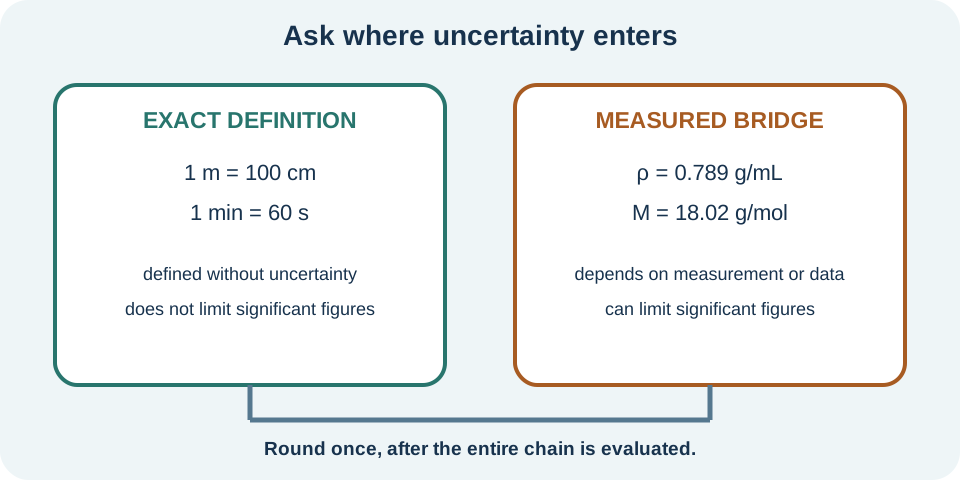
Some conversion factors are exact definitions and do not limit precision. The equality is exact, as is the definition . Counted quantities such as exactly twelve objects are also exact. Measured relationships, including an experimentally determined density, carry uncertainty and do affect significant figures. Distinguishing these categories prevents arbitrary rounding.
Suppose a measured mass of is converted to milligrams. The factor is exact, so the result retains the three significant figures of . Scientific notation, , makes that precision unambiguous. The trailing zero in ordinary notation may otherwise be misread. Unit conversion changes scale but does not invent measurement precision.
Keep guard digits during intermediate calculation and round once at the end. Premature rounding in a chain can shift the final answer, especially when factors are multiplied and divided several times. Significant figures communicate measurement resolution, whereas dimensional analysis communicates unit meaning. Both are necessary, but they solve different problems. A result can have perfect units and still report unjustified precision.
Powered units require powered conversion factors
Area and volume conversions are common sources of large errors because the exponent applies to the unit and its conversion factor. Since , squaring both sides gives . Cubing gives . The exponent acts on both the numerical scale and the unit symbol. A centimeter-scale cube is small in each of three independent directions.
Convert to square meters by writing . Squaring the factor produces , so square centimeters cancel. The result is . Using only would convert one length dimension and leave the area scale wrong by a factor of one hundred. The squared notation is therefore an instruction applied to the entire factor.
The useful volume identity is exact. Combining it with shows that . Therefore . Writing the entire factor with horizontal fraction bars makes the millionfold relationship visible and verifiable. The reciprocal forms describe the same equality from opposite conversion directions.
Density conversions couple mass and volume
Density is defined by , where the Greek letter is read “rho,” denotes mass, and denotes volume. A density unit therefore contains both a numerator and denominator that may need conversion. Convert to kilograms per cubic meter using separate mass and volume factors. Write . The expression keeps both dimensions visible throughout the conversion.
Grams cancel through the mass factor, and milliliters cancel through the volume factor. The remaining unit is . Numerically, . The final density is . The large numerical value is reasonable because one cubic meter contains one million milliliters.
Density can also act as a conversion bridge between mass and volume for a specified material. If ethanol has density , the ratio converts volume to mass, while its reciprocal converts mass to volume. This relationship is measured and depends on temperature, so it is not a universal exact definition. Always attach the substance and conditions to a density value. That context determines whether the chosen bridge applies.
Chemical conversion bridges connect particles, moles, and mass
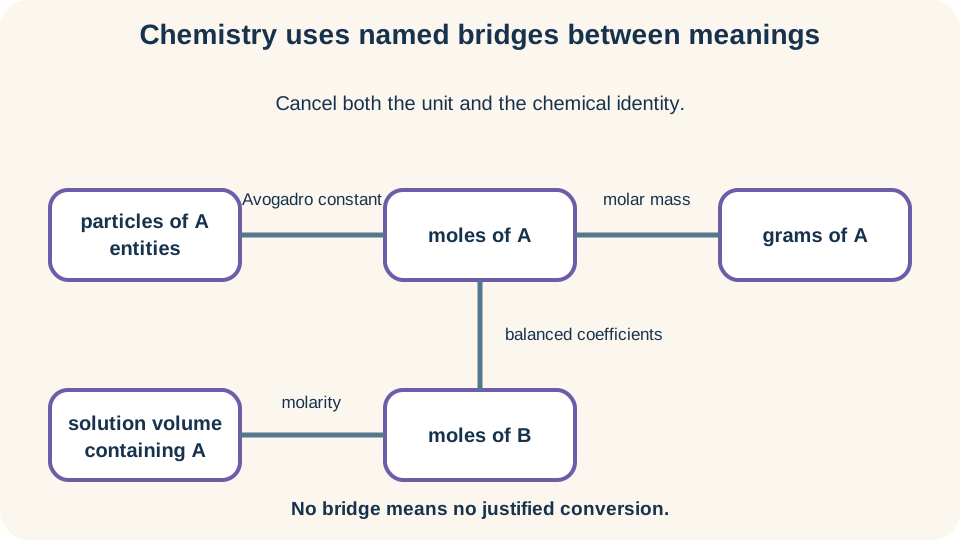
The mole connects microscopic counts to laboratory-scale amount. Avogadro’s constant is exactly , where “entities” must be replaced by atoms, molecules, ions, or formula units as appropriate. Molar mass connects moles to grams for a particular substance. A balanced chemical equation connects moles of one species to moles of another. These three relationships form the backbone of stoichiometric dimensional analysis.
For water, a molar mass near permits the conversion of of water to moles. Write . Both the unit and substance identity cancel together. Treating “grams” without the chemical label could incorrectly apply water’s molar mass to another substance. The formula label functions as part of the dimensional meaning.
To find molecules, continue the chain with Avogadro’s constant. The expression yields molecules of water to three significant figures. Moles cancel, leaving the counted entity. The label “molecules” matters because an ionic solid would instead be counted in formula units. Counting language should match the substance’s particle model.
Temperature conversions are affine, not simple ratios
Celsius and kelvin scales have equal-sized increments but different zero points. The relation is , where is temperature in kelvins and is the numerical Celsius temperature. Because the equation includes addition, it is not represented by a simple multiplicative conversion factor for absolute readings. A temperature of becomes . Kelvin is written without a degree symbol.
Temperature intervals behave differently from temperature readings. A rise of has the same size as a rise of because both scales use equal increments. Thus a change is also a change of , even though the endpoint readings differ by . The Greek capital delta means “change in,” calculated as final minus initial. Always decide whether a formula uses an absolute temperature or a temperature difference.
Gas-law equations require absolute temperature in kelvins because their proportionalities are referenced to absolute zero. Substituting a Celsius reading directly can produce nonsensical ratios or even a zero denominator at . The offset conversion must occur before the gas-law calculation. This exception demonstrates why unit reasoning must include the mathematical structure of the scale. Not every conversion is multiplication by a fraction.
Dimensional consistency diagnoses equations
Dimensions can test whether an equation is structurally possible. In , distance has length dimension, velocity has length divided by time, and time has time. Multiplying gives length, matching the left side. If someone proposed , the terms on the right would have incompatible dimensions and could not be added. No choice of ordinary units can repair that structural error.
In chemistry, the ideal gas law provides another check. Pressure multiplied by volume must match amount multiplied by gas constant and absolute temperature . The units chosen for must be compatible with the pressure and volume units in the data. Using with pressure in pascals would leave uncanceled units. Either convert the data or choose the compatible gas-constant representation.
Dimensional consistency is necessary but not sufficient. The equation is dimensionally consistent, but the numerical factor may be physically unjustified. Units cannot detect an incorrect sign, coefficient, model assumption, or chemical identity when dimensions still match. Use dimensional analysis as one layer of validation alongside chemical reasoning and magnitude checks. A plausible solution should pass all three.
Common mistakes and corrective habits
One common mistake is writing several numbers first and attaching a unit only to the final answer. This removes the cancellation structure that could expose an inverted factor. Write units on every measured value and throughout every line. Another mistake is canceling different units because they represent the same dimension, such as crossing out centimeters against meters directly. They require an explicit equality-based factor before cancellation.
A second mistake is applying a linear factor to a squared or cubed unit. Draw a small cube or square if the exponent is easy to overlook, then raise the entire conversion factor to that power. A third mistake is treating substance labels as optional in chemistry. Moles of oxygen and moles of methane share a unit dimension but are not interchangeable without a balanced-equation ratio. Cancel both unit and identity only when the factor authorizes it.
A final mistake is trusting calculator output without estimating magnitude. Converting kilometers per hour to meters per second should reduce a typical road-speed numeral because . Density conversion from grams per milliliter to kilograms per cubic meter should increase the numeral by . Such estimates do not replace the calculation. They provide an independent alarm when a reciprocal is reversed.
Guided practice
Convert to seconds. Use . Days, hours, and minutes cancel in succession. The result is to three significant figures. Each time definition is exact, so the measured starting value limits precision.
Convert to cubic meters. Write . Liters and milliliters cancel, leaving cubic meters. The result is . Explain why the numeral decreases even though a cubic meter is a larger volume unit.
A sample has mass and density . To find volume, use the reciprocal density factor: . Grams cancel and milliliters remain. The smaller volume is reasonable because the material contains more than one gram in each milliliter. This magnitude check supports the chosen orientation.
Retrieval and connection forward
Close the worked examples and reconstruct the method. State why a conversion factor equals one, explain how unit position determines its orientation, and distinguish an exact definition from a measured bridge. Describe why area factors must be squared and why an absolute Celsius temperature cannot enter a gas law directly. Then write a complete route from molecules of a compound to grams of that compound. If a step cannot be justified by an equality or defined relationship, it does not belong in the route.
Dimensional analysis is best understood as controlled substitution. Each factor replaces one representation with an equivalent representation while preserving the physical quantity. Cancellation displays the logical route, compound units preserve relationships, and significant figures preserve measurement honesty. Dimensional checks can reject impossible equations before numerical work obscures the error. Estimation then tests whether the magnitude agrees with physical intuition.
The next chemistry lessons will use this method repeatedly. Molar mass bridges grams and moles, balanced coefficients bridge reacting species, concentration bridges solution volume and solute amount, and gas laws connect pressure, volume, temperature, and amount. Preserve units at every step rather than treating the method as a chapter that can later be forgotten. The more complex the chemistry becomes, the more valuable the unit ledger becomes. A well-constructed chain is both a calculation and an explanation.