
Chemistry begins by deciding what kind of material is being observed and what evidence supports that classification. A clear liquid may be a pure substance or a homogeneous mixture, and a solid may contain one phase or several microscopic components. Appearance is useful evidence but rarely proves composition by itself. Classification determines which measurements, separation methods, and reaction models are appropriate. This lesson develops a decision framework that connects macroscopic observations with particle-level interpretations.
Learning objectives
By the end of the lesson, you should be able to distinguish matter from energy in an introductory model. You should classify samples as pure substances or mixtures and then refine those categories. You should distinguish elements from compounds and homogeneous from heterogeneous mixtures. You should connect each category with evidence and appropriate separation methods. Every classification should name the observation scale and conditions.
You will distinguish physical properties from chemical properties and physical changes from chemical changes. You will compare intensive and extensive properties and explain why some ratios become intensive. You will separate phase, physical state, and chemical identity. You will also evaluate common signs of reaction without treating them as automatic proof. These distinctions form a vocabulary for later laboratory and theoretical work.
Use a question sequence throughout the lesson. Is the composition fixed, can physical methods separate components, are all sampled regions equivalent, and did chemical identity change? Each answer narrows the classification. A later answer may require revising an earlier provisional label. The process is evidence-driven rather than based on one visual clue.
Matter and the system boundary
Matter is commonly defined as anything that has mass and occupies space. This operational definition works well for ordinary chemistry. A chemical sample contains atoms, molecules, ions, or extended structures. Energy is not classified as matter in this framework, although matter stores and transfers energy. Radiation can interact with matter without becoming a material component in the ordinary composition table.
Before classifying, define the system. A sealed flask containing liquid water and water vapor includes two physical phases of one chemical substance. A beaker plus surrounding air includes additional components. A sample boundary determines which material is counted. Changing that boundary can change whether a description is complete.
Conditions also matter. Temperature and pressure can change physical state or phase count. Humidity can add water to an exposed solid. A gas sample can appear uniform at one scale and reveal gradients at another. Classification statements should therefore include relevant conditions when they affect evidence.
A composition decision tree
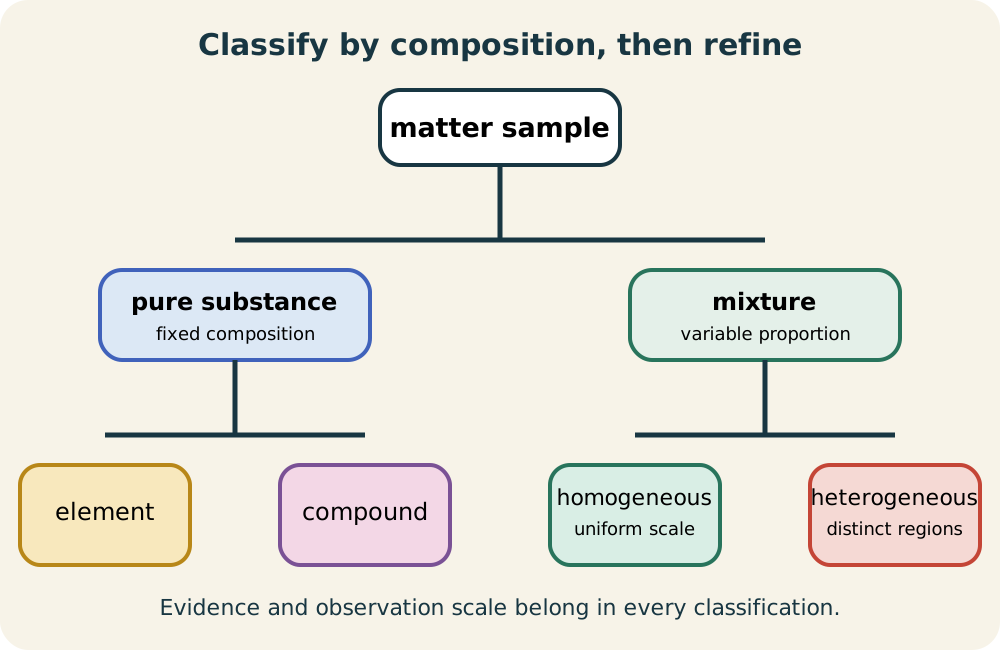
The first branch asks whether the sample has fixed chemical composition. A pure substance has a characteristic composition and set of identities under specified conditions. A mixture contains two or more substances in variable overall proportions. Pure does not mean safe, natural, or free from every detectable trace. It means the sample is modeled as one chemical substance at the intended resolution.
The second branch classifies a pure substance as element or compound. An element contains atoms with one atomic number. A compound contains atoms of two or more elements chemically combined in fixed stoichiometric proportions. Chemical methods can decompose some compounds into simpler substances. Ordinary chemical processes do not convert one element into another.
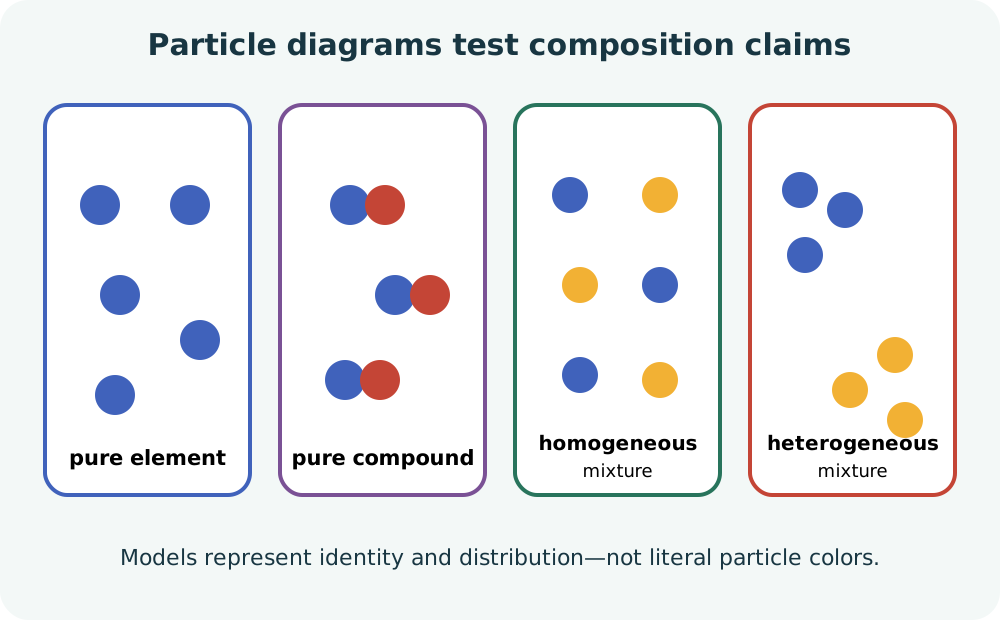
The mixture branch asks whether composition is uniform at the observation scale. A homogeneous mixture appears compositionally uniform across representative samples. A heterogeneous mixture contains distinguishable regions or phases with different compositions or properties. Uniform appearance is evidence, not proof of molecular purity. Better instruments can reveal heterogeneity hidden from the eye.
Elements
An element is defined by proton number. Every carbon atom has six protons, although carbon isotopes can contain different neutron numbers. Neutral atoms and ions of the same element can contain different electron counts. Those variations do not change elemental identity. Atomic number is the decisive criterion.
An elemental sample may contain individual atoms, molecules, or an extended lattice. Helium exists as monatomic particles under ordinary conditions. Oxygen commonly occurs as molecules. Carbon can form diamond, graphite, and other allotropes. One element can therefore have multiple structures and properties.
Allotropes show that element classification does not guarantee one physical form. Diamond and graphite both contain only carbon but have different bonding networks. They differ in hardness, conductivity, and appearance. Chemical identity at the elemental level is shared, while structural identity differs. Classification operates at more than one layer.
Compounds
A compound contains elements chemically combined in fixed ratios represented by a formula. Water is represented as , meaning two hydrogen atoms per oxygen atom in each molecule. Sodium chloride is represented as , expressing a one-to-one formula-unit ratio in an ionic lattice. The formula communicates composition rather than necessarily a discrete molecule. Structural model matters.
Compound properties can differ dramatically from those of constituent elements. Sodium metal is reactive, chlorine is a toxic gas, and sodium chloride is a crystalline solid with different behavior. The compound is not a physical blend of visible sodium and chlorine. Chemical bonding creates a new electron distribution and structure. Identity depends on that combined arrangement.
Compounds require chemical changes for decomposition into different substances. Electrolysis can decompose water into hydrogen and oxygen under suitable conditions. Heating can decompose some compounds. Filtration cannot separate a compound into its elements because the components are not merely intermingled particles. Separation method is therefore evidence about composition type.
Mixtures
A mixture contains substances together without one fixed overall composition. Salt water can contain different salt concentrations while remaining salt water. Air composition varies with humidity, altitude, and pollutants. Brass can contain different proportions of copper and zinc. Variable proportion distinguishes mixtures from stoichiometric compounds.
Each mixture component retains chemical identity even though interactions can alter properties. Dissolved sodium and chloride exist as solvated ions rather than intact crystal units, yet they remain chemically identifiable components. Ethanol and water molecules remain distinct in a solution. Component interactions can change boiling behavior or volume. Retained identity does not imply complete independence.
Mixtures can often be separated by physical methods that exploit property differences. Distillation uses volatility, filtration uses particle size and phase, chromatography uses differential interactions, and magnetism can separate magnetic components. Separation does not require converting components into new substances. More than one step may be required for a complex sample. Choosing a method requires knowing which property contrast exists.
Homogeneous mixtures
A homogeneous mixture has uniform macroscopic composition across representative regions. Solutions are common examples. Salt water, clean air, and many alloys can be modeled as homogeneous at ordinary scales. A small sample from one region has the same bulk composition as a sample from another. This does not mean every microscopic point contains identical particles.
Homogeneity depends on scale and equilibration. Milk looks uniform to the unaided eye but contains dispersed droplets and colloidal structures. Fog can appear like a uniform cloud from far away while containing droplets suspended in gas. A polished alloy can reveal multiple phases under microscopy. State the observation scale when classification is borderline.
A homogeneous mixture has one macroscopic phase under the conditions considered. Its composition can still vary between prepared samples. A sugar solution at ten percent and one at twenty percent are both homogeneous mixtures. Uniformity within one sample does not imply fixed composition across all samples. This distinction separates solutions from pure compounds.
Heterogeneous mixtures
A heterogeneous mixture has nonuniform composition or multiple distinguishable regions. Granite contains mineral grains with different appearances and compositions. Oil and water form separate liquid regions under ordinary conditions. Soil contains varied particles, organic material, water, and air. Sampling location can change measured composition.
Heterogeneity can be visible or instrument-dependent. Suspensions may settle over time. Colloids can scatter light even when individual particles are too small to see. Microscopy or centrifugation can reveal structure. Classification should track the best relevant evidence rather than naked-eye appearance alone.
Some heterogeneous systems are dynamic. An emulsion may remain dispersed for a long time because stabilizers slow separation. Shaking can temporarily redistribute phases. A uniform-looking moment does not necessarily establish thermodynamic homogeneity. Preparation history and time scale can matter.
Physical properties
A physical property can be observed or measured without changing the sample’s chemical identity. Examples include mass, volume, density, color, electrical conductivity, melting point, and boiling point. Measuring a property may still disturb the sample physically. Melting-point measurement changes phase. The chemical entities remain the same under an ideal physical change.
Physical properties depend on conditions. Density changes with temperature and pressure. Boiling point depends on external pressure. Conductivity can depend on phase, purity, and direction in a crystal. A property value without conditions can be incomplete.
Some physical properties help identify substances. A measured melting range, density, spectrum, or refractive index can be compared with reference data. No single property always proves identity. Multiple independent measurements provide stronger evidence. Purity assessment is therefore an inferential process.
Chemical properties
A chemical property describes the ability to undergo a change in chemical identity. Flammability, acidity, corrosion tendency, and reactivity with oxygen are examples. Observing such a property generally requires a reaction. The resulting substances differ chemically from the starting material. The property describes behavior under specified conditions.
Chemical properties are not labels detached from reaction partners. “Reactive” is incomplete without saying toward what and under which conditions. Nitrogen gas is relatively unreactive under many ordinary conditions but reacts under high-energy or catalytic conditions. Sodium reacts strongly with water. Context belongs in the property statement.
Chemical and physical properties can be related. Bonding and structure influence both melting point and reactivity. Conductivity may change during a chemical transformation. The classification depends on whether identity changes during observation. It does not imply that physical and chemical behavior have unrelated causes.
Physical changes
A physical change alters form, state, size, or arrangement without changing chemical identity. Melting ice changes solid water to liquid water. Cutting copper changes shape and size. Dissolving sugar in water disperses sugar molecules without necessarily converting them into new substances. The original identities can often be recovered physically.
Reversibility is not the definition. Breaking glass is difficult to reverse but remains physical. Dissolving can be reversible or practically difficult depending on the system. Some chemical changes are reversible under suitable conditions. Identity change is the decisive criterion.
Phase changes involve energy transfer. Melting requires energy even though molecular identity remains constant. Condensation releases energy to surroundings. Physical does not mean energetically unimportant. It means the chemical species are preserved in the model.
Chemical changes
A chemical change produces different substances through rearrangement of atoms and bonding. Rusting converts iron and environmental reactants into iron-containing products. Combustion forms new oxidized substances. Acid-base reactions redistribute protons and electron density. Chemical equations represent these identity changes.
Atoms are conserved in ordinary chemical reactions even though compounds change. Nuclear identities normally remain unchanged. Bonds break and form, and electrons redistribute. Total charge is conserved. Balanced equations record these constraints.
Chemical change can occur without dramatic visual evidence. A clear solution can react to form another clear solution. Conversely, a dramatic physical change can occur without reaction. Boiling produces bubbles but not a new chemical identity. Evidence must be interpreted rather than counted mechanically.
Evidence for chemical change
Color change, gas formation, precipitate formation, odor change, and temperature change can suggest reaction. Each observation has physical alternatives. Gas bubbles can come from boiling or dissolved gas release. Color can change through dilution, phase, or lighting. Temperature can change through mixing or phase transition.
A precipitate is a solid that forms from solution. Its appearance can support formation of a new low-solubility substance. However, suspended contamination or crystallization of an existing solute can resemble precipitation. Further analysis strengthens the claim. Chemical identity is the ultimate question.
Strong evidence can include spectroscopy, chromatography, mass changes in controlled systems, characteristic product tests, or reproducible stoichiometry. No single classroom indicator is universally decisive. Evidence should be combined with a plausible particle-level model. Repeated measurements help separate signal from observation error. A conclusion is strongest when observations rule out competing physical explanations.
Intensive properties
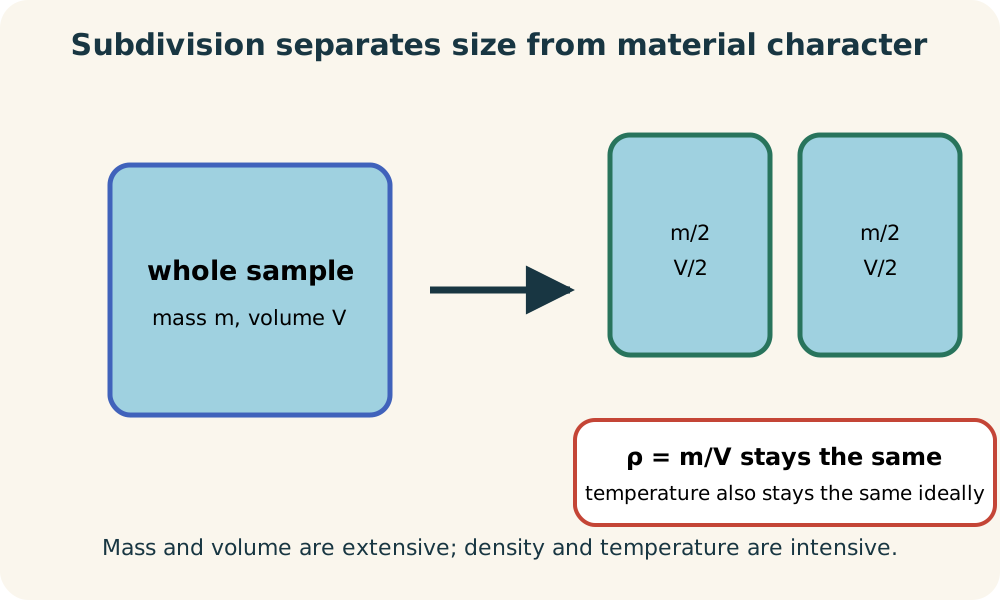
An intensive property does not scale directly with sample amount under fixed conditions. Temperature, density, pressure, and characteristic composition are common examples. Dividing a homogeneous sample into equal portions does not halve its temperature. Each portion ideally retains the same density. Intensive properties can help identify materials.
Density is . The Greek letter , pronounced rho, denotes density. Mass may be in grams or kilograms, and volume in cubic centimeters or cubic meters. Consistent units produce density such as grams per cubic centimeter or kilograms per cubic meter. The horizontal fraction bar expresses mass divided by volume.
Density is intensive because mass and volume both scale with sample size for a homogeneous material. Doubling the sample doubles numerator and denominator, leaving the ratio unchanged. This conclusion assumes fixed temperature, pressure, composition, and phase. Mixing or compression can change density. “Intensive” always carries relevant condition control.
Extensive properties
An extensive property scales with the amount of material. Mass, volume, total energy, and number of moles are common examples. Combining two identical samples doubles mass and volume. It also approximately doubles internal energy under matched conditions. Extensive properties describe system size as well as material.
Ratios of extensive quantities can be intensive. Density is mass divided by volume. Molar mass is mass divided by amount of substance. Concentration can be amount of solute divided by solution volume. The numerator and denominator scale together in an ideal subdivision.
Not every ratio is automatically intensive. The scaling behavior of both quantities must be analyzed. Surface-area-to-volume ratio changes with object size because area and volume scale with different powers of length. Total pressure is not obtained by simply dividing unrelated extensive variables. Definitions and scaling decide the classification.
State, phase, and identity
Physical state commonly refers to solid, liquid, gas, or plasma. A phase is a region with uniform physical and chemical properties separated from other regions by boundaries. One chemical substance can occupy multiple phases simultaneously. Ice and liquid water in equilibrium form two phases of one substance. State and identity are different categories.
A homogeneous solution is usually one phase containing multiple substances. Oil and water form two liquid phases. A solid alloy may contain several solid phases. Counting state labels alone therefore does not count substances or phases. The classification questions must remain separate.
Phase diagrams show which phases are stable under temperature and pressure conditions. Crossing a phase boundary changes physical organization. It need not change chemical formula. Some solids also have multiple crystal phases with the same composition. Matter classification must accommodate structural variety.
Separation methods as tests of properties
Filtration separates a solid from a fluid when particle size and phase permit. It does not remove dissolved ions from true solution because they pass with the solvent at molecular scale. Decanting exploits settling or immiscible phases. Centrifugation accelerates separation by density and particle response. Each method targets a physical difference.
Distillation exploits differences in volatility and vapor-liquid behavior. Simple distillation can separate a volatile solvent from a nonvolatile solute. Fractional distillation improves separation of liquids with closer boiling behavior. Boiling point alone does not guarantee perfect one-step purity. Vapor-liquid equilibrium and apparatus efficiency matter.
Chromatography exploits different distributions between mobile and stationary phases. Components travel at different rates because of differing interactions. Magnetism, sublimation, extraction, and crystallization provide other tools. A separation plan should name the property contrast. Randomly choosing a method without a mechanism is not chemical reasoning.
Worked classification: salt water
Suppose sodium chloride dissolves in water. The resulting clear sample is a homogeneous mixture at ordinary macroscopic scale. Its composition can vary, so it is not a compound. Sodium chloride and water remain identifiable components. The mixture is also called a solution.
Total mass is approximately if no material is lost. Mass fraction of sodium chloride is , or about . This fraction describes composition rather than a fixed chemical formula. Another salt-water sample can have a different fraction. Both can remain homogeneous.
Evaporation or distillation can separate much of the water physically. Crystallization can recover sodium chloride. These processes do not separate sodium chloride into sodium and chlorine elements. Chemical or electrochemical processes would be needed for that transformation. Separation evidence supports the mixture classification.
Edge cases and model resolution
Tap water contains dissolved substances but is commonly treated as a homogeneous mixture. At sufficiently fine resolution, suspended particles or microorganisms may be detected. Steel can be modeled as a homogeneous alloy for one purpose and a multiphase microstructure for another. Classification depends on the question and resolution. This does not make it arbitrary.
Purity is likewise resolution-dependent. Reagent labels such as acknowledge measurable impurities. A “pure substance” in an introductory problem means one dominant chemical identity within an accepted tolerance. Analytical chemistry quantifies deviations. The model should match measurement capability and purpose.
Air can be homogeneous in a well-mixed room but heterogeneous across an atmosphere with gradients, droplets, or particulate matter. A sample can change category when scale or conditions change. Good scientific language specifies the sample. It also identifies the analytical resolution being used. This avoids turning useful idealizations into absolute metaphysical claims.
Common mistakes and repairs
One mistake says every clear sample is pure. Many solutions are transparent homogeneous mixtures. Test composition, separation behavior, and characteristic properties. Another mistake says every solid is a pure substance. Rocks, alloys, composites, and soils can be mixtures.
A second mistake defines physical change as reversible and chemical change as irreversible. Reversibility is not decisive. Ask whether chemical identities changed. Broken glass remains glass, while a reversible equilibrium can still involve chemical conversion. Identity provides the consistent criterion.
A third mistake calls density extensive because it contains mass. Analyze the complete ratio and scaling. Mass and volume both double for a doubled homogeneous sample. Their ratio remains unchanged. Conditions must remain fixed for the conclusion.
Practice and retrieval
Classify oxygen gas, carbon dioxide, brass, muddy water, and distilled water. For each, identify pure substance or mixture and the appropriate subtype. State the observation scale for mixture classifications. Name one property or separation test that supports each decision. Avoid using appearance alone.
A sealed container holds liquid ethanol and ethanol vapor. Count substances, phases, and physical states present. Explain whether evaporation is physical or chemical. Identify intensive and extensive quantities that could be measured. Describe what changes if water is added and the liquids mix uniformly.
A student observes bubbles and a temperature decrease after combining materials. List at least two chemical and two physical explanations. Propose evidence that could distinguish them. Explain why bubbles alone do not prove new gas formation. Frame the conclusion in terms of identity change.
Solutions and reasoning
Oxygen gas is a pure elemental substance because it contains one atomic number, commonly as . Carbon dioxide is a pure compound with fixed formula . Brass is a mixture of metals with variable composition and is often macroscopically homogeneous. Muddy water is heterogeneous because suspended regions differ. Distilled water is modeled as a pure compound within stated purity limits.
The ethanol container has one chemical substance, two phases, and two physical states. Evaporation is physical because ethanol identity remains. Temperature and density are intensive, while total mass and volume are extensive. Adding water creates a two-substance mixture. If it mixes uniformly under the conditions, the liquid is a homogeneous solution, while vapor composition must be considered separately.
Bubbles could indicate a reaction-generated gas or boiling caused by cooling-pressure conditions, dissolved gas release, or agitation. Temperature decrease could result from an endothermic reaction, dissolution, evaporation, or simple heat exchange. Product tests, mass control, spectroscopy, or reversibility can help distinguish explanations. Bubble presence alone identifies a gas phase, not its origin. Chemical change requires evidence for new identities.
Connection forward
Atomic structure explains what makes one element different from another. Isotopes preserve proton number while changing neutron count. Ions preserve elemental identity while changing electron count. Those distinctions refine the pure-substance categories introduced here. Particle models then connect composition with measured properties.
Reaction lessons build on the physical-versus-chemical change distinction. Balanced equations record identity change while conserving atoms and charge. Stoichiometry quantifies fixed compound proportions and reaction amounts. Separation science relies on physical-property contrasts. Classification therefore organizes nearly every later chemistry topic.
Carry forward a disciplined decision sequence. Define the sample and conditions, ask whether composition is fixed, identify uniformity scale, and determine whether identity changed. Use multiple observations rather than one visual cue. Choose separation methods from property differences. With those habits, matter categories become evidence-based tools rather than vocabulary lists.