
Chemical reactions can appear bewilderingly diverse because rusting iron, burning methane, digesting food, and forming a mineral look nothing alike at human scale. At particle scale, however, each process rearranges atoms while conserving every nucleus and the total electric charge. Chemists classify recurring rearrangements so that an unfamiliar equation can activate a useful set of questions. A classification is therefore a reasoning tool rather than a label to memorize. This lesson develops that tool while repeatedly separating the pattern an equation resembles from the evidence that a reaction will actually occur.
You should already be able to interpret formulas and balance a chemical equation by changing coefficients rather than subscripts. Here you will learn to identify synthesis, decomposition, combustion, precipitation, acid–base, and oxidation–reduction patterns. You will also predict products in constrained cases, attach physical-state symbols, and use observations or chemical data to test a prediction. Several reactions fit more than one category, and that overlap is chemically informative. By the end, you should be able to defend a classification with both symbolic structure and particle-level evidence.
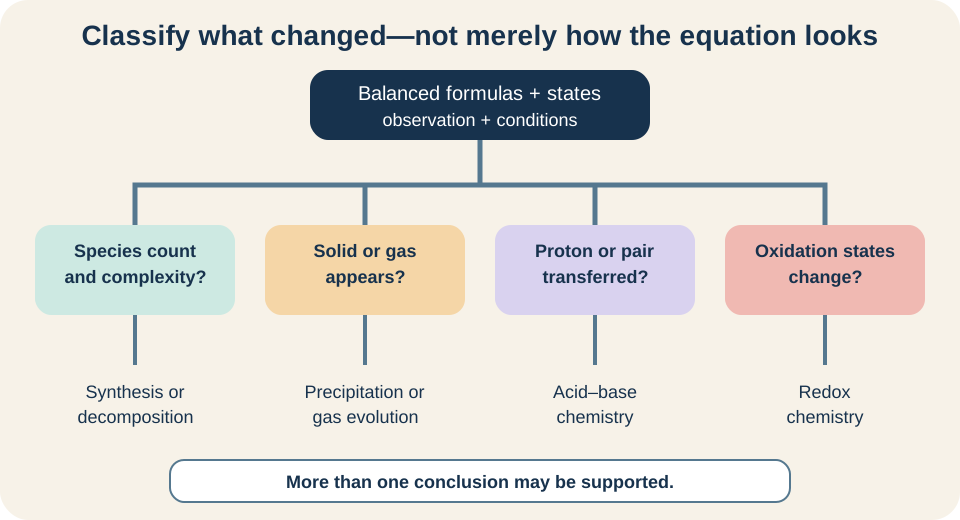
The guiding habit is simple: first inventory the species, then ask what changed, and only afterward choose a name. This order prevents a familiar-looking template from overruling solubility, oxidation-state, or acid–base evidence. It also makes the classification useful for later calculations because the chosen category points toward net ionic equations, electron accounting, equilibrium, or energy analysis. Keep a balanced equation visible whenever you reason, since coefficients preserve the atomic ledger. Treat every arrow as a claim that must be supported rather than as decorative punctuation.
Begin with evidence, not a name
A chemical equation compresses three kinds of information into one line. Formulas identify the reacting species, coefficients state whole-number amount ratios, and state symbols such as , , , and describe physical form. The arrow means “produces under the stated conditions,” not merely “can be rearranged on paper.” A balanced equation guarantees atom conservation, but it does not by itself establish that the proposed products are favored or observable. Classification begins only after these pieces are read accurately. Reading the notation aloud is a useful first check before interpreting the chemistry.
Observable evidence often includes formation of a solid, evolution of a gas, a persistent temperature change, emission or absorption of light, or a color change tied to a new species. None of these signs is perfectly exclusive because physical changes can imitate some of them. Boiling, for example, produces bubbles without creating a new substance. A good chemical argument connects the observation to particles: an insoluble ionic lattice formed, a molecular gas escaped, electrons moved between species, or protons were transferred. The macroscopic event and symbolic equation should tell the same story.
Thermodynamic and kinetic constraints add another layer. A negative Gibbs free-energy change under specified conditions indicates thermodynamic favorability, yet an activation barrier may make the reaction imperceptibly slow. Conversely, continuous external energy can drive a nonspontaneous process such as electrolysis. Concentration, temperature, pressure, catalysts, and solvent can therefore change what is observed. Classification organizes the transformation after the conditions are understood; it cannot replace those conditions.
Synthesis and decomposition describe structural direction
A synthesis reaction combines simpler reactants into a more complex product and is often represented schematically as . The letters are placeholders for chemical species, not necessarily individual atoms. For example, combines magnesium and oxygen into magnesium oxide. The coefficient before and balances magnesium atoms, while the subscript in belongs to oxygen’s molecular identity. This reaction is synthesis because its structural direction is many reactants toward one compound.
A decomposition reaction runs in the opposite structural direction, following the broad pattern . Consider when potassium chlorate is heated in suitable conditions. One compound produces more than one product, so decomposition is an appropriate class. The symbol written over an arrow may indicate heat, light, or a catalyst needed to make the rate practical. Decomposition does not mean every compound naturally falls apart; stability and activation energy still control occurrence.
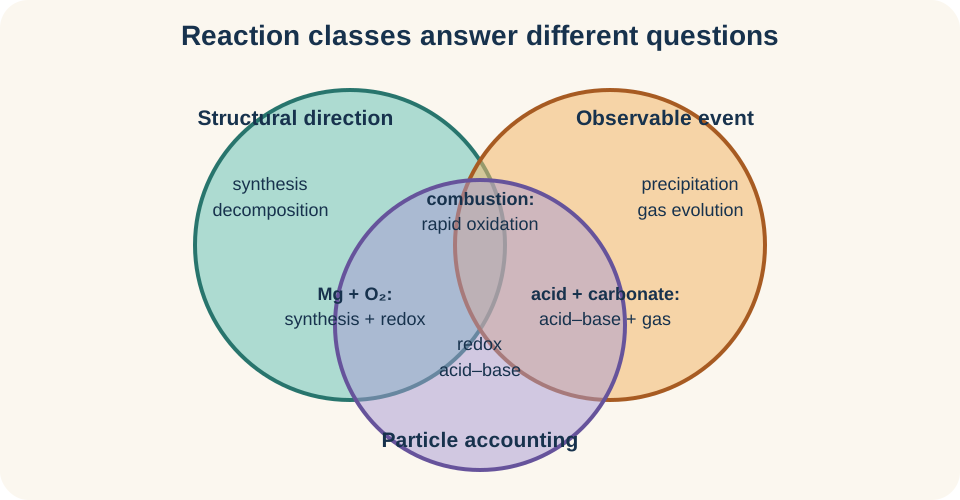
These two labels describe the number and complexity of species, but they do not fully describe electron behavior. Magnesium formation of magnesium oxide is also redox because magnesium’s oxidation state increases from to while oxygen’s decreases from to . Potassium chlorate decomposition is likewise redox because chlorine and oxygen oxidation states change. Overlap should not be treated as a mistake. Saying “synthesis and redox” communicates more than choosing either label alone.
Combustion is reaction with an oxidant
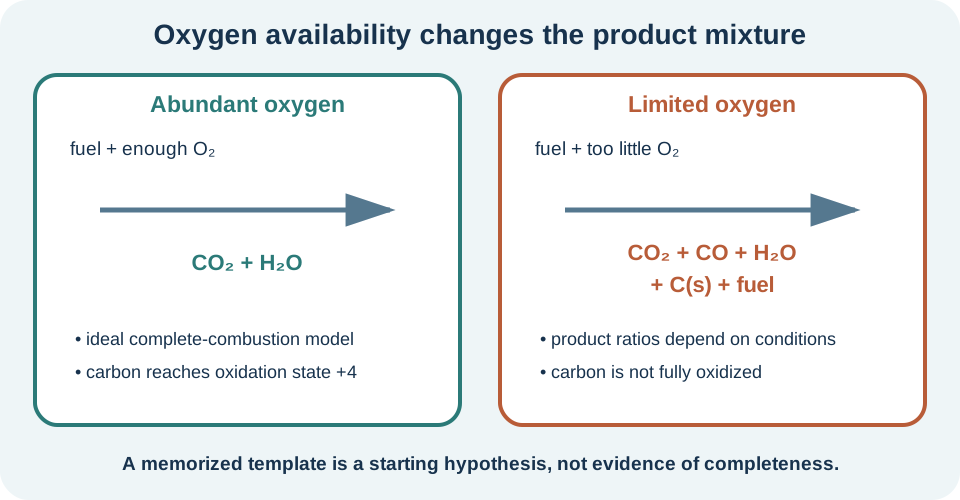
Combustion is a rapid oxidation process that releases energy, commonly as heat and light. In introductory problems, complete combustion of a hydrocarbon in excess oxygen produces carbon dioxide and water. The general symbolic form is before coefficients are determined. The subscripts and represent atom counts in the fuel, whereas balancing coefficients establish conservation. Oxygen is the oxidant because it accepts electron density as products form.
For methane, the balanced equation is when water remains vapor. One carbon atom appears on each side, four hydrogen atoms require two water molecules, and the resulting four product-side oxygen atoms require two oxygen molecules. At lower final temperature, water may be written , changing the reported enthalpy because condensation releases energy. State symbols therefore matter even when the atom ledger is unchanged. Complete combustion is an idealized endpoint, not an automatic guarantee.
Limited oxygen or poor mixing can yield carbon monoxide, soot, unburned fuel, and other products. A memorized “fuel plus oxygen” template cannot decide the product mixture without conditions. Combustion can also involve substances without carbon, such as burning magnesium in oxygen. Every combustion reaction is redox, but not every redox reaction is visibly aflame. The useful classification combines the kinetic observation of rapid oxidation with electron-transfer analysis.
Precipitation converts mobile ions into a solid
A precipitation reaction occurs when dissolved ions combine to form a poorly soluble solid. Mixing aqueous silver nitrate and sodium chloride provides the molecular equation . The state label means the substance is dispersed as hydrated ions, not present as intact molecular units. The label identifies silver chloride as a solid lattice that separates from solution. The visible cloudiness is evidence that previously mobile ions became an extended solid.
Writing the complete ionic equation exposes the particles actually present. Its reactant and product rows are shown below so every species remains legible. Sodium and nitrate ions appear unchanged on both sides and are called spectator ions. Canceling them yields the net ionic equation . This shorter equation reveals the chemically consequential change without losing charge or atom conservation.
Product prediction requires solubility evidence rather than mechanical swapping of ionic partners. A double-replacement pattern may be written as , but if both proposed products remain soluble, no net precipitation has occurred. Solubility rules provide a practical introductory screen, while solubility-product constants offer quantitative analysis. Concentrations matter because even a sparingly soluble salt precipitates only when its ion product exceeds the appropriate threshold. “Double replacement” describes a symbolic rearrangement; “precipitation” identifies the physical driving event.
Acid–base reactions transfer protons or electron pairs
In the Brønsted–Lowry model, an acid donates a proton and a base accepts a proton. Hydrochloric acid and sodium hydroxide can be represented by . After strong electrolytes are separated into ions and spectators are removed, the net ionic equation is . The proton symbol is a conventional shorthand for solvated proton species in water. Neutralization here is driven by formation of water from hydrated hydrogen and hydroxide ions.
Not every acid–base reaction produces a neutral solution or follows the strong-acid–strong-base template. Ammonia accepts a proton from water according to . The double arrow indicates that forward and reverse processes occur and equilibrium is established. Ammonia and ammonium form a conjugate base–acid pair differing by one proton. This particle-level definition is more general than recognizing a familiar neutralization formula.
The Lewis model broadens the category further by describing an acid as an electron-pair acceptor and a base as an electron-pair donor. When a Lewis base supplies a lone pair to a Lewis acid, a coordinate covalent interaction forms even if no proton moves. For foundational classification, state which acid–base model you are using whenever ambiguity matters. Then identify the transferred proton or donated electron pair explicitly. A named model turns a label into a testable mechanism of classification.
Redox reactions track oxidation states and electrons
Oxidation–reduction, shortened to redox, occurs when oxidation states change. Oxidation is an increase in oxidation state and corresponds to electron loss in an explicit half-reaction. Reduction is a decrease in oxidation state and corresponds to electron gain. In , zinc changes from to , while copper changes from to . Those paired changes demonstrate redox even before the reaction is placed in an electrochemical cell.
The oxidation half-reaction is , where denotes an electron. The reduction half-reaction is . Adding the equations cancels two electrons because electrons are transferred internally rather than created or destroyed. Zinc is the reducing agent because it supplies electrons and causes copper to be reduced. Copper(II) is the oxidizing agent because it accepts electrons and causes zinc to be oxidized.
Redox frequently overlaps with synthesis, decomposition, combustion, and single-displacement patterns. Acid–base reactions usually do not require oxidation-state changes, and precipitation can occur without electron transfer. Checking oxidation numbers resolves the issue rather than relying on appearance. Assign oxidation states to the same element on both sides and compare them. If no oxidation state changes, the transformation is not redox under ordinary electron-accounting definitions.
A repeatable classification workflow
Begin by writing correct reactant and product formulas with physical states. Balance the equation and verify every element count plus total charge. Next ask whether one species becomes many, many become one, a fuel reacts rapidly with an oxidant, or aqueous ions form a solid. Then test for proton transfer and oxidation-state changes. Finally identify the observation, condition, or chemical datum that supports the proposed transformation.
Consider reactants forming products . The balanced equation shows an acid reacting with carbonate, liquid water forming, and carbon dioxide gas leaving. It can be described as acid–base chemistry followed by decomposition of the intermediate carbonic acid, and it resembles a gas-evolution double replacement. Oxidation states do not change, so redox is not an appropriate label. Multiple labels capture successive aspects of the same overall change.
Now consider . Sodium displaces hydrogen from water, and oxidation-state analysis shows sodium changing from to while hydrogen changes from to . The equation is therefore single displacement and redox. Gas formation is observable evidence, but “gas evolution” alone does not specify the electron transfer. A defensible answer names the categories and points to the changes that justify each one.
Worked example: classify before and after canceling spectators
Suppose aqueous barium chloride is mixed with aqueous sodium sulfate. Ion charges suggest reactants forming products . Atom counts confirm one barium, two chlorine, two sodium, and one sulfate unit on both sides. Solubility evidence identifies as poorly soluble, so the solid state is justified. The process is a precipitation reaction and also fits the formal double-replacement pattern.
The complete ionic equation separates strong aqueous electrolytes into ions. The multiline equation below places every dissolved reactant ion before the reaction arrow and every product species after it. Canceling sodium and chloride gives . Charge is zero on both sides because and sum to zero. No oxidation number changes, so this is not redox.
The example illustrates why classification should survive a change of representation. The molecular equation highlights reactant compounds and the apparent exchange. The complete ionic equation shows every dissolved ion, while the net ionic equation isolates solid formation. All three representations describe the same event at different resolutions. If a proposed classification disappears when spectators are removed, reconsider what the chemistry actually is.
Common errors and how to correct them
One frequent error is changing a subscript to balance an equation. Turning into does not balance water; it changes water into hydrogen peroxide. Coefficients multiply entire formulas and are the only permitted balancing adjustments. Another error is omitting states, which erases evidence needed to identify precipitation or gas evolution. Write formulas first, assign plausible states, and only then balance coefficients.
A second error is assuming that exchanged partners guarantee reaction. If and are mixed, the ions generally remain hydrated because the possible products are also soluble strong electrolytes. The complete ionic equation would place the same ions on both sides, so everything cancels. The correct net ionic conclusion is no reaction under those stated conditions. Pattern recognition generated a hypothesis, and particle accounting rejected it.
A third error is forcing exactly one classification onto every equation. Chemical categories answer different questions: structural direction, observable phase change, proton transfer, and electron transfer. A reaction can therefore be combustion and redox, or decomposition and redox, without contradiction. State every well-supported category when the task allows, then provide a one-sentence justification for each. Evidence makes the answer precise even when vocabulary overlaps.
Practice with reasoning
Classify and identify whether it is redox. Start by observing that one compound produces two elemental substances, which supports decomposition. Mercury changes from in mercury(II) oxide to , and oxygen changes from to . Those oxidation-state changes also make the process redox. The two classifications describe structural direction and electron redistribution respectively.
Next analyze . Strong aqueous electrolytes separate, leaving the net ionic equation . This is an acid–base neutralization, and the molecular equation also resembles double replacement. Oxidation states remain unchanged, so redox is not supported. The formation of water from proton and hydroxide is the central particle-level event.
Finally decide what happens when aqueous potassium chloride and sodium bromide are mixed. A partner exchange could be written on paper, but all four ions remain soluble and unchanged. The complete ionic equation cancels entirely, so there is no net ionic reaction. Neither precipitation, gas formation, proton transfer, nor redox provides a driving event. The best classification is “no reaction under the stated aqueous conditions,” demonstrating why evidence outranks templates.
Retrieval check and connection forward
Without looking back, explain the difference between a balanced equation and evidence that a reaction occurs. Then list one diagnostic question for precipitation, acid–base, and redox chemistry. Classify methane combustion with every applicable category and justify each label. Finally explain why sodium chloride mixed with potassium nitrate does not produce a meaningful double-replacement reaction in dilute water. If any answer relies only on the arrangement of letters, return to the particle interpretation.
You should now see classification as a layered description rather than a sorting game. Synthesis and decomposition describe structural direction, combustion describes rapid oxidation, precipitation describes loss of dissolved ions into a solid, acid–base chemistry describes proton or electron-pair transfer, and redox describes oxidation-state change. Conditions and evidence determine whether the proposed arrow is credible. Balanced equations keep the material ledger honest. Multiple valid categories can coexist because they illuminate different chemical features.
The next lesson on oxidation–reduction reactions develops the electron ledger rigorously. Net ionic equations will extend the spectator-ion reasoning used for precipitation and strong acid–base reactions. Equilibrium will explain why many arrows should be reversible and how conditions influence extent. Thermodynamics will distinguish energetic favorability from classification, while kinetics will explain why a favorable process may still be slow. These connections turn reaction names into a coherent framework for predicting and explaining chemical change.