
A chemical equation is a conservation statement written in the language of formulas. Reactant particles rearrange into product particles, but the reaction does not create or destroy atomic nuclei. A balanced equation therefore contains the same number of atoms of each element on both sides and, when ions are involved, the same total electric charge. Balancing discovers the relative amounts that satisfy those constraints. It does not choose products, prove that a reaction occurs, or describe how fast it proceeds.
You will learn to distinguish coefficients from subscripts, build atom inventories, balance by inspection, preserve polyatomic groups, use fractional intermediates responsibly, solve coefficients algebraically, and check total charge. Each symbolic step will be translated into particle and mole meaning. Examples will include physical states and horizontal fractions where ratios appear. The goal is a repeatable reasoning process rather than trial-and-error guessing. By the end, you should be able to defend both the coefficients and their smallest whole-number scale.
Begin with chemically correct formulas because balancing cannot repair an incorrect chemical identity. Count atoms on each side before changing anything, choose an element or intact group that gives useful leverage, and adjust only coefficients. Recount after every change because one coefficient affects every element in the formula it precedes. Finish by reducing to the smallest whole-number ratio and checking atoms plus charge independently. This disciplined ledger makes even unfamiliar equations manageable.
Read the equation before attempting to balance it
A chemical equation contains formulas, plus signs, an arrow, coefficients, and often physical-state symbols. The plus sign separates distinct reacting or product species and is read “reacts with” on the left or “and” on the right. The arrow means “produces under the stated conditions.” State symbols , , , and denote solid, liquid, gas, and aqueous form. These states do not change atom counts, but they matter for chemical interpretation. Conditions written over the arrow may specify heat, light, or a catalyst.
Consider the skeleton . The word “skeleton” means the correct species are present but coefficients have not yet been established. The left side contains two hydrogen atoms and two oxygen atoms, while the right contains two hydrogen atoms and one oxygen atom. Hydrogen is already balanced at this temporary scale, but oxygen is not. An inventory reveals the exact constraint instead of relying on visual impression.
The equation must preserve element identity as well as total atom count. Two oxygen atoms cannot compensate for two missing hydrogen atoms because elements do not transform into one another in ordinary chemical reactions. Nuclear reactions are outside this chemical balancing framework. Each element therefore supplies its own conservation equation. Charge supplies an additional constraint for ionic equations.
Coefficients scale amount; subscripts define identity
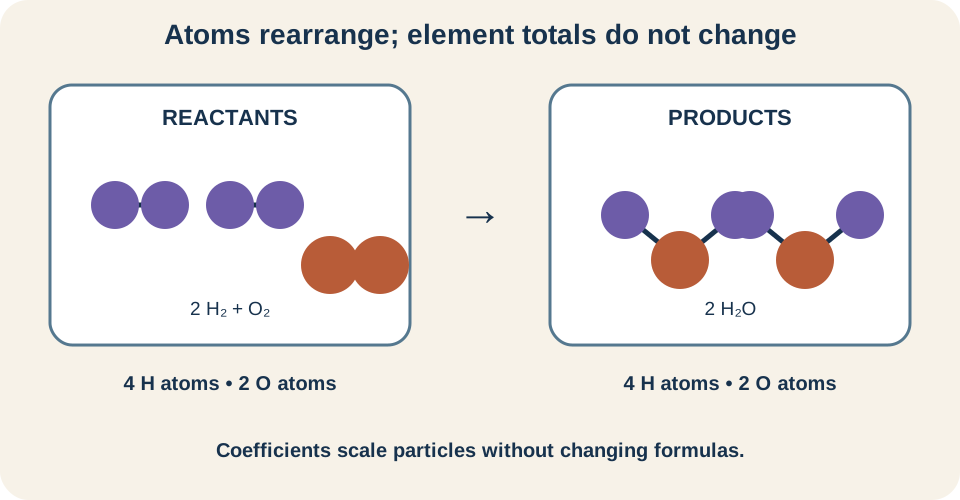
A coefficient is a number written before a chemical formula and multiplies the entire formula. In , the coefficient two represents two water molecules or two moles of water and therefore accounts for four hydrogen atoms and two oxygen atoms. A subscript is part of the formula itself. The subscript two in says that each water molecule contains two hydrogen atoms. Coefficients may change during balancing, but subscripts may not.
Changing to does not add a second water molecule. It changes water into hydrogen peroxide, a different substance with different bonding and properties. Similarly, changing to changes carbon dioxide into carbon monoxide. Balancing asks how many units of the given substances react, not which substances exist. Protect every subscript as fixed identity information.
An omitted coefficient means one, just as an omitted subscript means one. In the balanced equation , the coefficient of oxygen is understood to be one. Coefficients multiply parenthesized groups and all visible or omitted subscripts. Writing a small table of “coefficient times formula count” prevents scope mistakes. This distinction is the foundation of all subsequent stoichiometric ratios.
Build an atom inventory as an objective checkpoint
An atom inventory lists each element and its total count on both sides. For a species with coefficient and an element subscript , that species contributes atoms of the element. If nested parentheses occur, multiply through every applicable subscript first. Then add contributions from all species on the same side. The inventory turns a visual equation into a finite arithmetic comparison.
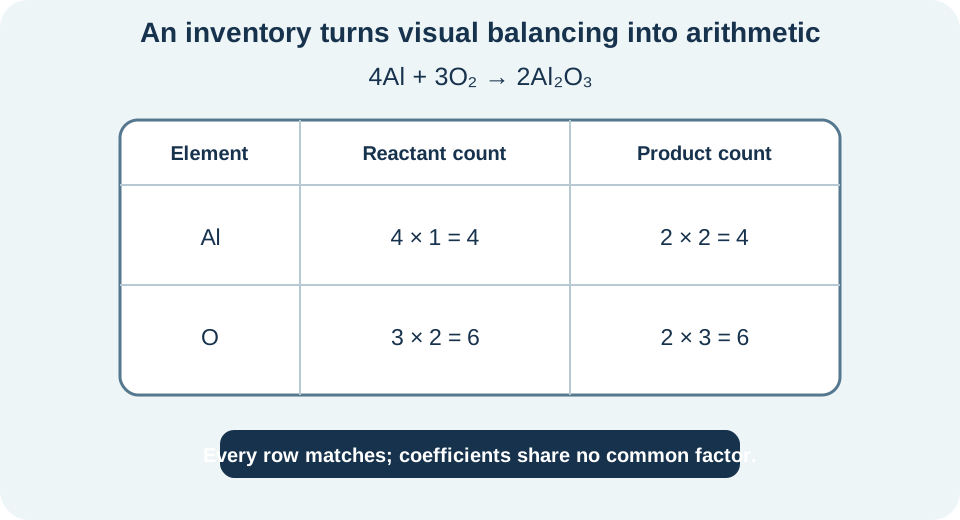
For , an initial inventory gives one aluminum and two oxygen atoms on the left, with two aluminum and three oxygen atoms on the right. Oxygen counts of two and three suggest their least common multiple, six. Placing before gives six reactant oxygen atoms, while placing before gives six product oxygen atoms. The product coefficient now creates four aluminum atoms, so place before aluminum. Each adjustment follows from a named conservation mismatch.
The result is . The final inventory shows four aluminum atoms and six oxygen atoms on each side. The coefficients share no common integer factor greater than one. They are therefore the smallest whole-number ratio. Recounting from scratch is safer than trusting the sequence of adjustments.
Balance by inspection with a deliberate order
Inspection means choosing coefficients through conservation relationships without first solving a formal system of equations. It is not random guessing. Begin with an element that appears in one reactant and one product and preferably occurs in a more complex formula. Leave free elemental forms such as and until later when they can absorb remaining counts. Revisit any element affected by a newly changed coefficient.
Balance propane combustion, . Three carbon atoms require , and eight hydrogen atoms require . Products now contain six oxygen atoms in carbon dioxide and four in water, for ten oxygen atoms total. Each molecule supplies two oxygen atoms, so the required coefficient is . The balanced equation is .
Verify every element after the last coefficient is placed. Carbon counts are three and three, hydrogen counts are eight and eight, and oxygen counts are ten and ten. The coefficients are already the smallest whole-number ratio. State symbols may be added if conditions specify them, but they do not alter this ledger. The coefficient ratio now supports quantitative mole conversions.
Treat unchanged polyatomic groups as units when helpful
A polyatomic ion that appears unchanged on both sides can often be counted as a group. Consider reactants forming products . Sulfate remains , so balancing sulfate as a unit avoids separately tracking sulfur and oxygen at first. Three sulfate groups on the left require on the right. That coefficient also establishes three calcium atoms.
Three calcium atoms require on the left. Those three formula units contain six hydroxide groups. Two aluminum atoms require , which also contains six hydroxide groups. The balanced reactant side is , and the product side is . Counting the preserved groups reveals a clean dependency chain.
The group strategy is valid only when the same intact formula group occurs on both sides. If sulfate is transformed into sulfur dioxide, it cannot be treated as a conserved sulfate unit. In that case, sulfur and oxygen must be counted independently. Grouping is an arithmetic convenience rather than a claim that the ion never exchanges bonds. Always expand the final equation to individual element counts for verification.
Fractional coefficients can be useful intermediates
Whole-number coefficients are conventional for the final equation, but fractions can simplify an intermediate balance. For ethane combustion, start with . Balance carbon with and hydrogen with . Products contain four plus three, or seven, oxygen atoms. That requires because each oxygen molecule contains two oxygen atoms.
The intermediate equation is . Multiply every coefficient by two to clear the denominator. The final equation becomes . Multiplying only the fractional term would destroy the conservation relationships. Scaling the entire equation preserves every ratio.
Fractions are not chemically impossible because coefficients describe ratios and can represent mole amounts. The smallest-integer convention is preferred for readability and for unambiguous particle-count interpretation. A coefficient such as mole is physically meaningful at macroscopic scale, but half a molecule is not a possible count for a single reaction event. Clearing denominators connects the mole-scale ratio to a whole-number molecular event. Always reduce again after clearing.
Algebra exposes the conservation system
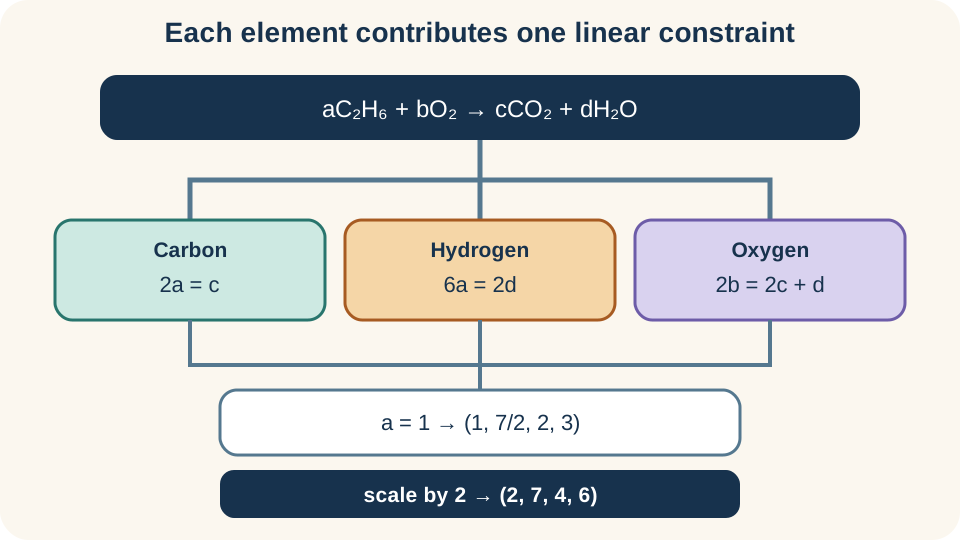
The algebraic method assigns a variable coefficient to each species and writes one linear equation per conserved element. For , carbon conservation gives . Hydrogen conservation gives . Oxygen conservation gives . These equations encode exactly the same reasoning used by inspection.
The system is homogeneous because scaling every coefficient by the same factor produces another solution. Choose a convenient nonzero value for one variable, such as . Then , , and , giving . Multiplying the solution vector by two yields . The algebra explains why balancing determines ratios rather than an absolute number of molecules.
For complicated equations, matrix methods can organize the same constraints. Each row represents an element or charge, each column represents a species, and signed entries count reactant and product contributions. A balanced coefficient vector lies in the null space of that conservation matrix. Introductory problems rarely require formal linear algebra, but the viewpoint clarifies that balancing is a structured constraint problem. Inspection is a human-efficient way to solve many instances of it.
Ionic equations must conserve total charge
Atom balance is necessary but not sufficient for equations containing charged species. Total charge equals each ion’s charge multiplied by its coefficient, summed across a side. For , atoms balance but charge does not. The half-reaction must include an electron: . The product charge is then , matching the reactant charge.
Consider . Two chlorine atoms occur on each side. The left charge is from the two electrons, and the right charge is from two chloride ions. Both element and charge ledgers close. Electron coefficients become the bridge used to combine oxidation and reduction half-reactions.
In a complete ionic equation, unchanged spectator ions appear on both sides and may be canceled to form a net ionic equation. Cancellation is permitted only when the species, charge, state, and coefficient amount match. The resulting net ionic equation must still conserve atoms and charge. Aqueous balancing may also require , , or under systematic redox methods. These additions depend on the stated medium and cannot be invented without context.
Coefficients express several related ratios
In , the coefficient ratio is . At particle scale, two hydrogen molecules react with one oxygen molecule to form two water molecules. At macroscopic scale, two moles of hydrogen react with one mole of oxygen to form two moles of water. The ratio does not directly state grams because different substances have different molar masses. Mass conservation emerges after mole amounts are converted with those masses.
The equation authorizes conversion factors such as and its reciprocal. These factors are conditional on the balanced reaction and connect amounts of different substances. They do not claim that every laboratory mixture reacts completely or that all product is recovered. Limiting reactants, equilibrium, side reactions, and yield affect actual amounts. The balanced equation supplies the ideal stoichiometric architecture.
Gas-volume ratios can match coefficients when gases are compared at the same temperature and pressure and behave ideally. Thus the example suggests two volumes of hydrogen per one volume of oxygen under matched conditions. This is not a universal volume rule for liquids and solids. Coefficients always express amount-of-substance ratios first. Additional models are required to translate moles into mass, solution volume, or gas volume.
Some equations require chemical information before balancing
Balancing cannot determine unknown product formulas from atom conservation alone. The skeleton cannot be balanced numerically until the fuel formula is specified. Likewise, knowing that iron reacts with oxygen does not by itself distinguish , , or . Conditions and chemical evidence identify products. Balancing begins after that identity question is answered.
Combustion may be incomplete, decomposition may yield different products under different conditions, and aqueous ions may remain spectators rather than react. A perfectly balanced proposed equation can still describe a reaction that is thermodynamically unfavorable, kinetically inaccessible, or chemically misidentified. Conservation is a necessary test, not sufficient evidence of occurrence. Classification, equilibrium, thermodynamics, and kinetics provide additional tests. Treat the arrow as a chemical claim.
State symbols and conditions written over the arrow contribute to that claim. Liquid water and gaseous water have identical atom counts but different energetic properties. A catalyst may alter rate without appearing in the net balanced equation because it is regenerated. Light or heat over an arrow may indicate required energy input. Balancing preserves material bookkeeping while leaving room for these other dimensions of chemical explanation.
Common errors and corrective checks
One common error is changing a correct subscript to make counts match. Circle or otherwise protect formulas before balancing, and edit only numbers placed in front. Another error is forgetting that a coefficient multiplies every atom in a formula. Expand one formula unit first, then multiply the entire inventory by its coefficient. Parentheses and nested subscripts should be resolved before totals are compared.
A second error is stopping as soon as one element balances. Every coefficient adjustment can disturb several element counts, so a final full inventory is mandatory. A third error is leaving coefficients such as when represents the same ratio more simply. Divide all coefficients by their greatest common factor. Do not reduce only part of the equation.
For ionic work, overlooking charge is a separate failure. Compute net charge numerically on each side after atoms balance. For all work, check that coefficients are positive and that a nonzero amount appears for every intended species. Then interpret the ratio aloud to see whether it matches the particle picture. Verification should be independent, not merely a repetition of the balancing path.
Guided practice and retrieval
Balance . Two nitrogen atoms require , which contains six hydrogen atoms. Six hydrogen atoms require . The balanced equation is . Its ratio means one mole nitrogen to three moles hydrogen to two moles ammonia.
Balance . Potassium and chlorine remain paired one-to-one, while oxygen counts of three and two suggest a least common multiple of six. Place before potassium chlorate and potassium chloride, then before oxygen. The result is . Verify six oxygen atoms on both sides and explain why changing to would be invalid.
Balance reactants into products . Two phosphate groups in the product require , and three magnesium atoms require . Those coefficients create six sodium and six chloride units, requiring . The complete balanced equation is shown below in two readable rows. Expand every group to verify the final element counts.
Connection forward
Reconstruct the balancing workflow from memory. Verify formulas, inventory atoms, choose a productive element or preserved group, change coefficients only, recount after each change, clear fractions, reduce the whole-number ratio, and check charge. Explain why the solution is determined only up to overall scale. Then state what chemical questions balancing does not answer. A method is secure when you can explain its boundaries as well as its steps.
The next stoichiometry lessons will treat coefficients as mole conversion factors. Limiting-reactant analysis will compare available amounts against those ratios, while percent yield will compare observed and theoretical product. Reaction classification will use patterns in balanced equations but will still require evidence. Redox balancing will extend the charge ledger through explicit electrons. Equilibrium will show that balanced coefficients also become exponents in reaction quotients and equilibrium constants.
The deepest idea is constrained rearrangement. Chemical formulas preserve the identities of participating species, while coefficients scale those species until every element and total charge balance. Inspection, grouping, fractional intermediates, and algebra are different tools for satisfying the same conservation system. The smallest whole-number ratio communicates a fundamental reaction event and a macroscopic mole relationship. With a verified ledger, the equation becomes a reliable foundation for quantitative chemistry.