
A balanced equation specifies the proportions in which reactants can be consumed, but laboratory mixtures rarely begin in exactly those proportions. One reactant may be exhausted while another remains, just as a workshop can run out of one required part while other parts remain on the shelf. The exhausted reactant limits how much product the reaction model can produce. The surviving reactants are present in excess. Experimental recovery then introduces a separate comparison between theoretical and actual yield.
You will identify limiting and excess reactants by two reliable methods, calculate theoretical product, determine excess remaining, and interpret percent yield. You will handle masses, moles, solutions, purity, and multi-product equations with units and substance labels. You will distinguish reaction extent from raw reactant amount and diagnose yields below or above one hundred percent. Every ratio will come from a balanced coefficient relation. The goal is to replace “choose the smaller number” with conservation-based comparison.
Begin by writing and checking the balanced equation. Convert every available reactant amount to moles of its own chemical identity. Compare each reactant against the stoichiometric demand using possible product or normalized reaction extent. Once the limiting reactant is known, use only it to compute theoretical yield. Then use stoichiometry to find how much excess reactant was consumed and subtract from the initial amount.
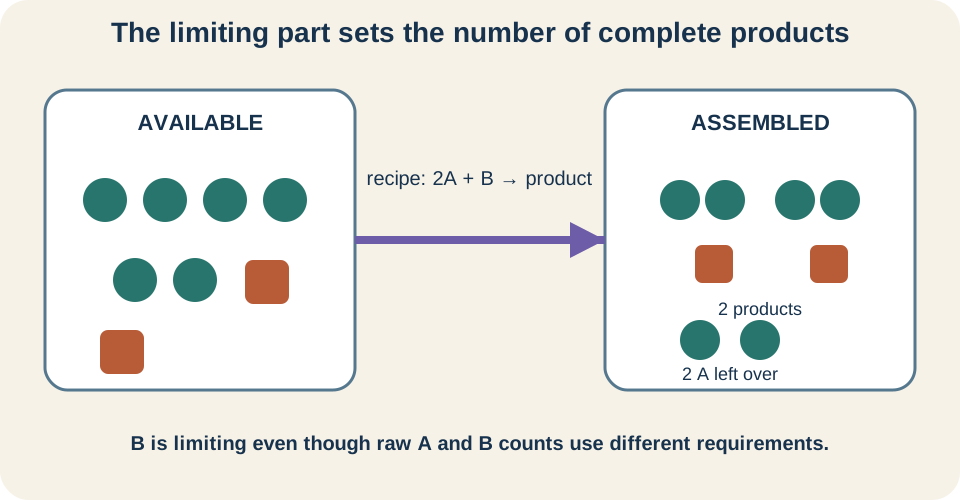
Stoichiometric coefficients define consumption ratios
For , one mole of nitrogen reacts with three moles of hydrogen to form two moles of ammonia in the ideal stoichiometric model. The coefficients are amount-of-substance ratios. They do not mean one gram nitrogen reacts with three grams hydrogen. Different molar masses convert those mole amounts into different masses. Limiting analysis must therefore reach a common mole or product basis.
The balanced equation also determines coupled changes. If reaction consumes moles nitrogen, it consumes moles hydrogen and produces moles ammonia. The variable represents reaction extent in moles of reaction as written. No reactant can be consumed beyond its available amount. The maximum allowed identifies the limiting constraint.
Changing all coefficients by the same factor does not change the physical ratio, but normalized calculations must use one consistent equation. The smallest whole-number form is easiest to interpret. Subscripts inside formulas define chemical identity and are never used as cross-species mole ratios by themselves. Coefficients supply the conversion factors. Balance before calculating.
The limiting reactant is not necessarily the smallest amount
The reactant with the fewest moles is not automatically limiting because coefficient requirements can differ. If a reaction needs ten moles of A per mole of B, a seemingly large amount of A may still be insufficient. Mass comparison is even less reliable because molar masses differ. Ask how much reaction or product each available amount can support. A common basis makes the comparison meaningful. That comparison, rather than raw size, identifies the chemical constraint.
In , compare with . Hydrogen has more moles numerically, yet the reaction needs three hydrogen for each nitrogen. Consuming all would require , which is unavailable. Hydrogen therefore limits despite having the larger raw mole amount. This example shows why amount and stoichiometric capacity are different ideas.
The phrase “consumed first” is shorthand under a well-mixed ideal reaction model. At microscopic scale, both reactants are consumed simultaneously as reaction proceeds. The limiting one reaches zero at the maximum modeled extent while an excess reactant remains. Kinetics, equilibrium, and side reactions can keep it from reaching literal zero experimentally. Limiting-reactant stoichiometry defines the theoretical completion constraint.
Method one compares possible product from each reactant
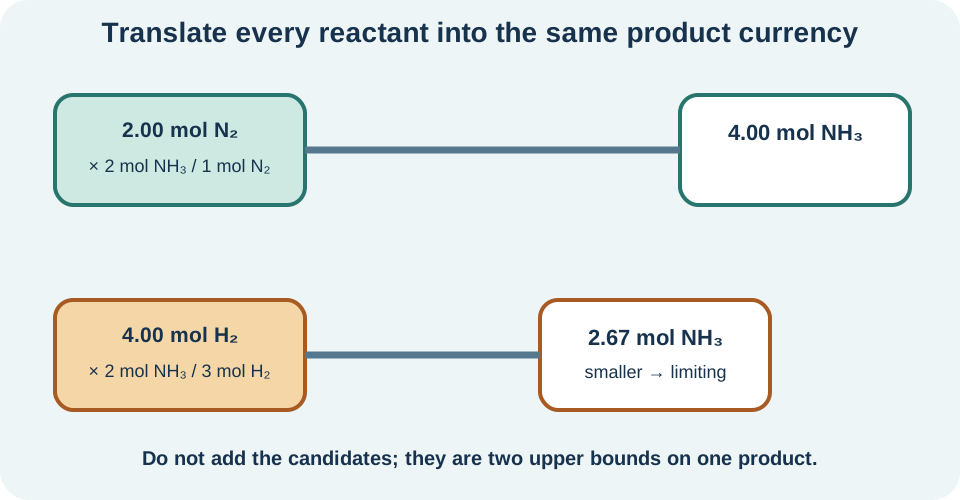
Convert each reactant independently into the same chosen product. For nitrogen, . The equation coefficient ratio cancels moles nitrogen and leaves moles ammonia. This is the product amount nitrogen could support if sufficient hydrogen were available. It is a candidate, not yet the actual theoretical yield.
For hydrogen, . Hydrogen supports less ammonia than nitrogen does. Therefore hydrogen is limiting and nitrogen is excess. The smaller common-product amount becomes the theoretical ammonia amount. The two candidates must never be added because they describe competing constraints on the same reaction.
This method is intuitive because every reactant is translated into one output currency. It works with any chosen product, provided all comparisons use that same species. If reactants predict equal product within precision, the mixture is stoichiometric and neither is meaningfully in excess under the ideal model. With three or more reactants, calculate a candidate product from each. The smallest candidate limits.
Method two compares normalized reaction extent
For each reactant, divide available moles by the magnitude of its stoichiometric coefficient. In the ammonia example, nitrogen gives , while hydrogen gives . The smaller normalized extent belongs to hydrogen. Multiplying that extent by the ammonia coefficient two gives . This agrees with method one.
The normalized value answers how many times the balanced reaction package can occur at mole scale. Dividing only raw moles without coefficient normalization would ignore recipe demand. The unit “moles of reaction” is a bookkeeping interpretation tied to the written equation. Scaling the entire equation changes the numerical extent while leaving predicted species amounts unchanged. Consistency with one equation is essential.
Extent comparison is efficient when many products or reactants are present. It finds the limiting constraint once, after which every species change follows by multiplying the same extent by its coefficient. The method also resembles optimization under resource constraints. Each reactant supplies an upper bound. The lowest bound controls the feasible reaction.
Convert mass inputs to moles before comparing
Mass is converted to amount using molar mass. If is moles, is mass, and is molar mass, then . Write units as . Substance identity must appear with each unit. Grams of one reactant cannot cancel with the molar mass of another.
Suppose a reaction uses hydrogen and oxygen. Equal masses do not mean equal moles because and have molar masses about and . Hydrogen amount is about , while oxygen amount is . In , oxygen supports only reaction extents while hydrogen supports about . Oxygen limits.
Significant figures should reflect measured inputs and molar-mass precision. Keep guard digits until the final reported yield. A mass may include impurities, solvent, or container contribution, so use actual reactive mass rather than gross sample mass. If purity is stated, multiply sample mass by purity fraction first. The mole comparison is only as accurate as the material definition.
Calculate theoretical yield from the limiter only
Theoretical yield is the maximum product predicted by the balanced reaction when the limiting reactant is consumed according to the ideal model. Once the limiter is identified, convert its amount to desired product. Do not average product candidates or use excess reactant. The limit defines the maximum extent. The result can be reported in moles, grams, particles, or volume under additional models.
For the ammonia example, hydrogen limits and predicts . Using ammonia molar mass , mass is to three significant figures. Moles ammonia cancel, leaving grams ammonia. This is theoretical, not guaranteed recovered mass. Its role is to establish the ideal comparison value for the experiment.
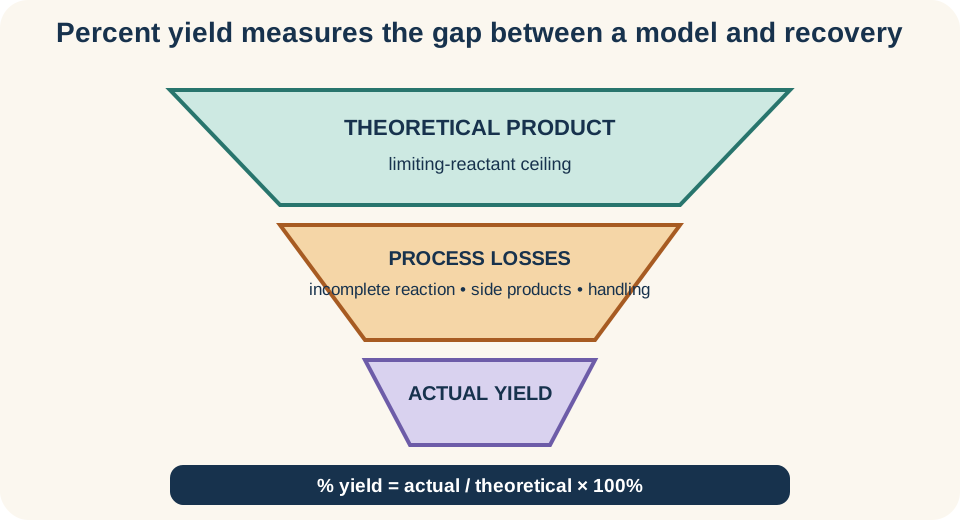
Theoretical yield assumes the stated reaction is complete with respect to the limiter, no competing products consume reactants, and product is defined consistently. Equilibrium may prevent complete conversion, kinetics may be slow, and side reactions may reduce selectivity. Those effects are compared later with actual yield. The stoichiometric ceiling remains a useful benchmark. It isolates reaction proportion from process performance.
Excess remaining requires a second stoichiometric conversion
To find excess remaining, calculate how much excess reactant is consumed by the actual theoretical extent set by the limiter. In the ammonia example, reacts with nitrogen according to . Initial nitrogen was . Remaining nitrogen is . Subtraction uses unrounded guard values for precision.
Do not subtract reactant amounts with different identities or units. First convert the limiting amount into consumed excess amount. Then subtract consumed excess from initial excess in the same unit and substance. If mass remaining is requested, convert remaining moles with that excess reactant’s molar mass. A result below zero signals a wrong limiter or ratio.
The excess fraction can be engineered intentionally. Industrial processes often use one reactant in excess to drive conversion, reduce cost, control selectivity, or compensate for losses. Excess can also create separation and recycling burdens. Stoichiometry quantifies remaining material, while process design weighs economics and safety. “Excess” is a relational amount, not waste by definition.
Reaction tables organize initial, change, and final amounts
An initial–change–final table can track all species in moles. Write initial amounts, express each stoichiometric change as coefficient times extent , and subtract or add according to reactant or product role. The Greek letter , read “xi,” commonly denotes extent of reaction. For , changes are , , and . Nonnegative final amounts constrain .
The maximum extent is for reactants under a complete one-direction model. The “min” function selects the smallest upper bound. This is the normalized-coefficient method in general notation. Final excess is for an excess A. Product is .
The table generalizes cleanly to initial product, multiple reactants, or partial extent. Equilibrium calculations use similar stoichiometric changes but determine through an equilibrium constant rather than setting a reactant to zero. Kinetics can make a function of time. The same conservation structure appears across chemistry. Limiting-reactant analysis is the maximum-extent special case.
Actual yield is measured, not predicted by stoichiometry
Actual yield is the amount of desired product obtained and measured through an experiment or process. It may be lower than theoretical yield because reaction is incomplete, side reactions occur, product decomposes, material is lost during transfer or purification, or measurements are imperfect. Actual yield must use the same product identity and amount dimension as theoretical yield before comparison. Comparing grams actual with moles theoretical is invalid. Convert one so units match.
Actual yield may refer to crude product or purified product depending on the protocol. A wet solid can include solvent, inflating measured mass. A crude mixture can contain impurities. Purification reduces recovered mass while improving identity. Yield reporting should state how product was isolated and characterized.
Analytical methods can estimate product amount without isolating all material. Spectroscopy, chromatography, titration, or calibrated detector response may quantify concentration or moles. Each method has uncertainty, calibration assumptions, and selectivity limits. The word “actual” does not mean perfectly known. It means empirically estimated rather than stoichiometrically predicted.
Percent yield compares actual with theoretical
Percent yield is . The numerator and denominator must describe the same product in the same units. Their units cancel, leaving a dimensionless ratio expressed per hundred. Theoretical yield belongs below the horizontal fraction bar because it is the benchmark maximum. Reversing the ratio changes the meaning.
If theoretical yield is and actual yield is , then . The calculation does not explain the missing fifteen percent. It quantifies the gap. Mechanistic and experimental evidence are needed to diagnose causes. Percent yield is therefore a performance indicator rather than a complete causal explanation.
Percent yield differs from percent conversion and selectivity. Conversion describes the fraction of a reactant consumed. Selectivity describes how consumed reactant distributes among desired and undesired products. Yield can combine both effects for desired product. A process may consume nearly all limiter yet have poor desired-product yield because side reactions dominate. Precise metrics prevent misleading performance claims.
Yields above one hundred percent require investigation
Under the stated correct reaction model and pure-product definition, recovered desired product should not exceed theoretical yield. A calculated value above is therefore a diagnostic signal. The product may be wet, contaminated, incompletely dried, or weighed with filter material. The actual measurement may be biased. The theoretical calculation may also use a wrong limiter, equation, purity, or molar mass.
An above-one-hundred result is not evidence that conservation was exceeded. It indicates the numerator and denominator do not represent the intended quantities accurately under the model. Recheck units, balances, tare mass, sample identity, and calibration. Characterize product purity. Report the discrepancy rather than forcing the value below one hundred.
Occasionally, a protocol’s “yield” definition differs from the simple isolated-pure-product metric. Solvates, hydrates, salts, or different oxidation states can change formula mass. If the theoretical benchmark assumes anhydrous material but the recovered product is a hydrate, mass comparison is inconsistent. Define product formula and state explicitly. Chemical identity belongs in every yield unit.
Solution reactants require concentration and volume
For a solution with molar concentration and volume , solute amount is . Use volume in liters when concentration is . A portion is . Multiplying by gives . Liters cancel.
Convert every solution reactant to moles before limiting comparison. Do not compare molarity alone because volumes may differ. Do not compare volume alone because concentrations may differ. The product supplies actual solute amount. Stoichiometric coefficients then supply reaction demand.
If solutions are mixed, final volume may matter for concentration-dependent equilibrium but not for the initial limiting comparison once solute moles are known. Precipitation reactions may require checking whether reaction is effectively complete or equilibrium-limited. Acid–base titrations often use stoichiometric limitation before equivalence and equilibrium afterward. The appropriate model depends on chemistry. A mole ledger remains the starting point.
Purity and composition adjust available reactive amount
If a solid sample is reactive substance by mass, a sample contains reactive material under that composition model. The remaining is impurity and should not enter the target reactant mole conversion unless it also reacts. Convert the reactive mass using the correct molar mass. Purity fraction is dimensionless. Apply it before the limiting comparison.
Hydrates require formula-aware treatment. A mass of contains fewer moles of copper sulfate formula units per gram than the same mass of anhydrous . Use the hydrate molar mass when weighing the hydrate. If only anhydrous equivalent is reactive in the equation, connect formula units stoichiometrically. Dropping waters from the molar mass overstates available moles.
Gas reactants may be converted through under ideal assumptions. The same pressure and volume do not imply the same mass for different gases, but they can imply the same moles at equal temperature. Real-gas corrections may matter at high pressure or low temperature. Every input pathway must end in moles before coefficients are compared. Dimensional analysis unifies the routes.
Uncertainty affects limiter confidence near stoichiometric mixtures
Measurements have uncertainty, so a mixture very close to stoichiometric proportion may not have an unambiguous limiter within experimental resolution. Suppose normalized extents are and . Their uncertainty intervals overlap substantially. Declaring one reactant definitively limiting overstates the evidence. Report near-stoichiometric status or propagate uncertainty.
Far from the boundary, limiter identity is robust. If normalized extents are and with small relative uncertainties, the first clearly limits. Theoretical yield uncertainty still depends on mass, concentration, volume, purity, and molar-mass inputs. Significant figures offer a simplified reporting convention but are not full uncertainty propagation. Precision should match evidence.
Percent yield inherits uncertainty from both actual and theoretical quantities. A difference between and may not be meaningful if measurement uncertainty is several percent. An apparently impossible value should trigger investigation, but interpretation should consider uncertainty. Report central value and uncertainty when available. Numerical decimals alone do not establish accuracy.
Common errors and corrective habits
One common error chooses the smaller mass or mole amount directly. Convert each reactant to common product or divide moles by coefficients. Another error computes product from only one arbitrarily chosen reactant without first identifying the limit. Run every reactant through the comparison. The smallest supported product controls.
A second error adds possible product amounts from separate reactants. They are alternative constraints, not independent product batches. Another subtracts unlike reactant moles to find excess remaining. Convert limiter consumption into consumed excess first. Keep chemical labels on every amount.
Yield errors reverse actual and theoretical values, compare different units, or use crude wet mass as pure product. Write the fraction in words before numbers. Check whether the result should ordinarily lie between zero and one hundred percent. If it does not, investigate rather than erase. The ledger and material definitions usually reveal the cause.
A complete mixed-unit example
Consider with aluminum and chlorine gas. Using molar masses and , amounts are approximately and . Normalize by coefficients: aluminum gives and chlorine gives . Chlorine limits. Raw masses would not have shown the coefficient constraint.
Theoretical aluminum chloride amount is . Using molar mass about gives theoretical product. Aluminum consumed is . About remains. The positive remainder confirms that aluminum was correctly identified as the excess reactant.
If dry pure product is recovered, percent yield is . The actual mass is below the theoretical ceiling. Possible causes include incomplete chlorine exposure, side reactions, transfer loss, or product handling. The calculation quantifies performance but does not identify the mechanism. That diagnosis needs experiment-specific evidence.
Retrieval and connection forward
Without looking back, explain why smallest raw amount is not a valid limiter rule. Demonstrate both common-product and normalized-coefficient methods and show why they agree. Then describe how to calculate theoretical yield, excess remaining, and percent yield in the correct order. Distinguish actual yield, conversion, and selectivity. If any step drops a chemical identity label, restore it.
Reaction classification determines which product equation the stoichiometry represents. Equilibrium will replace complete limiter consumption with a finite reaction extent when reversibility matters. Kinetics will explain whether theoretical extent can be approached on the available timescale. Analytical chemistry will refine actual-yield measurement and uncertainty. Process engineering will balance excess reactants, recycling, safety, conversion, and selectivity.
The enduring insight is constrained production. Each reactant places an upper bound on reaction extent, and the smallest stoichiometrically normalized bound controls theoretical output. Excess remaining follows from the same extent, while percent yield compares experimental recovery with that ideal ceiling. Units, identities, purity, and uncertainty determine whether the comparison is meaningful. A complete calculation is a material ledger, not a hunt for the smallest number.