
Begin by drawing the system boundary
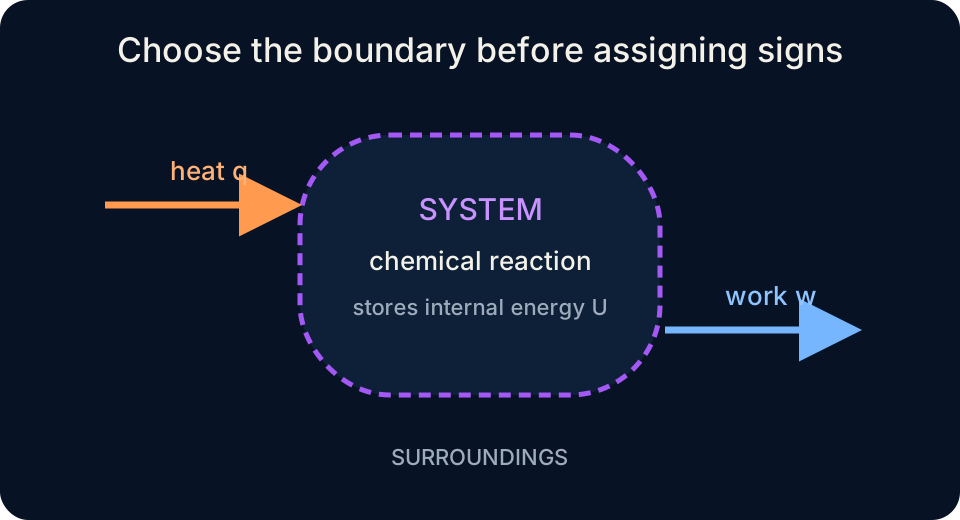
Thermochemistry is an accounting framework for energy transferred during chemical and physical change. The system is the material or process chosen for study, while the surroundings are everything outside that chosen boundary. Energy crossing the boundary must be assigned a direction, so the boundary determines every sign that follows. A reaction mixture may be the system while the solution, calorimeter, and room belong to the surroundings. Before writing an equation, state the system in words and sketch what can cross its boundary.
Internal energy, written , is the energy stored in the microscopic state of a system. It includes molecular translation, rotation, vibration, electronic energy, intermolecular interactions, and chemical bonding contributions. We generally cannot determine an absolute value of , but we can measure or calculate a change . The Greek capital delta, , means final value minus initial value rather than “a small amount.” A positive means the system finishes with more internal energy than it began with. The sign therefore compares endpoint states without specifying how the change occurred.
Heat and work are not substances stored inside matter. They name modes of energy transfer across the boundary: heat arises from a temperature difference, while work arises from organized force acting through displacement or another generalized coordinate. Once transferred, that energy contributes to the system’s internal energy rather than remaining a packet called heat or work. This distinction prevents phrases such as “the system contains heat” from confusing a transfer process with a state property. By the end, you should be able to declare a sign convention, apply the first law, calculate pressure-volume work, interpret enthalpy, scale thermochemical equations, and connect measurements to energy changes.
Apply the first law with a declared sign convention
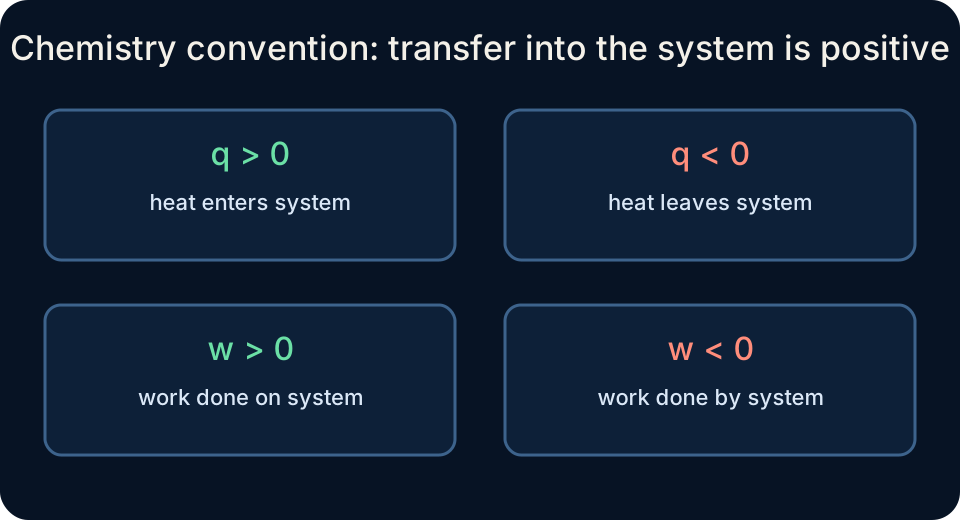
Using the chemistry convention that is work done on the system, the first law is . The symbol is energy transferred as heat, is energy transferred as work, and all three quantities are measured in joules or a consistent energy unit. Positive means heat enters the system, while negative means heat leaves it. Positive means the surroundings do work on the system, while negative means the system does work on the surroundings. The equation expresses energy conservation by requiring every change in stored energy to be matched by boundary transfer.
Suppose a system absorbs of heat and does of work on the surroundings. Heat entering gives , while work done by the system gives under the stated convention. Substitution gives . The positive result means the system’s internal energy increased even though some transferred energy left through work. Writing signs from verbal directions before arithmetic makes the physical story visible.
Some physics texts define as work done by the system and write . That form is not a contradiction because its work variable has the opposite directional definition. Problems arise only when a sign convention is changed mid-calculation or left unstated. A reliable solution writes the convention, assigns transfer signs from the boundary arrows, and then applies the matching equation. Conservation is independent of notation, but interpretation requires notation to be consistent.
Calculate pressure-volume work
A gas can transfer energy mechanically by moving a boundary against an external pressure. For constant external pressure, chemistry’s work-on-system convention gives . The symbol is the pressure exerted by the surroundings, and is the system’s volume change. Expansion has and therefore , meaning the system transfers energy outward by doing work. Compression has and therefore , meaning the surroundings transfer energy into the system.
Units require special attention because a liter-atmosphere is not yet a joule. The conversion is . If a gas expands by against , then . Multiplying by gives . Liter-atmospheres cancel and the negative sign records energy leaving through expansion work.
The constant-pressure formula is a special case of . The integral sign represents accumulation of many small pressure-volume contributions, represents an infinitesimal volume change, and the limits identify initial and final volumes. When external pressure varies, the area under a versus graph determines the magnitude of work. Introductory problems often use constant pressure so the rectangular area becomes . Naming the assumption keeps a convenient formula from being mistaken for a universal one.
Define enthalpy and understand why it is useful
Enthalpy is the state function . The product has energy dimensions because pressure is force per area and volume is area times distance, leaving force times distance. Enthalpy packages internal energy with the pressure-volume energy associated with occupying space in an environment. Like internal energy, its absolute value is usually less useful than its change . Because is a state function, depends on initial and final equilibrium states rather than the detailed path.
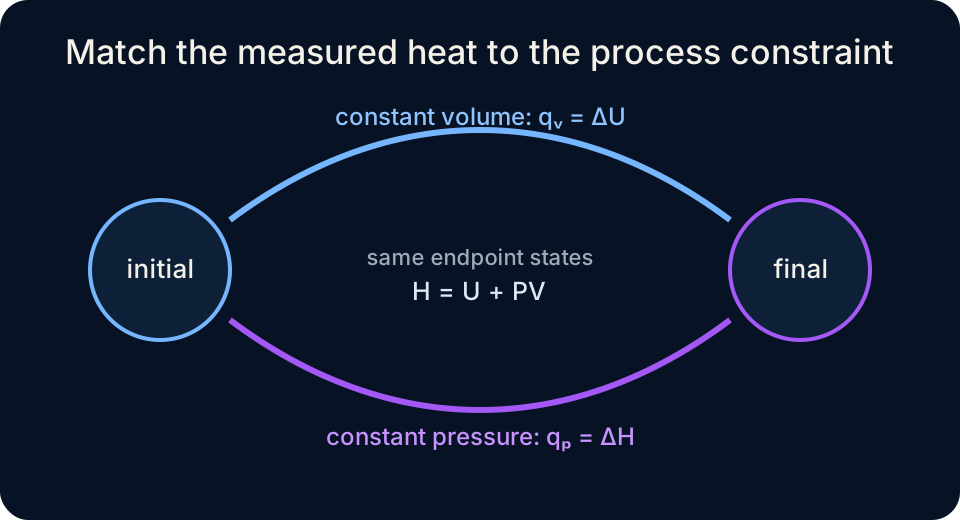
At constant pressure with only pressure-volume work, the heat transferred to the system equals the enthalpy change, . The subscript on specifies a constant-pressure process rather than multiplying heat by pressure. A negative means the system releases heat to the surroundings under those conditions and is called exothermic. A positive means the system absorbs heat and is called endothermic. These labels describe the system, so the surroundings experience the opposite heat direction.
The equality has conditions and should not be generalized carelessly. If pressure is not constant, if non-pressure-volume electrical work occurs, or if kinetic and potential energy changes are significant, additional accounting may be required. A bomb calorimeter operates at nearly constant volume and more directly measures , whereas an open coffee-cup calorimeter approximates constant pressure and is commonly related to . The experimental setup therefore determines which state-function change connects most directly to measured heat. Equations become meaningful only after the process conditions are matched to their derivations.
Read a thermochemical equation quantitatively
A thermochemical equation combines a balanced chemical equation with physical states and an enthalpy change for the reaction as written. For with , the value refers to two moles of liquid water formed according to those coefficients. The negative sign identifies an exothermic system change under the stated conditions. Physical states matter because forming liquid water and forming water vapor have different enthalpy changes. Temperature and pressure conditions should also be stated when precision matters.
Reaction enthalpy is extensive, so it scales with reaction amount. Forming water corresponds to one quarter of the written two-mole reaction amount. The scaled change is . Moles of water cancel within the ratio and kilojoules remain. The answer describes the specified reacted amount rather than an intrinsic “kilojoules per molecule” label.
Reversing a reaction reverses the sign of because initial and final states exchange places. Multiplying every stoichiometric coefficient by a factor multiplies by the same factor because twice as much material undergoes the change. Adding reaction equations adds their enthalpy changes, which is the basis of Hess’s law. These operations work because enthalpy is a state function and because the written equation defines a reaction extent. Manipulating the energy value without making the identical change to the chemical equation breaks that quantitative meaning.
Distinguish bond energy language from reaction accounting
Breaking a chemical bond requires energy input because bonded atoms occupy a lower-energy arrangement relative to the separated fragments under the specified model. Forming a bond releases energy because the system moves toward that lower-energy arrangement. A reaction can be exothermic when energy released by forming product interactions exceeds energy required to disrupt reactant interactions. It can be endothermic when the required disruption dominates. The overall is a net change, not a statement that every microscopic step releases or absorbs energy in the same direction.
Average bond enthalpies provide estimates for gas-phase reactions through . The symbol represents a positive bond dissociation enthalpy, and each summation sign means add the relevant bond contributions. Bonds broken appear with positive energy requirements, while bonds formed are subtracted because their formation releases comparable energy. The values are averages over molecular environments, so the calculation is approximate. Phase changes and intermolecular interactions must also be included when reactants or products are not all gaseous.
Energy diagrams place reactants and products on a vertical potential-energy or enthalpy axis. The vertical difference between product and reactant levels represents , while the barrier peak represents activation energy. A catalyst lowers the activation-energy barrier by providing another pathway but does not change the endpoint difference . Therefore a thermodynamically favorable exothermic reaction can still be slow. Keeping kinetics and thermodynamics separate prevents “releases energy” from being misread as “happens rapidly.” The diagram must label both the vertical scale and the direction of reaction to support that interpretation.
Connect energy transfer to calorimetry
Calorimetry infers an unseen energy transfer from a measurable temperature response. If a reaction warms a surrounding solution, the solution has gained sensible heat while the reaction system has lost energy as heat. Under an isolated-assembly approximation, . Each term is assigned to a named subsystem, and the sum is zero because energy transferred internally within the assembly is conserved. Neglecting the calorimeter term is an assumption to test rather than a fact about cups.
For a material with no phase change, sensible heat is . Here is mass, is specific heat capacity in units such as , and is temperature change. Multiplication leaves joules because grams and kelvins cancel their denominator units. A positive temperature change gives positive heat for the material whose , , and appear. The reaction heat then has the opposite sign when that material is the only modeled surroundings.
Measured heat must be divided by the actual reaction amount to report a molar enthalpy. If corresponds to of reaction as written, the molar reaction enthalpy is . The “mole” in that unit refers to reaction extent and must be connected to a specified stoichiometric equation. Using the wrong limiting-reactant amount changes the inferred molar value. Calorimetry therefore combines thermal measurement with stoichiometric accounting.
Diagnose signs, states, and hidden assumptions
Many errors begin by assigning signs from keywords instead of boundary directions. “The surroundings warm” means heat enters the surroundings and therefore leaves the reaction system, making negative. “The gas expands” means is positive and pressure-volume work on the system is negative under the chemistry convention. A sign should be justified before numbers are substituted. Drawing arrows across a labeled boundary is often the fastest reliable method.
Another error is calling enthalpy “heat content.” Enthalpy is a state function, whereas heat is path-dependent boundary transfer, and they are equal only for particular process constraints. Confusing with also ignores the contribution that distinguishes the functions. In condensed-phase reactions the numerical difference may be small, but small is not identical to conceptually absent. Stating constant pressure and allowable work modes protects the meaning of . Precise language keeps the property, the transfer, and the experimental constraint logically separate.
Units and reaction scaling provide further checks. Pressure-volume work must be converted to energy units, thermochemical coefficients must scale with enthalpy, and temperatures in heat-capacity expressions may use kelvin or Celsius differences because equal-sized increments have the same magnitude. A reaction value reported without physical states may be incomplete because vaporization, dissolution, and phase structure carry energy changes. Heat loss to the environment usually makes an observed temperature change smaller in magnitude and biases an uncorrected inferred reaction heat. An explanation should identify the direction of that bias rather than merely list “heat loss” as a generic error.
Practice a complete energy narrative
First, a system absorbs of heat while the surroundings do of work on it. The chemistry convention gives and . The first law gives . Both transfers enter the system, so the positive increase matches the boundary picture. Reporting only without its joule unit and transfer interpretation would leave the accounting incomplete.
Second, a gas expands from to against . The volume change is . Work is . The negative sign means energy leaves the system through work. If the system simultaneously absorbs as heat, its internal-energy change would be .
Third, a reaction has for the reaction as written and proceeds through of reaction extent. Scaling gives . The positive sign means the system absorbs heat at constant pressure when only pressure-volume work is relevant. Reversing the reaction for the same extent would give . This conclusion connects sign, amount, condition, and physical direction in one energy narrative.