
Begin with path independence
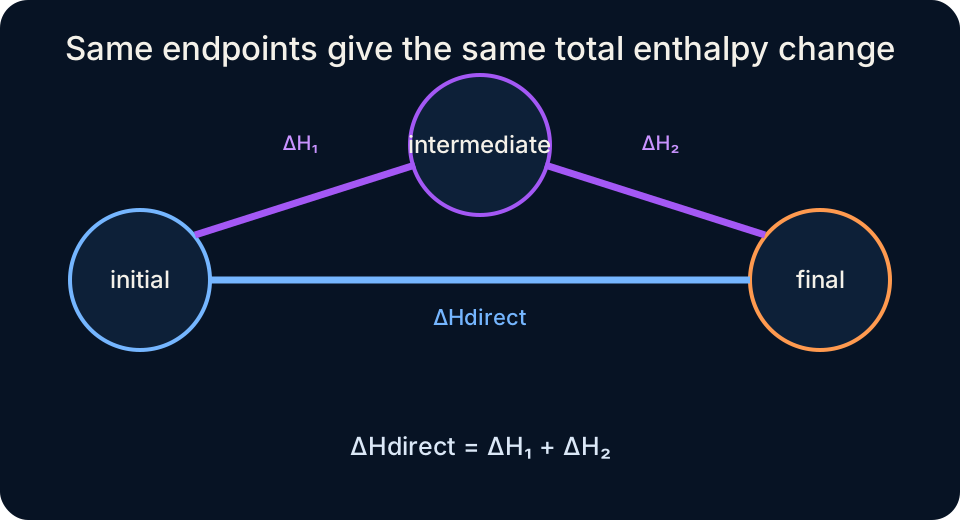
Enthalpy is a state function, so its change depends on initial and final equilibrium states rather than the route connecting them. If a reaction occurs directly or through several intermediate reactions, the total is the same when endpoint states and conditions are identical. Hess’s law uses this property to determine an unknown reaction enthalpy from other measured or tabulated changes. The method is especially valuable when the target reaction is slow, hazardous, incomplete, or difficult to isolate calorimetrically. It turns thermochemical equations into an algebra of state changes.
The symbol means . A negative change indicates the system’s final enthalpy is lower than its initial enthalpy, while a positive change indicates the reverse. Because subtraction telescopes across intermediate states, . The intermediate terms cancel exactly. Hess’s law is this cancellation written in chemical form.
This lesson develops equation manipulation, diagram interpretation, and tabulated formation methods. We will reverse and scale reactions, add equations while canceling intermediates, preserve physical states, calculate from standard formation enthalpies, and analyze uncertainty. Every operation on a chemical equation will be matched by the same operation on its . Examples will include units and an explicit target equation. By the end, you should be able to construct and audit a Hess cycle rather than manipulate signs by trial and error.
Treat thermochemical equations as quantities
A thermochemical equation includes a balanced chemical equation, physical states, conditions, and an enthalpy change for the reaction as written. For with , the value applies to one mole of reaction extent. The graphite allotrope and gas states define the endpoint substances. Changing carbon allotrope or product state changes the enthalpy. The equation and number form one inseparable quantitative statement.
Reaction coefficients define the amount basis. Doubling every coefficient describes twice the reaction extent and doubles because enthalpy is extensive. Halving every coefficient halves the energy change. Coefficients may be fractional in a formation equation when one mole of a product is the intended basis. The scale factor must multiply every species coefficient and the enthalpy value.
Physical states must remain visible during algebra. Forming releases more enthalpy than forming because condensation releases additional energy. A state mismatch prevents cancellation even when chemical formulas match. Temperature and pressure can also affect values, although standard tables specify reference conditions. Identical endpoint labels are required for rigorous path independence.
Reverse a reaction and reverse its sign
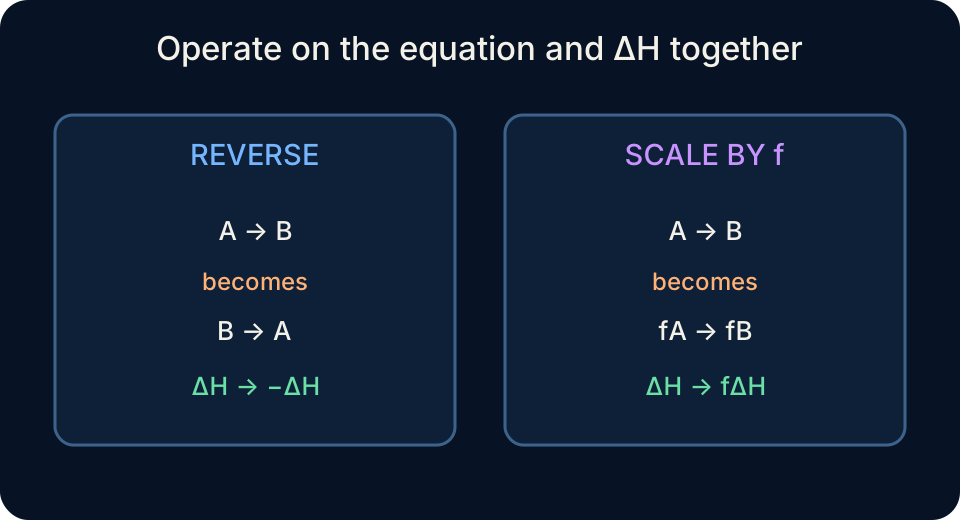
Reversing a reaction exchanges initial and final states. If forward change is , reverse change is . Therefore every reversed thermochemical equation requires the enthalpy sign to reverse. An exothermic forward reaction becomes an endothermic reverse reaction of equal magnitude. The amount basis remains unchanged unless coefficients are also scaled.
For with , the reverse is with . Decomposition requires the energy released by the original oxidation under matching conditions. Only the sign changes. Writing the reversed equation before changing the number prevents a mental sign shortcut from losing its physical basis. The magnitude remains equal because the same endpoint difference is traversed backward.
Whether a reaction must be reversed is determined by the target equation. A species needed as a target reactant must eventually appear on the reactant side, while a target product must appear on the product side. Intermediates should appear on opposite sides in different component equations so they cancel. This side-matching strategy is more reliable than choosing signs from exothermic or endothermic labels. The target equation guides every manipulation.
Scale reactions and enthalpy together
Multiplying a reaction by a factor multiplies its enthalpy change by . If has , then producing one mole of water uses half the equation and gives . The factor one half multiplies every coefficient and the energy. This operation changes total amount but not energy per corresponding reaction extent. Units should state the new basis clearly.
Scaling does not change intensive quantities such as temperature or electrode potential, but reaction enthalpy is extensive. Confusing these property types causes errors across thermochemistry and electrochemistry. The enthalpy associated with twice as many reacting particles is twice as large because twice as many microscopic interactions change. The molar enthalpy can remain numerically constant when expressed per mole of the scaled basis. Total and molar quantities must be distinguished.
Fractional coefficients are acceptable because equations can describe mole ratios rather than individual molecular events. The equation describes one mole of water formation even though half a single molecule is not proposed. Multiplying by two recovers whole molecular coefficients. Thermochemical tables often use fractional oxygen coefficients to define formation of exactly one mole of compound. The stated scale is an amount-level model.
Add equations and cancel intermediates
After orientation and scaling, add all reactant sides, add all product sides, and cancel identical species appearing on both sides. Cancellation means an intermediate is produced in one step and consumed in another with equal amount. The remaining equation must match the target exactly after reducing coefficients if needed. Enthalpy changes are added with their manipulated signs and scale factors. A mismatch in the final equation indicates the energy sum is not yet the target change.
Suppose the target is . Given carbon combustion to carbon dioxide at and carbon monoxide combustion to carbon dioxide at , reverse the second equation. Adding to cancels carbon dioxide and half of the oxygen. The net equation is the target. Summing gives .
The partial oxygen cancellation deserves explicit algebra. One mole oxygen appears on the reactant side and half a mole on the product side, leaving half a mole oxygen as a net reactant. Species coefficients can be treated like algebraic terms only when formula and state match. Carbon dioxide cancels completely because its coefficient and state are identical on both sides. The chemical ledger and enthalpy ledger must be audited in parallel.
Use an enthalpy cycle as a visual proof
An enthalpy cycle places chemical states at nodes and reaction enthalpies on directed arrows. The target change is one arrow between initial and final nodes. An alternate path travels through one or more intermediate nodes. Adding directed arrow changes along the alternate path must equal the direct arrow because both begin and end at the same states. The diagram makes reversal and sign direction visible.
Vertical position can suggest relative enthalpy, with exothermic arrows descending and endothermic arrows ascending. The drawing need not be to scale unless numerical magnitudes are encoded. Arrow labels should include signs, units, and reaction basis. A reversed traversal changes the sign of the labeled change. A closed loop must sum to zero because it returns to the same state.
Cycles are especially useful when several equations create a large cancellation network. Drawing the target states first clarifies which intermediates are needed. Each supplied reaction can then be placed as a directed connection. Missing links or inconsistent states become visible before arithmetic. A diagram complements rather than replaces balanced-equation verification.
Calculate from standard formation enthalpies
Standard enthalpy of formation, , is the enthalpy change for forming one mole of a substance from its elements in their standard states. The superscript circle indicates standard-state conditions, and subscript denotes formation. An element in its reference standard state has by definition. Graphite is carbon’s reference state at standard conditions, while diamond is not. Zero is a reference assignment, not a claim that the element contains no energy.
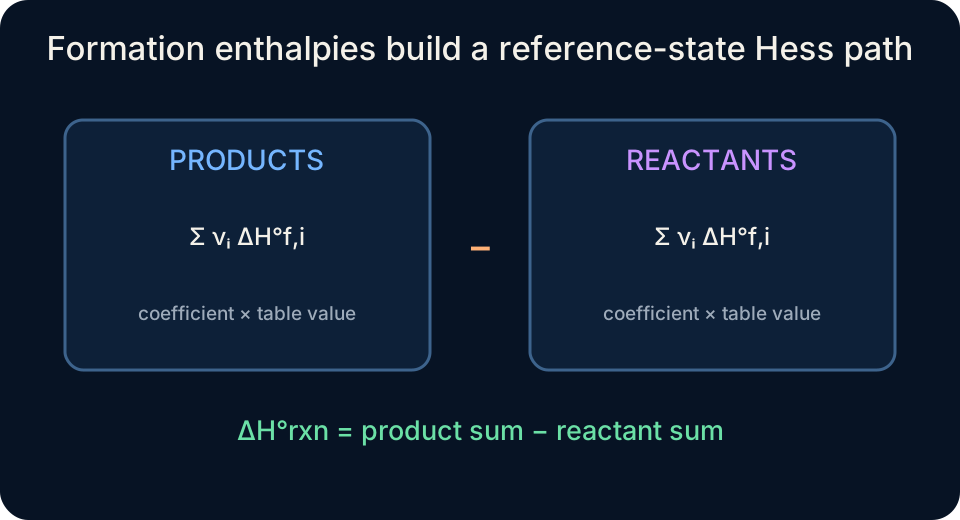
For a reaction, . The Greek letter represents each stoichiometric coefficient. The summation sign means add all coefficient-weighted formation enthalpies in the indicated group. Products minus reactants follows final state minus initial state. Units are typically for the equation as written.
For methane combustion, , insert formation enthalpies for methane, carbon dioxide, and liquid water while oxygen contributes zero. The water value must be multiplied by two. Subtract the methane reactant value after summing products. This formula is Hess’s law using each formation reaction as a path from elemental reference states. A table calculation and an equation-combination calculation are the same principle in different organization.
Connect Hess’s law with calorimetry and bond enthalpy
Calorimetry supplies many enthalpy changes used in Hess combinations. A difficult target may be inferred from several reactions that can each be measured safely and accurately. The target uncertainty depends on uncertainties in all component values. Hess’s law does not make imperfect measurements exact. It preserves state-function consistency across the measured path.
Average bond enthalpies provide another additive estimate. The approximation combines gas-phase bond changes. Bond dissociation values are averaged across molecular environments, so results are less specific than formation-enthalpy tables. Phase and intermolecular changes require additional terms. The method resembles Hess addition because microscopic steps are summed to an overall state change.
Phase-change enthalpies can correct state differences. If a table gives water vapor but the target contains liquid water, add condensation or subtract vaporization appropriately. The relation follows reaction reversal. A missing phase correction can shift a result substantially. State labels are energetic data, not decorative notation.
Organize complex Hess problems systematically
Begin by writing the target equation at the top and leaving it unchanged. Mark each target species with its desired side and coefficient. Choose a supplied equation containing a species that appears uniquely, orient it correctly, and scale it to match. Continue until target species are fixed and intermediates are positioned to cancel. Delay enthalpy addition until the net chemical equation has been verified.
A coefficient table can treat each species as a row and each supplied reaction as a column. Multipliers are selected so the weighted column sum equals the target coefficient vector. This is a linear-algebra view of Hess’s law. For a small problem, inspection is faster, but the table prevents hidden mismatch in a large system. The enthalpy vector uses the same multipliers.
After addition, check atoms, states, net coefficients, and energy units. Intermediates should disappear unless they belong in the target. Coefficients should match the requested scale rather than merely a proportional equation. If the final equation is twice the target, divide both coefficients and enthalpy by two. The target equation is the authoritative completion test.
Evaluate uncertainty and data consistency
When independent enthalpy values are added, absolute uncertainties combine rather than cancel merely because signs differ. A conservative estimate adds absolute uncertainty bounds, while statistical propagation often combines independent standard uncertainties in quadrature. Scaling a reaction scales its absolute uncertainty by the magnitude of the same factor. Reported precision should reflect the component data. Excess calculator digits overstate knowledge.
Hess cycles can test internal consistency. If measured changes around a closed loop do not sum to zero within uncertainty, at least one measurement, state label, or condition is inconsistent. The residual loop sum quantifies disagreement. Calibration error, heat loss, and unmatched temperatures may explain the discrepancy. The law provides a diagnostic constraint as well as a calculation tool.
Tabulated values from different sources may use different reference temperatures, pressure standards, or phases. Combining them without checking metadata can create an apparent violation. Standard notation does not guarantee every table uses identical conventions or precision. A rigorous solution cites conditions and sources when high accuracy matters. Consistent endpoints are the foundation of path independence.
Diagnose common Hess-law errors
The first error is reversing a chemical equation without reversing the sign of . The second is scaling coefficients without scaling enthalpy. The third is canceling species with different physical states. Writing manipulated equations and values together on one line makes each operation visible. A final comparison with the untouched target catches any remaining mismatch.
Another error is adding enthalpies before confirming the summed equation. A plausible number does not prove it belongs to the target reaction. Students may also subtract values based on an improvised rule instead of adding signed manipulated changes. Every component contributes through ordinary signed addition after orientation. The chemical equation determines the sign, not a memorized “products minus reactants” shortcut outside the formation formula.
Formation-enthalpy problems introduce further errors. Elements receive zero only in their reference standard states, and every compound value must be multiplied by its reaction coefficient. Product sum minus reactant sum must preserve the signs already contained in tabulated values. Units should identify the reaction basis. A final sign should be interpreted as exothermic or endothermic for the target direction.
Practice a complete Hess argument
First, reverse a reaction with . The reversed equation has because initial and final states exchange. If the reversed equation is then doubled, its change becomes . Both operations must be shown. The physical interpretation is twice the endothermic reverse process.
Second, use the carbon and carbon-monoxide combustions to obtain carbon-monoxide formation. Reverse and change to . Add it to at . Carbon dioxide cancels and net oxygen becomes one half mole. The target change is .
Third, explain why two paths must agree. Each path begins with identical reactant states and ends with identical product states. Enthalpy change equals final enthalpy minus initial enthalpy, so intermediate states do not appear in the endpoint difference. If measured path sums disagree beyond uncertainty, the data or conditions are inconsistent rather than enthalpy becoming path dependent. Hess’s law is therefore a direct consequence of state-function definition.