
Begin with an indirect measurement
Heat transfer cannot be placed directly on a balance or read from a ruler. A calorimeter instead surrounds a process with materials whose thermal responses can be measured. The observed temperature change, known masses, and heat-capacity information allow energy transfer to be inferred through conservation. This is an inverse problem because the desired reaction heat is reconstructed from effects in the surroundings. A trustworthy result therefore depends on both a correct energy model and controlled measurement.
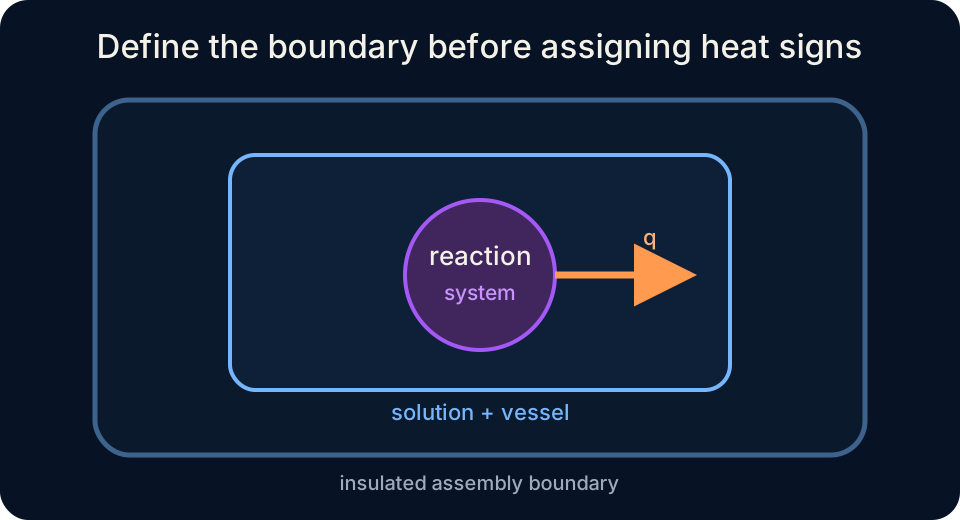
The reacting material is the system when reaction heat is requested, while the solution, vessel, thermometer, and nearby environment belong to the surroundings or a larger calorimeter assembly. Energy lost by one modeled part must be gained by other parts if the assembly is treated as isolated. Sign follows the boundary: heat entering a named part is positive for that part, and heat leaving is negative. A temperature rise in the solution means the solution gained energy, not that the reaction itself gained heat. Drawing a boundary before assigning signs prevents the most common conceptual reversal.
This lesson develops calorimetry through thermal response and energy accounting. We will distinguish heat capacity from specific heat, calculate sensible heat, include a calorimeter constant, analyze coffee-cup and bomb calorimeters, convert measured heat to molar enthalpy, and evaluate uncertainty. Every variable and unit will be explained before substitution. Worked examples will include signs, units, assumptions, and significant figures. By the end, you should be able to design and critique a calorimetric calculation rather than merely use by pattern.
Distinguish heat capacity and specific heat
Heat capacity describes the energy required to change the temperature of an entire object by one temperature interval. Its common unit is , and the thermal-response equation is . The symbol denotes heat transferred to the object, while is final temperature minus initial temperature. A larger means the same energy transfer produces a smaller temperature change. Heat capacity depends on both material and amount.
Specific heat capacity describes heat capacity per unit mass. Its common unit is , and the equation becomes . Here is mass in grams, is specific heat capacity, and temperature difference is in kelvins or Celsius degrees. Multiplication cancels grams and kelvins, leaving joules. The lowercase and uppercase symbols distinguish a mass-specific property from the capacity of a whole sample.
Temperature differences have the same numerical magnitude in kelvins and Celsius degrees because the scales use equal-sized increments. A rise from to is and also . Absolute temperatures are not numerically equal across the scales, but the differences are. Therefore may be used with either interval unit when it matches the heat-capacity unit. Writing the subtraction explicitly reduces sign mistakes.
Read the sensible-heat equation physically
The equation applies when a material changes temperature without undergoing a phase change or reaction that requires additional energy terms. Positive gives positive for a positive mass and heat capacity, meaning the material absorbs heat. Negative gives negative , meaning the material releases heat. The equation describes one named material rather than automatically describing the reaction that caused the change. Every term must refer to the same thermal body.
Suppose of water warms by and . Calculation gives . Grams and kelvins cancel, and the positive sign records energy gained by the water. The three-significant-figure result is limited by the temperature change. This number does not yet identify reaction heat until the energy balance is written.
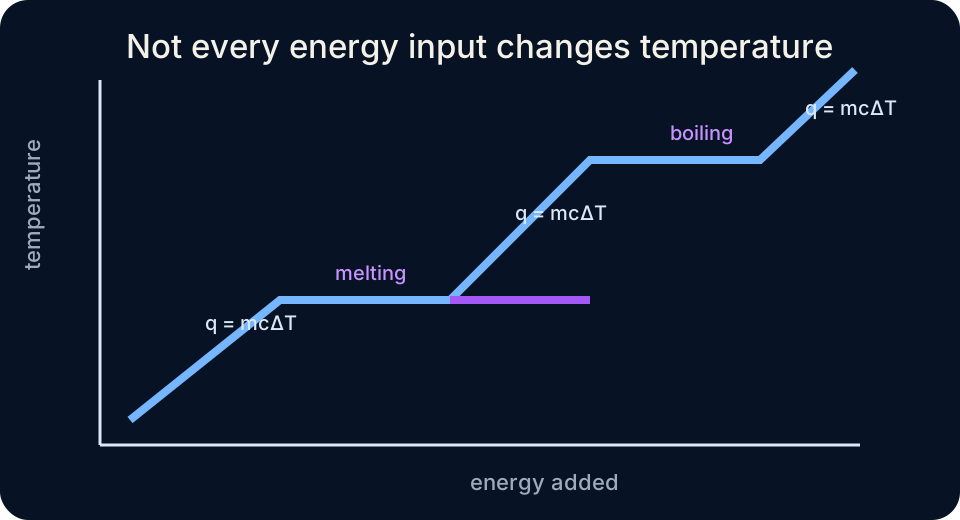
During a phase change, temperature may remain nearly constant while energy changes molecular organization. Melting requires a term such as , where is amount and is molar enthalpy of fusion. Heating across several phases requires adding sensible-heat and phase-change segments. Applying across a plateau would miss energy transferred at constant temperature. A process map should identify all thermal stages before calculation.
Write the calorimeter energy balance
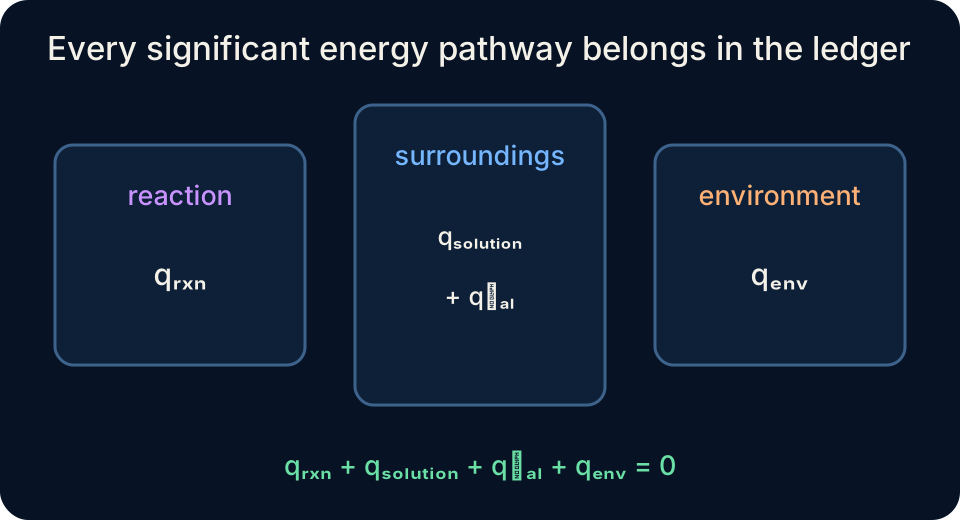
For an ideally isolated calorimeter assembly, the sum of heat transfers among modeled parts is zero. A common reaction experiment uses . The subscripts name the reaction, solution, and calorimeter vessel or hardware. Rearrangement gives . The leading minus sign encodes that energy gained by the surroundings was lost by the reaction system.
The calorimeter contribution is often written . The calorimeter constant has units and represents the combined thermal response of hardware included in calibration. If the cup contribution is negligibly small relative to solution heat, it may be omitted as an approximation. If it is not small, omission makes the reaction heat magnitude too low when the assembly warms. Assumptions should be quantified or justified rather than hidden.
The outer environment can be included with an additional term . In a real experiment, for a sufficiently broad accounting boundary. Insulation reduces but does not eliminate environmental transfer. Extrapolating a temperature-time curve back to the mixing time can estimate the temperature change before substantial loss. The model becomes more realistic as significant energy pathways are included.
Analyze coffee-cup calorimetry
A coffee-cup calorimeter approximates constant atmospheric pressure for reactions in solution. Under constant pressure with only pressure-volume work, reaction heat is related to enthalpy change through for the reacted amount. The cup reduces environmental exchange while allowing pressure to remain near ambient. It is well suited to neutralization, dissolution, and other aqueous processes. The approximation is less suitable for high-temperature, high-pressure, or gas-intensive reactions.
Suppose a reaction warms solution from to . Approximating gives . If cup heat is neglected, . The reaction is exothermic because energy left the reaction system and warmed the solution. The temperature rise alone supports the sign, while the equation determines the magnitude.
Using water’s specific heat for every solution is an approximation. Dissolved salts and concentration can change density and specific heat, and total solution mass should include all mixed components. Assuming solution volume equals solution mass through is another model choice that may introduce bias. More accurate experiments measure solution mass and determine or obtain the appropriate heat capacity. A complete report names these approximations and predicts their likely effects.
Analyze constant-volume calorimetry
A bomb calorimeter encloses a reaction in a strong sealed vessel at nearly constant volume. Because , pressure-volume work is approximately zero and measured reaction heat relates more directly to internal-energy change, . The surrounding water bath and calorimeter hardware absorb released energy. Combustion reactions are commonly studied this way because the sealed vessel contains gases and products safely under controlled conditions. Calibration determines the effective heat capacity of the assembly.
If the calibrated bomb calorimeter has and temperature rises by , the calorimeter gains . The reaction therefore has for the burned sample. The negative sign indicates energy leaving the reaction system. Converting this sample value to a molar value requires the amount actually combusted. The constant-volume condition identifies the result with under the stated model.
For ideal-gas reactions, enthalpy and internal-energy changes are related approximately by . The symbol is product gas moles minus reactant gas moles according to the balanced equation. This correction arises from the pressure-volume term in . It may be small compared with combustion energy but is conceptually necessary when converting constant-volume data to constant-pressure enthalpy. The balanced reaction and temperature must be known.
Convert sample heat to molar reaction enthalpy
Calorimetry initially determines heat for the amount that actually reacted. A molar reaction enthalpy requires dividing by reaction extent or a clearly specified stoichiometric amount. If corresponds to reaction as written, then . Kilojoules remain in the numerator and moles move to the denominator. The phrase “per mole of reaction” must be tied to a balanced thermochemical equation.
If the measured amount is a reactant rather than reaction extent, coefficients supply the conversion. For , consuming oxygen corresponds to reaction extent as written and produces water. Reporting per mole oxygen, per mole water, and per mole reaction gives different numerical values unless the basis is stated. Thermochemical equations define that basis through coefficients. Scaling energy without scaling chemical amount breaks extensive consistency.
The limiting reactant determines actual reaction extent when multiple reactants are mixed. Dividing heat by the initial amount of an excess reactant underestimates the magnitude per mole reacted because some of that reactant remains. Determine limiting amount from stoichiometry before normalizing the measured heat. Percent purity may also be needed if the weighed sample contains inert material. Calorimetry and stoichiometry are inseparable when molar results are requested.
Calibrate the calorimeter
Calibration determines an effective heat capacity by applying a known energy input and measuring temperature response. Electrical calibration may use , where is current, is potential difference, and is elapsed time. Amperes times volts times seconds reduce to joules because electrical power is . The calorimeter constant is then . Repeated calibrations reveal variability and possible drift.
A chemical calibration may use a reaction with a well-established energy change. The known reaction heat and measured solution contribution allow the hardware capacity to be inferred by energy balance. Calibration conditions should resemble experimental conditions because heat loss and sensor response can depend on temperature range and setup. A constant determined with different volumes or geometry may not transfer perfectly. Calibration is a model of the actual apparatus, not a timeless label on the cup.
The thermometer or probe also requires attention. Resolution is the smallest displayed increment, accuracy is closeness to a reference value, and response time controls how quickly the sensor follows changing temperature. Stirring improves spatial uniformity but can introduce small mechanical energy and environmental exchange. The sensor should not touch the vessel wall if wall temperature differs from the solution. Procedure quality determines whether the measured represents the modeled body.
Evaluate uncertainty and systematic bias
Random temperature fluctuations cause repeated trials to differ and can be summarized through spread. Systematic heat loss to the room biases a warming experiment toward a smaller observed . If that loss is ignored, calculated solution heat is too small and the exothermic reaction enthalpy is too small in magnitude. Heat absorbed by an omitted cup produces the same directional bias. Predicting direction makes an uncertainty discussion scientifically useful.
Evaporation can remove mass and energy, while incomplete reaction reduces the heat associated with the assumed reactant amount. Poor mixing can make the probe read a local temperature rather than the bulk average. Using an incorrect solution specific heat creates a scaling bias in . These effects are not interchangeable and should not be grouped under “human error.” Each has a mechanism, direction, and possible control. Naming that mechanism suggests a specific improvement for the next trial.
Uncertainty in , , and propagates into heat. When temperature change is small, fixed thermometer uncertainty can become a large fraction of . Increasing sample amount may produce a larger signal but can also increase heat loss duration or exceed equipment limits. Experimental design balances signal, safety, and model validity. Significant figures should reflect the least certain influential measurements rather than the number of calculator digits.
Diagnose common calculation errors
The first error is assigning reaction heat the same sign as solution heat. In an isolated two-part model, they must be opposite because . The second error is using initial temperature instead of temperature change. The third is mixing grams with a specific heat expressed per kilogram. Writing the energy balance and units before values addresses all three.
Another error is calling every measured heat . Constant-pressure heat can equal enthalpy change under specified work assumptions, while constant-volume bomb heat more directly gives internal-energy change. A calorimeter constant applies to the apparatus for which it was calibrated and should not be treated as a universal material property. Phase changes require latent-heat terms beyond . The physical process determines the equation set.
Molar normalization also causes errors. Heat for a sample must be divided by the amount that reacted, not automatically by total solution moles or excess-reactant amount. The balanced equation determines the reaction basis. Units such as must identify which mole basis is intended. A result without sign, basis, assumptions, and uncertainty is incomplete even if its arithmetic is correct.
Practice a complete calorimetric argument
First, a solution with warms by . The solution gains . Grams and kelvins cancel, leaving joules. If other calorimeter terms are negligible, reaction heat is . The negative reaction sign matches an exothermic process that warms its surroundings.
Second, include a calorimeter constant of for the same rise. Hardware gains . Total surroundings heat is . Reaction heat is therefore . Neglecting the hardware would have underestimated the exothermic magnitude.
Third, suppose that heat came from reaction extent. Molar enthalpy at constant pressure is . The fraction bar divides the sample energy by reacted amount, producing an energy-per-mole basis. The balanced equation must accompany the reported value so “mole of reaction” is defined. A complete conclusion states the exothermic sign, molar basis, constant-pressure assumption, and included calorimeter correction.