
Oxidation–reduction reactions power batteries, corrode metals, release energy from fuels, and support the electron-transfer chains used by living cells. These processes are often shortened to redox because oxidation and reduction always occur together. One species cannot lose electrons unless another species accepts them, so every redox equation is a balanced transaction. The central learning task is not memorizing which reactant “wins,” but tracking atoms, charge, and electrons through several representations. This lesson builds that tracking method from oxidation states to half-reaction balancing.
You will learn to assign oxidation states, identify which species is oxidized and reduced, distinguish oxidizing from reducing agents, and balance redox reactions in acidic and basic solution. Each symbol will be connected to a particle-level interpretation. You will also learn why formal oxidation states are bookkeeping numbers rather than measured charges on most covalent atoms. Worked examples will make conservation visible at every stage. Retrieval checks will help you distinguish rules that look similar but serve different purposes.
Begin every redox analysis with a balanced or balanceable chemical skeleton and explicit charges. Ask which element changes oxidation state, write the direction of that change, and only then name the agents. For complicated aqueous equations, separate the overall reaction into oxidation and reduction half-reactions. Balance atoms and charge within each half before recombining them. This routine turns a seemingly elaborate equation into two short conservation problems.
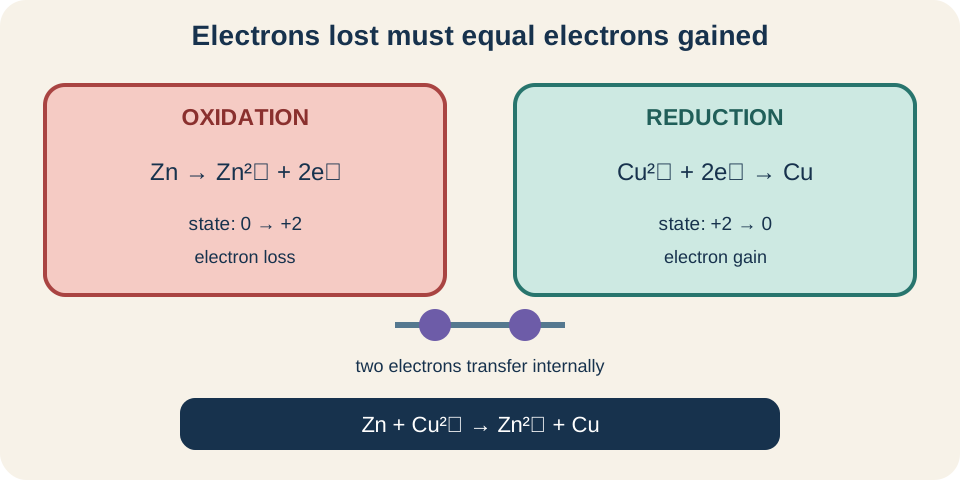
Oxidation and reduction are inseparable
Oxidation is loss of electrons, while reduction is gain of electrons. The mnemonic “OIL RIG” can recall those directions, but a diagram or half-reaction explains more than the mnemonic. In , the electron symbol appears on the product side, so zinc loses two electrons and is oxidized. In , electrons appear on the reactant side, so copper(II) gains two electrons and is reduced. Adding these half-reactions cancels the electrons and produces the observable overall equation.
The total equation is . One zinc atom and one copper atom occur on each side, and the net charge is on each side. The canceled electrons have not vanished physically; they moved from zinc toward copper through direct contact or an external circuit. A chemical equation normally suppresses the path of that transfer. Half-reactions restore the electron ledger so the paired processes can be inspected separately.
Oxidation and reduction must be paired because charge is conserved. An isolated oxidation half-reaction creates negative charge on its product side through released electrons, while an isolated reduction consumes the same negative charge. When the half-reactions are multiplied and added, the number of electrons lost must equal the number gained. If electrons remain in the final overall equation, the combination is incomplete. This equality is the defining accounting constraint of redox balancing.
Oxidation states reveal hidden electron transfer
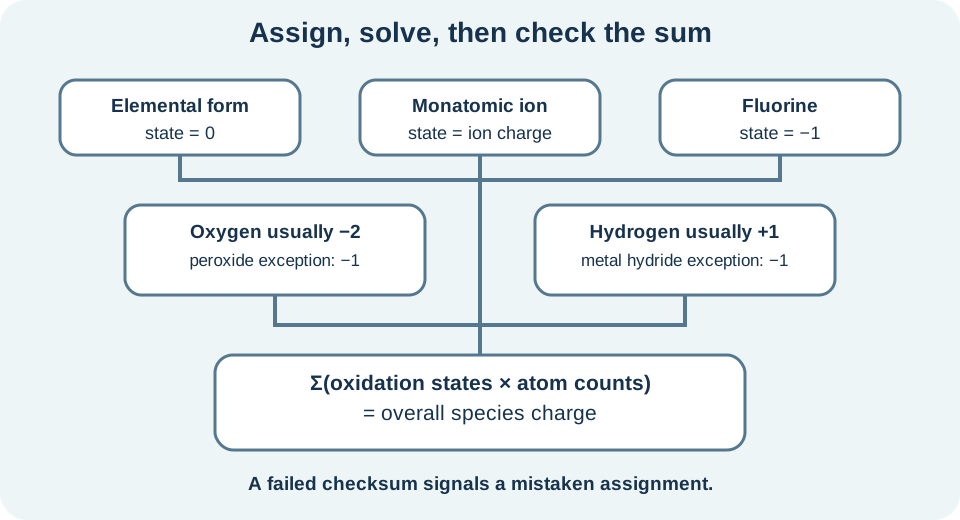
Many redox reactions do not display free electrons, so chemists assign oxidation states to identify formal electron movement. An oxidation state is a bookkeeping value obtained by assigning bonding electrons to the more electronegative atom according to agreed rules. It is written as a signed number such as or , with the sign preceding the magnitude. An increase from to is oxidation because the atom is formally poorer in electrons. A decrease from to is reduction because the atom is formally richer in electrons.
Several rules provide a reliable starting hierarchy. An element in its standard elemental form has oxidation state , so , , and all contain atoms assigned zero. A monatomic ion has an oxidation state equal to its charge, so is and is . Fluorine is in compounds, oxygen is usually , and hydrogen is usually when bonded to nonmetals. Exceptions exist, so the word “usually” is part of the rule rather than a nuisance to omit.
The sum of oxidation states equals the overall charge of the species. For neutral , two hydrogen atoms at contribute , requiring oxygen to contribute so the sum is zero. For sulfate, , four oxygens at contribute , so sulfur must be to produce the ion’s total. Let represent sulfur’s unknown oxidation state, so must equal the ion charge . Solving gives , and the check reproduces the ion charge.
Rules, exceptions, and chemical judgment
Oxidation-state rules must be applied in an order that respects their exceptions. Oxygen is in ordinary peroxides such as rather than its usual . Hydrogen is in ionic metal hydrides such as rather than its usual . Oxygen can even be positive when bonded to fluorine because fluorine is more electronegative. These cases show that oxidation states encode an electron-assignment convention grounded in bonding, not a universal table detached from context.
Consider hydrogen peroxide, . Hydrogen contributes , and the neutral molecule requires the two oxygens together to contribute . Each equivalent oxygen therefore has oxidation state . If one mechanically assigned oxygen its common value, the sum would be rather than zero and would contradict the molecular charge. Checking the sum exposes the mistake immediately.
Oxidation state also differs from formal charge. Formal charge assigns bonding electrons equally between bonded atoms, whereas oxidation state assigns them to the more electronegative atom. Both are useful models, but they answer different questions. Formal charge helps compare Lewis structures, while oxidation state helps track redox change. Neither number should automatically be interpreted as the atom’s measured partial charge in a molecule.
Identify the species and agents without reversing the names
The species oxidized loses electrons and experiences an increase in oxidation state. Because it supplies electrons that reduce another species, it is called the reducing agent. The species reduced gains electrons and experiences a decrease in oxidation state. Because it accepts electrons and thereby oxidizes another species, it is called the oxidizing agent. Agent names describe what a species causes, not what happens to that species.
Return to . Zinc rises from to , so zinc is oxidized and serves as the reducing agent. Copper falls from to , so copper(II) is reduced and serves as the oxidizing agent. The words “oxidized” and “reducing agent” therefore refer to the same reactant from two viewpoints. Writing the oxidation-state arrows before naming agents prevents the most common reversal.
In , magnesium changes from to , while oxygen changes from to . Magnesium is oxidized and is the reducing agent. Oxygen is reduced and is the oxidizing agent. The reaction is both synthesis and redox, illustrating that structural classification and electron accounting can overlap. The paired state changes also show why oxidation cannot occur alone.
Balance simple electron transfer by change counting
For a simple equation, oxidation-state changes can determine coefficients. Consider the unbalanced skeleton . Each aluminum atom loses three electrons, while each copper(II) ion gains two electrons. The least common multiple of and is , so two aluminum atoms release the six electrons accepted by three copper ions. The balanced equation is .
Charge verifies the result. The reactant side carries , and the product side carries . Atom counts also match, with two aluminum and three copper atoms on both sides. No electron symbol appears because the six released electrons cancel the six accepted electrons. The coefficients encode electron conservation even though electrons are implicit.
Change counting becomes harder when oxygen, hydrogen, and polyatomic species must also be balanced. It can identify electron ratios, but it does not by itself supply water or hydrogen ions needed in aqueous reactions. The half-reaction method makes those additions systematic. Use simple change counting when the skeleton contains easily tracked atoms, and use half-reactions when the medium matters. Both methods enforce the same electron ledger.
Balance redox equations in acidic solution
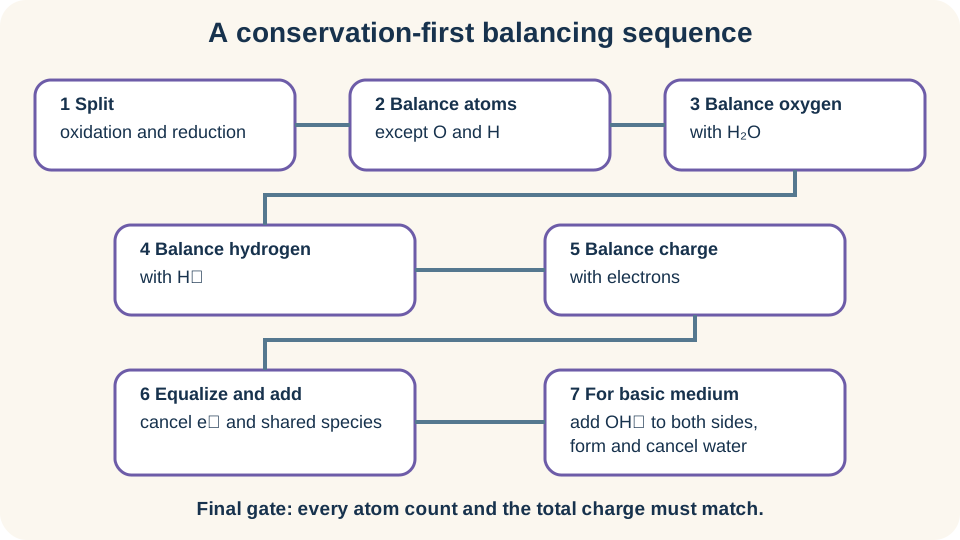
The acidic-solution half-reaction method follows a fixed order. First separate oxidation from reduction and balance every element except oxygen and hydrogen. Next balance oxygen by adding , then balance hydrogen by adding . Balance charge by adding electrons to the more positive side. Finally multiply half-reactions so electron counts match, add them, cancel identical species, and verify atoms plus charge.
Balance reactants into products in acidic solution. For the manganese half, add four waters to the product side to balance four oxygens, then add eight hydrogen ions to the reactant side to balance eight hydrogens. Charge on that reactant side is , while the product charge is , so add five electrons to the reactant side. The reduction half has reactants forming products . The electrons belong on the reactant side because manganese is being reduced.
The iron oxidation half is . Multiply it by five so it releases the five electrons consumed by permanganate. Adding the half-reactions gives the combined equation shown below. The left charge is , and the right charge is . Every atom and the total charge are conserved, so the equation passes both checks.
Convert an acidic balance to basic solution
Balancing in basic solution is easiest when built from the acidic method. First obtain the correctly balanced acidic equation. Then add the same number of ions to both sides as there are ions. Combine and on one side to form water, and cancel water molecules that appear on both sides. Finish by checking atoms and charge again.
Consider the reduction half-reaction in basic solution. Its acidic form is . Add four hydroxide ions to both sides, turning the four hydrogen ions on the left into four waters. Cancel two waters from each side to obtain . The left charge is , matching the right charge of .
Hydroxide is not added arbitrarily to make symbols disappear. Adding equal amounts to both sides preserves the equation, just as adding the same number to both sides of an algebraic equality does. The neutralization identity then expresses the basic medium without free hydrogen ions. Water cancellation removes identical species that participate in both directions of the bookkeeping path. The final equation must be assessed independently rather than trusted because the procedure was followed.
Disproportionation and comproportionation broaden the pattern
In a disproportionation reaction, the same element in one initial oxidation state is both oxidized and reduced. Hydrogen peroxide can disproportionate according to . Oxygen begins at , decreases to in water, and increases to in elemental oxygen. One reactant thus supplies atoms to both redox directions. The paired nature of oxidation and reduction still holds even though both roles begin in the same compound.
Comproportionation is the complementary pattern. Two species containing the same element at different oxidation states form a product at an intermediate oxidation state. For example, conceptual combinations of iron species at and can yield iron at under suitable conditions. The electron donor and acceptor contain the same element but begin in different species. Oxidation-state tracking reveals the relationship more clearly than surface-level reaction categories.
These patterns reinforce that oxidation states are comparisons across an equation. An element name alone does not determine whether it is oxidized or reduced. The initial and final states must be identified for particular atoms in particular species. If one initial state maps to two final states, test for disproportionation. If two initial states converge, test for comproportionation.
Common errors and diagnostic checks
A common error is balancing atoms while ignoring charge. An equation can contain equal numbers of each element and still violate electrical conservation. After balancing, add all ionic charges multiplied by their coefficients on each side. The sums must match exactly. This charge check often identifies a missing electron, hydrogen ion, or hydroxide ion.
Another error is assigning oxidation states to an entire polyatomic ion without resolving the atom of interest. Sulfate has charge , but sulfur in sulfate is , not . Use an unknown such as and make the oxidation-state sum equal the species charge. A third error is labeling the oxidizing agent as the species oxidized because the words resemble each other. Remember that an agent is named for what it causes another species to do.
A final error is changing subscripts while balancing. Subscripts define chemical identity, whereas coefficients define reacting amount. Changing to another manganese oxide invents a new species and invalidates the given skeleton. Add only permitted balancing species for the stated medium, and adjust coefficients. Then verify elements, charge, electron cancellation, and plausible physical conditions.
Guided practice and retrieval
For , chlorine changes from to , so it is reduced and is the oxidizing agent. Bromine changes from to , so bromide is oxidized and is the reducing agent. Each chlorine molecule gains two electrons in total, while two bromide ions lose two electrons. Atom and charge counts both balance. Explain these conclusions aloud without using only the words “more reactive.” The oxidation-state evidence should carry the argument.
Assign nitrogen’s oxidation state in nitrate, . Let represent nitrogen, assign each ordinary oxygen , and write . Solving gives . The negative ion charge does not mean every atom has a negative oxidation state. This algebraic check is the transferable method.
Finally, balance . Cerium gains one electron and iron loses one electron, so the electron ratio is already one to one. The atoms are balanced, and both sides have total charge . Identify cerium(IV) as the oxidizing agent and iron(II) as the reducing agent. If you can justify each name from electron direction, the vocabulary is secure.
Connection forward
Redox accounting becomes physically visible in electrochemical cells. A galvanic cell separates oxidation and reduction so electrons travel through an external conductor and can perform electrical work. Cell notation, electrode signs, voltage, and the Nernst equation all build on the half-reactions developed here. Electrolysis reverses the energetic direction by using an external power source. Corrosion connects the same ideas to coupled reactions on metal surfaces.
Before moving forward, reconstruct the full workflow from memory. Assign oxidation states, locate increases and decreases, name the oxidized and reduced species, name the agents by what they cause, and write half-reactions. Balance non-oxygen and non-hydrogen atoms, then oxygen, hydrogen, charge, and electrons in the appropriate medium. Recombine only after electron counts match. End with independent atom and charge checks.
The deepest idea is conservation through representation. Oxidation states make hidden electron redistribution visible, half-reactions separate a coupled event into manageable ledgers, and the final equation reunites those ledgers without creating matter or charge. Rules are useful because they support that reasoning, not because chemistry is a vocabulary contest. When the symbols are interpreted particle by particle, unfamiliar redox equations become structured problems. That structure will support every later study of batteries, metabolism, corrosion, electroplating, and energetic change.