
Begin with separated electron transfer
A redox reaction transfers electrons from a species that is oxidized to a species that is reduced. If both species contact one another directly, electron transfer can occur locally and release energy mainly as thermal motion. A galvanic cell separates the oxidation and reduction processes into half-cells connected by an external conducting path. Electrons then travel through that path and can deliver electrical work to a device before reaching the reduction half-cell. The cell converts a spontaneous chemical change into organized electrical energy without creating energy from nothing.
The system contains two coupled circuits. The external circuit carries electrons through metal conductors, while the internal ionic path carries charge through electrolytes and a salt bridge or porous separator. Both paths must be continuous because sustained electron flow would otherwise create charge buildup that opposes further reaction. The electrodes provide surfaces where electron-transfer reactions occur, but the electrodes are not always consumed. A complete model must track particles, charges, energy, and the chosen direction of conventional current.
This lesson builds one consistent map across representations. We will assign oxidation states, identify anode and cathode, trace electron and ion motion, write cell notation, calculate standard potential, and connect voltage with Gibbs energy. Each equation will be read symbol by symbol, and each sign will be related to a physical direction. We will also distinguish intensive electrode potential from extensive reaction amount. By the end, you should be able to explain how a galvanic cell works rather than merely recall that anode and oxidation begin with vowels.
Identify oxidation and reduction from electrons
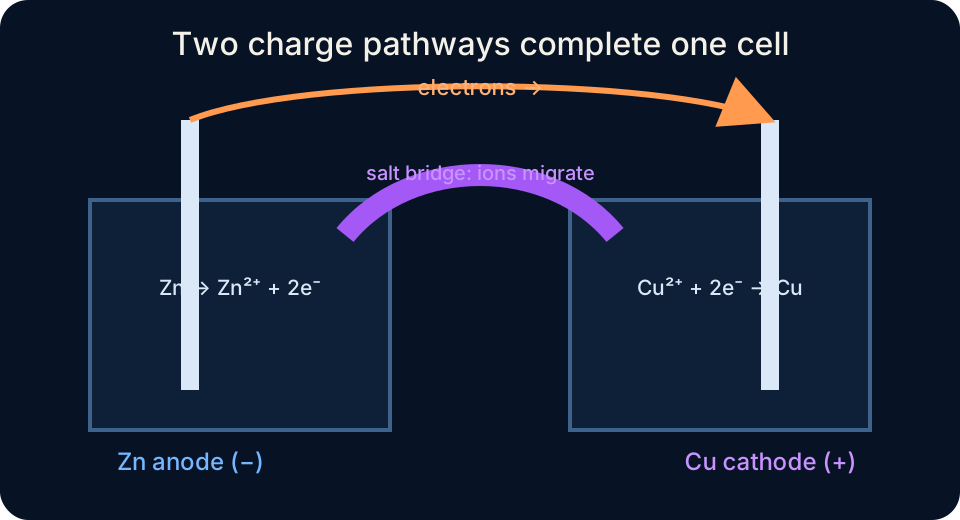
Oxidation is loss of electrons, while reduction is gain of electrons. For zinc metal, the oxidation half-reaction is . The symbol represents an electron, the coefficient two balances both charge and transferred amount, and the state labels distinguish solid metal from aqueous ions. Zinc’s oxidation state increases from zero to plus two, which provides a second way to recognize oxidation. Electrons appear on the product side because zinc releases them.
For copper ions, the reduction half-reaction is . Copper’s oxidation state decreases from plus two to zero as each ion gains two electrons. Electrons appear on the reactant side because reduction consumes them. Adding the half-reactions cancels two electrons and gives . Electron cancellation shows that charge transferred from the oxidation process exactly matches charge accepted by reduction.
The reducing agent causes reduction by donating electrons and is itself oxidized. In the zinc-copper cell, zinc metal is the reducing agent because it supplies electrons to copper ions. The oxidizing agent causes oxidation by accepting electrons and is itself reduced, so copper ion is the oxidizing agent. These names describe roles in the overall reaction rather than electrode locations. Identifying electron donor and acceptor before assigning cell components makes the later direction rules easier to derive.
Locate the anode and cathode
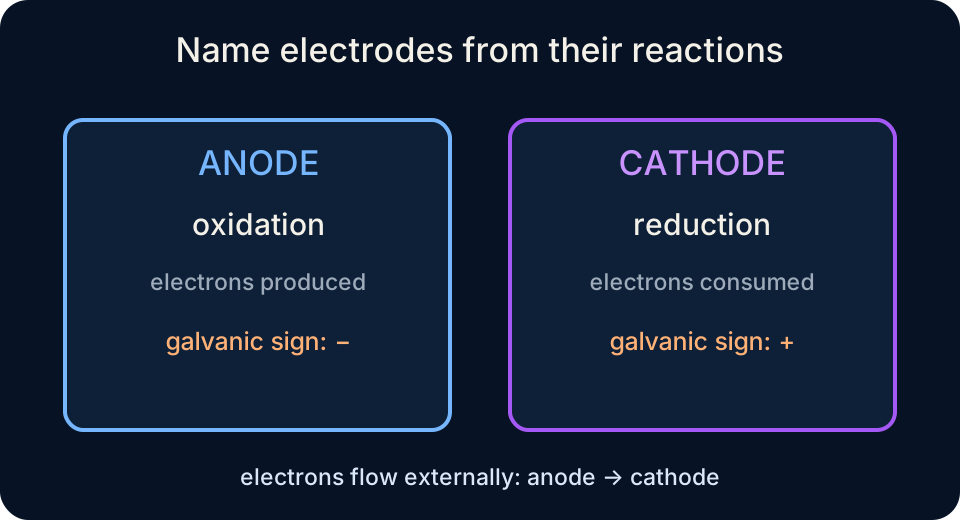
Oxidation always occurs at the anode, and reduction always occurs at the cathode. These definitions apply to both galvanic and electrolytic cells even though electrode signs can change between cell types. In a galvanic cell, the spontaneous oxidation reaction supplies electrons to the anode, making it the negative electrode relative to the cathode. The cathode receives electrons through the external circuit and is the positive electrode. Electrode names should therefore be tied to reactions first and signs second.
In the zinc half-cell, zinc atoms enter solution as while leaving electrons in the metal. The zinc electrode loses mass as oxidation continues, assuming zinc metal itself is the reacting electrode. In the copper half-cell, ions receive electrons and deposit as copper metal. The copper electrode gains mass as reduction continues. These mass changes provide observable evidence for the assigned half-reactions.
Not every half-cell uses a reactive solid electrode. If all redox species are dissolved or gaseous, an inert conductor such as platinum may provide an electron-transfer surface without appearing in the net reaction. The electrode can still be an anode or cathode because that name identifies the reaction occurring at its interface. A graphite electrode may likewise conduct without being consumed under the intended conditions. Reading the half-reaction prevents electrode material from being confused with a required reactant.
Trace electrons and conventional current
Electrons leave the galvanic anode and move through the external circuit toward the cathode. In the zinc-copper example, electrons travel from zinc to copper through the wire. A voltmeter measures an electric potential difference while drawing ideally negligible current, whereas a connected load allows appreciable electron flow and extracts work. Opening the circuit interrupts the electron path and stops sustained redox progress. The direction follows directly from electron production at oxidation and electron consumption at reduction.
Conventional current is defined in the direction positive charge would move, so it points opposite the electron drift in a metal wire. Thus conventional current travels externally from the galvanic cathode toward the anode. This convention predates knowledge of electrons but remains standard in circuit analysis. Stating whether an arrow represents electrons or conventional current prevents an apparent contradiction. Both descriptions refer to the same electrical process with opposite reference directions.
Individual electrons drift slowly, yet the electric field establishing circuit response propagates rapidly through the conductor. Electrical energy transfer should therefore not be pictured as one fast electron carrying a packet of energy from one beaker to the other. The cell’s chemical reactions maintain an electric potential difference that drives coordinated charge motion throughout the circuit. A load converts some of the available free-energy decrease into another form such as light, motion, or stored electrical energy. This systems view connects microscopic charge carriers with macroscopic power.
Explain why the salt bridge is necessary
Oxidation in the anode compartment produces additional cations, so positive charge would accumulate there without compensating ion motion. Reduction in the cathode compartment removes cations, leaving an excess of anions or a deficit of positive charge. This charge separation creates an electric field that opposes continued electron transfer. A salt bridge allows ions to migrate and maintain approximate bulk electroneutrality in both half-cells. It completes the internal ionic circuit without allowing the solutions to mix rapidly.
Anions from the bridge generally migrate toward the anode compartment, where oxidation creates positive ions. Cations from the bridge generally migrate toward the cathode compartment, where reduction removes positive ions. The exact motion should be reasoned from charge balance rather than memorized without context. Salt-bridge ions should be chosen to avoid unwanted precipitation or redox reactions with half-cell species. Potassium nitrate is common because its ions are often relatively spectator-like in introductory systems.
The salt bridge does not carry electrons through solution. Electron transport occurs in the external electronic conductor, while ions carry charge internally. Removing the bridge quickly suppresses sustained current even if the wire remains connected because charge imbalance develops. Replacing it with a direct mixed solution may allow chemical reaction but can destroy the controlled separation needed for useful electrical work. The two charge pathways have different carriers and equally necessary roles.
Read and write cell notation
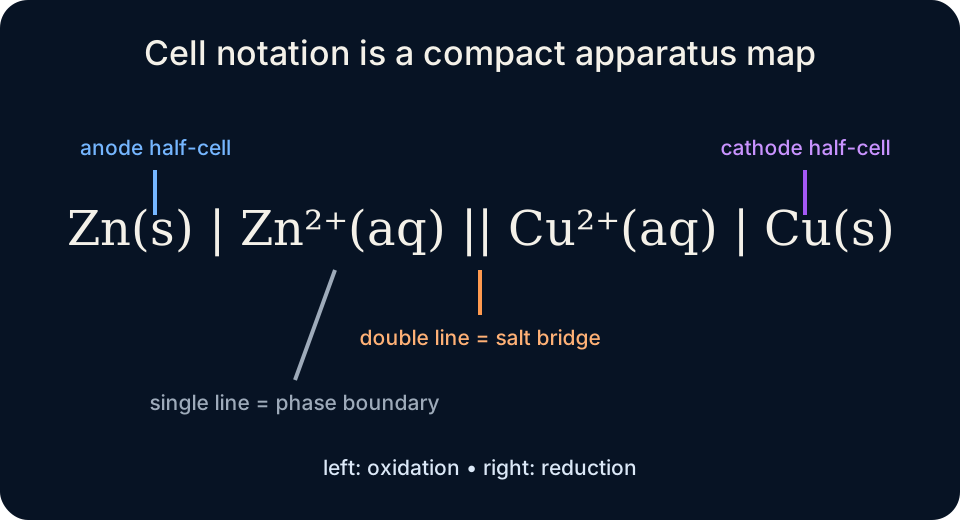
Cell notation compresses the physical arrangement into a symbolic line. The zinc-copper cell is written . A single vertical line represents a phase boundary, while the double line represents the salt bridge or liquid junction. By convention, the anode half-cell is written on the left and the cathode half-cell on the right for a galvanic cell. Species in the same phase may be separated by commas when needed.
The left portion places solid zinc beside the aqueous zinc ions produced by oxidation. The right portion places aqueous copper ions beside deposited copper metal. Reading left to right follows the overall electron-source-to-electron-sink organization, although electrons are not written inside the notation. Concentrations or gas pressures may be added when nonstandard conditions matter. Inert electrodes appear explicitly when no conducting solid redox species is present.
Cell notation is a map rather than a balanced reaction. Coefficients needed for electron balance do not generally appear as multipliers in the notation. The notation also does not by itself state solution volume, electrode area, or maximum current. Those properties affect capacity or rate but are distinct from the thermodynamic voltage description. Translating between notation, a labeled apparatus, and half-reactions tests whether the compact symbols have been understood.
Calculate standard cell potential
Tabulated standard electrode potentials are usually written as reduction potentials. Standard cell potential is . The symbol denotes electric potential difference, the superscript circle denotes standard-state conditions, and the subscripts identify the complete cell or the electrode role. Subtraction works because the anode tabulation is written as reduction even though the operating anode reaction runs in reverse. Equivalent reasoning adds the cathode reduction potential to the anode oxidation potential.
For copper reduction, , and for zinc reduction, . The zinc electrode operates as an oxidation anode, so calculation gives . The positive standard potential indicates that the forward cell reaction is thermodynamically spontaneous under standard conditions. Volts measure energy per charge, with . The sign describes the chosen reaction orientation rather than an absolute property of either electrode alone.
Electrode potential is intensive and does not multiply when a half-reaction is scaled. Doubling doubles amounts and transferred charge, but it does not double energy per unit charge. Therefore coefficients used to balance electrons do not multiply tabulated values. Extensive quantities such as Gibbs-energy change and total electrical work do scale with reaction amount. Keeping potential intensive prevents one of the most common electrochemistry errors.
Connect voltage with Gibbs energy
Standard Gibbs energy and standard cell potential are related by . Here is the number of moles of electrons transferred per mole of reaction as balanced, is Faraday’s constant, and is measured in . Coulombs cancel and the result has energy per mole of reaction. The negative sign means a positive galvanic potential corresponds to a negative spontaneous Gibbs change. The relationship connects a measurable electrical quantity to chemical thermodynamics.
For the zinc-copper reaction, and . Calculation gives . Converting gives approximately . Electron moles and coulombs cancel according to their numerator-denominator placement. The negative result agrees with the positive cell voltage and spontaneous forward direction.
The maximum non-expansion work available reversibly is tied to . Real cells deliver less useful work because of internal resistance, activation losses, concentration gradients, and other irreversible processes. Voltage under load can therefore be lower than equilibrium open-circuit voltage. Energy not delivered to the load is dispersed, often as thermal energy. Thermodynamics provides an upper bound while electrochemical kinetics and engineering determine actual performance.
Understand composition and cell operation over time
Standard potential applies only to standard-state activities and a specified temperature. As a cell operates, reactant activities decrease and product activities increase, changing the reaction quotient . The actual Gibbs change obeys , so the actual voltage changes as composition changes. The Nernst equation expresses the same dependence electrically. A battery’s voltage is therefore connected to its state of charge rather than permanently fixed by electrode names.
For the zinc-copper reaction, because pure solid activities equal one. Increasing zinc-ion activity or decreasing copper-ion activity raises and reduces the forward driving force. When reaches the equilibrium constant , actual and the equilibrium cell potential is zero. The system may still contain both reactants and products, but no net reaction can deliver reversible work. Standard potential remains a reference value even when actual potential has changed.
Cell capacity depends on total available reactant amount, whereas voltage is an intensive driving measure. A larger electrode or greater reactant inventory can supply more total charge without necessarily changing initial equilibrium voltage. Current depends on rate, electrode area, transport, and circuit resistance. Power is , where is current and is voltage, while energy delivery also depends on duration. Distinguishing voltage, current, capacity, power, and energy prevents the word “stronger” from hiding several different cell properties.
Diagnose common cell misconceptions
The first misconception is that anions always move toward the anode because the anode is inherently positive. In a galvanic cell the anode is negative, yet bridge anions still migrate toward it because oxidation creates cations in that solution. The charge-balance mechanism is more reliable than an electrode-sign shortcut. A second misconception is that electrons cross the salt bridge. They instead travel through the external conductor while ions migrate internally.
Another error is multiplying a standard potential by a stoichiometric coefficient. Potential is energy per charge and remains intensive when a half-reaction is scaled. Gibbs energy scales because the total charge and total reaction amount scale. Students also sometimes add two tabulated reduction potentials without reversing the sign associated with the oxidation half-reaction. Writing both operating half-reactions before combining potentials prevents this mismatch.
Finally, a positive standard voltage does not guarantee a large current or an indefinitely operating cell. Kinetic barriers, poor conductivity, passivating layers, and high internal resistance can limit current. Reactants can be exhausted, composition can approach equilibrium, and unwanted reactions can reduce usable capacity. A complete evaluation distinguishes thermodynamic possibility from rate and engineering performance. Cell diagrams, half-reactions, and measured behavior should be made consistent rather than interpreted separately.
Practice a complete cell explanation
First, identify electrode roles in a cell where magnesium is oxidized and silver ions are reduced. Magnesium oxidation occurs at the anode, so electrons leave the magnesium electrode. Silver-ion reduction occurs at the cathode, so electrons arrive at the silver electrode. In a galvanic arrangement, magnesium is the negative electrode and silver is the positive electrode. Bridge anions migrate toward the magnesium compartment while bridge cations migrate toward the silver compartment to maintain charge balance.
Second, calculate if and . Silver is the reduction cathode and magnesium is the oxidation anode. Therefore . The positive result supports spontaneous forward operation under standard conditions. Balancing electron transfer changes reaction coefficients but does not multiply either potential.
Third, explain why cell voltage decreases as a zinc-copper cell discharges. Zinc ion accumulates and copper ion is consumed, so rises. The composition term makes actual less negative. Because , the cell potential correspondingly decreases. At equilibrium, , , and no net reversible electrical work remains available.