
Begin with voltage as energy per charge
An electrochemical cell produces a potential difference because its oxidation and reduction processes have a thermodynamic driving force. Electric potential is energy per charge, with . Standard electrode tables describe reference conditions, but real cells usually contain nonstandard concentrations, pressures, and activities. As composition changes during operation, the driving force and measured equilibrium voltage change. The Nernst equation quantifies that composition dependence.
Cell potential is intensive, while total electrical work and cell capacity are extensive. Doubling electrode size or reactant inventory can increase total charge available without doubling equilibrium voltage. Voltage describes free-energy change per transferred charge for the current state. Current describes charge flow per time and depends on kinetics, resistance, and transport. A complete cell description must therefore keep voltage, current, energy, power, and capacity distinct.
This lesson derives the Nernst equation from thermodynamics and applies it systematically. We will construct a dimensionless reaction quotient, identify the electron-transfer number , use natural and base-ten logarithm forms, predict voltage direction, analyze concentration cells, and connect voltage with equilibrium. Every substitution will include units and reaction orientation. We will also distinguish open-circuit equilibrium potential from voltage under load. By the end, you should be able to explain why composition changes voltage rather than treating the equation as an isolated formula.
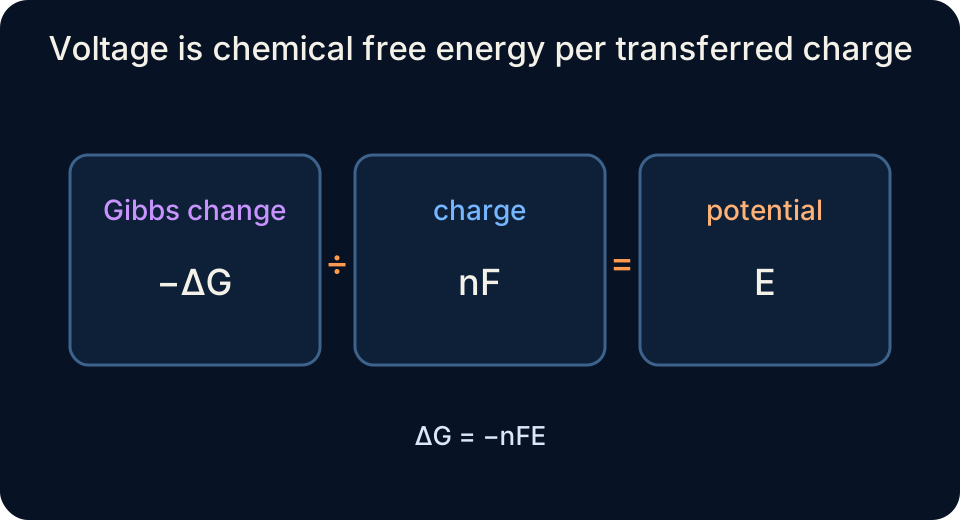
Derive the Nernst equation from Gibbs energy
For a reaction at constant temperature and pressure, actual Gibbs change is . The superscript circle marks a standard-state reference, is the gas constant, is absolute temperature, and is the reaction quotient. Electrochemical work connects Gibbs change and cell potential through . Here is moles of electrons transferred per mole of reaction, is Faraday’s constant, and is cell potential. The negative sign links a positive galvanic voltage with a favorable negative Gibbs change.
The standard version is . Substituting both electrical expressions into the composition equation gives . Multiplying by negative one and dividing by yields . This is the Nernst equation in natural-logarithm form. The minus sign links product-rich composition with reduced forward driving force.
Units verify the prefactor. has units , has kelvins, has , and has . The combination reduces to per reaction basis, which is volts. The logarithm is dimensionless. Dimensional balance supports both the algebra and the required meaning of .
Construct the reaction quotient from the cell reaction
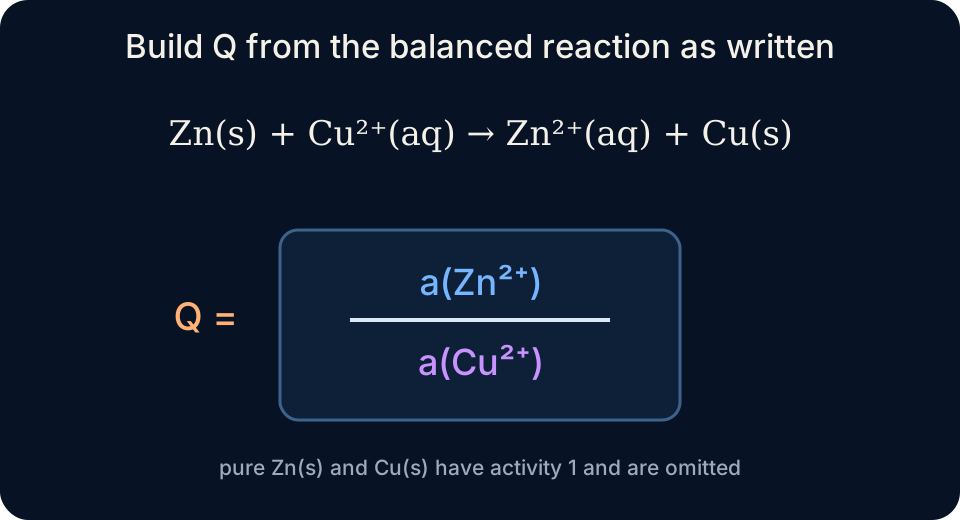
For , the reaction quotient is . Lowercase denotes activity, while stoichiometric coefficients become exponents. Products appear in the numerator and reactants in the denominator for the reaction as written. Pure solids and pure liquids have activity one and are omitted. Gases and solutes require dimensionless activities referenced to standard pressure or concentration.
For the zinc-copper cell, the reaction is . Pure zinc and copper solids are omitted, leaving . In dilute introductory problems, activities may be approximated by numerical concentration ratios to . Writing raw concentration units inside a logarithm is thermodynamically incomplete. The approximation should be stated when used.
Reaction orientation controls both and . Reversing the reaction replaces with and changes the signs of and for that orientation. The electron number remains a positive transfer magnitude. Mixing a forward standard potential with a reverse quotient creates a sign inconsistency. Write the balanced operating reaction before building either quantity.
Identify the electron-transfer number
The value is determined by balancing the oxidation and reduction half-reactions and counting canceled electrons. For zinc oxidation and copper reduction, both half-reactions exchange two electrons, so . It is not the charge on one ion by itself and not the sum of all coefficients. It is moles of electrons transferred per mole of the balanced cell reaction. The reaction scale therefore determines its value.
Multiplying the entire cell reaction by two produces and doubles , but it does not change or raised according to the scaled reaction when the equation is handled consistently. The Nernst quotient exponents also double, making . Both numerator and denominator of the correction scale by two and cancel. This confirms that potential is intensive. An inconsistent partial scaling would falsely change voltage.
For multielectron redox reactions, half-reaction balancing must occur before Nernst calculation. In acidic solution, water, hydrogen ions, and electrons may be introduced to balance atoms and charge. In basic solution, hydroxide can transform the balanced acidic form. The final overall reaction supplies both and quotient exponents. A balancing error propagates into standard potential, composition correction, and equilibrium predictions.
Use the base-ten form at 25 degrees Celsius
The identity converts the natural-log equation to base ten. At , or , . The convenient form is . The numerical constant applies only at that temperature. Other temperatures require the full expression.
Suppose the zinc-copper cell has , , and under the dilute approximation. Then and . With , . Product-rich composition lowers forward voltage, matching the sign prediction. The corrected voltage remains positive, so the forward reaction is still favored.
If , its logarithm is negative and subtracting the correction increases above . This corresponds to relatively reactant-rich composition and stronger forward driving. If , voltage decreases below standard potential. If , the logarithm vanishes and . Predicting these directions before arithmetic catches inverted quotients.
Connect cell potential with equilibrium
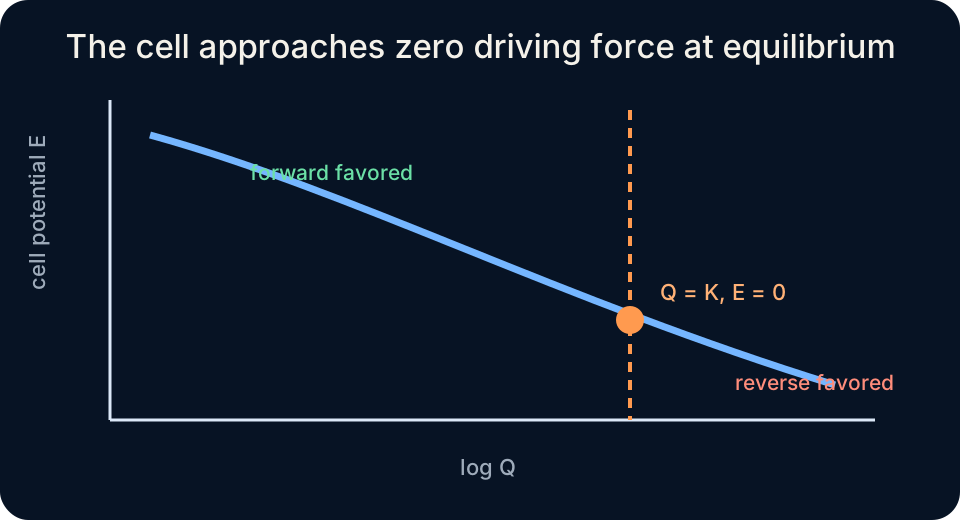
At equilibrium, actual and therefore for the reaction as written. The reaction quotient equals the equilibrium constant, . Substituting into the Nernst equation gives . Rearrangement yields . This is equivalent to combined with .
A positive standard cell potential implies for the forward reaction. A large positive potential can correspond to an enormous equilibrium constant because voltage enters an exponential relationship. A negative standard potential implies for that orientation, meaning the reverse reaction is favored under standard-state comparison. Equilibrium does not require equal reactant and product concentrations. It requires chemical-potential balance represented by .
For and at , . Thus for the idealized zinc-copper reaction. The huge value indicates strongly product-favored equilibrium. It does not guarantee rapid electron transfer or large operating current. Thermodynamic position and kinetic performance remain separate.
Analyze concentration cells
A concentration cell uses chemically identical electrode couples at different activities. Standard potentials cancel because both half-cells have the same intrinsic reduction potential. The cell voltage arises entirely from the composition gradient. The spontaneous process transfers material in a direction that reduces the concentration difference. Chemical mixing free energy becomes electrical work.
For metal-ion electrodes , the more concentrated ion solution has the greater reduction tendency under common conditions. It acts as the cathode, while the dilute side acts as the anode where metal dissolves and raises ion concentration. Electrons flow externally from the dilute side to the concentrated side. Salt-bridge ions preserve electroneutrality. The cell operates until activities approach equality, at which point voltage approaches zero.
If two half-cells have concentrations and , the ratio produces a nonzero Nernst voltage with . At , magnitude is . The concentrated side is the cathode. The result is smaller than many chemically different galvanic cells because no standard-potential difference contributes. Its energy source is the free-energy decrease associated with reducing the concentration gradient.
Interpret temperature dependence carefully
Temperature appears explicitly in the Nernst correction and implicitly in , activities, and equilibrium constants. Holding and artificially fixed, a larger increases the magnitude of the composition correction . Real standard potentials also vary with temperature because reaction enthalpy and entropy influence Gibbs energy. A simple correction using only the explicit factor may therefore be incomplete over a wide range. Values should be evaluated at the same stated temperature.
The temperature dependence of standard potential follows when property changes are treated as constant. A positive reaction entropy makes the term increasingly influential as temperature rises. Differentiation gives a connection between potential slope and reaction entropy under appropriate conditions. This relationship allows electrochemical measurements to reveal thermodynamic properties. It also explains why the shortcut should not be transplanted to another temperature.
Temperature also changes kinetics, conductivity, viscosity, diffusion, and electrode behavior. A warmer cell may deliver more current even if its equilibrium voltage changes only modestly. Conversely, side reactions or material degradation can accelerate and reduce useful performance. An experiment comparing voltage across temperatures must allow equilibration and distinguish open-circuit potential from loaded behavior. Thermodynamic and kinetic temperature effects should be reported separately.
Distinguish open-circuit and operating voltage
The Nernst equation describes an equilibrium electrode or cell potential for specified activities and temperature. A high-impedance voltmeter approximates open-circuit measurement by drawing negligible current. When a load is connected, finite current produces activation overpotential, ohmic loss, and concentration polarization. Terminal voltage then differs from the equilibrium Nernst value. The difference depends on current and cell construction.
Ohmic loss follows approximately , where is current and is internal resistance. Activation overpotential arises from finite electron-transfer kinetics at electrode surfaces. Concentration polarization arises when transport cannot replenish reactants or remove products as quickly as reaction consumes or produces them. These losses dissipate available free energy. The Nernst equation remains the thermodynamic reference around which operating behavior is analyzed.
Measuring voltage without allowing equilibrium time can also give unstable values. Electrode surfaces may require conditioning, temperature must equilibrate, and liquid-junction potentials can contribute offsets. Reference electrodes provide stable comparison potentials in analytical measurements. Calibration and uncertainty belong in voltage interpretation. More displayed digits do not remove electrochemical nonideality.
Account for activities and nonideal solutions
In real solutions, activity includes an activity coefficient . The standard concentration makes the ratio dimensionless. At very low ionic strength, may approach one and concentration becomes a useful approximation. At higher ionic strength, electrostatic interactions make effective chemical behavior differ from concentration. The Nernst equation fundamentally uses activities.
Individual ion activities cannot generally be measured independently without conventions because electroneutrality couples ions. Mean ionic activity coefficients are often used for electrolytes. Introductory problems usually suppress this complexity and use stated concentrations. The simplification should not be mistaken for a universal equality. Nonideal corrections become important in concentrated solutions and precision electrochemistry.
Gas activities are related to fugacity or approximated by pressure relative to standard pressure. Pure solid and liquid activities are one only while those phases are present and pure. If a solid solution or alloy changes composition, its activity may not be one. Quotient construction must follow actual phases. State labels therefore remain thermodynamic information in electrochemical calculations.
Diagnose common Nernst errors
The first error is building from half-reactions instead of the balanced overall cell reaction. The second is including pure solids in the quotient. The third is using ion charges as quotient exponents instead of stoichiometric coefficients. Writing the full reaction first prevents all three. Product activities belong above reactant activities for the chosen forward direction.
Another error is using at a temperature other than . The full equation uses kelvin temperature. Students may also forget division by or multiply electrode potentials by balancing coefficients. Potential is intensive, while controls energy per transferred charge in the correction. Unit and scaling checks reveal inconsistencies.
A final error is claiming that means the battery contains no chemical species or no molecular reactions occur. Zero equilibrium potential means no net thermodynamic driving force for the chosen reaction. Forward and reverse processes can continue dynamically. Under load, terminal voltage can reach zero for kinetic or resistance reasons before thermodynamic equilibrium. The measurement condition must accompany interpretation.
Practice the complete reasoning sequence
First, write the Nernst equation for . The quotient is , pure solids are omitted, and . Thus . At , it may be written . Every sign and exponent follows the balanced reaction.
Second, predict the effect of increasing copper-ion activity while holding zinc-ion activity fixed. The denominator of increases, so decreases. Its logarithm becomes smaller and the subtracted correction decreases. Forward cell potential therefore rises. This matches the physical idea that more oxidizing-agent reactant strengthens forward reduction driving.
Third, distinguish a measured open-circuit value from loaded terminal voltage. Open-circuit voltage after equilibration approximates the Nernst potential for interfacial activities and temperature. Loaded voltage is reduced by activation, ohmic, and mass-transport losses in a galvanic cell delivering current. The gap is not corrected by changing alone. A full explanation separates thermodynamic composition from kinetic and engineering performance.