
Electrolysis uses electrical energy to drive a redox reaction in a direction that is not spontaneous under the operating conditions. The process produces metals, purifies copper, generates industrial chemicals, charges some batteries, and applies protective or decorative coatings. Although an external power source changes the energy direction, the definitions of oxidation and reduction never change. Oxidation still occurs at the anode, reduction still occurs at the cathode, and electrons still move through the external circuit from the oxidation site toward the reduction site. The challenge is coordinating that invariant chemistry with electrode signs, ionic motion, and quantitative charge.
You will learn to compare galvanic and electrolytic cells, trace charge through each part of a cell, predict products in molten and aqueous electrolytes, and calculate product amount using current and time. You will interpret and Faraday’s law with units at every stage. You will also account for competing reactions, overpotential, resistance, and current efficiency. Diagrams will connect the visible apparatus to half-reactions and mole ratios. The goal is to understand electrolysis as coupled conservation of charge, matter, and energy.
Begin every problem by identifying the electrolyte, electrode materials, and whether the substance is molten or aqueous. Write candidate half-reactions at each electrode rather than guessing products from ion names. Use the external source to determine polarity, but use oxidation and reduction definitions to determine anode and cathode. Only after selecting and balancing half-reactions should you convert current and time into chemical amount. This order separates qualitative product prediction from quantitative yield.
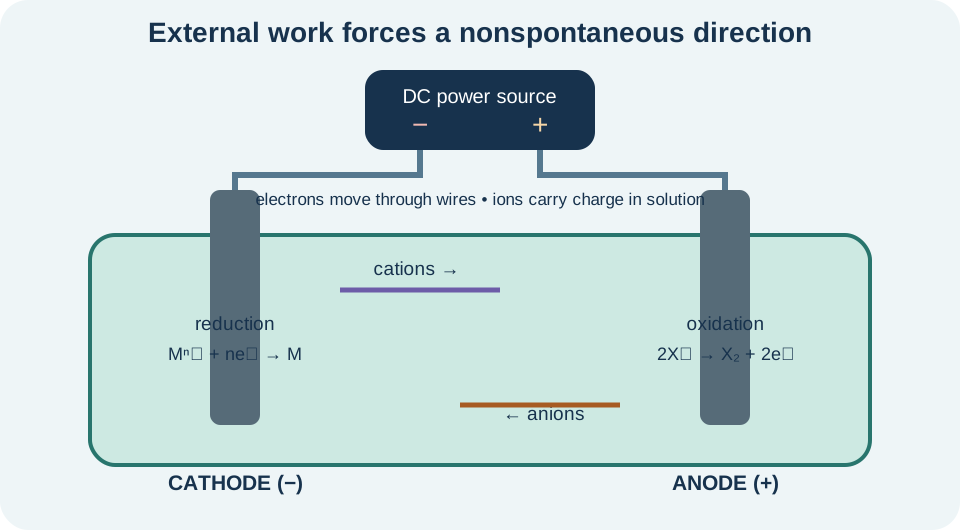
External electrical work forces the redox direction
A galvanic cell converts a spontaneous redox reaction into electrical work, whereas an electrolytic cell consumes electrical work to drive a nonspontaneous reaction. For a galvanic cell operating spontaneously, the cell potential is positive and the Gibbs energy change is negative. The relationship is , where is moles of electrons transferred per mole of reaction and is Faraday’s constant. Reversing the chemical reaction reverses the signs of and . An external source must then supply enough potential difference to maintain that reversed direction.
The power source separates charge at its terminals and pushes electrons through the external circuit. Its negative terminal supplies electrons to the electrolytic cathode, making that cathode negative relative to the electrolyte. Its positive terminal withdraws electrons from the electrolytic anode, making that anode positive. These signs differ from those of a galvanic cell because the source forces the direction. The process definitions remain invariant even when the signs change.
The applied voltage must usually exceed the magnitude suggested by reversible thermodynamics. Real systems also require voltage to overcome kinetic activation barriers at electrode surfaces, ohmic resistance through electrolyte and wiring, and concentration gradients near electrodes. The extra kinetic voltage is called overpotential. Consequently, observing that a power supply exceeds the standard cell-potential magnitude does not imply perfect energy conversion. Thermodynamic threshold and practical operating voltage are related but not identical.
Anode and cathode are defined by reactions
The anode is always the electrode where oxidation occurs. The cathode is always the electrode where reduction occurs. These definitions apply to galvanic cells, electrolytic cells, rechargeable batteries during either mode, and corrosion sites. Electrode sign is a consequence of operating mode rather than part of the definition. Remembering “anode oxidation, cathode reduction” is more reliable than attaching permanent signs to the names.
At an electrolytic cathode, electrons arriving from the negative source terminal are consumed by a reduction half-reaction. A metal ion may gain electrons and plate as solid metal, as in . At an electrolytic anode, a species loses electrons that are drawn toward the positive terminal. Chloride oxidation can be represented as . Electron placement in each half-reaction verifies its electrode role.
Conventional current points opposite electron motion in the metallic circuit because it is defined as the direction positive charge would move. Inside the electrolyte, charge is carried by ions rather than free electrons traveling through solution. Cations migrate generally toward the cathode, while anions migrate generally toward the anode. Migration helps prevent charge buildup as electrode reactions proceed. The complete circuit therefore combines electronic conduction outside the solution with ionic conduction inside it.
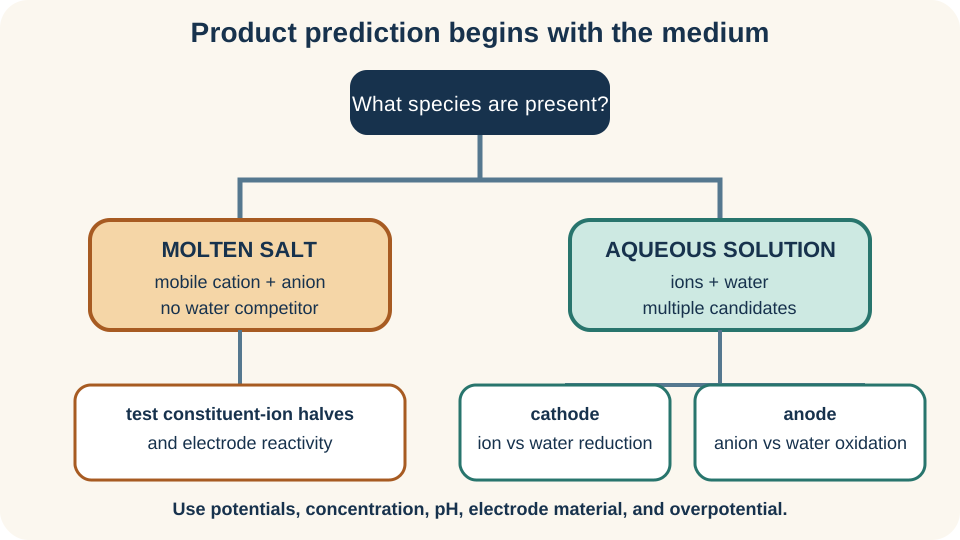
Molten electrolysis isolates the constituent ions
A molten ionic compound contains mobile cations and anions but no water. This simpler environment often makes introductory product prediction direct. In molten sodium chloride, moves toward the cathode and is reduced according to . Chloride moves toward the anode and is oxidized according to . Multiplying the sodium half-reaction by two permits electron cancellation.
The overall equation is . The state on sodium chloride indicates a molten ionic liquid rather than an aqueous solution. Two sodium atoms and two chlorine atoms appear on each side, and the overall equation is neutral. Electrical energy drives sodium ions toward elemental sodium even though sodium metal and chlorine gas would react spontaneously in the opposite direction under ordinary conditions. The equation is decomposition and redox as well as electrolysis.
Electrode material can still matter. An inert electrode such as graphite or a suitable noble metal is intended mainly to transfer electrons without becoming a stoichiometric reactant. A reactive electrode may dissolve, alloy, or form surface compounds and thereby change the half-reaction. “Inert” is conditional because no material is unreactive under every potential and chemical environment. Product prediction must include the actual electrode composition and operating conditions.
Aqueous electrolysis introduces competing reactions
Water adds candidate oxidation and reduction processes. At a cathode, a dissolved metal ion may be reduced, but water may instead form hydrogen gas under suitable conditions. At an anode, an anion may be oxidized, but water may instead form oxygen gas. Standard reduction potentials provide thermodynamic guidance, yet concentration, pH, electrode surface, and overpotential influence which pathway dominates. A simple activity-series rule is therefore a screening device rather than a complete prediction model.
For an aqueous copper(II) sulfate solution with inert electrodes, copper deposition is commonly represented by at the cathode. Sulfate is difficult to oxidize under ordinary aqueous conditions, so water can be oxidized at the anode: . Multiplying the copper half-reaction by two balances four electrons. The solution near the anode becomes more acidic because hydrogen ions are produced. The overall particle changes follow from adding the two balanced halves.
In concentrated aqueous sodium chloride, chloride oxidation to chlorine can compete successfully with oxygen formation, despite simplified standard-potential comparisons that might suggest otherwise. Chlorine production benefits from concentration and kinetic effects at suitable electrodes. At the cathode, water reduction commonly produces hydrogen and hydroxide rather than sodium metal because sodium-ion reduction is extremely unfavorable in water. Thus aqueous sodium chloride does not behave like molten sodium chloride. Solvent identity changes the candidate reaction set.
Current and time determine total charge
Electric current is the rate of charge flow. The relationship defines current as charge divided by elapsed time . Rearranging gives . In SI units, one ampere equals one coulomb per second, written . Multiplying amperes by seconds therefore leaves coulombs.
Suppose a current of flows for . The charge is . Seconds cancel between the current denominator and elapsed-time factor. Three significant figures are retained from the given current and time. The calculation finds total transported charge without yet specifying which chemical reaction used it.
Time must be converted to seconds when current is in amperes. For , use . The minute-to-second equality is exact, so it does not limit precision. Substituting minutes directly into while using coulombs per second would leave an invalid unit product. Unit cancellation should precede numerical evaluation.
Faraday’s constant connects charge to moles of electrons
Faraday’s constant is the magnitude of charge carried by one mole of electrons. A commonly used value is . The relationship converts total charge into moles of electrons . The subscript on identifies the counted species as electrons. Coulombs cancel, leaving moles of electrons.
For , write . The Faraday factor is oriented with coulombs in the denominator so the given coulombs cancel. This electron amount is an ideal charge inventory. A balanced half-reaction is still required to convert electron moles into product moles. Charge alone does not identify which species accepted or released those electrons.
Faraday’s constant is closely tied to elementary charge and Avogadro’s constant. One electron carries magnitude , and one mole contains entities, so conceptually . This relationship connects microscopic charge to macroscopic electrolysis. The sign of electron charge is handled through reaction direction, while is normally used as a positive magnitude. Keeping these meanings separate avoids inserting an unnecessary negative sign into amount calculations.
Half-reaction stoichiometry predicts ideal product amount
The copper deposition half-reaction states that two moles of electrons produce one mole of copper. From , use . Electron units and identities cancel. The coefficient ratio supplies chemical selectivity that current and time alone cannot provide. The factor orientation leaves moles of copper in the numerator.
Convert copper amount to mass using its molar mass. The calculation is to three significant figures. Moles of copper cancel, leaving grams of copper. This result assumes that all charge contributes to the stated copper reduction. It is therefore a theoretical electrochemical yield.
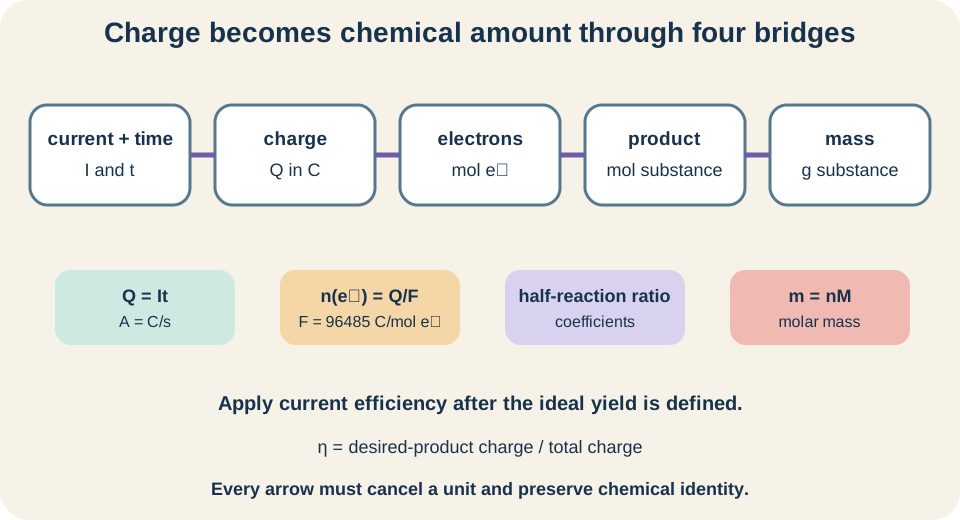
The complete path can be summarized as time to charge, charge to electrons, electrons to product moles, and product moles to mass. Each arrow requires a distinct relationship: current, Faraday’s constant, a balanced half-reaction, and molar mass. Combining the chain into one line is efficient only after each bridge is understood. Keeping the factors separate makes unit checking and diagnosis easier. The diagram should be readable in either direction when solving for time or current instead.
Current efficiency accounts for competing pathways
Not every coulomb necessarily produces the desired product. A competing reduction may generate hydrogen at a cathode while metal deposition occurs, or a competing oxidation may consume current at an anode. Current efficiency is the fraction of total charge assigned to the desired reaction. If expressed as a decimal, the actual product amount is . The Greek letter is read “eta.” Its value lies between zero and one for this simple fraction model.
If the ideal copper mass is and current efficiency is , first convert the percent to . Then to three significant figures. The missing ideal yield corresponds to charge consumed by other processes or operational losses represented by the efficiency model. Efficiency modifies yield but does not change the balanced stoichiometric ratio of the desired half-reaction. The observed mass should therefore not exceed the ideal value under these assumptions.
Faradaic efficiency is often product-specific. Several products can have efficiencies that sum approximately to one when all significant charge-consuming pathways are measured. Mass loss, poor adhesion, or later chemical dissolution can make recovered mass differ from charge-based deposition even when interfacial electron transfer occurred. Therefore a measured coating mass reflects both electrochemical selectivity and material retention. Experimental interpretation must distinguish these mechanisms.
Electroplating links charge to coating geometry
Electroplating places the object to be coated at the cathode so metal ions are reduced onto its surface. The metal-source arrangement varies: a soluble anode may replenish metal ions, or an inert anode may support another oxidation. Surface cleaning matters because oxides, oils, and particles interfere with nucleation and adhesion. Current distribution also matters because edges and protrusions can receive higher local current density. Uniform mass deposition does not automatically mean uniform thickness.
If deposited mass and metal density are known, coating volume is . For a uniform coating over area , average thickness is . Here is a length, not elapsed time, so symbol definitions must be stated. Units verify the relation: mass divided by mass per volume gives volume, and volume divided by area gives length. Converting the final length to micrometers may make the scale easier to interpret.
The ideal thickness model assumes a uniform, dense coating with known area and no inaccessible regions. Real roughness increases true surface area, while pores and nonuniform current alter local thickness. Agitation, ion concentration, temperature, additives, electrode spacing, and current waveform can affect deposit quality. Faraday’s law predicts total electrochemical amount more directly than spatial distribution. Geometry and transport must supplement the charge ledger.
Industrial electrolysis is an energy and materials system
The chlor-alkali process electrolyzes brine to produce chlorine, hydrogen, and sodium hydroxide in separated product streams. Separation is essential because products can react with one another if allowed to mix. Membranes manage ion transport while limiting undesired crossover. Electrode materials are selected for catalytic behavior, corrosion resistance, and product selectivity. The cell is therefore an engineered system rather than a beaker with two wires.
Aluminum production uses electrolysis because aluminum ions are difficult to reduce in water. Alumina is dissolved in a molten medium, lowering practical operating temperature relative to pure alumina. Large currents produce aluminum at the cathode, while carbon-containing anodes participate in oxygen-related reactions and are consumed. Energy demand depends on thermodynamics, overpotential, resistance, and heat management. The industrial equation must be interpreted together with actual cell materials.
Electrorefining uses an applied potential to dissolve impure metal at an anode and deposit purer metal at a cathode. Some impurities remain in solution, while others form anode residues depending on their chemistry. Selective potential control and electrolyte composition separate species. The same anode-oxidation and cathode-reduction definitions still apply. Scale changes engineering constraints, not foundational electron accounting.
Common errors and corrective checks
The most common conceptual error is assigning cathode and anode solely by sign. In an electrolytic cell the cathode is negative and the anode positive, but those signs reverse in a galvanic cell. Define electrodes through reduction and oxidation first, then infer signs from operating mode. Write an electron-containing half-reaction next to each electrode. Electron consumption must occur at the cathode and electron production at the anode.
A common numerical error is using amperes as though they were coulombs. Current is charge per time, so it must be multiplied by time in seconds to obtain charge. Another error is converting charge directly to grams without the half-reaction electron ratio and molar mass. Preserve the full chain and its units. A product requiring three electrons per ion cannot be calculated using a two-electron ratio.
A final error is assuming aqueous ions always discharge into their elements. Water may compete, and actual products depend on potential, concentration, pH, electrode material, and kinetics. List candidate half-reactions and compare them within the real conditions. Check whether gases, pH changes, or deposits support the prediction. Treat simplified rules as models with stated domains rather than universal laws.
Guided practice and retrieval
A current of flows for . Convert time to and calculate . Then divide by Faraday’s constant to obtain approximately . State which factors are exact and which given measurement controls significant figures. Do not choose a chemical product until a half-reaction is specified.
If silver deposits by , the electron-to-silver ratio is one to one. The preceding charge would ideally produce . Multiplication by gives approximately . At current efficiency, the expected retained mass under the simple model is about . Explain where each reduction in the reasoning chain enters.
Now compare molten sodium chloride with aqueous sodium chloride. The molten system offers sodium ions and chloride ions as the principal charge-carrying chemical species, permitting sodium formation at the cathode. The aqueous system also offers water, which is reduced preferentially to hydrogen under ordinary conditions rather than producing sodium metal. Chloride or water oxidation can compete at the anode depending on conditions. This comparison tests whether you identify the solvent as a reactant candidate.
Connection forward
Reconstruct the full electrolysis model without looking back. Identify anode and cathode from half-reactions, determine polarity from the external source, trace electrons and ions, list competing reactions, and balance the selected overall process. Convert current and time to charge, charge to electron amount, electron amount to product amount, and product amount to mass or gas volume. Apply efficiency only after defining the ideal yield. End with unit, charge, atom, and magnitude checks.
Electrolysis connects directly to cell potential and the Nernst equation because the required external voltage depends on reaction free energy and composition. It also connects to kinetics because overpotential and current density determine practical rates. Mass transport explains concentration gradients, while materials chemistry explains electrode stability and coating structure. Environmental analysis compares electrical energy sources, raw materials, product hazards, and recycling. The cell equation is necessary but not sufficient for evaluating the whole technology.
The enduring framework is conservation under forced direction. The power supply does not create electrons or atoms; it performs work that sustains a coupled electron transfer. Half-reactions conserve atoms and charge, Faraday’s law counts transported electrons, and stoichiometry maps that count into matter. Competing pathways explain why ideal and observed yield may differ. With those layers separated and then reconnected, electrolysis becomes a predictable quantitative system rather than a collection of sign rules.