
A logarithm is an exponent treated as an output. It answers the inverse question, “What power of this base produces that positive number?” This viewpoint turns logarithms from mysterious calculator buttons into a direct extension of exponent reasoning. Logarithms solve for unknown exponents, compress multiplicative ranges, and transform products into sums. This lesson derives each major rule, insists on domain and unit discipline, and connects symbolic procedures to meaningful applications.
Learning objectives and the inverse question
By the end of this lesson, you will translate fluently between exponential and logarithmic statements. You will derive and apply product, quotient, and power laws without inventing a false law for sums. You will solve exponential and logarithmic equations while checking every candidate against the original domain. You will interpret base, argument, output, and reference ratios in context. You will also explain how logarithmic transformations expose exponential structure in data.
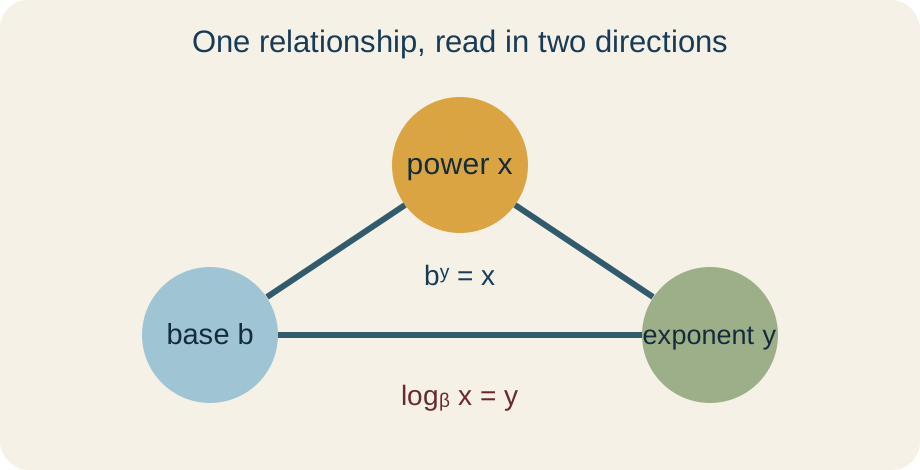
Inverse operations answer reversed questions. Addition asks for a sum, while subtraction can recover an unknown addend. Exponentiation asks for a power, while a logarithm can recover an unknown exponent. In , the base is , the exponent is , and the resulting power is . Reversing the question gives .
The notation contains three roles that should be read explicitly. The subscript is the base, the positive number is the argument, and the whole expression is the exponent that produces . Saying “log base of ” keeps these roles clear. Parentheses are helpful for complicated arguments, as in . The diagram below treats exponential and logarithmic forms as two readings of one relationship.
Define a logarithm precisely
For , , and , the definition is if and only if . The phrase “if and only if” means each statement guarantees the other. The condition keeps real powers consistently defined. Excluding is necessary because always equals one and cannot produce varied outputs. Requiring reflects the fact that a positive base raised to a real power is positive.
Several exact values follow immediately. Since , it follows that . Since , it follows that . If , then , and if the known base is five, the statement becomes . These facts are consequences of the definition rather than isolated rules.
Two bases receive special names. The common logarithm uses base and is often written when convention is clear. The natural logarithm uses base , where is approximately , and is written . The natural base is especially useful in continuous growth and calculus because the derivative of is itself. A calculator label should never replace identifying which base a problem requires.
Understand inverse functions and graphs
Exponentials and logarithms undo one another on their appropriate domains. The identities are for every real and for every positive . In the first identity, the logarithm asks for the exponent already displayed. In the second, the exponent is defined as the power needed to produce . These equations are inverse-function identities, not cancellation tricks without conditions.
The graph of is the reflection of across the line . Reflection exchanges input and output coordinates, so on the exponential graph corresponds to on the logarithmic graph. The exponential point becomes the logarithmic point . The exponential range of positive numbers becomes the logarithm’s domain . The exponential domain of all real numbers becomes the logarithm’s range of all real numbers.
The logarithmic graph has vertical asymptote . When , it increases slowly and tends toward negative infinity as approaches zero from the right. When , it decreases because its exponential inverse decreases. Neither graph crosses the vertical axis because zero is not in the domain. Any proposed logarithmic graph that includes a point with nonpositive input violates the definition.
Derive the logarithm laws
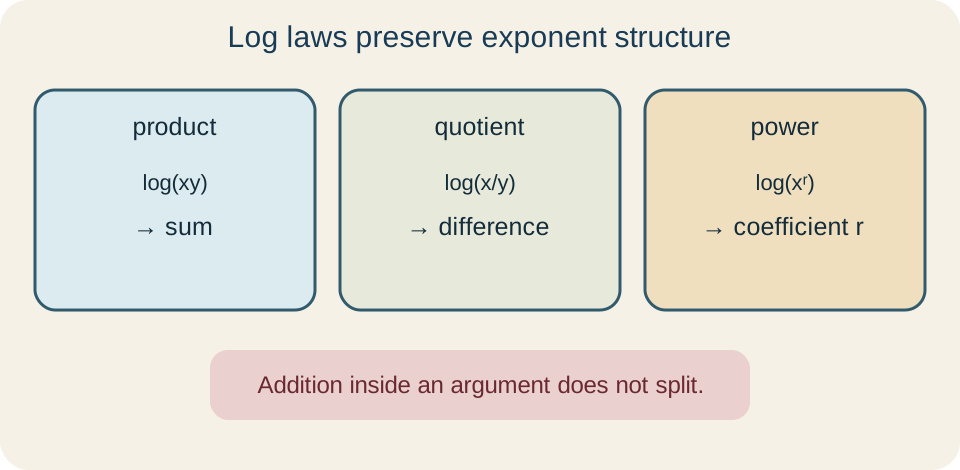
The product law comes from the exponent rule . Let and , so and . Then , which means . Substituting the definitions back gives . The law requires both and in real-number work.
The quotient law follows from . For positive and , it gives . The horizontal fraction bar denotes division of the entire numerator by the entire denominator. A quotient becomes a difference because dividing equal-base powers subtracts exponents. Reversing the rule combines a difference of logarithms into one logarithm of a quotient.
The power law follows from . It states when the real expressions are defined. The exponent moves to the front as a coefficient because a power of a power multiplies exponents. For positive and , one may expand . Every step preserves multiplication, division, or powers inside the argument.
Reject false laws and preserve structure
There is no law that turns into . The exponent laws include a rule for multiplying equal-base powers, not for adding them. A numerical counterexample settles the issue. Using base ten, , while . Since is approximately , the expressions are unequal.
Subtraction inside an argument does not split either. The expression has one argument, namely the entire difference . It also has domain restriction . Writing would instead mean by the quotient law. These are different functions with different domains and values.
A useful structural test is to identify the outermost operation inside the logarithm. If it is multiplication, division, or exponentiation, a valid law may apply. If it is addition or subtraction, keep the argument intact unless algebra first factors it into a product. For example, can become only on a domain where both factors are positive. Factoring alone does not erase the need for domain analysis.
Solve exponential equations
When both sides can be written with the same base, use one-to-one behavior. For , rewrite as . Equal positive-base powers with base other than one have equal exponents, so . Solving gives . Substitution verifies .
When a common base is inconvenient, take a logarithm of both sides. For , applying gives . The power law produces . Solving yields . Both sides of the original equation are positive, so taking logarithms is valid.
In a population model , ask when the population reaches . Dividing by gives the dimensionless ratio . Taking gives . Thus . Substitution confirms that this time produces the stated target population.
Solve logarithmic equations with domain checks
Before manipulating a logarithmic equation, require every argument to be positive. For , the conditions are and . Together they reduce to . This restriction belongs to the original equation and must remain visible through every algebraic step. A later polynomial equation may generate candidates outside it.
Using the product law gives . Exponential form then gives . Expanding and rearranging produces , whose candidates are and . Only satisfies . Direct substitution confirms the accepted solution.
Extraneous solutions often arise because combining logarithms and solving a polynomial forgets the individual argument restrictions. Consider . The domain requires , and the quotient law gives . One-to-one behavior yields , so . The result is valid because both original arguments are positive.
Change base and interpret the output
Change of base states for any valid base . To derive it, let , so . Taking gives . Dividing by the nonzero number isolates . This derivation shows that changing base rescales logarithmic outputs by a constant.
Calculators usually provide common and natural logarithms, so change of base evaluates other bases. For example, . The result is approximately , meaning is approximately seven. Because base two counts doublings, the output describes how many doubling steps connect one to seven. The same multiplicative position can be reported in another base with a different numerical scale.
Base choice determines the unit of multiplicative comparison. Base ten counts powers of ten, base two counts powers of two, and base measures natural exponential growth. Unlike ordinary physical units, these “steps” describe ratios rather than additive intervals. Converting bases resembles converting coordinate scales while preserving the underlying multiplicative relationship. A stated base is therefore part of the meaning, not merely notation.
Use dimensionless logarithmic scales
The argument of a logarithm must be dimensionless in a physically meaningful equation. One cannot take the logarithm of alone because changing from meters to centimeters would change the numerical argument arbitrarily. Instead use a ratio such as . The units cancel across the horizontal fraction bar. The logarithm then acts on a pure number.
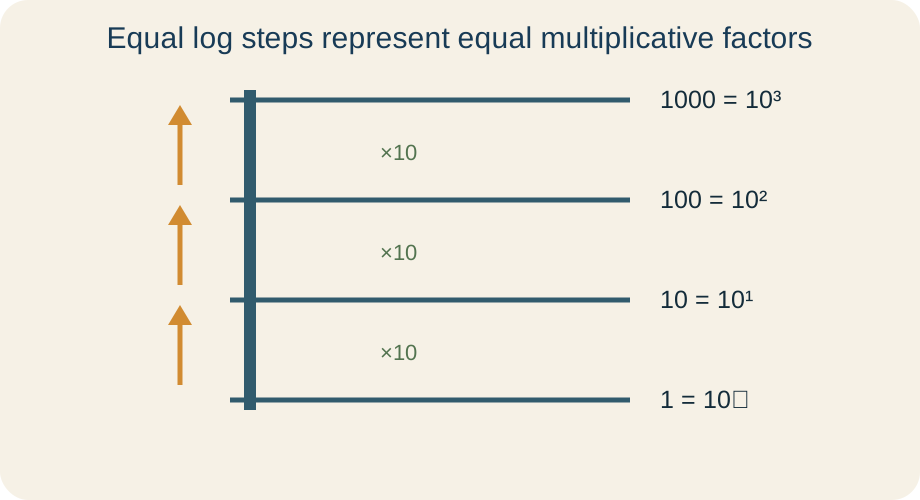
Sound level can be written , where and have identical intensity units. If , then the ratio is and the level is . Multiplying intensity by ten adds . The scale compresses enormous intensity ranges into manageable additive values. Decibels describe a ratio relative to a stated reference, not intensity itself.
The pH scale similarly uses a dimensionless activity relative to a standard state, although elementary formulas often abbreviate that detail. A one-unit pH change corresponds to a factor of ten in hydrogen-ion activity. Earthquake magnitude and information measures also encode multiplicative or probabilistic relationships logarithmically. Each application has its own coefficient, base, and reference convention. Interpret the definition used rather than transferring conclusions mechanically between scales.
Linearize exponential relationships carefully
If with and , taking natural logarithms gives . The transformed equation is linear in . A plot of against should therefore be approximately a straight line when the exponential model is suitable. Its slope estimates , and its vertical intercept estimates . Exponentiating the intercept recovers .
Linearization is useful but changes the error structure. Equal vertical errors in do not become equal errors in . Small positive values can receive relatively large influence after transformation. Zero and negative observations cannot be logged in real-number analysis. A statistically sound method must match assumptions about whether errors are additive, relative, or otherwise structured.
Residuals should be checked in the scale relevant to the scientific question. Curvature in a log-transformed plot indicates that the relative rate may not be constant. A straight-looking line over a short range does not prove the mechanism is exponential. Compare alternative models and examine whether fitted parameters remain stable as more data arrive. Transformation is a diagnostic and computational tool, not a guarantee of truth.
Guided practice and error analysis
Expand for positive and . The quotient law gives . Applying the power law gives . The coefficients three and two originated as exponents. Positivity ensures every logarithm is defined.
Condense for positive and . The power law in reverse gives . The quotient law then gives . The horizontal fraction bar groups the entire squared numerator over . The original positivity conditions remain sufficient for the condensed expression.
For independent synthesis, solve . State the domain before combining terms, convert the resulting logarithmic statement to exponential form, and solve the polynomial. Check every candidate in the original equation. Then explain why directly writing would be invalid. Your explanation should refer to multiplication structure rather than merely saying the rule is wrong.
Synthesis and connection forward
A logarithm reports an exponent relative to a chosen base. Its definition explains exact values, graph behavior, inverse identities, and domain restrictions. Exponent laws generate the product, quotient, and power laws. Those laws preserve multiplicative structure and never split sums or differences. Domain checks and dimensionless arguments keep symbolic work meaningful.
The most reliable problem-solving sequence begins by identifying the inverse question. State the base and argument, record the domain, and decide whether exponential form or logarithmic form makes the unknown easier to isolate. Apply only laws supported by exponent structure. Solve the resulting equation and substitute candidates into the original statement. Interpret the final number with units and reference information supplied by the model.
Logarithms connect Algebra II to calculus, statistics, chemistry, physics, and information theory. They solve for growth time, turn power laws into linear relationships, and measure multiplicative scale. In calculus, the natural logarithm has derivative and helps integrate reciprocal expressions. In data analysis, transformations can reveal patterns while changing error assumptions. The inverse-exponent viewpoint remains the conceptual anchor across all of these uses.