
A reversible reaction can reach a dynamic state in which forward and reverse reaction rates are equal. Concentrations then remain constant at the macroscopic scale even though molecular events continue in both directions. An equilibrium constant compresses the equilibrium composition relationship into one temperature-dependent number for a specifically written balanced reaction. It does not require equal reactant and product amounts, and it does not report how quickly equilibrium is reached. Learning to read that number requires attention to activities, coefficients, phases, and reaction direction.
You will learn to construct thermodynamic equilibrium expressions, understand concentration and pressure shorthand, omit pure solids and liquids for the correct reason, transform constants when equations are reversed or scaled, and use alongside the reaction quotient . You will solve simple equilibrium-composition problems with an ICE table and test approximations rather than assuming them. Every exponent, bracket, subscript, and standard-state ratio will be explained. Calculations will retain units on measured quantities while recognizing that thermodynamic activities and are dimensionless. The goal is to connect symbolic expressions to molecular competition between forward and reverse processes.
Begin each equilibrium problem by writing and balancing the exact reaction of interest. Record temperature and physical states because changing either can change the constant or its expression. Construct the activity expression from products over reactants with stoichiometric coefficients as exponents. Only then introduce ideal concentration or pressure approximations if the problem justifies them. Finish by checking whether the calculated composition is nonnegative, mass-balanced, and consistent with the magnitude of .
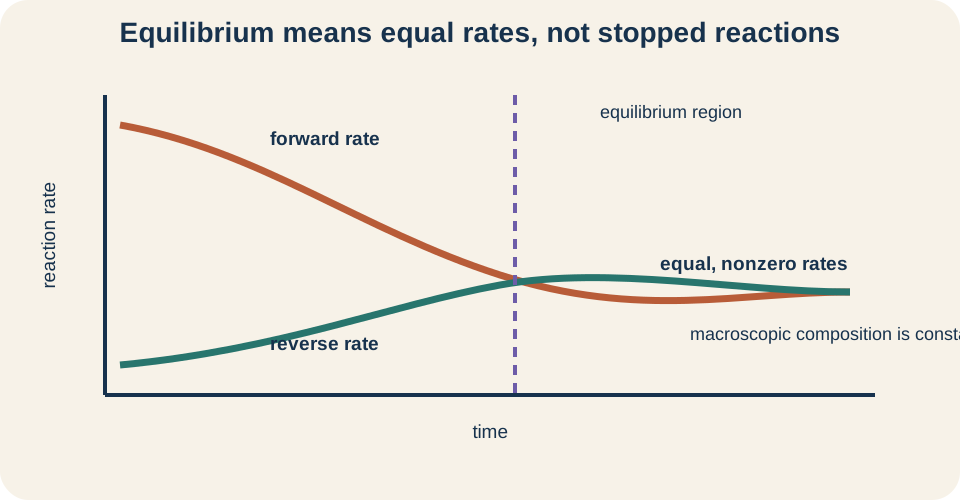
Equilibrium is dynamic rather than motionless
For a reversible reaction , particles of A convert to B while particles of B convert to A. Initially, a sample containing mostly A may have a large forward rate and a small reverse rate. As B accumulates, the reverse rate increases while changing composition can reduce the forward rate. Equilibrium occurs when the two rates become equal. Equal rates cause no net macroscopic change even though individual conversions continue.
Equal rates do not imply equal concentrations. If the forward and reverse rate relationships differ, the common rate can occur with much more B than A or much more A than B. Equilibrium composition depends on energetics, temperature, and the written reaction. A constant concentration trace is evidence of no net change, not evidence that reactions have stopped. Microscopic exchange continues around a stable macroscopic average.
Equilibrium also does not mean the system is isolated from all possible disturbances. A closed reaction mixture can exchange energy with surroundings while retaining matter, and it can establish equilibrium at fixed temperature. Changing temperature, pressure, volume, or composition disturbs the existing state and causes net change until a new equilibrium is reached. The equilibrium constant changes with temperature, while many other disturbances change composition at the same constant. Stating the constraint is part of stating the equilibrium problem.
The thermodynamic expression uses activities
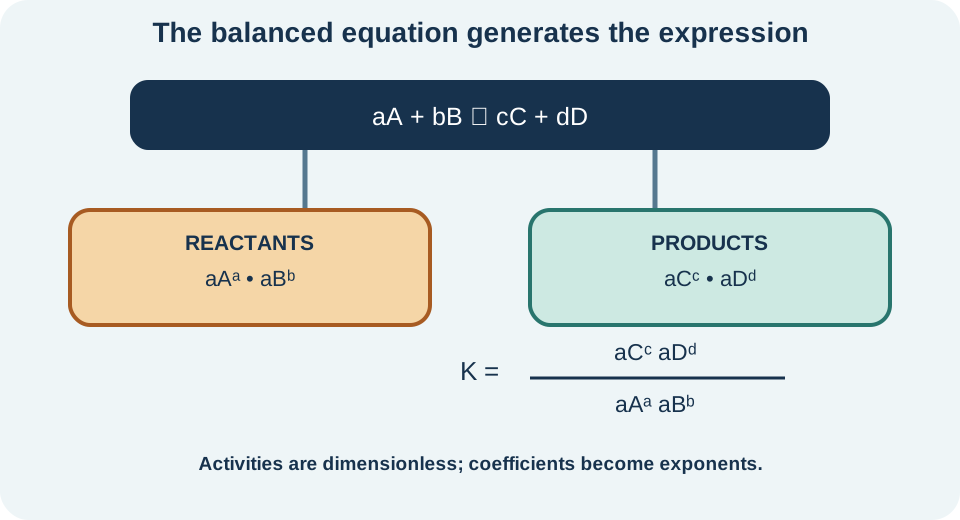
For , the thermodynamic equilibrium constant is . The lowercase italic denotes the activity of species , not a stoichiometric coefficient. The italic letters , , , and in the balanced equation are coefficients and become exponents in the expression. Product activities appear in the numerator and reactant activities in the denominator. Every activity is evaluated at equilibrium when the expression equals .
Activity is an effective, dimensionless measure of chemical availability relative to a standard state. For a solute, it can be represented as , where is an activity coefficient, is concentration, and is the standard concentration. The ratio is dimensionless because numerator and denominator share concentration units. In an ideal dilute solution, approaches one. The familiar concentration expression is therefore an approximation to the thermodynamic form.
For a gas, activity is often modeled as , where is fugacity and is standard fugacity. At sufficiently low pressure, fugacity is approximated by partial pressure, giving . Again the standard-state ratio removes units. Textbook expressions often write pressures or concentrations without explicitly showing those denominators. Remembering the hidden standard states explains why a thermodynamic equilibrium constant is dimensionless.
Stoichiometric coefficients become exponents
Consider . The activity expression is . The exponent two comes from the ammonia coefficient, while the exponent three comes from the hydrogen coefficient. An omitted exponent means one, just as an omitted reaction coefficient means one. The exponents make the constant depend on the exact scale of the written equation.
In a dilute-solution approximation, brackets such as denote molar concentration of A. The corresponding shorthand for is often written . The subscript signals concentration-based representation, not the stoichiometric coefficient . Strictly, each bracketed concentration is compared with its standard state. The shorthand is useful when its ideality assumptions are understood.
Coefficients must be established before the expression is written. Changing a balanced equation changes the exponents and therefore changes the numerical value of its constant. Subscripts inside formulas never become exponents merely because they count atoms. For , the expression contains because the coefficient is two. The formula subscript in belongs to molecular identity and does not create a fourth power.
Pure solids and liquids have constant standard-state activity
The activity of a pure solid or pure liquid in its standard state is defined as one. Therefore these phases do not appear explicitly in the equilibrium expression. For , the constant is because the two pure-solid activities equal one. In an ideal-gas pressure approximation, this becomes . The solids remain chemically necessary even though their activities do not vary in the expression.
Omission does not mean the amount of solid is irrelevant under every condition. At least some of each required pure phase must be present for the stated heterogeneous equilibrium to coexist. Removing all calcium carbonate eliminates a reactant phase and changes the applicable physical state. Adding more of an already present pure solid generally does not change equilibrium gas pressure at fixed temperature because its activity remains one. Phase presence and phase activity are different concepts.
Solvents require similar care. Pure liquid water is omitted from many aqueous equilibrium expressions because its activity is approximately constant and included in the constant. In concentrated solutions, water activity can depart meaningfully from one. A gaseous or dissolved species with formula is not automatically omitted, because its activity can vary. Decide from physical state and standard-state model rather than from formula name alone.
The magnitude of K describes equilibrium position
A very large means the activity product in the numerator is much larger than the corresponding denominator product at equilibrium for the reaction as written. Chemists often summarize this by saying products are favored. A very small means reactants are favored. A value near one indicates that neither side overwhelms the other under the expression’s weighted activity ratio. These statements concern equilibrium position, not completion in an absolute sense.
Suppose for a simple one-to-one reaction. The equilibrium tends strongly toward the written products, yet some reactant may remain and exact composition depends on starting amounts and constraints. Suppose instead . The written forward reaction has little equilibrium extent from many ordinary starting mixtures, but product concentration is not mathematically required to be zero. “Favored” is comparative rather than all-or-nothing language.
The magnitude of says nothing direct about rate. A reaction can have a large equilibrium constant and proceed extremely slowly because of a high activation barrier. A catalyst can accelerate approach to equilibrium without changing at fixed temperature. Forward and reverse rate constants may relate to in a specified elementary model, but their absolute sizes determine timescale. Thermodynamics addresses position; kinetics addresses speed.
Reaction algebra transforms equilibrium constants
Reversing a reaction inverts its equilibrium expression. If has , then has . The original numerator becomes the reverse denominator and vice versa. A product-favored forward reaction becomes reactant-favored when written backward. Always attach a constant to its exact reaction direction.
Multiplying every coefficient by a factor raises the original expression to that power. If has , then has . Dividing every coefficient by two would take the square root of the original constant. This behavior follows because all activity exponents scale with the equation. The constant is not an intrinsic standalone label for a set of substances.
Adding reactions multiplies their equilibrium constants after intermediate species cancel. If reaction 1 has and reaction 2 has , their sum has . Taking logarithms turns this product into a sum, consistent with addition of standard Gibbs-energy changes. Reverse, scale, and add operations can be combined. Perform the reaction algebra first and apply the matching constant operation at each step.
The reaction quotient compares a current state with equilibrium
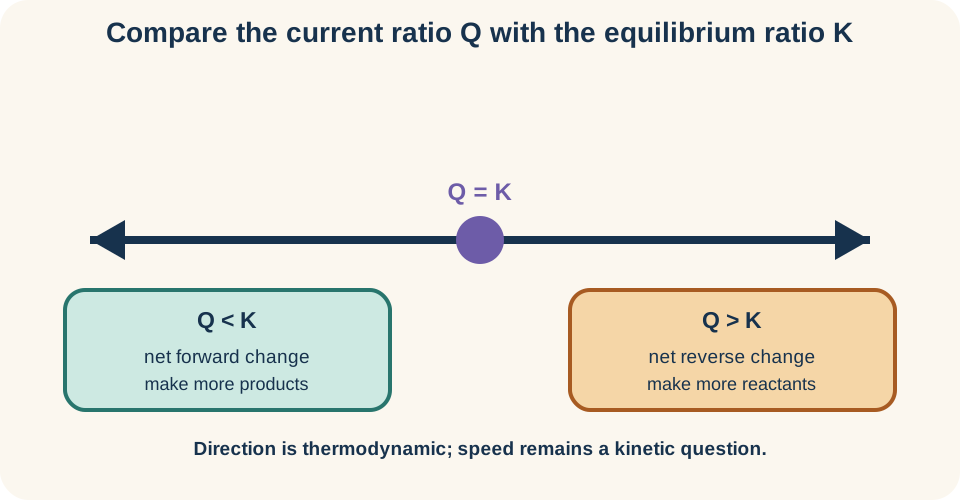
The reaction quotient uses the same activity expression as but evaluates it at the current composition, which need not be equilibrium. If , the activity ratio is too product-poor relative to equilibrium, so net forward change is favored. If , the mixture is too product-rich, so net reverse change is favored. If , the state is at equilibrium. This comparison predicts net direction, not instantaneous molecular silence.
For with , suppose the current activities are and . Then . Because , net production of B is favored until the ratio reaches four under the maintained conditions. Both forward and reverse molecular reactions may occur during this change. The word “net” keeps the dynamic picture intact.
The Gibbs-energy connection is . The symbol is the gas constant, is absolute temperature, and is standard reaction Gibbs energy. At equilibrium, and , giving . A large corresponds to a negative standard Gibbs-energy change. The equations unify composition, direction, and energetic driving force.
ICE tables organize composition changes
An ICE table records Initial, Change, and Equilibrium amounts or concentrations for each species. The change row must follow balanced stoichiometric coefficients. For starting with concentration and no B, let be the amount of concentration converted forward. Then the equilibrium concentrations are and . The same variable appears with opposite signs because A is consumed while B is formed.
Suppose and for the one-to-one reaction. The concentration expression gives when concentrations are understood relative to standard concentration. Multiply both sides by to obtain . Solving gives . Thus equilibrium concentrations are A and B.
Check the solution by substitution: . Both concentrations are nonnegative and their sum preserves the original one-to-one material amount. An algebraic root that makes a concentration negative must be rejected as physically inadmissible. For coefficients other than one, the change row uses corresponding multiples such as or . The balanced equation, not convenience, controls those entries.
Quadratic equations and approximation checks
Many equilibrium problems produce a quadratic equation. For starting with A only, equilibrium concentrations might be and . The expression contains and leads to a quadratic after rearrangement. Both mathematical roots should be calculated. Chemical constraints then identify any root that would produce negative concentrations.
When is small, an approximation such as may simplify the algebra. This approximation says the change is small relative to the initial concentration. It must be tested after solving, often by computing . A common classroom guideline accepts a change below about five percent, but the required accuracy should determine the threshold. Never invoke the approximation merely because it is familiar.
If the check fails, solve the unapproximated polynomial or use an appropriate numerical method. Retaining the exact denominator preserves mass balance and avoids systematic error. A calculator result still requires root screening, significant figures, and substitution into the original expression. Approximation is a model decision rather than an algebraic entitlement. Reporting its test makes the reasoning auditable.
Kc and Kp use different ideal representations
For gas reactions, uses concentration ratios while uses partial-pressure ratios. Under ideal-gas assumptions, they are related by . The exponent is the sum of gaseous product coefficients minus the sum of gaseous reactant coefficients. Only gaseous species count in this exponent. A consistent convention of standard-state ratios is implicit in the compact relationship.
For , . Therefore within the ideal convention. The two numerical constants need not be equal because pressure and concentration representations scale differently when gas mole count changes. If , the compact ideal relation gives equal numerical values. Temperature and unit conventions must be handled consistently.
Neither nor is a different equilibrium phenomenon. Both approximate the same underlying activity relationship using different measurable variables. At high pressure or strong nonideality, fugacity and activity coefficients improve the model. Introductory formulas work best when their assumptions are stated. The thermodynamic constant remains dimensionless even when shorthand calculations appear to carry powers of concentration or pressure units.
Temperature changes K; catalysts do not
The equilibrium constant has a particular value at a particular temperature for a particular written reaction. Heating changes molecular energy distributions and can change . The direction of that change depends on reaction enthalpy. For an endothermic forward reaction, increasing temperature commonly increases over an applicable range. For an exothermic forward reaction, increasing temperature commonly decreases .
The van ’t Hoff relationship gives a quantitative temperature connection under suitable approximations: . The subscripts label two temperatures and their constants. Absolute temperatures must be in kelvins, and the energy units of must match those in . The equation often treats standard enthalpy as approximately constant over the temperature interval. It expresses temperature sensitivity rather than a reaction-rate law.
A catalyst changes activation barriers for both forward and reverse pathways without changing the equilibrium free-energy difference. It therefore does not change or the equilibrium composition at fixed temperature. It can make the equilibrium state reachable much sooner. Changing initial composition also does not change at fixed temperature, although it changes and thus the direction of net adjustment. Separate changes to state from changes to the governing constant.
Common errors and corrective habits
A common error is inserting every species from the equation into the expression. Pure solids and liquids have standard-state activity one and are omitted explicitly. Another error is using formula subscripts as exponents. Only balanced stoichiometric coefficients determine exponents. Write the balanced equation directly above the expression and map each coefficient deliberately.
A second error is attaching one constant to any rearrangement of the reaction. Reversal takes the reciprocal, coefficient scaling takes a power or root, and reaction addition multiplies constants. A third error is interpreting large as fast. State equilibrium position and kinetic rate in separate sentences. A catalyst is the clearest test of whether those ideas have been separated.
Numerical errors often arise from an ICE change row that violates stoichiometry or from accepting a negative-concentration root. Substitute the proposed equilibrium values into material balances and the original expression. Test every small-change approximation after solving. Keep temperature in kelvins and distinguish current from equilibrium . These checks are faster than debugging an unexplained calculator output.
Guided practice and retrieval
Write the equilibrium expression for . The activity form is . Product activity appears above the horizontal fraction bar, reactant activities below, and coefficients become exponents. Reversing the reaction takes the reciprocal. Halving every coefficient takes the square root of the original constant.
For , explain why the expression contains only carbon dioxide activity. The pure solid activities are fixed at one while those phases coexist in their standard states. Adding more calcium carbonate does not change equilibrium carbon dioxide pressure at fixed temperature if both solid phases remain present. Removing an entire phase can change which equilibrium description applies. Omission from the expression is not omission from the physical system.
Suppose a current composition gives while . Since , the activity ratio contains too much product relative to equilibrium, so net reverse change is favored. This conclusion says nothing about how quickly the adjustment happens. As the mixture changes in the reverse direction, approaches . At equilibrium the forward and reverse rates are equal and .
Connection forward
Reconstruct the full workflow from memory. Balance the exact reaction, record temperature and phases, construct an activity expression, apply justified ideal approximations, and distinguish current from equilibrium . Explain why coefficients become exponents and why pure phases contribute activity one. Then apply reverse, scale, and addition rules to reaction algebra. End by testing any equilibrium composition against nonnegativity, conservation, and the original expression.
The reaction-quotient and Le Châtelier lesson will use to analyze disturbances without replacing it with a verbal slogan. Acid–base equilibria will apply the same framework to proton-transfer constants, while solubility equilibria will apply it to ion products and precipitation. Gibbs free energy supplies the energetic relation . Kinetics explains how quickly the equilibrium state is approached. Each application rests on the same activity-based foundation.
The central lesson is specificity. An equilibrium constant belongs to one balanced reaction at one temperature under a defined standard-state framework. Its magnitude describes a weighted equilibrium composition ratio, not equality, completion, or speed. Activities make the constant dimensionless and connect ideal shorthand to real chemical behavior. Reaction algebra, ICE tables, and comparisons then become consequences of that definition rather than isolated tricks.