
A system at chemical equilibrium is not motionless. Forward and reverse reactions continue, but their rates are equal, so macroscopic composition remains constant. A disturbance can make those rates unequal and cause a net composition change. The reaction quotient, , tells whether the current composition satisfies the equilibrium condition. Comparing with the equilibrium constant, , predicts the direction of net change.
Le Châtelier’s principle offers a qualitative summary: an equilibrium system responds to a disturbance in a direction that partially counteracts it. That language is useful when it follows careful bookkeeping. Used alone, words such as “stress” and “shift” can hide which quantities changed and why. The – comparison supplies the mechanism behind the mnemonic. It also identifies cases in which no shift occurs.
This lesson begins with a balanced general reaction and builds the quotient from activities. It then treats concentration, pressure, volume, temperature, dilution, and catalysts one at a time. Every case will distinguish the immediate physical change from the subsequent chemical response. This before–immediately-after–new-equilibrium timeline prevents many contradictions. The same reasoning will later support acid–base, solubility, and electrochemical equilibria.
Learning objectives and an opening model
After this lesson, you should construct a reaction quotient from a balanced equation. You should compare with to predict net forward reaction, net reverse reaction, or equilibrium. You should analyze disturbances using a precise event timeline. You should distinguish a composition shift from a change in the numerical value of . You should also explain why catalysts change approach time but not equilibrium composition.
Consider the reversible reaction . Suppose equilibrium has been reached and then additional A is injected at constant temperature and volume. Immediately, the amount and partial pressure of A rise, while B has not yet had time to react. The quotient falls because A appears in its denominator. Since , net forward reaction follows until again.
Notice the two stages. Addition changes composition physically before chemical reaction appreciably proceeds. Reaction then consumes some added A and forms B, partially opposing the original composition change. The system does not necessarily restore every concentration to its old value. It restores the equilibrium ratio required by the unchanged .
Build the reaction quotient from the equation
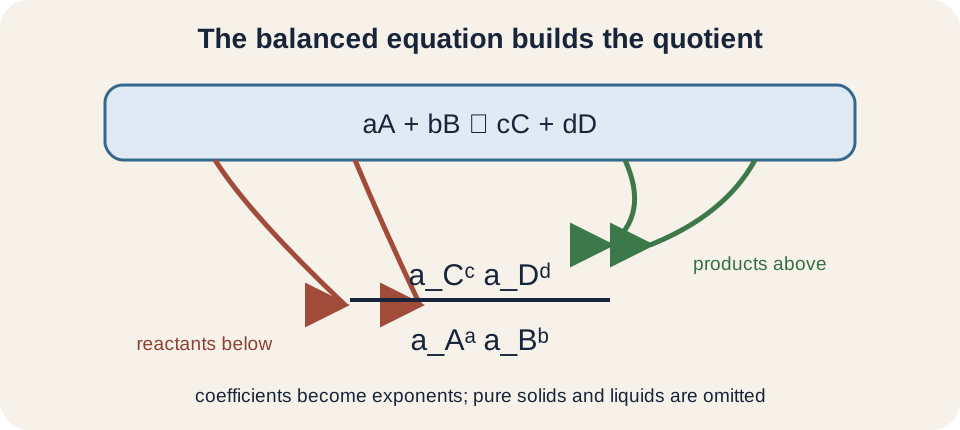
For , the activity reaction quotient is . Lowercase italic coefficients , , , and come from the balanced equation. Activity symbols such as represent dimensionless effective concentrations. Products appear above the horizontal fraction bar and reactants below it. Each activity is raised to its stoichiometric coefficient.
Pure solids and pure liquids have activities approximated as one and are omitted from ordinary equilibrium expressions. Their amount may matter for whether the phase remains present, but changing the amount does not change their activity under the model. Gases are often represented by partial pressure relative to a standard pressure. Dilute dissolved species are often approximated by concentration relative to a standard concentration. These approximations explain the familiar and expressions.
For , under the ideal-gas approximation. Each denotes a partial pressure, not total pressure. The exponents two, one, and three come from coefficients. One must balance the equation before constructing the quotient. Changing all coefficients by a common factor changes the corresponding numerical equilibrium constant.
Compare the current state with equilibrium
The equilibrium constant is the value of the reaction quotient at equilibrium for a specified reaction and temperature. Thus uses the same algebraic expression as . The difference is not formula structure but when the composition is sampled. can be calculated for any valid current composition. describes the equilibrium target ratio at the stated temperature.
If , the quotient must increase to reach . Net forward reaction generally raises product activities and lowers reactant activities, increasing the quotient. If , net reverse reaction lowers product activities and raises reactant activities, decreasing the quotient. If , the system is at equilibrium under the modeled conditions. These comparisons predict net direction, not reaction speed.
A tiny does not automatically mean the forward reaction is fast. Thermodynamics identifies the favored direction, while kinetics controls how rapidly composition changes. A high activation barrier can make an out-of-equilibrium mixture persist. Likewise, equality of and does not mean reactions stop. It means forward and reverse rates are equal, producing no net composition change.
Use a three-snapshot timeline
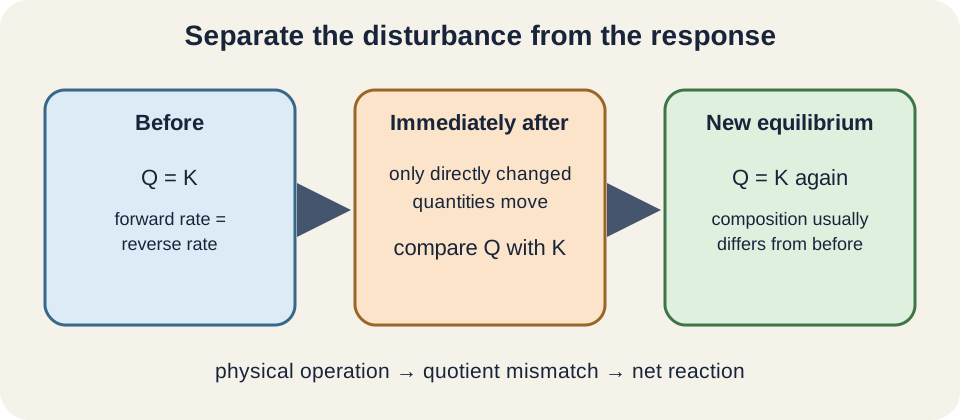
Analyze every disturbance with three snapshots: before disturbance, immediately after disturbance, and after re-equilibration. Before disturbance, if the system begins at equilibrium. The immediate snapshot changes only quantities directly affected by the physical operation. Reaction has not yet had time to alter the remaining species. Comparing the immediate with the fixed-temperature predicts what follows.
During re-equilibration, species change according to stoichiometry. A forward shift increases product amounts and decreases reactant amounts. A reverse shift does the opposite. At the final equilibrium, again. The final composition is usually different from the initial one even though the quotient returns to the same numerical value.
This timeline resolves the phrase “the system opposes the change.” Adding reactant does not cause the system to remove every added particle. It consumes some of the added reactant while forming products until the required activity ratio returns. The original disturbance is only partially counteracted. The final reactant amount can remain larger than it was initially. Conservation laws and the finite equilibrium constant determine the new composition.
Concentration changes alter the quotient
For , the concentration approximation gives . Square brackets denote molar concentration in . Adding A raises the denominator immediately and lowers . If temperature is unchanged, remains fixed, so . Net forward reaction then consumes A and produces B.
Adding B raises the numerator and makes , producing net reverse reaction. Removing B lowers the numerator and produces net forward reaction. Removing A lowers the denominator, which raises the quotient and produces net reverse reaction. These cases can be reasoned from algebra rather than memorizing four separate rules. Always identify whether the directly changed species appears above or below the fraction bar.
Suppose , , and . Then , so the system is at equilibrium. If A instantly becomes , . Because , net forward reaction follows. Stoichiometric changes then raise the quotient until it returns to .
Volume changes in gas systems require exponent counting
Compressing an ideal gas mixture at constant temperature raises every reacting-gas partial pressure by the same factor immediately. Whether rises or falls depends on the difference between total gaseous product and reactant coefficients. For the ammonia reaction, there are two gaseous product moles and four gaseous reactant moles per stoichiometric event. If every partial pressure doubles, the numerator gains a factor while the denominator gains . The quotient is divided by four and falls below .
The subsequent net reaction goes toward the side with fewer gas moles, forward in this example. Expansion does the reverse because all partial pressures fall and the side with more total pressure exponents is affected more strongly. The phrase “compression favors fewer gas moles” is therefore an algebraic consequence of how scales. It applies to gaseous coefficients, not to solids or liquids. If gas coefficients sum equally on both sides, uniform volume change does not alter in the ideal model.
Volume and pressure are not independent operations. Decreasing container volume at fixed temperature changes reacting-gas partial pressures. Increasing total pressure by adding an inert gas at constant volume does not change their partial pressures in the ideal model. Consequently, remains unchanged and no equilibrium shift occurs. The word “pressure” alone is insufficient; the physical method must be specified.
Inert gas additions depend on constraints
At constant volume and temperature, adding an inert gas raises total pressure but leaves each reacting gas’s amount, volume, and temperature unchanged. By , each reacting partial pressure remains fixed. The quotient therefore remains equal to if the system began at equilibrium. No composition shift follows under the ideal-gas model. Total pressure changed without changing the quantities inside the equilibrium expression.
At constant total pressure, adding inert gas requires the container to expand. Expansion lowers all reacting-gas partial pressures. The quotient may then change depending on the gaseous coefficient difference. The system responds as it would to a volume increase. Thus inert gas can matter indirectly through the constraint used during addition.
This comparison illustrates a broad modeling lesson. The name of an added substance does not uniquely determine the result. Boundary conditions such as constant volume, constant pressure, and constant temperature belong in the problem statement. An answer that ignores them is incomplete. Write the gas law before applying a verbal equilibrium rule.
Temperature is different because it changes K
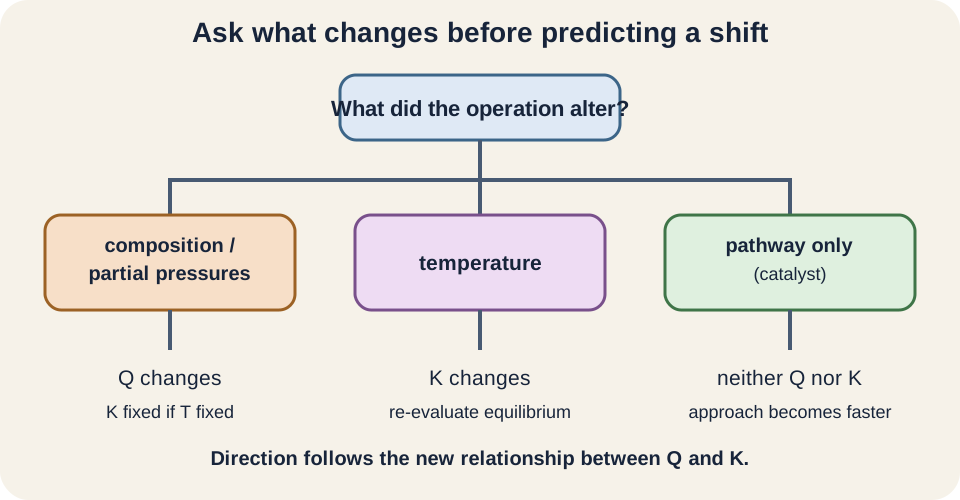
Concentration and pressure disturbances change immediately while leaving unchanged at constant temperature. A temperature change is fundamentally different because it changes the equilibrium constant. One can reason qualitatively by treating energy as a product for an exothermic forward reaction. Heating then favors the endothermic reverse direction. Cooling favors the exothermic forward direction.
For an endothermic forward reaction, energy is treated as a reactant. Heating favors net forward reaction and commonly increases . For an exothermic forward reaction, heating favors net reverse reaction and commonly decreases . The words “increase” and “decrease” refer to the constant written for the chosen forward equation. Reversing the reaction replaces with its reciprocal and reverses the enthalpy sign.
Temperature can also immediately change gas partial pressures or concentrations through expansion and density effects, depending on the apparatus. A rigorous analysis specifies what is held fixed and distinguishes those physical changes from the temperature dependence of . At the high-school level, many problems intend only the equilibrium-constant effect. State that assumption rather than leaving it implicit. Only temperature changes for a fixed reaction definition under the usual treatment.
Catalysts change rates, not the equilibrium condition
A catalyst provides an alternative pathway with lower activation energy. It increases both forward and reverse reaction rates for the same mechanism network. It does not alter the free-energy difference between reactants and products. Consequently, it changes neither nor the equilibrium composition. It can make equilibrium arrive sooner.
If a catalyst is added to a system already at equilibrium, forward and reverse rates both increase while remaining equal. There is no net composition shift. If it is added to a system with , the system still proceeds net forward but approaches equilibrium faster. Direction comes from compared with , not from the catalyst. Rate and equilibrium must remain separate ideas.
Enzymes illustrate the same principle in biological chemistry. They can make otherwise slow reactions occur rapidly under cellular conditions. Cells maintain nonequilibrium states through coupled reactions, material flows, and energy inputs, not because catalysts redefine equilibrium. Removing the coupling would allow the system to relax toward its thermodynamic equilibrium. Catalysis controls pathways and timescales.
Pure solids, liquids, and phase presence
Consider . The activity expression reduces to under the standard pure-phase approximation. Adding more calcium carbonate solid does not alter if a pure solid phase already remains. It increases the amount available, not its activity. Therefore it does not shift equilibrium composition by itself.
Removing an entire pure phase can change which equilibrium description remains physically possible. An expression that omits a solid assumes that phase is present to participate. If all calcium carbonate is consumed, the system cannot continue the forward decomposition according to the same phase assemblage. Phase amount is irrelevant within a range but crucial at its boundary. A phase-presence check must accompany the quotient calculation. This nuance is lost in the slogan “solids never matter.”
Changing particle size can change rate by changing surface area. Powdered solid may equilibrate faster than a large crystal. At equilibrium, however, pure-phase activity remains approximately one regardless of surface area under the basic model. Again, kinetics changes without a new equilibrium constant. Extremely small particles can introduce surface-energy effects beyond the elementary approximation.
Quantitative example with Q
For , suppose at a stated temperature. Let , , and . Using standard-state ratios implicitly, . Because , net forward reaction occurs. Hydrogen iodide increases while hydrogen and iodine decrease.
An ICE table can determine the new equilibrium composition. Let the forward change in each reactant pressure be and the product change be , following coefficients. The equilibrium quotient becomes . The unknown measures reaction progress in pressure units under the simplified constant-volume, constant-temperature ideal-gas setup. A physically valid root must keep every partial pressure nonnegative.
The direction prediction should precede equation solving. Since , the chosen signs must represent forward reaction. A negative solution for would contradict that sign convention or indicate algebraic mishandling. Substitution of the final values into the quotient provides a check. Comparing the recovered quotient with verifies equilibrium consistency.
Common misconceptions and repairs
One misconception says equilibrium shifts to “use up” an added substance completely. The response is partial and stops when . Another says concentrations become equal at equilibrium. Equilibrium requires a particular quotient, not equal numerical concentrations. A large or small can favor very unequal equilibrium compositions.
A second misconception says increasing pressure always favors products. Direction depends on gaseous stoichiometric coefficients and how pressure was changed. Compression favors the side with fewer gas moles in the ideal model. Adding inert gas at constant volume creates no change in reacting partial pressures. A reaction with equal gaseous coefficient sums shows no volume-driven quotient change.
A third misconception says the equilibrium constant changes whenever the equilibrium position changes. Concentration, pressure, and volume can shift composition while stays fixed. Temperature changes the numerical value of for the chosen reaction. Catalysts change neither composition target nor . Separating , , and rate resolves all three errors.
Practice and guided feedback
For , predict the response to adding sulfur trioxide at fixed temperature and volume. Then predict the response to compression. Finally, state what adding an inert gas at constant volume does. Use the quotient . Explain the immediate change before naming a direction.
Adding sulfur trioxide increases the numerator, so and net reverse reaction follows. Compression multiplies each partial pressure by a common factor, causing the denominator to gain three powers while the numerator gains two. The quotient falls, so net forward reaction follows toward two gaseous product moles from three gaseous reactant moles. Adding inert gas at constant volume leaves reacting partial pressures unchanged. Therefore remains equal to and no shift occurs.
Now suppose the forward sulfur trioxide formation is exothermic. Heating changes and favors the endothermic reverse direction. Cooling favors forward reaction and increases the equilibrium proportion of sulfur trioxide. A catalyst changes how quickly either new equilibrium is reached but not its composition. Each conclusion should be tied to a distinct physical cause.
Retrieval and connection forward
Without looking back, write the general activity quotient and explain why coefficients become exponents. State the three versus direction cases. Draw the before–immediate–final timeline for adding a reactant. Explain why compression and inert-gas addition at constant volume are not equivalent. Finish by distinguishing a catalyst’s kinetic effect from temperature’s thermodynamic effect.
Acid–base equilibria apply this same framework to proton transfer. Solubility equilibria use it to predict precipitation or dissolution. Electrochemistry relates reaction quotients to cell potential through the Nernst equation. Coupled biological reactions use large and small quotients to direct network flows. Mastering turns many specialized rules into one transferable comparison.
Keep the central model concise. describes the current activity ratio, and describes the equilibrium ratio at a specified temperature. A disturbance may change , change , change both under complex constraints, or change neither. Net reaction proceeds in the direction that restores when the system can equilibrate. Le Châtelier’s principle is the verbal shadow of that quantitative structure.