
Begin with the question Gibbs energy answers
Thermodynamics asks which direction of change is favored under specified conditions. At constant temperature and pressure, Gibbs free energy packages the system’s enthalpy and entropy into a state function suited to that question. A negative change predicts that the forward process is thermodynamically spontaneous for the stated composition, while a positive change predicts that the reverse direction is favored. The word spontaneous means capable of proceeding without continuous external driving after initiation, not necessarily rapid or dramatic. A reaction may be strongly favored and still proceed imperceptibly slowly because kinetics controls the pathway and barrier.
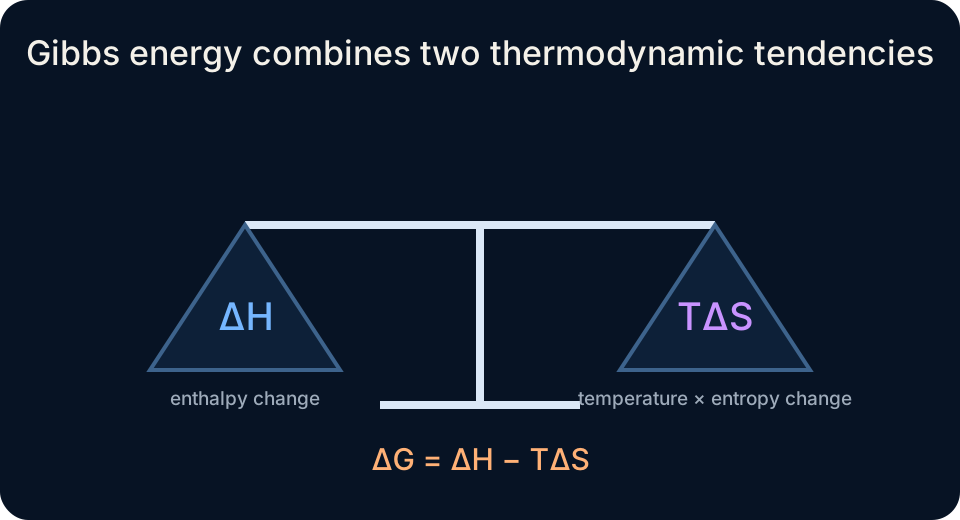
The Gibbs function is . Here is Gibbs free energy, is enthalpy, is absolute temperature in kelvins, and is entropy. The product has energy units because entropy is commonly measured in for a system and temperature is measured in kelvins. The subtraction balances an energetic tendency represented by enthalpy against dispersal possibilities represented by entropy. Every term refers to the same system state and compatible units.
This lesson builds from state-function meaning to equilibrium prediction. We will interpret , analyze temperature dependence, relate standard free energy to the equilibrium constant, and use the reaction quotient for nonstandard composition. We will also separate thermodynamic direction from rate and explain why a catalyst does not change equilibrium. Worked examples will carry units explicitly and test the sign against a physical prediction. By the end, you should be able to calculate, interpret, and communicate Gibbs-energy results rather than treating them as isolated sign rules.
Derive and interpret the change equation
For a process at constant temperature, the change form is . The symbol means final value minus initial value, so each change compares two defined states. Constant temperature allows to factor outside the entropy difference. If temperature varies substantially, a more careful path-dependent integration of property changes is required. Introductory calculations usually provide or assume one temperature for the entire comparison.
Unit consistency is essential because tabulated enthalpies are often in while entropies are in . Before subtraction, convert one energy scale so both terms use joules or both use kilojoules per mole. For example, . Multiplying by gives , because kelvins cancel. Subtracting quantities with mismatched units would be physically meaningless even if a calculator accepted the numbers.
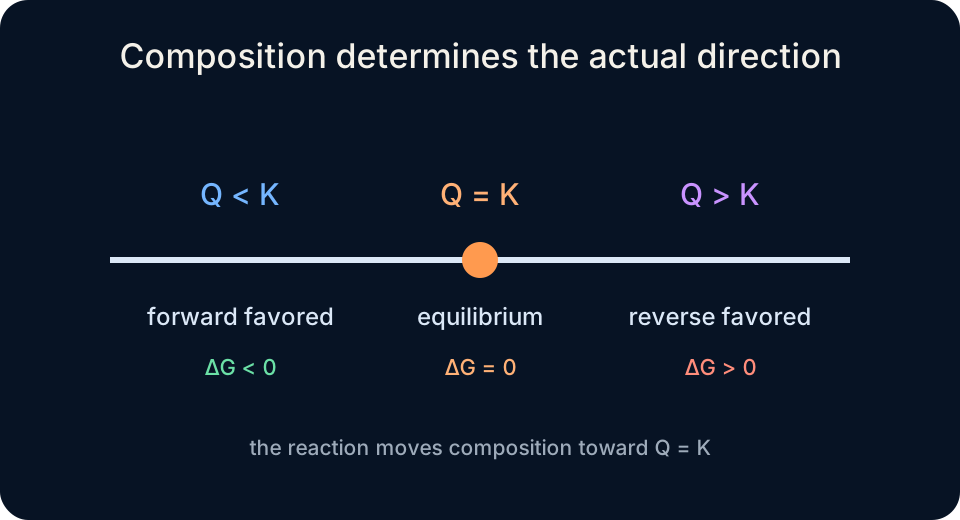
At constant temperature and pressure, identifies a forward-favored spontaneous change, identifies a reverse-favored change, and identifies equilibrium for the specified composition. These criteria describe an infinitesimal tendency from the current state rather than guaranteeing complete conversion to products. As the reaction proceeds, composition changes and therefore Gibbs driving force changes. Equilibrium is reached when no net thermodynamic preference remains, even though forward and reverse molecular events continue dynamically. The zero condition is a balance of chemical potentials rather than inactivity.
Analyze the four enthalpy-entropy sign combinations
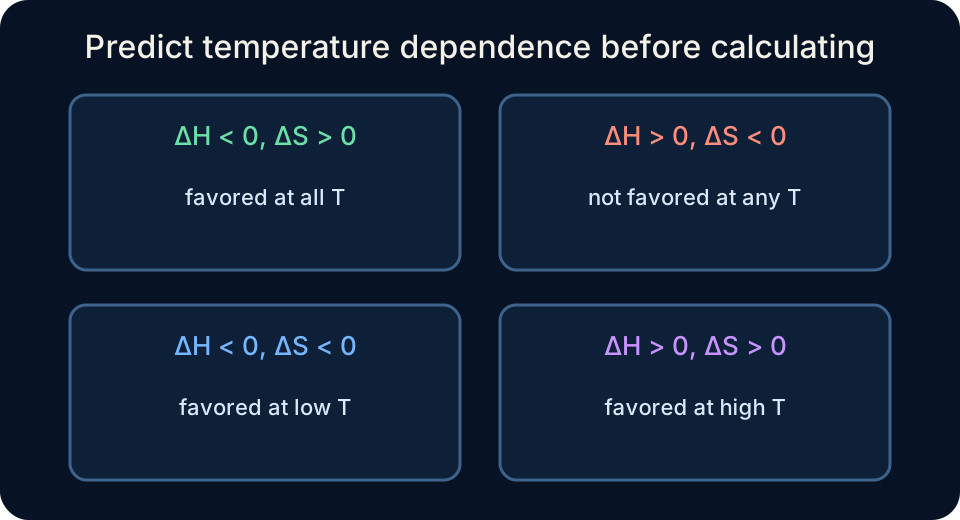
If and , both terms favor a negative . The system releases enthalpy and increases entropy, so the process is favored at every positive temperature within the model’s valid range. If and , both terms make positive. That process is not forward spontaneous at any positive temperature under the same approximation. These two cases can be classified without calculating a crossover temperature.
If and , enthalpy favors the process while entropy opposes it. Because is positive in this case, increasing temperature makes less favorable. The process is favored below the crossover temperature where . Setting zero equal to gives , with both numerator and denominator negative so the ratio is positive. Property changes must be expressed in compatible units before interpreting the resulting kelvin temperature.
If and , entropy can overcome the unfavorable positive enthalpy at sufficiently high temperature. Here becomes increasingly negative as temperature rises. The process is favored above under the constant-property approximation. Melting often illustrates this competition because ordered solid becomes more dispersed liquid while requiring enthalpy input. The crossover idea explains temperature dependence without memorizing four disconnected slogans.
Calculate a temperature-dependent direction
Suppose a process has and . Converting entropy gives . At , the entropy term is . Therefore . The positive value means the forward process is not favored at this temperature under the stated conditions.
The crossover temperature is . Moles and kilojoules cancel, leaving kelvins. Above approximately , the positive entropy contribution multiplied by temperature becomes large enough to make negative. Below that point, the positive enthalpy term dominates. This result matches the predicted high-temperature favorability for positive and positive .
The calculation assumes and remain approximately constant across the temperature interval. Real heat capacities can make both properties temperature dependent, and phase changes can alter the model abruptly. A crossover estimate is therefore not automatically a precise phase-transition prediction. It still provides valuable conceptual guidance and often adequate introductory accuracy. State the approximation whenever a wide temperature range is involved.
Distinguish standard and actual free-energy change
The standard reaction free energy, , compares reactants and products in defined standard states. The superscript circle marks standard-state reference conditions; it does not mean zero or equilibrium. For solutes, the standard state is tied to unit activity, while gases use a specified standard pressure. An actual mixture rarely has every species at standard activity. Therefore describes a reference tendency rather than the direction under every composition.
Composition enters through . The symbol is the gas constant, is absolute temperature, is the natural logarithm, and is the dimensionless reaction quotient built from current activities. For , the quotient is , with lowercase representing activity and stoichiometric coefficients becoming exponents. Pure solids and pure liquids have activity one and are omitted. The quotient encodes the current product-to-reactant composition in the direction the reaction is written.
If is very small, is negative and the composition term pushes downward, favoring forward product formation. If is very large, is positive and the term pushes upward, favoring the reverse direction. When , the logarithm is zero and . These conclusions show why standard favorability alone cannot predict the direction of an arbitrary mixture. Direction depends on both the reference energetics and the present composition.
Connect Gibbs energy with equilibrium
At equilibrium, and the reaction quotient equals the equilibrium constant, . Substituting those conditions into gives . Rearrangement yields . This equation connects a standard-state energy difference with the location of equilibrium. It does not claim that the actual Gibbs change is zero whenever standard free energy is zero.
If , then and , so products are favored in the standard-state comparison. If , then and , so reactants are favored. If , then and . “Favored” does not mean exclusive because equilibrium generally contains both reactants and products. The magnitude of indicates how strongly composition is shifted under the specified temperature.
For at , use after converting free energy to . Rearrangement gives . Substitution gives . The exponential reverses the natural logarithm, and the units cancel inside its dimensionless argument. Products are favored at equilibrium, but an actual mixture still moves according to whether its current is below or above .
Separate thermodynamic direction from kinetics
Gibbs energy compares state stability and driving direction, while kinetics describes the pathway and rate. A negative does not remove the activation-energy barrier that must be crossed for bonds to rearrange. Diamond converting to graphite is thermodynamically favored under ordinary conditions but kinetically negligible because the pathway barrier is enormous. Combustion can also be favorable yet require ignition. “Spontaneous” and “instantaneous” are therefore not synonyms.
A catalyst provides an alternative pathway with lower activation energy. It accelerates forward and reverse reactions and helps the system reach equilibrium sooner. Because the catalyst does not change reactant or product state functions, it does not change or . It also cannot make an equilibrium composition permanently favor a different side without coupling another process. Energy diagrams should show the same endpoints with a lower barrier for the catalyzed pathway.
Thermodynamic coupling can drive an otherwise unfavorable process when it is linked to a sufficiently favorable one. The Gibbs changes add, so . If the total is negative under the actual conditions, the coupled overall change is favored. Biological systems frequently couple reactions through shared intermediates rather than allowing each step to proceed independently. The accounting must include every coupled process inside the chosen system boundary.
Connect Gibbs energy with useful work
At constant temperature and pressure, the decrease in Gibbs energy sets the maximum non-expansion work available from a reversible process. Non-expansion work includes electrical work in a galvanic cell rather than the pressure-volume work already incorporated into enthalpy. For electrochemistry, , where is moles of electrons transferred per mole of reaction, is Faraday’s constant, and is cell potential. A positive cell potential gives negative Gibbs change for the forward cell reaction. This connection turns chemical driving force into a measurable voltage.
The word maximum requires a reversible limiting process. Real devices dissipate some available energy through resistance, friction, gradients, and other irreversible effects. They therefore deliver less useful work than predicts. This does not violate conservation because the unavailable portion is dispersed to the surroundings. Thermodynamic efficiency compares real performance with the ideal bound.
Free energy is not a separate material stored inside a battery. It is a state function that quantifies how much useful non-expansion work could ideally be obtained as the system moves between specified states. Voltage falls as composition changes because the actual depends on . At equilibrium, no net electrical work can be extracted from an infinitesimal forward reaction because . The Nernst equation is the electrochemical expression of this composition dependence.
Diagnose common interpretation errors
The first error is deciding spontaneity from alone. Exothermic change can be opposed by entropy, and endothermic change can be favored by a sufficiently positive entropy term at high temperature. The second error is mixing joules and kilojoules in . The third is using Celsius in place of kelvins. A sign table, unit conversion, and temperature check address all three before substitution.
Another error is using as though it were the actual free-energy change for every mixture. The circle marks a standard reference, while adjusts for current composition. Equilibrium has actual , but is generally nonzero unless . Students also sometimes insert concentrations with units directly into a logarithm. Activities or properly normalized approximations make dimensionless as a logarithm requires.
A final error is claiming that negative Gibbs energy proves a reaction will be fast or go to completion. Rate requires kinetic information, and equilibrium usually leaves both sides present. Large negative often corresponds to large , but “large” still describes a ratio rather than absolute purity. Temperature must accompany because equilibrium constants and standard free energies are temperature dependent. A complete conclusion states direction, conditions, and what the calculation does not establish.
Practice the decision sequence
First, evaluate for , , and . Convert entropy to , giving . Then . The negative result favors the forward process at this temperature. Because both enthalpy and entropy changes are negative, increasing temperature eventually makes the process less favorable.
Second, determine direction when and at the same temperature. Because , the mixture contains too little product relative to its equilibrium composition. The forward reaction is favored and actual . No numerical value of or is needed to determine the sign in this comparison. The reasoning follows directly from how composition must change to bring toward .
Third, interpret a reaction with at a specified temperature. Because , is negative and is positive. Reactants are favored in the standard-state comparison and at equilibrium, although some product remains. This statement does not determine reaction speed and does not forbid forward reaction in a mixture with sufficiently small . The complete interpretation separates standard tendency, equilibrium composition, actual direction, and kinetics.