
Begin with what is actually present in solution
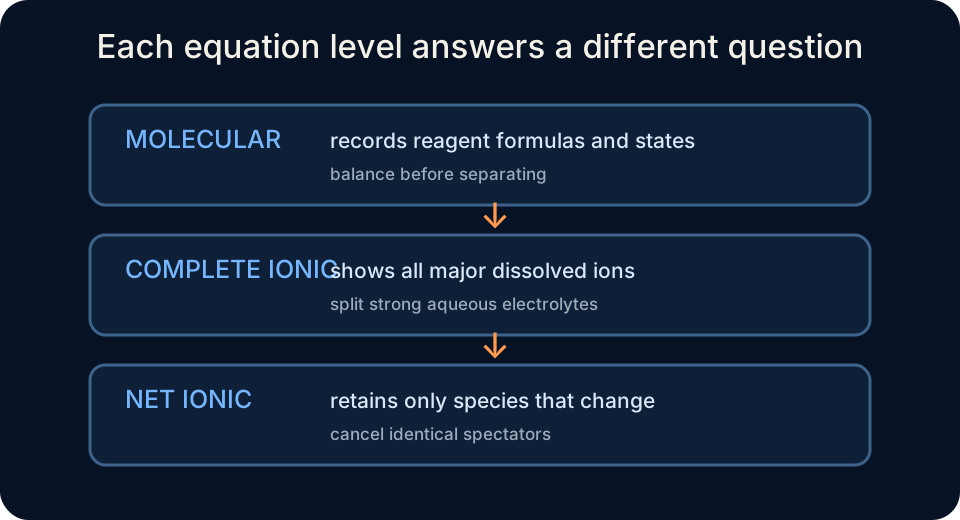
A molecular equation often writes dissolved ionic compounds as intact formulas even though those compounds exist mainly as separated hydrated ions in water. This notation is convenient for recording reagents, but it can hide the species that actually change. A complete ionic equation rewrites strong aqueous electrolytes as ions, and a net ionic equation removes species that remain unchanged. The resulting equation exposes the smallest chemically meaningful transformation supported by the model. Moving among these forms requires understanding states and electrolyte behavior rather than mechanically splitting every formula. Each representation answers a different but connected chemical question.
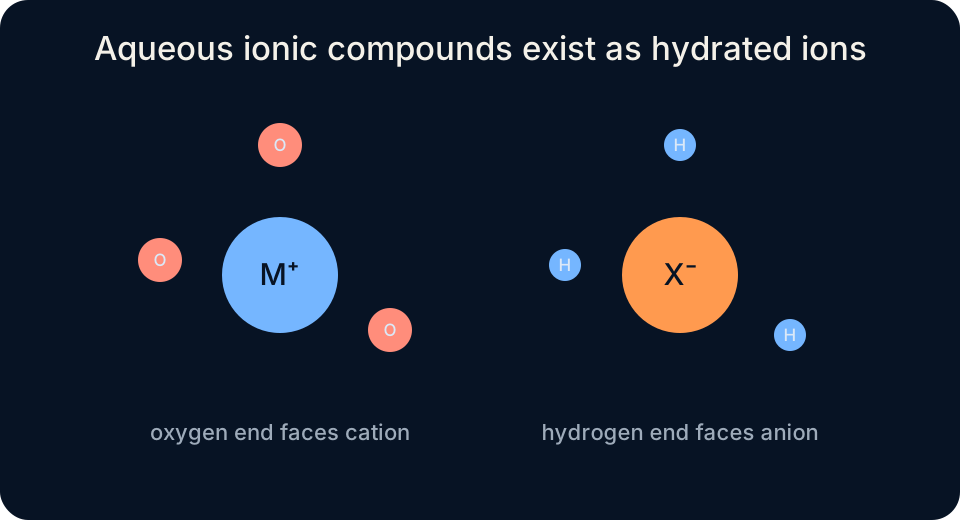
Water molecules orient around dissolved ions through ion-dipole attractions. The oxygen end of water points preferentially toward cations, while the hydrogen ends point preferentially toward anions. Hydration stabilizes separated ions and allows them to move through solution. The state label means a species is dissolved and hydrated in water, not simply that the formula contains water. Particle-level composition should therefore guide symbolic rewriting.
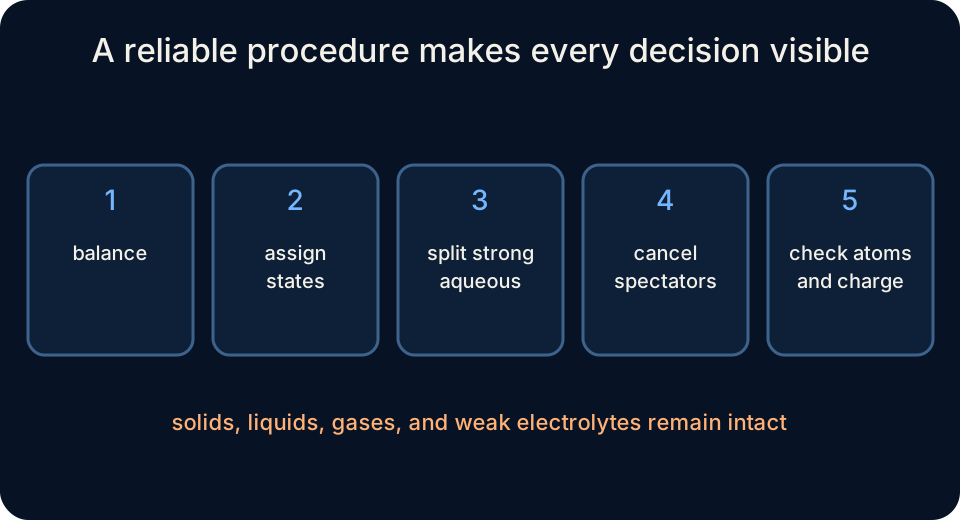
This lesson develops a five-stage method. First write and balance the molecular equation with physical states, then classify each aqueous species as a strong electrolyte, weak electrolyte, or nonelectrolyte. Separate only the strong aqueous electrolytes, cancel identical spectator species, and verify both atom and charge conservation. We will apply the method to precipitation, acid-base, and gas-forming reactions. By the end, you should be able to explain why each species is split, preserved, canceled, or retained.
Distinguish molecular, complete ionic, and net ionic forms
A molecular equation records compounds using neutral formulas whenever practical. For silver nitrate and sodium chloride, it is . Coefficients of one are implied, and state labels identify three dissolved substances and one solid precipitate. The equation conserves silver, nitrogen, oxygen, sodium, and chlorine atoms. It communicates reagent identity but does not show that the aqueous salts are dissociated.
The complete ionic equation is shown below in a multiline form that keeps every species visible on a narrow screen. Superscripts record ion charge, while subscripts remain part of chemical formulas. Silver nitrate, sodium chloride, and sodium nitrate are written as ions because they are modeled as strong soluble electrolytes. Solid silver chloride remains intact because a precipitate is not freely dissociated in solution. The complete form displays every major dissolved ionic species participating in the mixture.
Sodium and nitrate ions appear unchanged on both sides, so they are spectator ions. Canceling equal amounts gives . The net ionic equation conserves one silver atom, one chlorine atom, and net charge zero on both sides. It shows that many soluble sources of silver and chloride would produce the same core precipitation reaction. Cancellation is justified by unchanged chemical identity, state, charge, and amount.
Decide which substances separate into ions
Strong electrolytes produce ions extensively in aqueous solution. Soluble ionic compounds, strong acids, and strong bases are commonly separated in complete ionic equations. Examples include , , and . Their coefficients must be distributed to every ion produced, and formula subscripts determine ion ratios. Charge and atom counts must remain conserved after separation.
Weak acids and weak bases ionize only partially and are usually preserved as molecular formulas in net-ionic work. Acetic acid is written rather than fully separated because intact acid is a major solution species. Water, gases, solids, and pure liquids also remain intact. A state label therefore affects the symbolic decision: separates, while does not. The procedure models dominant species rather than claiming no minority ions exist.
Solubility rules help decide whether an ionic product remains aqueous or forms a precipitate. Nitrates and alkali-metal salts are generally soluble, while many silver halides and barium sulfates are poorly soluble. These rules summarize empirical patterns and have exceptions, so advanced work uses solubility equilibria quantitatively. In an introductory equation, an insoluble product receives and remains intact. Correct physical states must be determined before ionic separation begins.
Preserve charge and stoichiometric coefficients
When an aqueous formula separates, the original coefficient multiplies every ion. For , one formula unit gives one and two . If the molecular coefficient is three, separation yields three calcium ions and six chloride ions. The positive charge is and the negative charge is , preserving electrical neutrality. Ignoring a coefficient or subscript breaks both atom and charge balance.
Net ionic equations must conserve total charge, not necessarily contain the same number of charged particles. In , the reactant charge is and the product charge is zero. The coefficient two on hydrogen ions is required by both atom and charge balance. Counting only symbols without their charges could miss an invalid equation. A charge ledger is as important as an element ledger.
Charges are superscripts and atom counts are subscripts, so their positions communicate different information. is one iron ion with charge plus three, while would indicate three iron atoms within a formula. Coefficients multiply the entire following species, including its charge contribution. Never change a subscript to balance an equation because that changes chemical identity. Adjust coefficients while preserving formulas and charges.
Follow a repeatable five-step procedure
Step one is to predict products and write a balanced molecular equation with states. Step two is to identify strong aqueous electrolytes using acid strength, base strength, and solubility information. Step three separates those species into correctly charged ions with distributed coefficients. Step four cancels identical species appearing in equal amounts on both sides. Step five checks every element and total charge in the remaining net equation.
The order matters because canceling before balancing can hide unequal amounts. State labels must be known before splitting because the same formula behaves differently as an aqueous solute and a solid. Weak electrolytes must remain intact because their partial ionization is part of the chemical process. Spectators are identified from the complete ionic equation rather than guessed from familiar ion names. This disciplined sequence prevents shortcuts from replacing chemical reasoning.
A useful written layout places molecular, complete ionic, and net ionic equations on separate labeled lines. Underlining or color-coding spectators can make cancellation visible without deleting evidence prematurely. After cancellation, coefficients should be reduced to the smallest whole-number ratio. If every species cancels, the model predicts no net reaction under the stated conditions. That conclusion is meaningful rather than a failed procedure.
Analyze precipitation reactions
Mixing barium chloride and sodium sulfate places on the reactant side and on the product side. Solubility rules identify barium sulfate as a precipitate and sodium chloride as aqueous. The complete ionic form is shown below, with aqueous labels understood for the separated ions. Sodium and chloride ions cancel. The net equation is .
The particle picture shows dispersed barium and sulfate ions coming together into an extended ionic solid. Sodium and chloride ions remain hydrated before and after the precipitate forms. Their continued presence helps maintain electroneutrality but does not define the chemical core. The precipitate removes barium and sulfate from the dissolved pool until equilibrium limits further formation. Introductory equations often approximate that removal as complete when solubility is very low.
Stoichiometry can be applied directly to the net equation. One mole of barium ion reacts with one mole of sulfate ion to form one mole of barium sulfate. If both ion amounts are given, the smaller amount limits because the ratio is one to one. Spectator amounts do not determine precipitate yield unless they reveal the source-solution composition. The net equation therefore simplifies quantitative reasoning as well as conceptual interpretation.
Analyze acid-base and gas-forming reactions
A strong acid and strong base neutralization reduces to . For hydrochloric acid and sodium hydroxide, chloride and sodium ions cancel as spectators. The hydrogen-ion notation is a common shorthand, while a more explicit aqueous model may use hydronium as . Both forms describe proton transfer under different notation conventions. Water remains intact because it is a weak electrolyte and pure liquid product.
A weak acid must not be split completely. In the net equation, reactants form products . Acetic acid remains molecular because its ionization is incomplete, while soluble sodium acetate separates if sodium is present in the molecular equation. The reaction shows hydroxide removing a proton and converting weak acid to conjugate base. Splitting the acid prematurely would cancel the chemically changing species and erase the proton-transfer process.
Gas formation can drive an aqueous reaction. Carbonate with acid can be represented as . Carbon dioxide leaves the solution as a gas, helping shift the process forward. The equation conserves two hydrogen atoms, one carbon atom, three oxygen atoms, and total charge zero. Visible bubbling provides macroscopic evidence for the symbolic product state.
Connect net equations to equilibrium
Net ionic equations often present reactions with one-way arrows when product formation is strongly favored. At a deeper level, precipitation, proton transfer, and gas solubility are equilibrium processes. Silver chloride has a small but nonzero solubility described by . The one-way precipitation arrow is an approximation appropriate when the reaction quotient strongly exceeds the solubility-product threshold. Advanced analysis can calculate the remaining dissolved concentrations.
Weak-acid neutralization is favored because hydroxide removes hydronium-equivalent acidity and forms water. Its extent can be related to acid and water equilibrium constants. Strong and weak labels determine which species dominate and therefore how the net equation should be written. The equation is not merely bookkeeping; it is a compact statement about dominant equilibrium participants. Conditions such as concentration and temperature can affect whether the proposed transformation is appreciable.
Spectator status can change with reaction context. Nitrate is often a spectator in precipitation reactions, but nitrate can participate as an oxidizing agent under strongly acidic redox conditions. Chloride may be a spectator in one mixture and a precipitating or complex-forming ligand in another. A memorized permanent list is therefore less reliable than comparing actual species on both sides. Spectator is a role within a particular modeled reaction.
Diagnose common symbolic mistakes
The first mistake is separating every aqueous formula without considering electrolyte strength. Weak acids, weak bases, and many dissolved molecular substances remain largely intact. The second mistake is splitting solids, liquids, or gases. State labels decide whether ionic separation is appropriate. Writing states before dissociation prevents both errors.
The third mistake is canceling species that are not identical. cannot cancel with , and cannot cancel with because charge and oxidation state differ. Species must match in formula, charge, state, and coefficient amount. Partial cancellation is allowed only when unequal coefficients share a common portion. The remaining equation must then be reduced and rechecked.
The fourth mistake is checking atoms but ignoring net charge. An equation can conserve every element and still violate charge conservation. Summing charge separately on each side catches missing electrons, coefficients, or ion charges. Another warning sign is a net equation that contains only spectator-like soluble ions and no precipitate, gas, weak electrolyte, or redox change. Chemical evidence and formal balance should support each other.
Practice the complete method
First, write the net equation for potassium iodide mixed with lead nitrate when lead iodide precipitates. The balanced molecular equation is . Separating strong aqueous electrolytes and canceling potassium and nitrate gives . Atom and charge totals are both zero on the two sides. The coefficient two follows from the lead iodide formula and charge balance.
Second, write the equation for nitric acid reacting with potassium hydroxide. Both reactants are strong electrolytes, so the complete ionic equation contains , , , and . Potassium and nitrate cancel. The result is . This equation conserves atoms and net charge and identifies water formation as the core process.
Third, decide whether mixing sodium nitrate and potassium chloride produces a net reaction under ordinary dilute conditions. All possible products remain soluble strong electrolytes, so the complete ionic equation contains the same ions on both sides. Every species cancels and no net ionic equation remains. The model therefore predicts no precipitation, gas formation, weak-electrolyte formation, or redox change. “No reaction” here means no modeled net chemical transformation, even though hydrated ions continue moving and colliding.