
Acid–base chemistry explains sour solutions, antacid action, buffer regulation, mineral dissolution, protein structure, and many reaction mechanisms. No single introductory definition captures every event chemists call acid–base behavior. Instead, Arrhenius, Brønsted–Lowry, and Lewis models form a widening set of perspectives. Each model highlights a transferable particle or electron-pair process. Choosing the model explicitly prevents familiar words from hiding different mechanisms.
You will compare the three models, write proton-transfer equations, identify conjugate acid–base pairs, recognize amphiprotic species, and connect acid strength to equilibrium. You will distinguish strength from concentration and amount, interpret and , and explain why solvent affects observable strength. Chemical formulas, charges, arrows, and equilibrium expressions will be read at particle level. Examples will use horizontal fractions and retain concentration units where measured quantities appear. The goal is to select the narrowest model that fully explains a reaction while understanding how broader models extend it.
Begin any acid–base analysis by inventorying possible proton donors, proton acceptors, electron-pair donors, and electron-pair acceptors. Write the transferred proton or donated electron pair explicitly rather than relying on a label. Compare reactant and product species to find pairs that differ by exactly one proton. Then decide whether the reaction is represented as essentially complete or as an equilibrium. Finally, separate the amount present from the intrinsic or condition-dependent tendency to react.
Observable behavior motivates particle models
Acidic aqueous solutions can react with certain metals, neutralize bases, affect indicators, and conduct electricity. Basic solutions can neutralize acids, affect indicators in the opposite direction, and often feel slippery because of interactions with surface materials. These observations are macroscopic evidence, not definitions by themselves. Many non-acidic substances also conduct electricity, and tactile tests are unsafe and chemically nonspecific. Particle models explain which species produce the recurring behavior.
An aqueous solution contains water molecules and solvated particles. A proton written is not ordinarily a bare isolated nucleus traveling freely through liquid water. It is associated with water in species commonly represented as hydronium, , and more extended hydrated structures. Introductory equations use both and notation depending on purpose. Stating the convention keeps the shorthand connected to physical chemistry.
Acid–base indicators change molecular form with protonation state, producing different light absorption and color. Conductivity arises because ions carry charge through solution. Neutralization changes the populations of proton-donating and proton-accepting species. The model should connect each observation to particles rather than merely restating that an acid was present. This evidence-first habit makes the definitions useful beyond memorization.
The Arrhenius model focuses on aqueous hydronium and hydroxide
In the Arrhenius model, an acid increases the concentration of hydronium ions in water, while a base increases the concentration of hydroxide ions. Hydrochloric acid and water, , react to form hydronium and chloride, . The water molecule accepts a proton from HCl to form hydronium. Solid sodium hydroxide, , dissociates into when it dissolves. These equations connect the labels to measurable aqueous ions.
Arrhenius neutralization of a strong acid and strong base can be reduced to . Sodium and chloride ions, for example, remain unchanged spectators and disappear from the net ionic equation. Atom counts and charge are conserved: the left side has net charge zero and contains four hydrogen plus two oxygen atoms in total. The product side contains the same atoms in two water molecules. The reaction explains why hydronium and hydroxide concentrations decrease.
The Arrhenius model is useful but deliberately narrow. It centers on water and on hydronium or hydroxide production. Ammonia, , contains no hydroxide group yet makes water basic by accepting a proton and forming . Acid–base reactions can also occur outside water and without hydroxide production. Broader models explain those cases more directly.
Brønsted–Lowry chemistry tracks proton transfer
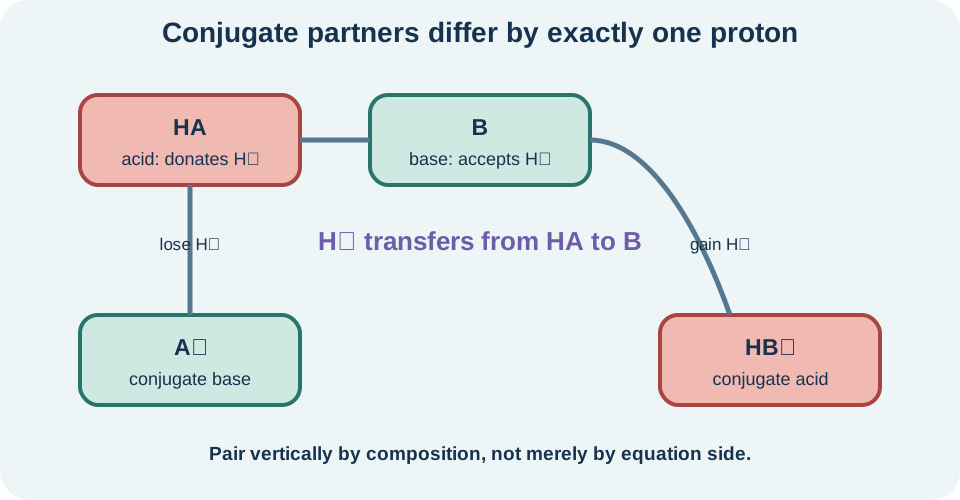
A Brønsted–Lowry acid donates a proton, while a Brønsted–Lowry base accepts a proton. A proton is represented as because an ordinary hydrogen atom loses its electron. In the general equation , HA donates a proton to B. Therefore HA is the acid and B is the base. The products retain the complementary proton-transfer capacities.
The species is the conjugate base of HA because it can accept a proton to regenerate HA. The species is the conjugate acid of B because it can donate a proton to regenerate B. A conjugate pair differs by exactly one . Charges also differ by one positive unit. Comparing formulas and charges provides a reliable identification method.
The reversible arrow indicates forward and reverse proton transfers occur. In the reverse direction, donates a proton and accepts it. Acid and base roles are therefore reaction-direction descriptions. A species called a base in one reaction can act differently with another partner. The reaction context determines which transfer occurs.
Identify conjugate pairs systematically
Start by locating a proton that changes ownership. In , HCl loses and becomes . Therefore is one conjugate acid–base pair. Water gains and becomes hydronium. Therefore is the other pair.
Do not pair species merely because they appear on opposite sides. HCl and hydronium are not a conjugate pair because they do not differ only by one proton; chlorine and oxygen composition also differ. Draw a line between formulas that share every atom except one hydrogen and whose charges differ by one. Then label the proton-richer member conjugate acid and the proton-poorer member conjugate base. This structural test prevents arbitrary pairing.
Polyprotic acids can donate more than one proton in stages. Carbonic acid forms the sequence , , and . The first two are a conjugate pair, as are the last two. Carbonic acid and carbonate are not a single conjugate pair because they differ by two protons. Each transfer step has its own equilibrium tendency.
Water is amphiprotic
An amphiprotic species can donate or accept a proton depending on its reaction partner. Water accepts a proton from HCl, acting as a Brønsted base and forming . Water donates a proton to ammonia in , acting as a Brønsted acid. The same molecule has both capacities. Reaction context selects which is expressed.
Bicarbonate, , is also amphiprotic. It can accept a proton to form or donate a proton to form . Its charge alone does not determine its role. Formula structure and reaction partner matter. Amphiprotic behavior is common among intermediate forms of polyprotic acids.
The word amphoteric is sometimes used more broadly for substances that react as acids or bases under a chosen model. Amphiprotic specifically refers to the ability to donate or accept protons. Metal oxides and hydroxides can display amphoteric Lewis or Brønsted behavior without a simple molecular proton donor picture. Precise vocabulary indicates which mechanism is being claimed. When foundational clarity matters, state the actual transfer rather than relying on either adjective alone.
Lewis chemistry tracks electron-pair donation and acceptance
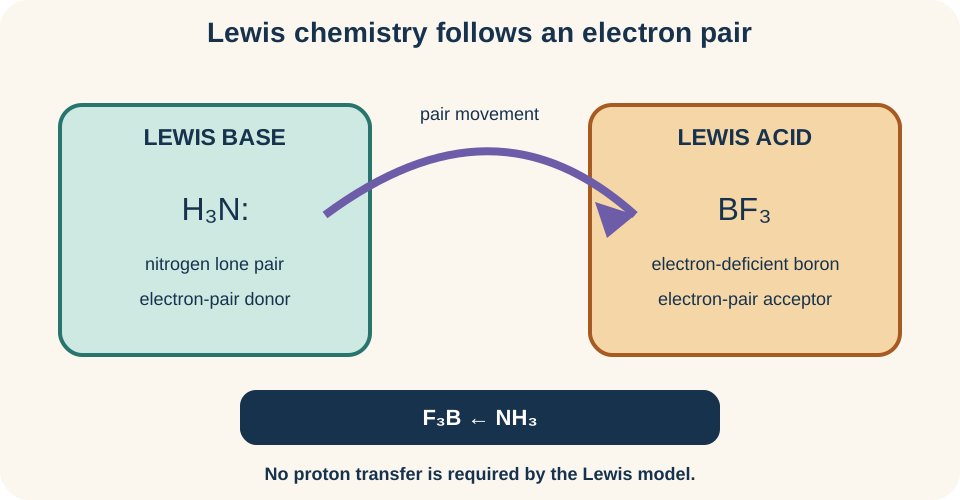
A Lewis acid accepts an electron pair, while a Lewis base donates an electron pair. This definition does not require a proton or water. A curved-arrow mechanism often shows the electron pair moving from the Lewis base toward the Lewis acid. The new bond uses the donated pair. Electron accounting therefore provides the classification test.
In , ammonia donates its nitrogen lone pair and acts as the Lewis base. Boron trifluoride has an electron-deficient boron center that accepts the pair and acts as the Lewis acid. No proton moves. The product contains a coordinate covalent bond, meaning both bonding electrons originated from the donor in the bookkeeping picture. Once formed, the bond is still a covalent interaction.
Every Brønsted proton transfer can be interpreted through Lewis electron pairs. A base donates an electron pair to a proton, and the proton accepts it. Thus the Lewis model includes Brønsted–Lowry behavior while also covering electron-pair acceptance by metal ions and electron-deficient molecules. The broader model is not always the most informative label for a proton-transfer problem. Use the model that exposes the mechanism the question emphasizes.
Model scope is nested but context still matters
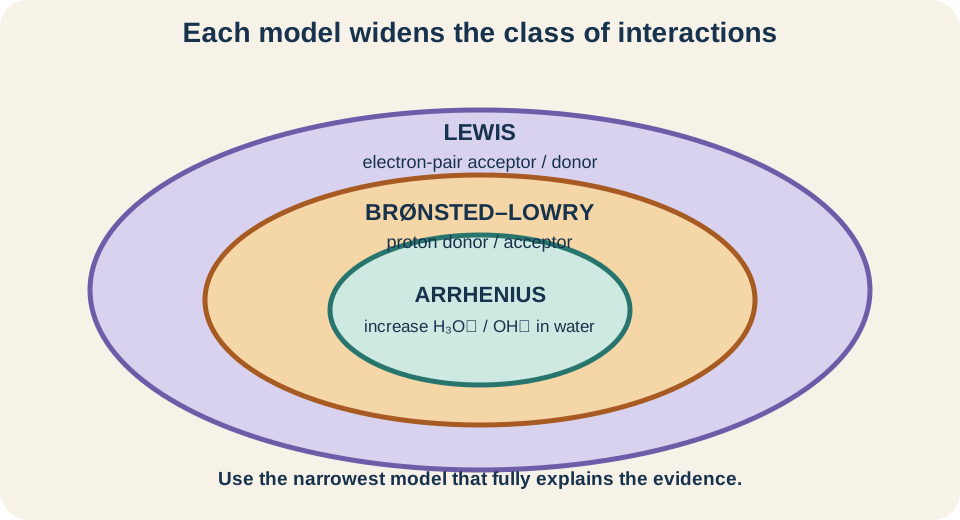
Arrhenius acids and bases are described through their effect on aqueous hydronium and hydroxide. Brønsted–Lowry theory includes those proton transfers and extends them beyond the simplest aqueous formulations. Lewis theory includes proton acceptance as electron-pair acceptance and extends further to reactions without protons. This nesting explains why one reaction can receive several valid labels. The labels answer at different levels of generality.
Broader is not automatically better for every explanation. Calling HCl a Lewis acid in its reaction with water is defensible through the proton’s electron-pair acceptance, but the Brønsted model directly highlights proton transfer and conjugate pairs. Calling sodium hydroxide an Arrhenius base directly explains hydroxide increase in water. Calling ammonia a Brønsted base explains its proton acceptance. A good model is broad enough to cover the evidence and specific enough to illuminate it.
Models also have assumptions and domains. The Arrhenius model presumes aqueous behavior, idealized proton notation suppresses solvent structure, and simple Lewis diagrams suppress detailed orbital and solvation effects. These limitations do not make the models useless. They define which questions the models answer reliably. Scientific maturity includes choosing a model and stating what it omits.
Acid strength is an equilibrium tendency
Acid strength describes the tendency of an acid to donate a proton to a specified base, commonly water in introductory chemistry. For , the acid ionization constant is when liquid water activity is included in the constant. The symbols are dimensionless activities. A larger indicates greater product formation for the reaction as written. Strength is therefore an equilibrium comparison.
In dilute ideal shorthand, the expression is often written . Brackets denote molar concentration, though standard-state ratios are implicit in the thermodynamic interpretation. A strong acid reacts essentially completely with water under ordinary dilute conditions, while a weak acid establishes substantial equilibrium with unionized acid remaining. “Weak” does not mean unimportant or safe. It describes equilibrium extent under stated conditions.
Acid strength also depends on the base receiving the proton and the solvent environment. A substance may donate readily to a strong base but not to a weak one. Tables of values standardize the comparison through a defined aqueous reaction and temperature. Temperature should accompany precise constants. Strength is not an intrinsic adjective detached from reaction context.
Base strength and conjugate strength are linked
For a base reacting with water, write . The base ionization constant is with water absorbed into the constant. A larger indicates greater proton acceptance from water for the reaction as written. Base strength is therefore also an equilibrium tendency. It should not be inferred only from whether a formula visibly contains hydroxide.
For a conjugate acid–base pair in water, . Here is the water autoionization constant for the same temperature. A stronger acid has a weaker conjugate base because a favorable forward proton donation corresponds to an unfavorable reverse proton acceptance. Likewise, a stronger base has a weaker conjugate acid. This inverse relationship helps predict proton-transfer direction.
For example, chloride is the conjugate base of strong acid HCl and is an extremely weak base in water. Acetate is the conjugate base of weak acetic acid and has measurable basicity. The comparison does not mean acetate is universally “strong” in every solvent. It means its proton-accepting equilibrium in water is more favorable than chloride’s. Pairwise reasoning avoids absolute labels without context.
Strength, concentration, and amount are different variables
Concentration describes amount of solute per solution volume, commonly in . Strength describes equilibrium tendency to ionize or accept a proton. A dilute solution of a strong acid can contain less hydronium than a concentrated solution of a weak acid. Conversely, a concentrated weak acid can contain substantial un-ionized acid while still producing significant hydronium. The adjectives answer different questions.
Amount is another distinct quantity measured in moles. A small volume of concentrated solution may contain fewer total moles than a large volume of dilute solution. Hazard, neutralization capacity, pH, and reaction rate depend on overlapping but different variables. No single word such as “strong” determines all of them. Quantitative reasoning requires the relevant measurement.
For a monoprotic strong acid modeled as completely ionized, acid gives approximately hydronium before other corrections. A weak acid might ionize only partially yet still yield more hydronium than the dilute strong acid. Exact comparison requires its and an equilibrium calculation. Strength alone does not order solution pH across arbitrary concentrations. Initial concentration supplies the scale on which the strength equilibrium acts.
Proton-transfer direction compares two conjugate pairs
The general reaction contains two acids, HA and , and two bases, B and . Equilibrium tends toward the side containing the weaker acid and weaker base under comparable conditions. A strong acid donates readily, leaving a weak conjugate base. A strong base accepts readily, producing a weak conjugate acid. Relative values make this comparison quantitative.
If HA has a much larger than , HA is the stronger acid. The forward transfer forms the weaker acid and weaker base , so products are favored. One can relate the transfer constant to the ratio of acid constants under a consistent standard-state framework. The magnitude, not just the sign of a verbal strength ranking, determines how complete the transfer appears. Equal-strength acids would produce a less one-sided equilibrium.
This rule should be derived from the actual pairs rather than applied as “strong goes to weak” without labels. Identify both acids, find their conjugate bases, and write the proton movement. Then compare strengths for the same solvent and temperature. The favored side does not mean the reverse reaction stops. Dynamic equilibrium still includes both directions.
Solvent leveling limits observable aqueous strength
In water, any acid substantially stronger than hydronium transfers its proton essentially completely to water. The strongest acid that can persist at appreciable equilibrium concentration in water is therefore hydronium under the leveling description. HCl, HBr, and several other strong acids all appear completely ionized in dilute water. Their distinct intrinsic gas-phase or nonaqueous strengths are not fully resolved by ordinary aqueous ionization extent. The solvent levels their observable behavior.
Similarly, bases stronger than hydroxide react with water to form hydroxide. An amide ion, for example, is not maintained as a simple strong base in ordinary aqueous solution because it removes a proton from water. Water therefore limits the strongest base that persists in that medium. Choosing a different solvent can reveal strength differences hidden in water. Acid and base strength are solvent-dependent comparisons.
The leveling effect reinforces why a bare ranking has a domain. An acid called strong in water is classified by near-complete proton transfer to water under specified conditions. A nonaqueous solvent with different proton affinity may produce different extents and equilibria. Solvent molecules are reaction participants, not passive empty space. Their role belongs in the chemical equation.
Common errors and corrective habits
One common error labels any hydrogen-containing substance an acid. Methane contains hydrogen but does not donate a proton appreciably to water under ordinary conditions. Inspect bonding, products, and equilibrium rather than formula presence alone. Another error labels any oxygen-containing species a base. Electron pairs and reaction context determine basic behavior.
A second error reverses conjugate-pair membership. Pair species that differ by exactly one proton and verify a one-unit charge difference. A third error calls the proton-rich member the base. Within a conjugate pair, the proton-rich member is the acid and the proton-poor member is the base. Drawing the transferred resolves both errors.
A final error treats strong, concentrated, corrosive, and reactive as synonyms. State whether the claim concerns equilibrium strength, concentration, hazard, or rate. Keep units on concentration and use or for equilibrium strength. Hazard assessment also requires identity, exposure route, amount, and conditions. Precise language improves both chemistry and safety reasoning.
Guided practice and retrieval
For , ammonia accepts a proton and is the Brønsted base. Water donates a proton and is the Brønsted acid. The conjugate pairs are and . In the reverse direction, ammonium acts as acid and hydroxide as base. State each role from the proton transfer rather than from memorized formula categories.
For , nitrogen’s lone pair moves toward electron-deficient boron. Ammonia is the Lewis base because it donates the pair, and boron trifluoride is the Lewis acid because it accepts the pair. No proton transfer occurs, so a Brønsted description does not capture the central event. The Lewis model is necessary. Drawing a curved arrow from donor pair to acceptor makes the classification visible.
Compare a strong acid with a weak acid. The first is stronger by ionization tendency but far more dilute. The second may produce a larger hydronium concentration despite incomplete ionization. A value is needed for a quantitative pH prediction. This comparison demonstrates why strength and concentration must remain separate axes.
Connection forward
Reconstruct the three models without looking back. Define each acid and base, give one reaction that the model explains well, and state the model’s scope. Identify conjugate pairs by a one-proton difference and explain amphiprotic behavior through two partner-dependent reactions. Then distinguish strength, concentration, and amount. If any label lacks a transferred particle or electron pair, make the mechanism explicit.
The pH lesson will quantify hydronium and hydroxide activity on logarithmic scales. Buffer lessons will use conjugate pairs to resist composition changes, while titration lessons will track stoichiometry and equilibrium across added volume. Lewis acidity will reappear in coordination chemistry and reaction mechanisms. Equilibrium constants will remain the quantitative language of strength. Net ionic equations will expose the species that actually transfer protons in solution.
The enduring idea is model choice. Arrhenius theory organizes aqueous ion production, Brønsted–Lowry theory organizes proton transfer, and Lewis theory organizes electron-pair transfer. Their nested scope allows several true descriptions while favoring the one most explanatory for a given question. Conjugate pairs reveal reversibility, and equilibrium constants replace vague strength language with measurable comparisons. With species, charges, solvent, and model explicit, acid–base chemistry becomes a coherent family of interactions.