
Begin with the distinction that prevents most mistakes
An acid solution can be described by both its concentration and its strength, but those words answer different questions. Concentration tells us how much acid was placed in a given volume of solution, whereas strength tells us how extensively that acid transfers protons to water at equilibrium. A concentrated weak acid may therefore have a lower pH than a very dilute strong acid, even though the weak acid has the smaller tendency to ionize. This distinction matters because pH measures the condition of a particular solution rather than assigning a permanent label to the dissolved substance. Before calculating anything, ask whether the problem gives a solution composition, an equilibrium constant, or both.
The operational quantity behind pH is the activity of the hydronium ion, written . Activity is a dimensionless effective concentration that accounts for interactions among ions, so it is the most accurate quantity to place inside a logarithm. In dilute classroom solutions, we commonly approximate activity with the numerical value of the molar concentration relative to the standard concentration . Square brackets mean equilibrium molar concentration, names the hydronium ion, and the superscript plus sign records its positive charge. The approximation is useful, but stating it reminds us why very concentrated or highly ionic solutions require more advanced corrections.
This lesson follows a repeatable reasoning path rather than treating pH as a button-pressing exercise. First identify the acid or base model, then decide whether dissociation is essentially complete or governed by equilibrium, and only then calculate hydronium or hydroxide concentration. Next translate that concentration through a base-ten logarithm and interpret the result on a multiplicative scale. Finally check whether the sign, magnitude, units, and chemical story agree with one another. By the end, you should be able to calculate pH and pOH, use , interpret and , solve a weak-acid equilibrium, and explain why pH alone does not identify intrinsic acid strength.
Read the pH and pOH definitions symbol by symbol
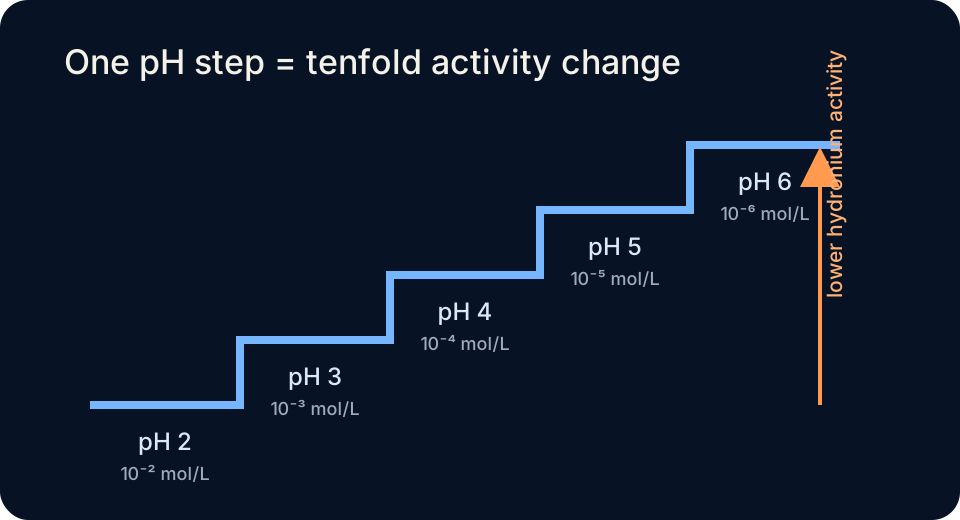
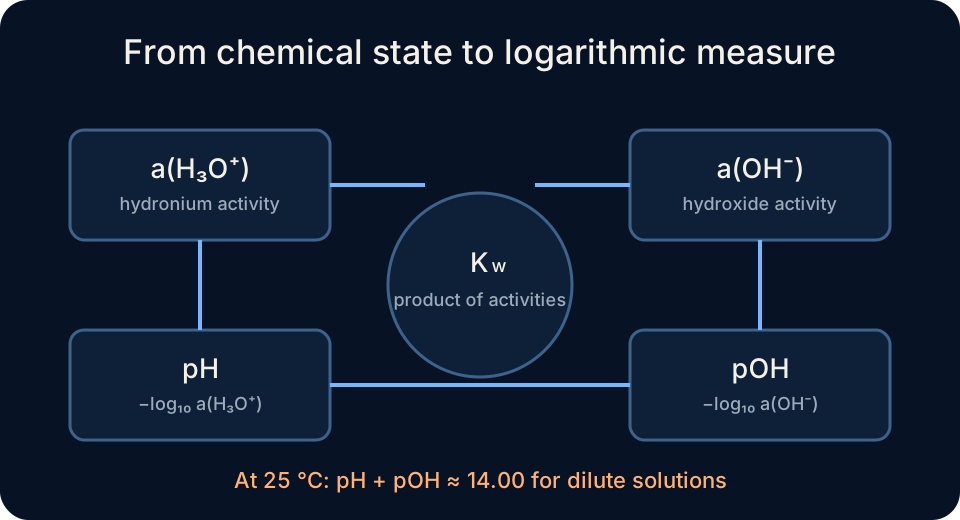
The thermodynamic definition of pH is , where the operator asks for the exponent to which ten must be raised. The minus sign reverses the sign of that exponent, making ordinary acidic concentrations produce convenient positive pH values. For a dilute solution with , the activity is approximately and . Applying the leading minus sign gives . Because a logarithm is defined only for a dimensionless positive number, units belong in the concentration statement but not on the final pH value.
The corresponding definition for hydroxide is . The symbol denotes hydroxide, and its superscript minus sign indicates one negative elementary charge. At , water autoionization gives . Taking the negative base-ten logarithm of both sides converts multiplication into addition, producing under the dilute-solution approximation. The value is temperature dependent because is temperature dependent, so it should not be treated as a universal constant at every temperature.
Logarithmic scales encode ratios, not equal additive changes in concentration. If pH falls from to , hydronium activity increases by a factor of ten because is ten times . If pH falls by units, hydronium activity increases by . A change of pH unit corresponds to a factor of about , which is why modest-looking pH changes can be chemically important. To reverse the calculation, use and then interpret the result as an approximate concentration only when the dilute ideal model is justified.
Separate complete dissociation from equilibrium dissociation
A strong monoprotic acid is modeled as transferring essentially all of its available protons to water at the concentrations used in introductory problems. For hydrochloric acid, the reaction is , and the one-way arrow communicates the complete-dissociation approximation. If the formal HCl concentration is , the stoichiometric ratio is one mole of hydronium per mole of HCl. We therefore estimate and calculate . The two decimal places in pH correspond to the two significant figures in the concentration because digits after the decimal in a logarithm carry the concentration precision.
A weak acid does not dissociate completely, so its initial concentration cannot be inserted directly into the pH equation. For a generic monoprotic acid, the equilibrium is . Here represents the undissociated acid, is its conjugate base, and the double arrow indicates that forward and reverse processes both occur. The acid ionization constant is . A larger means the equilibrium lies farther toward ions and therefore identifies a stronger acid within a comparable solvent and temperature.
Weak bases are described in the same equilibrium language through a base ionization constant . For , the expression is in the dilute approximation. A conjugate acid-base pair satisfies , so a stronger acid necessarily has a weaker conjugate base. This relationship is comparative: it connects members of the same conjugate pair rather than claiming that every weak acid has a chemically unimportant conjugate base. When given , , or , translate the number into an equilibrium tendency before beginning arithmetic.
Build a weak-acid calculation from an equilibrium table
Consider acetic acid with at . An initial-change-equilibrium table begins with and approximates the acid-provided initial hydronium and acetate concentrations as zero. If dissociates, stoichiometry decreases by and increases both and by . The equilibrium concentrations are therefore , , and , all measured in . Substitution gives , and every symbol now has a chemical meaning rather than being an unexplained algebraic placeholder.
If dissociation is small compared with , we may test the approximation . The equation becomes . Because represents the equilibrium hydronium concentration, . The percent ionization is , which is below the conventional five-percent threshold and supports the approximation. If that check had failed, we would solve the original quadratic equation instead of pretending the denominator stayed constant.
The result illustrates why concentration and strength must remain separate. A strong monoprotic acid would give approximately hydronium and pH , whereas the weak acid gives only hydronium and pH . Nevertheless, sufficiently diluting the strong acid could make its solution pH higher than that of the more concentrated weak acid. The label strong describes the position of an ionization equilibrium, not the danger, amount, or pH of every possible solution. A chemically responsible conclusion states both the substance property and the solution condition.
Diagnose common errors before they become habits
One frequent error is writing as though “pH” were a chemical species that can be added inside an equilibrium expression. The relationship comes from applying logarithm rules to , and it is valid under specified temperature and activity assumptions. Another error is reporting pH with units such as , even though pH is a dimensionless logarithmic quantity. A third error is entering a negative concentration into the logarithm after an algebra mistake, which should immediately signal that the calculated state is physically impossible. Dimensional analysis, sign checks, and a quick order-of-magnitude estimate catch these problems before a calculator hides them.
Another common mistake is using the initial weak-acid concentration as . That shortcut silently replaces a reversible equilibrium with complete dissociation and can shift the answer by several pH units. Students also sometimes compare acid strength by looking only at solution pH, ignoring different formal concentrations and polyprotic behavior. The correct comparison uses or under comparable conditions, with larger and smaller indicating the stronger acid. When a problem supplies both concentration and , it is signaling that equilibrium reasoning is required.
A final cluster of errors comes from treating calculator output as self-explanatory. For example, may appear as , but the justified report is because the concentration has two significant figures. Conversely, converting pH back to concentration gives two significant figures, , rather than a long string of unsupported digits. A sensible acidic result should have hydronium concentration greater than hydroxide concentration at , while a basic result should show the reverse. Precision, units, and chemical interpretation are part of the answer rather than decorations added after calculation.
Connect equations, graphs, and particle pictures
The same acid-base state can be represented numerically, graphically, and at the particle level, and fluency means moving among all three views. A concentration such as tells us an amount per solution volume, while pH locates that state on a compressed logarithmic scale. A particle picture cannot show hydronium ions individually in one liter, so it uses a representative sample whose relative counts communicate composition rather than literal scale. A titration curve adds another view by plotting pH on the vertical axis against added titrant volume on the horizontal axis. Whenever a representation is simplified, identify what information it preserves and what information it suppresses.
A graph of pH against hydronium concentration is curved if the concentration axis is linear because the defining logarithm compresses orders of magnitude. Equal horizontal concentration changes therefore do not produce equal vertical pH changes, especially near very small concentrations. If the horizontal axis instead displays , the relationship becomes a straight line with slope under the dilute approximation. The negative slope encodes the inverse relationship: increasing hydronium activity decreases pH. Reading the axes and their scales before interpreting a graph prevents the common error of treating logarithmic spacing as though it were ordinary linear spacing.
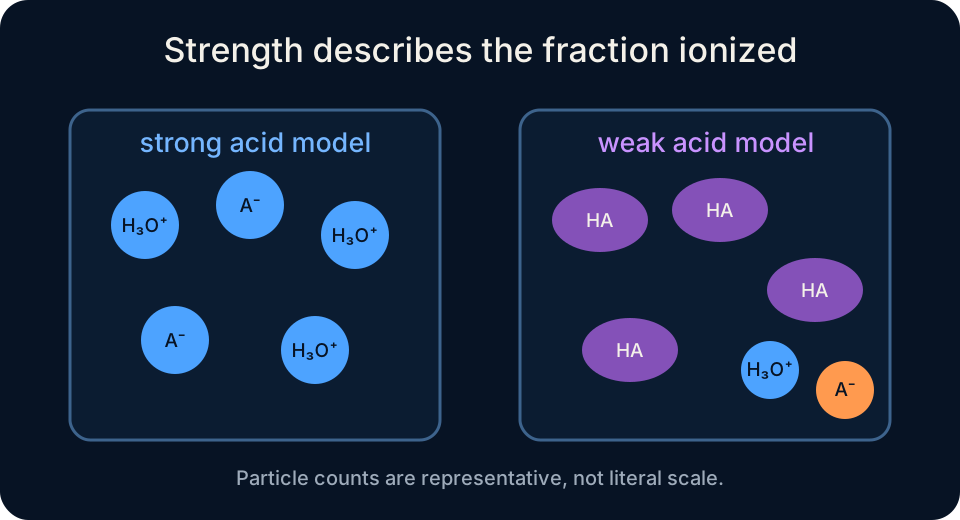
Particle diagrams are especially helpful for distinguishing strength from concentration because they can vary total particle density independently from the fraction ionized. A concentrated weak-acid diagram contains many acid-derived particles but shows most as intact , whereas a dilute strong-acid diagram contains fewer acid-derived particles but shows nearly all as and . The weak acid may still contribute more total hydronium if its initial concentration is sufficiently larger, which is why the diagram must include both fraction and scale. Equilibrium arrows in a symbolic equation communicate dynamic interchange that a still image cannot display. Coordinating the particle picture, equilibrium equation, numerical constant, and measured pH produces a more durable model than memorizing any single representation.
Measure pH without confusing resolution and accuracy
An indicator estimates pH through a color-changing equilibrium, while a pH meter estimates it through an electrical potential sensitive to hydrogen-ion activity. Indicator paper is quick and inexpensive, but its color bands usually provide only coarse resolution and can be difficult to read in strongly colored solutions. A calibrated glass electrode provides finer numerical resolution, although the displayed digits are not automatically accurate. Temperature, electrode condition, contamination, and calibration quality all affect the measurement. Choosing an instrument therefore requires matching its capabilities to the precision and chemical environment of the question.
Calibration uses buffer standards with well-characterized pH values to connect electrode potential with the logarithmic scale. A two-point calibration checks both offset and response slope, and standards should bracket the expected sample pH when practical. Rinsing the electrode prevents carryover, while gently blotting rather than wiping avoids static charge and physical damage. The measurement should be allowed to stabilize, and the sample temperature should be recorded because electrode response and acid-base equilibria depend on temperature. These procedural details are part of quantitative reasoning because an equation cannot repair data produced by an uncontrolled method.
Measurement uncertainty should shape the number of digits reported and the strength of the conclusion drawn. A meter displaying pH does not justify three decimal places if calibration uncertainty is pH unit. Replicate readings reveal short-term variability, but they do not expose every systematic bias, such as a degraded standard buffer. When comparing two solutions, ask whether the observed difference is large relative to the combined uncertainty before claiming a meaningful chemical distinction. This habit connects acid-base calculations to the broader scientific principle that measured values are estimates supported by evidence rather than exact declarations.
Practice deliberately and explain each conclusion
First, find the pH of a dilute solution with . The exponent immediately suggests a pH near five, and direct substitution gives . At , , so . The hydronium concentration is therefore times the hydroxide concentration, which is consistent with an acidic solution. This check connects the numerical answer to the physical balance of ions.
Second, compare two acids with and at the same temperature. Acid 1 is intrinsically stronger because its is fifty times larger, meaning its ionization equilibrium favors products more strongly. That statement alone does not determine which prepared solution has the lower pH because the formal concentrations have not been supplied. If the two solutions had equal formal concentration and similar stoichiometry, Acid 1 would generally produce more hydronium and the lower pH. The conditional phrase is important because it keeps an equilibrium property from being confused with a solution measurement.
Third, analyze a weak acid with using the small-ionization approximation. The estimate is , where denotes the initial formal acid concentration. This produces , and the percent ionization is . Because the percentage is well below five percent, neglecting in is self-consistent. The calculation is complete only after that approximation check and the explanation that the resulting pH describes this particular solution.