
Ionic bonding describes the collective electrostatic stabilization of oppositely charged ions. Introductory diagrams often show one atom transferring an electron to another, but that event alone does not explain why a stable solid forms. Removing an electron generally requires energy, and isolated ion formation must be included in the account. The major stabilization arises when many cations and anions assemble into an extended lattice. Ionic bonding is therefore a many-particle structure and energy problem.
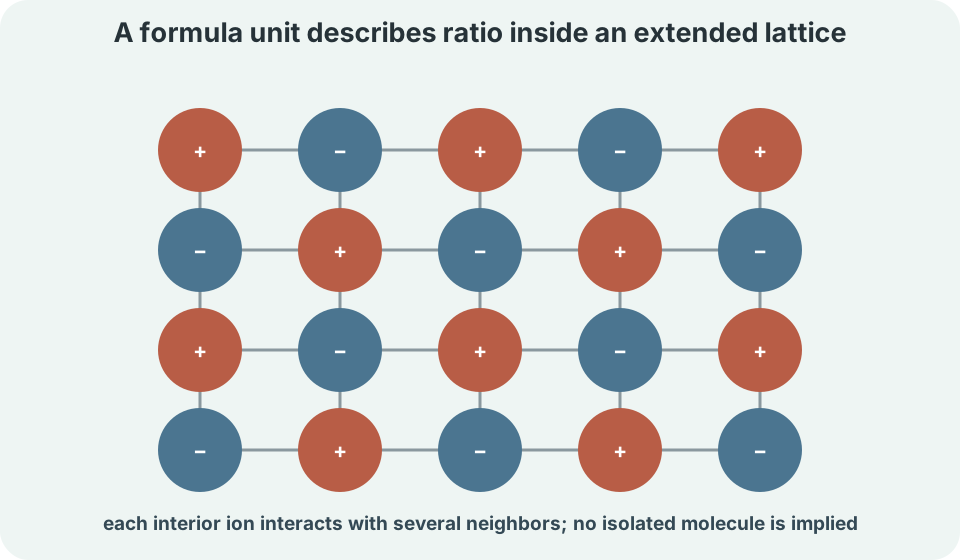
An ionic formula such as reports the simplest whole-number ratio of ions. It does not ordinarily identify a single sodium chloride molecule floating inside the crystal. Each sodium ion interacts with several chloride ions, and each chloride ion interacts with several sodium ions. Attractions and repulsions extend throughout the array. The observed structure minimizes the total energy under the material’s conditions.
This article builds the model from electron configurations, charge balance, Coulomb interaction, and lattice geometry. It then connects structure to melting behavior, brittleness, conductivity, and dissolution. Equations are interpreted symbol by symbol and used only within their assumptions. The final workflow asks for evidence at every step. The goal is to replace a cartoon of electron transfer with a predictive material model.
Ions form by changing electron count
An atom becomes an ion when its number of electrons differs from its number of protons. Losing electrons produces a positively charged cation. Gaining electrons produces a negatively charged anion. The nucleus does not change during ordinary ion formation. The element’s identity remains determined by proton number.
Main-group metals often form cations by losing their outermost electrons. Sodium has the valence configuration and commonly forms by losing that electron. Chlorine has valence configuration and commonly forms by gaining one electron. Both ions then have electron counts matching nearby noble-gas configurations. This pattern helps predict charge but is not the physical force of bonding.
Transition metals can form several common charges because valence orbital energies are close. Iron forms both and compounds. A Roman numeral in an ionic compound name identifies the cation charge, not the number of atoms. Iron(III) chloride contains . Charge balance then requires three ions per iron ion.
Ion formation has an energy cost and benefit
Ionization energy is the energy required to remove an electron from a gaseous atom or ion. It is positive under the usual convention because energy must be supplied. Successive ionization energies generally increase because electrons are removed from increasingly positive species. A very large jump often appears after all valence electrons have been removed. This helps explain why sodium commonly forms rather than .
Electron affinity describes the energy change when a gaseous atom gains an electron. Sign conventions differ among tables, so the definition accompanying a value must be read carefully. Some sources report energy released as a positive magnitude, while thermochemical conventions may report the energy change as negative when energy leaves the system. A number without its sign convention is ambiguous. The underlying process must be written before values are combined.
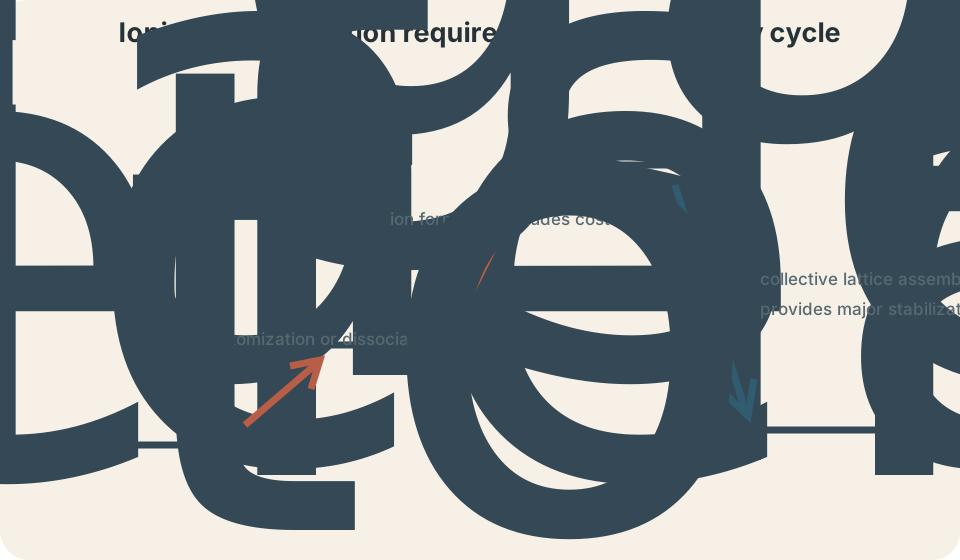
Creating separated gaseous ions is not automatically favorable. The ionization cost can exceed the electron-gain stabilization. Stable ionic solids become understandable only after lattice assembly is included. Many opposite-charge attractions then lower energy. The complete cycle matters more than any one step.
Coulomb interaction favors unlike charges
For ideal point charges, electric potential energy is . Here is potential energy, is Coulomb’s constant, and are charges, and is their separation. Opposite charges make negative. Their interaction energy therefore decreases as they approach from large distance. The negative result is relative to the conventional zero at infinite separation.
Like charges make the charge product positive and repel one another. An ionic crystal contains both unlike-charge attractions and like-charge repulsions. Its geometry arranges near neighbors primarily with opposite charge while keeping like charges farther apart. The total lattice energy sums an enormous set of interactions. A single cation–anion pair cannot represent the full result.
Real ions have finite size and deformable electron clouds. At short distance, electron-cloud overlap creates strong repulsion. The equilibrium separation balances attractive and repulsive contributions. Ionic radius, charge, and crystal coordination all affect that distance. Coulomb’s point-charge equation supplies direction and trend, not a complete short-range model.
Lattice energy is collective stabilization
Lattice energy measures the energetic effect associated with forming or separating an ionic lattice, depending on the stated convention. One convention defines it as energy released when gaseous ions form a solid. Another defines it as positive energy required to separate the solid into gaseous ions. The magnitudes may match while signs differ. Always write the process before using a tabulated value.
Greater ionic charge magnitude generally strengthens lattice interaction. A lattice containing and ions can have much stronger electrostatic stabilization than a comparable and lattice. Smaller ions can also approach more closely, reducing and strengthening attraction. These trends follow the charge product and separation in Coulomb reasoning. Crystal structure and polarization refine the comparison.
The Born–Haber cycle combines measurable or tabulated energy steps using Hess’s law. Atomization, bond dissociation, ionization, electron gain, and lattice formation connect elements in standard states to an ionic solid. Because enthalpy is a state function, the sum around the cycle must be consistent. Unknown lattice energy can therefore be inferred indirectly. The cycle makes omitted costs visible.
Ionic solids are extended lattices
An ionic crystal repeats a three-dimensional pattern called a unit cell. The unit cell is the smallest repeating geometric description, not necessarily the smallest independent cluster. Coordination number states how many nearest neighbors of a specified kind surround an ion. In the rock-salt structure, each ion has six nearest neighbors of opposite charge. Other compounds adopt different coordination patterns.
The formula unit gives the lowest whole-number ion ratio consistent with composition and charge. Sodium chloride has one sodium ion per chloride ion overall, so its formula is . Calcium fluoride requires one for two ions, giving . The subscripts describe ratio, not a discrete molecular shape. Lattice geometry requires structural evidence beyond the formula.
Temperature and pressure can change which crystal arrangement is most stable. Different structures balance packing, electrostatics, and repulsion differently. Defects can leave vacancies, substitute ions, or place ions in interstitial positions. Real crystals are not perfect infinite arrays. Their deviations often control electrical, optical, and mechanical behavior.
Charge neutrality determines empirical formulas
A bulk ionic compound is electrically neutral unless a charged defect or surface is being described. The sum of positive and negative ionic charges must therefore equal zero. For cation charge and anion charge , subscripts can be chosen so total positive charge equals total negative charge. The smallest whole-number ratio is used. Common factors must be reduced.
For aluminum oxide, aluminum is modeled as and oxide as . Two aluminum ions contribute total charge , and three oxide ions contribute . The formula is . Writing preserves neutrality but is not the simplest empirical formula. Writing fails charge balance.
Polyatomic ions remain recognizable units when writing many formulas. Calcium nitrate combines with . Two nitrate ions are required, so the formula is . Parentheses show that the subscript applies to the entire polyatomic ion. They are unnecessary when only one such ion appears.
Names preserve ion identity and charge
Binary ionic compounds are named with the cation first and the monatomic anion ending in “-ide.” Sodium and chlorine form sodium chloride. Magnesium and oxygen form magnesium oxide. Subscripts are not spoken with molecular prefixes in this naming system. Charge balance already fixes the ratio. The name therefore identifies ion types while the formula records their neutral proportion.
Metals with variable charge require a Roman numeral. is iron(II) chloride because two chloride ions contribute , requiring . is iron(III) chloride because three chloride ions require . The numeral states oxidation charge in the compound. It is not a count of iron atoms.
Polyatomic-ion names are retained. is sodium sulfate, and is ammonium chloride. Memorizing common polyatomic ions supports naming, but charge reasoning still verifies the formula. Names and formulas should translate in both directions. A correct name contains enough information to reconstruct charge balance.
Structure explains high melting temperatures
Melting an ionic solid requires enough thermal energy and entropy gain to disrupt its ordered lattice. Many strong electrostatic contacts oppose separation and rearrangement. Ionic solids therefore often melt at higher temperatures than small molecular substances. The comparison is a trend rather than a universal rule. Charge, ion size, lattice structure, and competing material types matter.
Melting does not create neutral atoms from ions. The liquid still contains charged particles, though their long-range positional order is lost. Chemical identity and phase are separate descriptions. Vaporization can produce more complex gas-phase species depending on conditions. Particle-level claims must match the actual phase transition.
Lattice-energy trends often correlate with melting temperature, but packing and entropy also contribute. A direct one-number ranking may fail when structures differ substantially. Experimental melting behavior can include decomposition before a clean liquid forms. State the property actually observed. Do not infer a simple melting point when the compound chemically changes first.
Brittleness follows lattice displacement
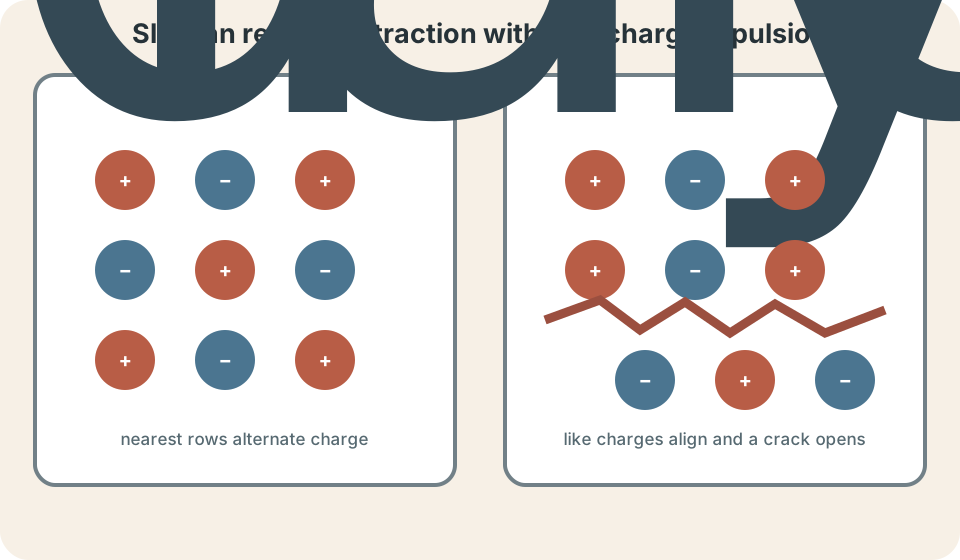
Ionic crystals can be hard because small displacements resist compressing charged arrays. They are often brittle because a larger slip can align like charges across a plane. Strong repulsion then drives a crack rather than sustained plastic deformation. The same electrostatics that stabilizes the original arrangement contributes to fracture after misalignment. Hardness and toughness are different properties.
Hardness measures resistance to localized deformation or scratching. Toughness measures energy absorbed before fracture. A material can be hard yet brittle. Describing ionic solids simply as “strong” hides this distinction. Mechanical response depends on defects, grain boundaries, temperature, and loading conditions.
Metals often deform more readily because their bonding is less directionally tied to alternating charge positions. Layers can move while delocalized electrons continue to stabilize the structure. This contrast is a model-level explanation, not a rule without exceptions. Ceramics can be engineered with microstructures that improve toughness. Structure at several scales determines performance.
Conductivity requires mobile charge
Electric current requires charge carriers that can move through a material. In a typical solid ionic lattice, ions vibrate around fixed positions but do not migrate freely. The solid therefore conducts poorly under ordinary conditions. The presence of charges alone is insufficient. Mobility is the missing condition.
When an ionic compound melts, ions can move through the liquid. An applied electric field then drives cations and anions in opposite directions. An aqueous ionic solution can conduct for the same reason when solvated ions are mobile. Conductivity depends on concentration, ion mobility, temperature, and interactions. “Molten or dissolved ionic compounds conduct” is a useful foundation, not a complete transport model.
Solid ionic conduction can occur through defects in specialized materials. Vacancies and interstitial sites allow ions to hop through a lattice. Solid electrolytes exploit this behavior in batteries and sensors. Their conductivity can be highly temperature dependent. Real materials extend beyond the ideal immobile-lattice picture.
Dissolution is an energy and entropy competition
To dissolve an ionic solid, ions must separate from the lattice. This costs energy because attractive lattice interactions are disrupted. Solvent molecules must also reorganize, which can disrupt solvent–solvent attractions. New ion–solvent attractions form and can release energy. Entropy changes as ions disperse and solvent shells organize.
In water, ion–dipole interactions create hydration shells. The oxygen side of water points preferentially toward cations, and the hydrogen side points toward anions. Several water molecules surround each ion dynamically. The ions remain charged rather than becoming neutral atoms. Hydration stabilizes separated charge in solution.
Not every ionic compound is highly soluble in water. A large lattice cost may outweigh hydration and entropy benefits. Solubility rules summarize observed patterns but do not replace thermodynamic reasoning. Temperature can change the balance. A rigorous explanation compares interactions broken, interactions formed, and dispersal effects.
Ionic character exists on a continuum
No real bond is perfectly represented by rigid point ions. Cations polarize neighboring anion electron clouds. Small highly charged cations have strong polarizing power, and large diffuse anions are readily polarized. Increased polarization gives an interaction more covalent character. Fajans-type reasoning predicts this trend.
Electronegativity difference offers another qualitative guide. A large difference often supports substantial charge separation and an ionic description. Numerical cutoffs are conventions rather than physical boundaries. Structure and measured electron density provide stronger evidence. The useful model depends on the question.
Silver chloride, for example, is commonly classified as ionic but has appreciable covalent character. Network, molecular, metallic, and ionic descriptions can overlap in complex solids. Model humility is part of chemical rigor. A label should generate predictions and be revised when evidence disagrees. Categories organize a continuum rather than command it.
A reliable ionic-compound workflow
First identify likely ions from electron configuration, periodic position, or a supplied name. State each charge explicitly. Balance total charge to obtain the lowest whole-number formula. Preserve parentheses around repeated polyatomic ions. Verify the result by summing charges.
Second describe the material as an extended lattice unless evidence identifies discrete molecular ions or another structure. Use Coulomb reasoning to compare charge products and ion separations. Include both attractive and repulsive interactions. For energy questions, write the formation or separation convention before assigning a lattice-energy sign. Keep the complete thermochemical cycle visible.
Third connect structure to one defined property. For conductivity, ask whether charge carriers are mobile. For brittleness, analyze displacement and like-charge alignment. For melting, discuss disruption of collective interactions and entropy. For dissolution, compare lattice separation, solvent reorganization, hydration, and dispersal.
Retrieval practice and synthesis
Construct formulas for magnesium nitride, aluminum sulfide, and iron(III) oxide. Write each ion charge before choosing subscripts. Show that total positive and negative charge cancel. Reduce every ratio to lowest terms. Explain why the formula represents a lattice composition rather than one molecule.
Predict which has the stronger lattice interaction in a simplified comparison: or . Magnesium oxide has ions with charge magnitudes two rather than one and generally smaller relevant separations. Coulomb reasoning therefore predicts much greater stabilization magnitude. State that crystal structure and repulsion refine the quantitative result. Connect the prediction to an expected melting-temperature trend without claiming perfect proportionality.
Explain why solid sodium chloride does not conduct well while molten sodium chloride does. Both phases contain ions. In the solid, the lattice constrains long-range ion movement. In the liquid, ions can migrate under an electric field. The comparison isolates mobility as the controlling variable.