
A covalent bond does not always distribute electron density equally between its atoms. Differences in nuclear attraction, atomic size, orbital energy, and molecular environment can pull shared density toward one end of a bond. Chemists summarize much of this tendency with electronegativity. Uneven density gives atoms partial charges and creates a bond dipole. The direction and magnitude of all bond dipoles then combine with molecular geometry to determine whole-molecule polarity.
Several related ideas must remain distinct. Electronegativity is a model-based relative tendency, not the number of electrons on an isolated atom. Partial charge is a distributed feature of electron density, not necessarily a full ionic charge. Bond polarity describes one bond, whereas molecular polarity describes the vector sum across the complete structure. Confusing these levels produces incorrect predictions even when individual electronegativity values are remembered.
This article builds a repeatable reasoning chain. Identify the bonded atoms, compare their electronegativities, and mark the expected direction of electron-density shift. Represent each polar bond with a vector whose direction and magnitude have meaning. Determine the three-dimensional molecular geometry and add the vectors. Use the resulting distribution to predict intermolecular behavior while acknowledging the limits of simple scales.
Electronegativity compares attraction within a bond
Electronegativity describes an atom’s relative tendency to attract shared electron density when it is chemically bonded. The phrase “when bonded” is essential because electronegativity is not a directly measurable property of a free isolated atom in the same way that mass is. Several scales infer values from bond energies, ionization energies, electron affinities, or other data. The Pauling scale is the most familiar in introductory chemistry. Fluorine is assigned the largest Pauling electronegativity.
Across a main-group period, electronegativity generally increases from left to right. Effective nuclear charge increases while valence electrons remain in the same principal shell, so bonding density is held more strongly. Down a group, electronegativity generally decreases because valence regions are farther from the nucleus and more shielded. These trends are useful first approximations. Transition elements and unusual oxidation states require more careful comparison.
An electronegativity value has no ordinary physical unit. It is a dimensionless scale value constructed for comparison. A difference is written . The Greek letter , pronounced “kai,” represents electronegativity, and the vertical bars mean take the absolute value. The expression measures contrast, not the direction of electron shift.
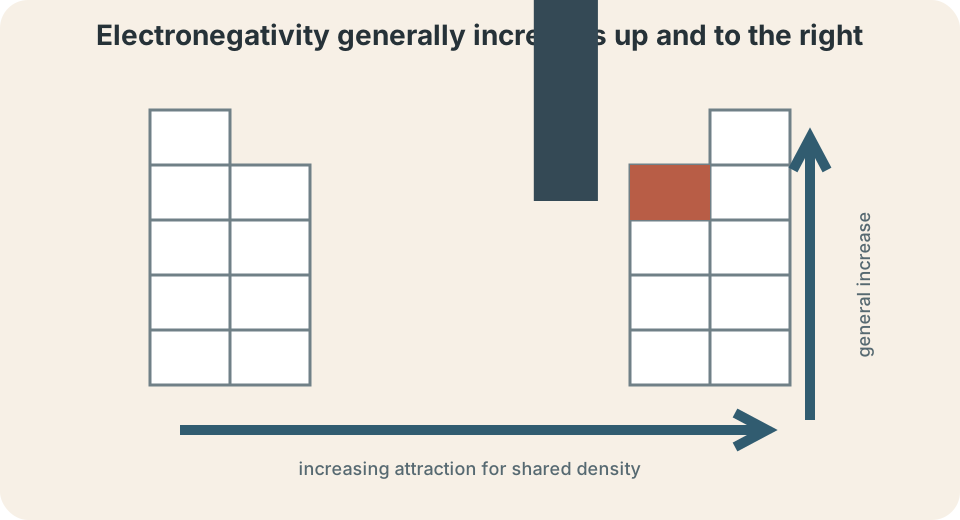
Electronegativity difference predicts a continuum
When two bonded atoms have equal electronegativity, their bond is modeled as nonpolar covalent. Shared density is then distributed symmetrically in the simplest isolated-bond picture. When the values differ modestly, the bond is polar covalent. When charge transfer and lattice stabilization dominate, an ionic model may become more useful. These descriptions form a continuum rather than three boxes separated by universal numerical walls.
Textbooks sometimes assign cutoff values to . Such thresholds help beginners classify examples consistently, but different sources choose different numbers. Bond character also depends on oxidation state, coordination, polarization, and surrounding structure. A difference near a cutoff does not make nature switch mechanisms suddenly. State the convention if a classification depends on one.
The better question is often what the model must explain. A Lewis structure may use a covalent line while measured electron density is strongly asymmetric. An ionic lattice model may use integer charges while real ions polarize one another. Spectroscopy, bond length, dipole moment, and chemical reactivity provide evidence beyond a table. Electronegativity begins the analysis rather than ending it.
Partial charges represent uneven density
In a polar bond, the more electronegative atom is labeled and the less electronegative atom is labeled . The lowercase Greek letter , pronounced “delta,” signals a partial charge. It is deliberately different from the full charges written on ideal monatomic ions. The labels communicate direction of density shift. They do not specify an exact fraction of the elementary charge unless a charge model supplies one.
Consider hydrogen chloride, . Chlorine is more electronegative than hydrogen, so bonding density is shifted toward chlorine. Hydrogen is labeled and chlorine . The molecule remains electrically neutral because the partial charges balance overall. Neutrality does not require uniform charge distribution.
Partial charges depend on how electron density is partitioned in a model. Mulliken, natural population, electrostatic-potential, and other computational schemes can assign different numerical values to the same molecule. That disagreement does not make polarity fictional. It shows that electron density is continuous while an atom-by-atom charge is a summary. Trends are often more robust than any single assigned number.
A bond dipole is a vector
An electric dipole contains separated positive and negative charge centers. Its magnitude in a simple model is . The symbol , pronounced “mu,” denotes dipole moment, is the magnitude of separated charge, and is the separation. Greater charge separation or greater distance increases the simple dipole magnitude. Molecular electron density requires a more complete calculation, but the relationship supplies intuition.
Dipole moment is a vector because it has direction as well as magnitude. In chemistry diagrams, a bond-dipole arrow commonly points toward the more electronegative, partially negative end. A crossed or plus-marked tail identifies the partially positive end. Physics conventions may define the electric dipole vector in the opposite direction. Always read the diagram’s stated convention rather than assume.
The common molecular unit is the debye, symbol . One debye equals approximately , where is coulombs and is metres. Scientific notation is needed because molecular charge separations are extremely small in SI units. A measured value of zero can result from symmetry even when individual bonds are polar. The unit and vector nature must accompany any numerical comparison.
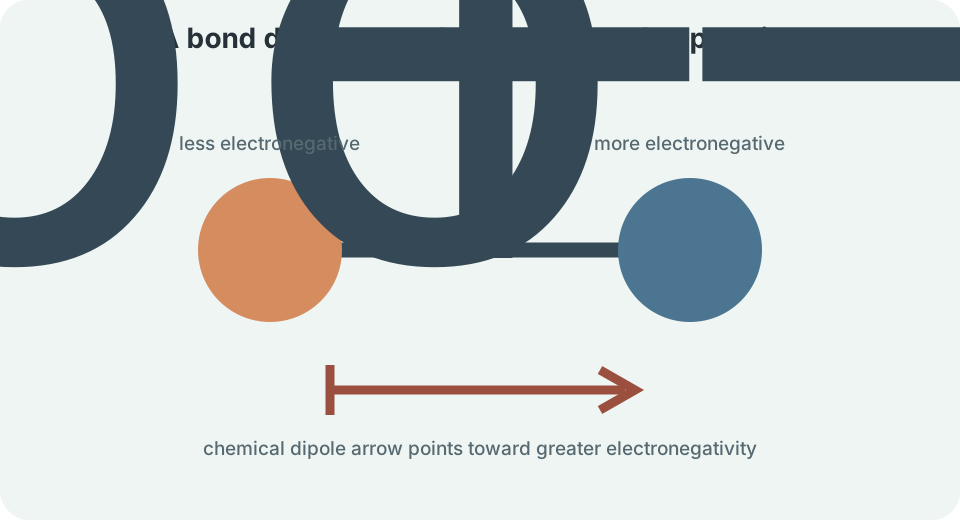
Molecular polarity requires vector addition
Whole-molecule dipole moment is the vector sum of bond dipoles and other contributions from electron distribution. Symbolically, . Bold symbols indicate vectors, the subscript “mol” means molecular, and means add the contributions indexed by . Vector addition depends on angles. Adding only magnitudes ignores cancellation.
Carbon dioxide contains two polar carbon–oxygen bonds. Its equilibrium geometry is linear, so the equal bond-dipole vectors point in opposite directions. They cancel to give zero permanent molecular dipole in the ideal symmetric structure. The bonds remain polar even though the molecule is nonpolar. This example separates local bond polarity from global molecular polarity.
Water also contains two polar oxygen–hydrogen bonds, but its geometry is bent. Their vectors do not point opposite one another. Components along one direction cancel partly, while components along the molecular bisector reinforce. Water therefore has a nonzero molecular dipole. Geometry converts the same number of polar bonds into a different molecular result.
Use components to make cancellation explicit
Suppose two equal bond dipoles of magnitude form angle with one another. Symmetry places the resultant along the angle bisector. Each bond contributes component along that bisector. The perpendicular components cancel. The resulting magnitude is in this ideal two-vector model.
If , then . The resultant is zero, matching a linear symmetric molecule. If the angle is smaller than , the cosine is positive and the resultant is nonzero. The calculation demonstrates why geometry matters. It is not a formula to apply when the two bond dipoles have unequal magnitudes.
For more complex molecules, choose coordinate axes and resolve each vector into components. Add all components, all components, and all components. The magnitude is . Each subscript labels a directional component. A zero sum requires cancellation in every dimension.
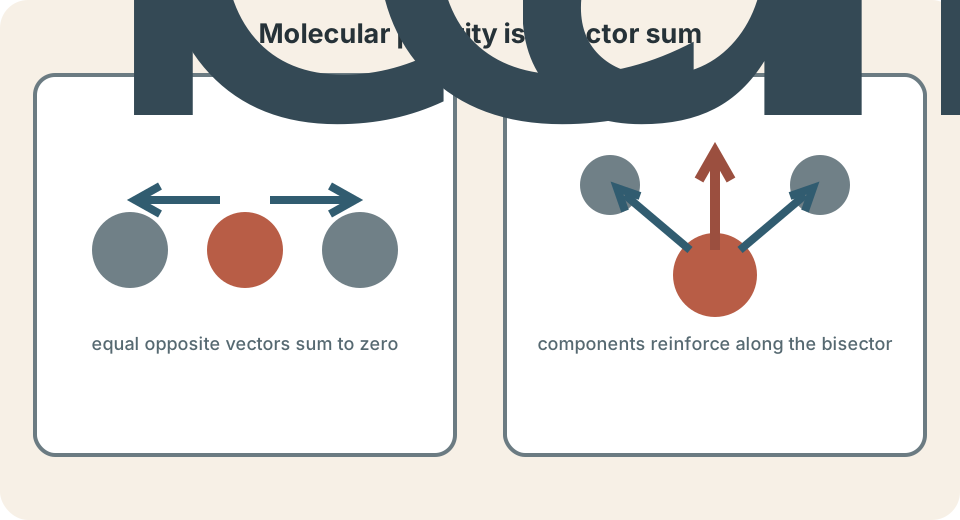
Symmetry is a powerful shortcut
Highly symmetric molecules with identical surrounding atoms often have canceling bond dipoles. Boron trifluoride is trigonal planar, and its three equivalent boron–fluorine vectors are separated evenly in the plane. Their vector sum is zero in the ideal geometry. Methane is tetrahedral with four equivalent carbon–hydrogen directions. Its symmetry also gives no permanent molecular dipole.
Replacing one surrounding atom can destroy cancellation. Chloromethane retains approximately tetrahedral geometry around carbon, but one carbon–chlorine direction differs from the three carbon–hydrogen directions. The vector sum is no longer zero. Molecular polarity can therefore change without changing the central-atom geometry category. Symmetry requires both geometric arrangement and equivalent contributions.
Lone pairs often lower symmetry and influence molecular shape. Ammonia has a trigonal-pyramidal molecular geometry rather than trigonal planar. Its nitrogen–hydrogen bond contributions reinforce along the pyramid axis. Sulfur dioxide is bent and polar even though a related symmetric linear arrangement would cancel. Draw the electron-domain and molecular geometry before invoking symmetry.
Resonance and environment refine the picture
Resonance delocalizes electron density across several atoms. A single Lewis contributor may display one localized polar bond that is not uniquely present in the resonance hybrid. Equivalent contributors can make several measured bonds equivalent. Formal charges help bookkeep electrons but do not equal physical partial charges. Polarity belongs to the hybrid electron distribution.
The molecular environment can alter bond polarity. Nearby substituents withdraw or donate density through inductive and resonance effects. Solvent electric fields polarize solute molecules. Coordination to a metal or protonation can change orbital energies and charge distribution. An electronegativity table cannot represent all of these contextual changes by itself.
Even a nonpolar molecule can acquire an induced dipole in an external field. Its electron cloud shifts slightly relative to its nuclei. Polarizability describes the ease of that distortion. Instantaneous and induced dipoles generate London dispersion interactions. Permanent molecular polarity is therefore not the only route to intermolecular attraction.
Polarity influences intermolecular behavior
Polar molecules can align favorable partial-charge regions with one another. This adds dipole–dipole attraction to the London dispersion present in all matter. Among molecules of similar size and shape, stronger permanent dipoles can raise boiling point by increasing the energy required for separation. The comparison must control polarizability and hydrogen bonding. Otherwise several changes act at once.
Hydrogen bonding requires more specific donor and acceptor structures than polarity alone. A molecule can be polar without containing a hydrogen attached to nitrogen, oxygen, or fluorine. Acetone is polar and can accept hydrogen bonds, but pure acetone lacks a conventional hydrogen-bond donor. Water can donate and accept. Functional-group analysis therefore goes beyond one molecular dipole number.
Polarity also informs solubility, but “like dissolves like” is only a starting heuristic. Dissolution disrupts solute–solute and solvent–solvent attractions while forming solute–solvent attractions. Entropy contributes as particles disperse and solvent reorganizes. A polar group may support water solubility, while a large nonpolar region opposes it. Molecular size and the balance of functional groups matter.
Worked molecular comparisons
Compare and . Both contain polar bonds, but boron trifluoride is trigonal planar with three equivalent vectors that cancel. Ammonia is trigonal pyramidal, and its three nitrogen–hydrogen vectors reinforce along the symmetry axis. Boron trifluoride is nonpolar in its ideal isolated geometry. Ammonia has a permanent molecular dipole.
Compare and . Both have tetrahedral carbon centers and polar carbon–chlorine bonds. Carbon tetrachloride has four equivalent surrounding atoms arranged symmetrically, so its vectors cancel. Dichloromethane has two hydrogens and two chlorines, so the vector contributions are not equivalent. It has a nonzero molecular dipole.
Compare cis and trans arrangements of a symmetric substituted alkene. In the cis isomer, similar bond-dipole contributions can lie on the same side and reinforce. In the trans isomer, symmetry can place them opposite one another and produce greater cancellation. Connectivity alone does not determine the answer. Spatial arrangement changes the vector sum.
Common mistakes and repairs
One mistake is declaring a bond ionic solely because exceeds a memorized cutoff. Numerical thresholds are conventions applied to a continuum. Examine the material’s structure and the purpose of the model. An extended lattice and evidence of substantial charge separation support an ionic description. A molecular substance with uneven shared density may be better described as polar covalent.
Another mistake is calling every molecule with polar bonds polar. Molecular polarity requires vector addition in the actual three-dimensional geometry. Draw or determine the shape before summing contributions. Check whether surrounding atoms and bond moments are equivalent. Symmetry can cancel strong local dipoles.
A third mistake is treating partial-charge symbols as fractional ions with known values. The symbols and communicate direction, not an exact charge magnitude. Numerical atomic charges depend on a chosen partition method. Use experimental dipole moments and calculated density as evidence when magnitude matters. Keep formal charge, oxidation state, and partial charge conceptually separate.
A reliable polarity workflow
First, draw a valid Lewis structure and identify resonance if present. Determine the electron-domain geometry and molecular geometry. Mark the more electronegative end of every significantly polar bond. Include lone-pair influence through the resulting geometry and electron distribution. Do not attempt cancellation from a flat formula alone.
Second, represent bond contributions as vectors. Use symmetry to identify equivalent vectors and likely cancellation. When symmetry is insufficient, resolve vectors into components. Add directionally rather than counting arrows. State whether the predicted molecular dipole is zero or nonzero and explain why.
Third, connect polarity to a defined observation. For boiling point, compare attractions among similar particles. For solubility, inventory interactions broken and formed. For spectroscopy, relate changing dipole moment to infrared activity when appropriate. A property claim becomes rigorous only when the mechanism between structure and measurement is explicit.
Retrieval practice and synthesis
Explain why carbon dioxide has polar bonds but no permanent molecular dipole. Define bond polarity, identify its linear geometry, and describe vector cancellation. Then explain why bending the molecule instantaneously during a vibration can create a temporary changing dipole. Distinguish equilibrium geometry from a vibrational distortion. This reasoning connects static structure to spectroscopy.
Predict whether , , and have permanent molecular dipoles in their ideal geometries. Sulfur dioxide is bent, so its bond contributions do not cancel. Sulfur trioxide is trigonal planar with equivalent surrounding oxygens, so symmetry cancels them. Sulfur hexafluoride is octahedral with six equivalent directions, so its vectors cancel. Verify each conclusion with geometry rather than formula inspection.
Create a claim–evidence–reasoning explanation comparing two isomers. State which has the larger molecular dipole. Use bond polarities and three-dimensional vector arrangement as evidence. Explain how reinforcement or cancellation produces the difference. End by naming an experimental observation, such as measured dipole moment or intermolecular behavior, that could test the claim.