
A Lewis structure records connectivity and valence-electron placement on a flat page. Molecules, however, occupy three-dimensional space. Valence-shell electron-pair repulsion theory, abbreviated VSEPR, converts a Lewis structure into a qualitative shape prediction. Electron-rich regions around a central atom arrange to reduce repulsion. The resulting geometry helps explain polarity, reactivity, intermolecular attraction, and spectroscopy.
VSEPR is a model rather than a fundamental force law. It treats bonds and lone pairs as electron domains with characteristic spatial demands. The model predicts many main-group molecular shapes efficiently, but it does not calculate exact electron density. Transition-metal complexes and delocalized bonding can require other theories. A good prediction states both the geometry and the model’s expected accuracy.
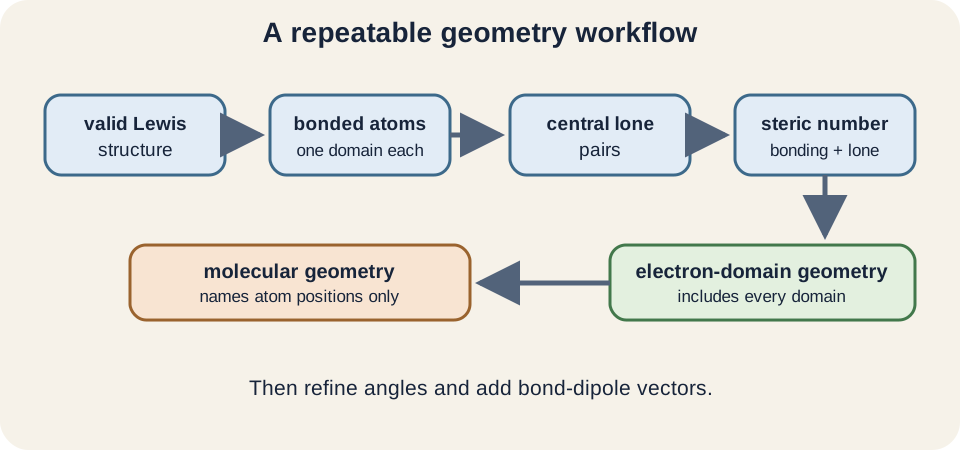
This lesson uses a repeatable sequence. First draw and validate a Lewis structure, then count domains, identify the electron-domain geometry, and finally name molecular geometry using atom positions only. Lone-pair effects and multiple bonds will refine ideal angles. Vector addition will connect shape with molecular polarity. Examples will include standard notation without allowing notation to replace reasoning.
Learning objectives and an opening prediction
After this lesson, you should count bonding and nonbonding electron domains around a central atom. You should distinguish electron-domain geometry from molecular geometry. You should predict common shapes for two through six domains and estimate ideal angles. You should explain lone-pair and multiple-bond distortions. You should also combine bond polarity with geometry to predict molecular polarity.
Compare carbon dioxide and water. Both contain three atoms, but is linear while is bent. Carbon has two bonding domains and no central lone pairs. Oxygen in water has two bonding domains and two lone pairs. Atom count alone cannot determine shape.
Predict whether a double bond counts as one or two domains. VSEPR counts one region of electron density between the same pair of atoms, so a single, double, or triple bond counts as one bonding domain. Multiple bonds can repel somewhat more strongly than single bonds, affecting precise angles. They still occupy only one directional region around the central atom. Domain counting and repulsion strength are related but distinct steps.
Begin with a valid Lewis structure
VSEPR cannot repair an incorrect Lewis structure. Count total valence electrons, choose plausible connectivity, distribute electrons to satisfy typical valence patterns, and evaluate formal charges. Include brackets and charge for ions. Resonance forms may be needed when one drawing cannot localize the bonding. Geometry follows the actual domain arrangement implied by the resonance hybrid.
The central atom is often the least electronegative nonhydrogen atom, though structure and known chemistry take precedence. Hydrogen forms one bond and is never a conventional central atom in these examples. Halogens commonly occupy terminal positions. Carbon frequently forms the molecular skeleton. A formula’s written order does not always reveal connectivity.
For , nitrogen contributes five valence electrons and three hydrogens contribute three, giving eight total. Three N–H bonds use six electrons, leaving one lone pair on nitrogen. The central nitrogen therefore has four domains: three bonding and one nonbonding. Four domains establish a tetrahedral electron-domain arrangement. That count, rather than the four atoms alone, begins the geometry prediction.
Count domains with one clear rule
Each atom bonded to the central atom contributes one bonding domain, regardless of bond order. Each lone pair on the central atom contributes one nonbonding domain. An unpaired electron can also occupy a domain in radical species, though elementary examples often avoid them. The total is called steric number or electron-domain count. Only domains around the selected central atom are counted.
For , carbon has two double bonds and no lone pairs, giving two domains. For in a common resonance description, sulfur has two bonding regions and one lone pair, giving three domains. For , sulfur has six S–F bonding regions and no central lone pair, giving six domains. Each example counts one center independently. Terminal-atom lone pairs do not enter the central count.
The notation summarizes a local center. is the central atom, represents surrounding bonded atoms, counts those atoms, represents lone pairs on , and counts those pairs. Water is , ammonia is , and carbon dioxide is . An omitted subscript one is conventionally understood. The notation records domain counts but not chemical identity.
Electron-domain geometry minimizes repulsion
Two domains arrange linearly with ideal angle . Three arrange trigonal planar with separations. Four arrange tetrahedrally with ideal angle about . Five arrange trigonal bipyramidally with , , and relationships. Six arrange octahedrally with and relationships.
These arrangements maximize angular separation within three-dimensional constraints. Four domains do not form a flat square because separations would produce more repulsion than the tetrahedral arrangement. Six domains do form an octahedral pattern, which can be pictured as four in a square plane plus one above and one below. Names refer to geometric frameworks, not electron orbit paths. Electrons remain quantum-mechanical distributions.
Electron-domain geometry includes every bonding domain and lone pair. Molecular geometry names only the positions of atoms. Removing the invisible lone-pair directions from the name can change it. A four-domain center may therefore be tetrahedral, trigonal pyramidal, or bent as molecular geometry. State both when lone pairs are present.
Two and three domains
An center with two domains is linear. Carbon dioxide is the standard example, with O–C–O angle . Beryllium chloride in a gas-phase molecular treatment also illustrates the pattern. No lone pair occupies the central atom in these elementary structures. Electron-domain and molecular geometries are both linear.
An center with three bonding domains is trigonal planar. Boron trifluoride has approximately F–B–F angles. All four atoms lie in one plane under the ideal model. Boron has an incomplete octet in the elementary Lewis structure. VSEPR uses the observed three domains despite the incomplete octet.
An center has trigonal-planar electron-domain geometry but bent molecular geometry. Sulfur dioxide is a common example. The lone pair occupies one of the three domain positions, leaving two bonded atoms at an angle smaller than the ideal in a simple qualitative prediction. Resonance makes the S–O bonds equivalent in the usual model. Bent geometry prevents the bond dipoles from canceling completely.
Four domains and lone-pair compression
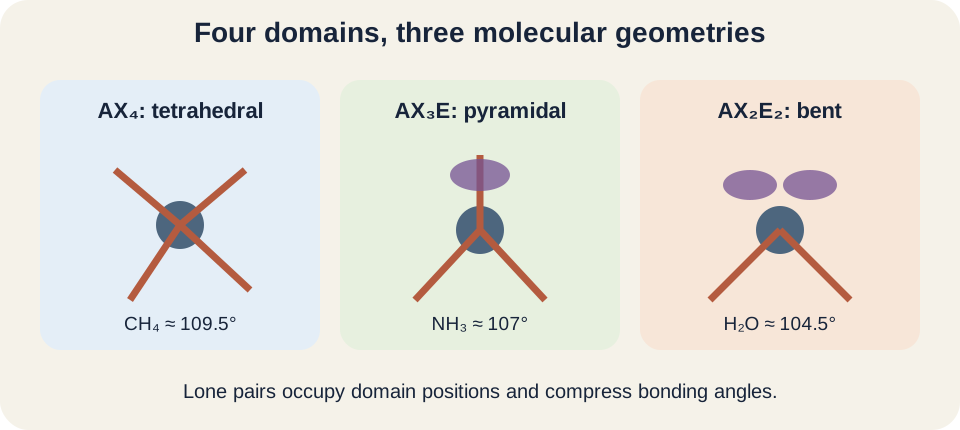
An center is tetrahedral. Methane has four equivalent C–H bonding domains and ideal H–C–H angles of about . A flat drawing with ninety-degree lines does not represent its spatial geometry. Wedge-and-dash notation indicates bonds projecting out of or behind the page. Physical models help translate the drawing into space.
An center has tetrahedral electron-domain geometry and trigonal-pyramidal molecular geometry. Ammonia is the standard example. Its H–N–H angle is about , smaller than . The lone pair is more spatially diffuse near the central atom than a bonding pair shared between nuclei. It therefore compresses the bonding-domain angles.
An center has tetrahedral electron-domain geometry and bent molecular geometry. Water has a bond angle about . Two lone pairs create greater compression than one central lone pair in ammonia. A useful qualitative hierarchy is lone pair–lone pair repulsion greater than lone pair–bonding pair repulsion, which is greater than bonding pair–bonding pair repulsion. This hierarchy predicts trends rather than exact angles.
Five domains contain inequivalent positions
Five domains form a trigonal bipyramidal electron-domain arrangement. Three equatorial positions lie in a plane at from one another. Two axial positions lie above and below that plane. Each axial domain has three interactions with equatorial domains. An equatorial domain has only two interactions with axial domains.
Lone pairs prefer equatorial positions because this placement reduces the number of ninety-degree interactions. Thus commonly forms a seesaw molecular geometry with the lone pair equatorial. forms a T-shaped geometry with both lone pairs equatorial. becomes linear because all three equatorial positions are occupied by lone pairs. Placement must precede shape naming.
Phosphorus pentachloride is and trigonal bipyramidal in its gas-phase molecular description. Sulfur tetrafluoride is and seesaw. Chlorine trifluoride is and T-shaped. Xenon difluoride is and linear. These examples also involve expanded-valence descriptions used in elementary chemistry.
Six domains form an octahedral family
Six domains form an octahedral electron-domain geometry. Every position is equivalent before different ligands or lone pairs are assigned. Adjacent directions are apart, and opposite pairs are apart. Sulfur hexafluoride is and octahedral. Its high symmetry supports complete bond-dipole cancellation.
An center has square-pyramidal molecular geometry. The lone pair occupies one octahedral direction, leaving four atoms in a square plane and one above or below. Bromine pentafluoride is a standard example. Bond angles are based near ninety degrees but can distort. Electron-domain geometry remains octahedral.
An center commonly has square-planar molecular geometry. The two lone pairs occupy opposite positions to remain apart. Xenon tetrafluoride illustrates this arrangement. Four fluorine atoms lie in a square plane around xenon. Symmetry can cancel their bond dipoles despite polar individual bonds.
Multiple bonds and unequal surrounding atoms distort angles
A multiple bond is one domain for geometry classification, but it contains greater electron density than a comparable single bond. It can repel neighboring domains more strongly. Formaldehyde has approximately trigonal-planar carbon, yet angles around carbon are not all exactly . The C=O domain pushes the C–H domains somewhat closer together. Ideal angles are starting references.
Different surrounding atoms also alter electron distribution. More electronegative terminal atoms can draw bonding density away from the central atom, changing local repulsion. Steric size, bonding character, and resonance contribute as well. VSEPR does not provide an exact quantitative formula for these competing effects. Experimental structures or higher-level calculations supply precise angles.
When a problem asks only “predict geometry,” use the ideal domain structure. When it asks for relative angle trends, discuss lone pairs and multiple bonds qualitatively. When exact values are supplied by data, do not force them to equal ideal numbers. A model should organize observations rather than erase them. State “approximately” for idealized bond angles.
Molecular polarity combines bonds as vectors
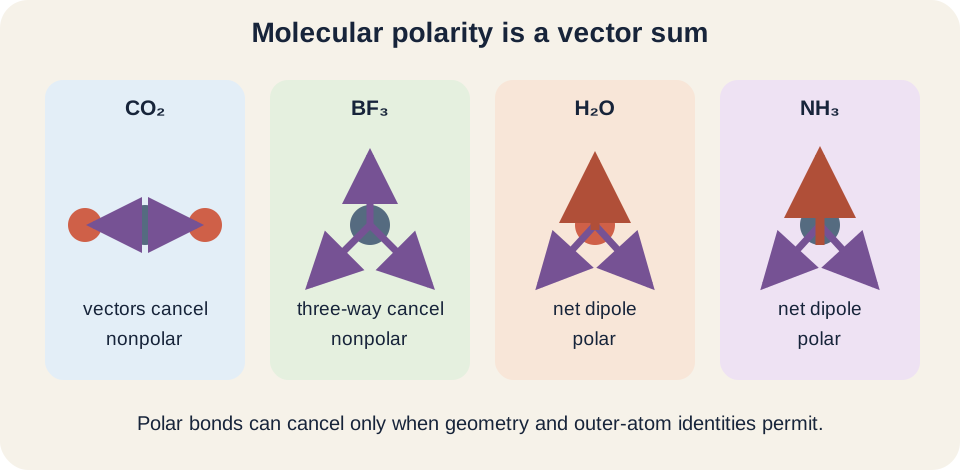
Bond polarity arises from unequal electron sharing and produces a bond dipole vector. Molecular polarity is the vector sum of all bond dipoles. Polar bonds do not guarantee a polar molecule. Geometry determines whether vectors cancel. Lone pairs influence geometry and can also contribute to the overall charge distribution.
Carbon dioxide contains polar C=O bonds, but its linear equal and opposite dipoles cancel, making the molecule nonpolar overall. Water’s O–H bond dipoles do not cancel because the molecule is bent. Boron trifluoride’s three B–F dipoles cancel in an ideal trigonal-planar arrangement. Ammonia’s trigonal-pyramidal geometry leaves a net dipole. Symmetry and identical outer atoms are central to cancellation.
Replacing one outer atom can break symmetry. is nonpolar in its ideal tetrahedral form, while is polar because the bond vectors differ. A geometry name alone is insufficient when surrounding atoms are not identical. Draw vector arrows and add components conceptually. Formal molecular charge is also distinct from dipole moment.
Worked example: water from electrons to polarity
Water has eight valence electrons: six from oxygen and one from each hydrogen. Two O–H bonds use four electrons, and the remaining four form two lone pairs on oxygen. Oxygen therefore has four electron domains. Four domains select tetrahedral electron-domain geometry. With only atom positions named, molecular geometry is bent.
Ideal tetrahedral angle is about , but the two lone pairs compress the measured H–O–H angle to about . Each O–H bond is polar toward oxygen. Because the two bond vectors meet at a bent angle, they do not cancel. Water has a net molecular dipole. That polarity contributes to hydrogen bonding and many bulk properties.
The reasoning chain matters more than the final word “bent.” An incorrect Lewis structure with no lone pairs would produce the wrong geometry. A correct geometry without bond-polarity vectors would not establish molecular polarity. Each conclusion uses a different layer of evidence. The measured angle then tests the qualitative repulsion refinement. Keeping layers explicit prevents shortcut errors.
Worked example: xenon tetrafluoride
In the elementary expanded-valence Lewis structure for , xenon has four Xe–F bonding domains and two lone pairs. The steric number is six. Electron-domain geometry is octahedral. The two lone pairs choose opposite directions to maximize separation. The remaining four fluorines occupy one plane.
Molecular geometry is square planar. Adjacent F–Xe–F angles are approximately , and opposite ones are . The molecule’s four equivalent bond dipoles cancel vectorially in the ideal shape. Thus a molecule with highly polar Xe–F bonds can be nonpolar overall. Bond polarity and molecular polarity are not synonyms.
Writing records the domain pattern. It does not explain why lone pairs are opposite. Repulsion minimization supplies that reasoning. Nor does it calculate exact bond lengths or electron density. The notation is a compact summary after the structure has been justified.
Resonance and equivalent bonds
Resonance structures are alternative Lewis drawings for one delocalized electronic structure. The molecule does not switch back and forth between them as separate species. VSEPR counts domain regions in the resonance hybrid. Equivalent resonance bonds often have equal intermediate bond orders. A double-bond mark in one contributor should not be interpreted as a permanently localized direction.
Nitrate, , has three bonding domains around nitrogen and no central lone pair in its usual contributors. Its electron-domain and molecular geometries are trigonal planar. The three N–O bonds are equivalent in the resonance hybrid. Ideal O–N–O angles are approximately . One drawn double bond does not create a fourth domain.
Ozone has two bonding regions and one central lone pair, producing trigonal-planar electron-domain geometry and bent molecular geometry. Its resonance contributors distribute bonding. The central lone pair remains a distinct domain. Domain counting survives delocalization when connectivity is understood. Lewis resonance and VSEPR complement rather than contradict each other.
Model limitations and better theories
VSEPR works best for many main-group compounds with identifiable central atoms. It is less reliable for transition-metal complexes, where ligand-field effects and d-orbital energetics strongly influence geometry. Four-coordinate transition metals may be tetrahedral or square planar depending on electronic structure. Domain counting alone cannot decide. Coordination chemistry requires additional models.
VSEPR also provides qualitative rather than highly precise bond angles and lengths. Molecular orbital theory describes electrons as delocalized orbitals across a molecule. Valence-bond and hybridization models offer another language for bonding directions. Computational quantum chemistry can predict structures by minimizing electronic and nuclear energy. These approaches explain more but require more information.
A simple model remains valuable when used within scope. It can generate a testable first prediction quickly. Spectroscopy, diffraction, microwave measurements, and computation can then refine or contradict it. Scientific competence includes knowing when a model is enough. It also includes recognizing when evidence demands a richer one.
Common misconceptions and repairs
One misconception counts a double bond as two VSEPR domains. Count connected atom directions, not shared electron pairs individually. A multiple bond is one domain but may exert stronger repulsion. Carbon dioxide therefore has two domains, not four. Its central geometry is linear.
Another misconception names electron-domain geometry as molecular geometry when lone pairs exist. Ammonia is not molecularly tetrahedral; its domains are tetrahedral and its atoms are trigonal pyramidal. Water’s domains are tetrahedral and its atoms are bent. State both labels when teaching or checking reasoning. Lone pairs occupy space even though the molecular name omits them.
A third misconception decides polarity from polar bonds alone. Vector cancellation depends on geometry and ligand identity. Symmetric molecules with identical surrounding atoms can be nonpolar despite polar bonds. Asymmetric shapes commonly retain a net dipole. Draw arrows rather than guessing from one bond.
Practice with guided feedback
First, determine electron-domain and molecular geometry for , , and . Second, predict which central lone-pair site is favored in a trigonal bipyramid. Third, decide whether ideal and are polar. Fourth, explain why a multiple bond counts once but can distort angles. Show the domain count before each name.
Carbon dioxide is , linear in both descriptions. Ammonia is , tetrahedral by domains and trigonal pyramidal by atoms. Sulfur tetrafluoride is , trigonal bipyramidal by domains with an equatorial lone pair and seesaw molecular geometry. Equatorial placement reduces ninety-degree interactions. Boron trifluoride is nonpolar by symmetric cancellation, while bent water is polar.
For a self-check, use the sequence Lewis structure, domains, electron geometry, lone-pair placement, molecular geometry, angle refinement, and polarity. Skipping a step makes an accidental answer more likely. Compare predicted symmetry with bond-vector cancellation. Use “approximately” for ideal angles. If a transition metal appears, question whether elementary VSEPR is adequate.
Retrieval and connection forward
Without looking back, list domain geometries for two through six domains. Explain why molecular geometry can differ from electron-domain geometry. Compare , , and with angle trends. Explain axial and equatorial lone-pair placement for five domains. Finish by using vectors to distinguish bond polarity from molecular polarity.
Bond-polarity lessons provide the electronegativity basis for individual dipoles. Intermolecular-force lessons use molecular geometry and polarity to predict attractions. Hybridization and molecular-orbital lessons offer deeper electronic descriptions. Spectroscopy connects shape to rotational and vibrational signatures. VSEPR supplies the first spatial model linking those topics.
Keep one organizing statement: VSEPR arranges central-atom electron domains to reduce repulsion. A valid Lewis structure determines domain count, domains determine electron geometry, and visible atom positions determine molecular geometry. Lone pairs and multiple bonds refine ideal angles. Molecular polarity then follows from the vector sum of bond dipoles in that three-dimensional shape. Experimental evidence decides whether the qualitative model is adequate.