
Lewis structures are valence-electron bookkeeping models. They show which atoms are connected, how many bonding pairs connect them, and where lone pairs or formal charges are assigned. They do not display exact electron density or three-dimensional molecular shape. A useful Lewis structure is therefore a disciplined model rather than a literal photograph of a molecule. Its claims and limitations must both be understood.
Construction works best as a cycle of counting, arranging, checking, and revising. The total available valence electrons constrain every acceptable drawing. Typical bonding patterns and electronegativity guide the initial skeleton. Octets and duets organize electron placement for many main-group species. Formal charge and resonance then compare alternatives.
This lesson explains every stage rather than presenting a bare recipe. Examples include neutral molecules, polyatomic ions, multiple bonds, resonance, odd-electron species, incomplete octets, and expanded valence shells. Three diagrams make the bookkeeping visible. Every count is checked independently. The goal is to justify a structure and interpret what it can teach.
Learning goals and an opening puzzle
You should count total valence electrons for molecules and ions. You should choose plausible connectivity and distribute bonding and nonbonding pairs. You should calculate and interpret formal charge. You should recognize resonance and common octet-rule exceptions. You should also distinguish Lewis structure from molecular geometry and measured electron density.
Compare carbon dioxide and water. Both contain three atoms, but their Lewis structures organize electron pairs differently. Carbon dioxide uses two double bonds around carbon. Water uses two single bonds and two lone pairs around oxygen. Those differences lead into different geometries and chemical behavior.
Predict why simply connecting atoms is not enough. The same skeleton can support different bond orders and charge placements. Electron totals eliminate some drawings. Formal charges help compare others. Experimental evidence ultimately decides whether the model is adequate.
Valence electrons are the accounting currency
Lewis structures usually track valence electrons rather than every electron. For main-group atoms, valence count follows the periodic-table group pattern. Carbon contributes four, nitrogen five, oxygen six, and halogens seven. Hydrogen contributes one. Noble gases generally contribute a filled outer-shell count.
Add contributions from every atom in the formula. For a negative ion, add one electron for each negative charge unit. For a positive ion, subtract one electron for each positive charge unit. Electrons carry negative charge, so this adjustment is physically consistent. Write the target total before drawing bonds.
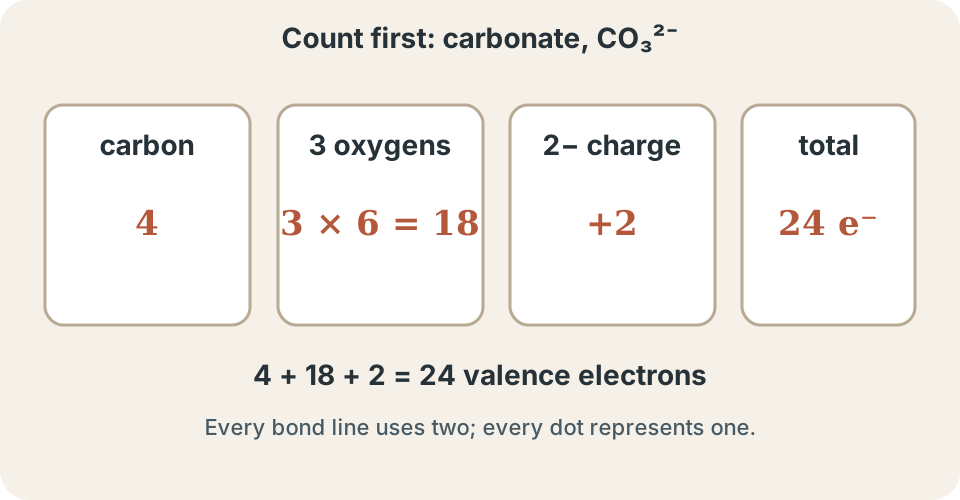
For carbonate, , the total is valence electrons. Carbon contributes four, three oxygens contribute eighteen, and the charge adds two. The arithmetic produces a count, not an energy. Every line and dot in the final structure must account for exactly those twenty-four electrons. The final formal charges must also sum to .
Lines and dots have precise meanings
One line between atoms represents one shared electron pair, or two electrons. A double bond contains two shared pairs and is drawn with two lines. A triple bond contains three shared pairs. Dots placed on one atom represent nonbonding electrons. A paired set of dots is called a lone pair.
Counting around an atom assigns both electrons in each adjacent bond to that atom for the octet check. A carbon with four single bonds therefore sees eight electrons. For formal charge, each bond is instead divided equally between its two atoms. These are different bookkeeping questions. Mixing them produces incorrect charges.
Hydrogen follows a duet rule because its shell holds two electrons. It normally forms one bond in ordinary Lewis structures. Second-period atoms carbon, nitrogen, oxygen, and fluorine cannot exceed an octet in the elementary model. Later-period atoms require more nuanced treatment. The periodic location matters.
Choose a plausible skeleton
The skeleton states which atoms are bonded before lone pairs and bond orders are finalized. The least electronegative nonhydrogen atom is often central. Hydrogen is terminal because it forms only one ordinary bond. Halogens are usually terminal. Carbon frequently forms the central framework.
The formula does not always uniquely reveal connectivity. Ethanol and dimethyl ether share molecular formula but have different atom connections. They are constitutional isomers. Additional names, reactivity, or spectroscopy may be required. Lewis rules cannot invent missing structural evidence.
Connect the proposed skeleton with single bonds first. Count two electrons for every line and subtract them from the budget. This establishes connectivity while preserving a clear remaining-electron count. If the skeleton is implausible, later formal charges may expose the problem. Revision is part of the method.
Complete terminal atoms before the center
After drawing single bonds, complete duets for hydrogen and octets for terminal atoms. Terminal halogens usually receive three lone pairs after one bond. Terminal oxygen with one single bond commonly receives three lone pairs at this stage. Each added lone pair consumes two electrons. Keep a running balance.
Place any remaining electrons on the central atom. If the central atom reaches an octet and the total count is correct, a candidate structure exists. If the central atom lacks an octet, a multiple bond may be needed. If too many electrons remain, the species may permit an expanded valence shell or the skeleton may need revision. Formal-charge analysis then distinguishes plausible alternatives.
This order is a reliable default, not a substitute for thought. Hydrogen never receives extra lone pairs to create an octet. Boron often remains electron deficient. An odd total cannot pair every electron. Recognizing these cases prevents forced and impossible drawings.
Multiple bonds repair some octet deficits
If a central second-period atom lacks an octet after all electrons are placed, convert a neighboring lone pair into an additional bonding pair. Moving the pair into the bond does not change the total electron count. It changes which atoms share the pair. Repeat only as needed. Recheck formal charges after each change.
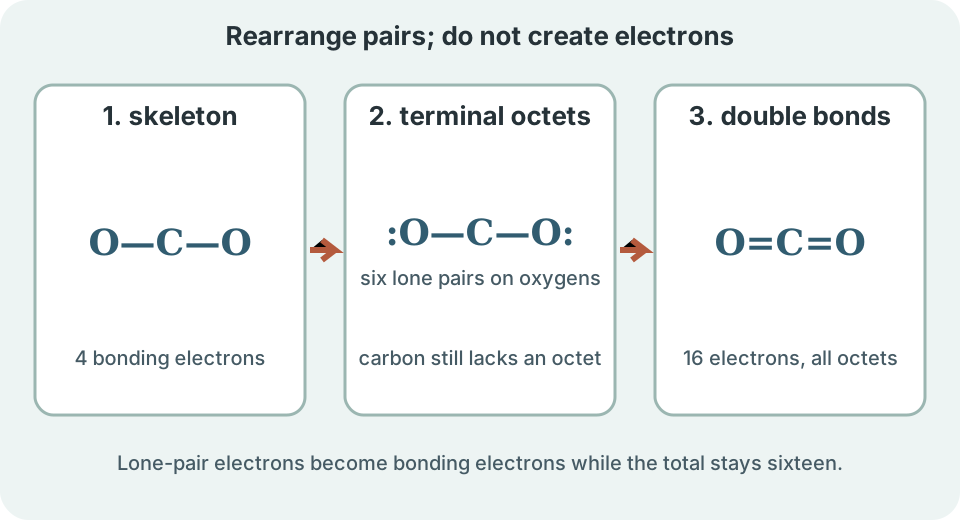
Carbon dioxide has valence electrons. The single-bond skeleton uses four electrons. Completing both oxygen octets consumes the remaining twelve and leaves carbon with only four electrons around it. One lone pair from each oxygen becomes a bonding pair, producing . No electrons are added or removed during that rearrangement.
The final structure uses eight electrons in four bonding pairs and eight electrons in four oxygen lone pairs. Carbon sees eight electrons from its two double bonds. Each oxygen sees four bonding electrons plus four lone-pair electrons. The total remains sixteen. Electron conservation and octets both pass.
A complete construction algorithm
First, calculate the total valence-electron budget. Second, choose a defensible skeleton. Third, connect atoms with single bonds and subtract bonding electrons. Fourth, complete terminal duets and octets. Fifth, place remaining electrons on the center.
Next, repair central octet deficits with multiple bonds when chemically reasonable. Calculate formal charges on every atom. Compare alternate skeletons or bond placements. Enclose an ion in brackets and write its overall charge outside. Verify the electron total one final time.
The algorithm produces candidates rather than guaranteed truth. Some species violate the octet rule. Resonance may require several contributors. Hypervalent bonding is described more accurately by advanced models. Experimental geometry and spectroscopy remain important tests.
Formal charge is a comparison tool
Formal charge assigns bonding electrons equally, regardless of electronegativity. For one atom, . Here is the atom’s valence-electron count, is its nonbonding-electron count, and is the number of bonding electrons around it. The horizontal fraction divides bonding electrons equally between bonded atoms. Every symbol refers to one selected atom.
An equivalent shortcut is valence electrons minus dots minus bond lines. Each bond line contributes one assigned electron to the atom. For oxygen with two lone pairs and two bonds, . For oxygen with three lone pairs and one bond, . Both methods must agree.
Formal charges in a structure must sum to the species’ overall charge. Neutral molecules must sum to zero. An ion with charge must sum to . This sum is an independent accounting check. A mismatch means the structure or charge calculation is wrong.
Comparing candidate structures
Structures with smaller formal-charge magnitudes are often favored when other considerations are similar. Structures with less charge separation are often favored. Negative formal charge is generally more plausible on a more electronegative atom. These are comparison guidelines rather than absolute laws. Octet satisfaction and experimental evidence also matter.
Consider carbon monoxide with ten valence electrons. A triple bond plus one lone pair on each atom satisfies both octets. Formal charges are on carbon and on oxygen. That placement seems counterintuitive from electronegativity alone. Yet alternate simple structures fail electron or octet constraints more severely.
This example shows why no single slogan decides every structure. Formal charge is not the same as measured partial charge. It is an accounting construct tied to equal bond splitting. Quantum electron density can distribute charge differently. Use formal charge to compare Lewis candidates within its scope.
Polyatomic ions require brackets and charge
For ammonium, , count valence electrons. Four nitrogen–hydrogen single bonds use all eight. Nitrogen has an octet and each hydrogen a duet. Formal charge on nitrogen is . Enclose the structure in brackets with outside.
For hydroxide, , count electrons. One O–H bond uses two. Three lone pairs on oxygen use the remaining six. Oxygen’s formal charge is . Brackets distinguish the overall ion from a neutral molecule.
Do not place the ionic charge as though it were another lone-pair dot. Charge changes the electron budget. The bracketed drawing then shows where formal charge is assigned in that contributor. In salts, counterions may be shown separately. The Lewis structure of a polyatomic ion preserves its internal connectivity.
Resonance represents delocalization
Sometimes multiple valid structures share the same atom connectivity but differ in electron placement. These are resonance contributors. They are linked with a double-headed resonance arrow, not an equilibrium arrow. The actual species does not jump back and forth as a classical object. Its electron distribution is represented by a resonance hybrid.
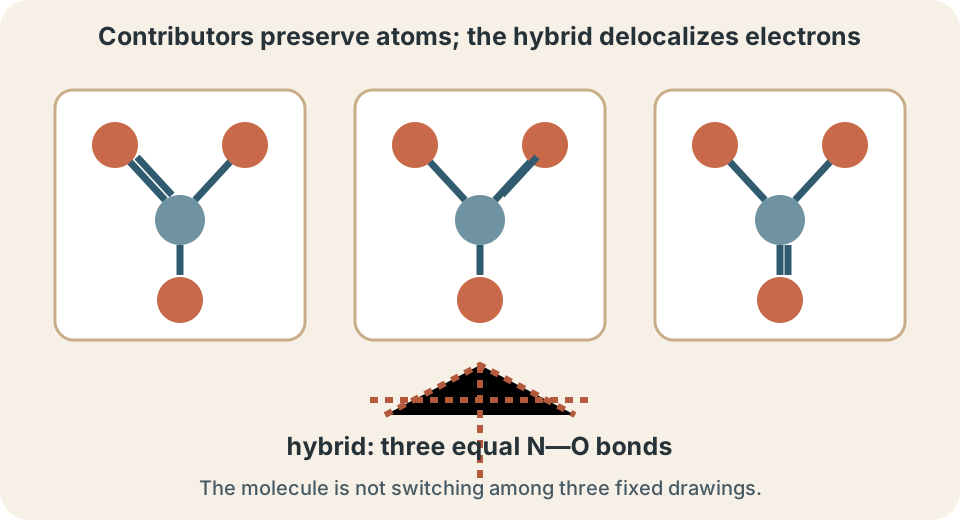
Nitrate, , has three equivalent major contributors in an elementary Lewis treatment. Each shows one N=O double bond and two N–O single bonds. The double bond occupies a different oxygen position in each contributor. Experiments find equivalent N–O bonds. The hybrid distributes bonding across all three.
Only electrons move between resonance contributors. Atom positions and connectivity remain fixed. Moving nuclei creates a different structure or isomer rather than resonance. Curved-arrow notation can track electron-pair movement. Every contributor must retain the same total electron count and overall charge.
Resonance contributors are not always equal
Equivalent contributors have equal importance by symmetry. Nonequivalent contributors can contribute unequally. Lower formal-charge magnitude, complete octets, and favorable charge placement usually indicate larger contribution. A very poor contributor may still help describe polarization. The hybrid is not a simple time average.
For ozone, two equivalent major contributors place the double bond on opposite sides. The measured O–O bonds are equal and intermediate between typical single and double bonds. Formal charges appear in each contributor. Delocalization explains why one fixed bond placement is inadequate. The resonance hybrid better matches symmetry.
Fractional bond order is a useful summary. If one double and one single bond are distributed equally across two positions, average bond order is . This number describes the model’s shared bonding character. It does not mean a line should literally be drawn one and one-half times. More advanced orbital models explain delocalization directly.
Odd-electron species
A species with an odd total number of valence electrons cannot pair every electron. Nitric oxide, , has valence electrons. It is a radical. One unpaired electron remains in any Lewis representation. Forcing all electrons into pairs would violate the total.
Construct the best candidate by satisfying as many octets and favorable formal charges as possible. Mark the unpaired electron explicitly. Radicals are often reactive because of their open-shell electronic structure. Yet some radicals can be persistent. Lewis notation flags the unpaired count but does not determine lifetime alone.
Odd-electron exceptions show why counting must come first. An odd budget announces that a universal-octet drawing is impossible. The exception is not repaired by inventing or deleting an electron. Charge and formula determine the count. More advanced molecular orbital theory describes radical distribution more fully.
Incomplete octets
Some stable compounds have central atoms with fewer than eight electrons. Boron trifluoride, , is a standard example. Three B–F bonds place six electrons around boron. Forcing B=F double bonds introduces unfavorable formal-charge patterns and does not reflect the best elementary description. Boron remains electron deficient.
Beryllium compounds can also have incomplete octets. Hydrogen is always a duet case rather than an octet case. Electron deficiency can make a molecule a Lewis acid, able to accept an electron pair. Boron trifluoride reacts with donors such as ammonia. The acid–base reaction helps complete boron’s coordination environment.
Do not assume an incomplete-octet structure is automatically wrong. Check the element, electron total, and formal charges. Second-period boron is a known exception. Carbon, nitrogen, oxygen, and fluorine much more strongly follow octet constraints in ordinary neutral compounds. Chemical context controls the exception.
Expanded valence shells
Third-period and heavier central atoms are sometimes drawn with more than eight electrons in introductory Lewis structures. Sulfur hexafluoride is represented with six S–F bonds, placing twelve electrons around sulfur by the counting convention. Phosphorus pentachloride similarly has ten around phosphorus. These drawings organize connectivity and formal charge. They are commonly described as expanded-valence structures.
Older explanations invoke empty orbitals as simple expanded-octet containers. Modern bonding descriptions show that this picture is often misleading. Hypervalent bonding can involve delocalized molecular orbitals and significant ionic character. Lewis structures remain a bookkeeping approximation. Avoid claiming that drawn lines prove localized two-electron bonds.
Second-period central atoms cannot expand their valence shell in the elementary model. Carbon cannot exceed an octet by invoking low-energy orbitals. If a proposed structure gives carbon ten electrons, revise it. Periodic position provides a firm first diagnostic. Later-period flexibility still requires evidence and sensible formal charges.
Coordinate covalent bonds
A covalent bond may form when both electrons in the shared pair initially come from one atom. This is called a coordinate covalent or dative bond in formation language. After formation, the pair functions as a bond pair. Lewis structures may show an arrow during the formation step. Final ordinary line notation often treats equivalent bonds alike.
Ammonia donates its nitrogen lone pair to a proton to form ammonium. The proton supplies no electron. Nitrogen supplies both electrons for the new N–H bond. The resulting ammonium ion has four equivalent N–H bonds in the usual model. Bond history does not make one line permanently different.
This idea links Lewis structures to Lewis acids and bases. A Lewis base donates an electron pair. A Lewis acid accepts an electron pair. Tracking lone pairs reveals possible donor sites. Geometry and orbital availability then refine whether reaction occurs.
From Lewis structure to VSEPR
Lewis structures identify electron domains around a central atom. Each single, double, or triple bond counts as one bonding domain in VSEPR. Each lone pair counts as one nonbonding domain. Domain repulsions predict an electron-domain geometry. Lone pairs then influence molecular shape.
Carbon dioxide has two domains around carbon and is linear. Water has four domains around oxygen, two bonding and two lone-pair domains. Its electron-domain geometry is tetrahedral while its molecular shape is bent. The Lewis structure supplies the domain inventory. It does not itself draw the three-dimensional angles.
Resonance structures should lead to one consistent geometry for the hybrid. Multiple bonds can exert somewhat different repulsion than single bonds. Lone pairs often compress adjacent bond angles. VSEPR is another model layered on electron bookkeeping. Experimental geometry remains the test.
What Lewis structures cannot show
A Lewis structure does not display exact bond length, bond angle, or electron probability density. It often depicts delocalized electrons through multiple contributors rather than one picture. It does not directly calculate bond energy. It also omits most core electrons. These omissions are intentional simplifications.
Molecular orbital theory can describe delocalization, magnetism, and bond order beyond fixed pair placement. Valence-bond theory provides another framework for localized bonding and hybridization. Computed electron density and spectroscopy supply more detailed evidence. Models can complement rather than simply replace one another. Select the simplest model adequate for the question.
Lewis structures remain useful because they organize valence count, connectivity, lone pairs, and formal charge quickly. They support acid–base reasoning, reaction mechanisms, and geometry predictions. Their usefulness does not make every line literal. State conclusions at the model’s resolution. Scientific understanding includes knowing where a representation stops.
Common misconceptions and repairs
One misconception treats an octet as the only correctness test. A drawing can satisfy octets while having implausible formal charges or connectivity. Electron total, formal charge, chemical context, and evidence all matter. Known exceptions also exist. Use several checks rather than one slogan.
Another misconception changes atom positions when drawing resonance. Resonance moves electron pairs while preserving nuclear connectivity. A changed skeleton is an isomer or reaction product. Mark electron movement with arrows. Recount electrons after the move.
A third misconception identifies formal charge with actual localized charge. Formal charge splits bonds equally by definition. Partial charge reflects uneven electron density. Electronegativity and molecular environment influence that density. Keep the bookkeeping label distinct from measurable distribution.
A reliable solution routine
Write the total valence-electron budget first. Choose and justify a skeleton. Draw single bonds and subtract two electrons per bond. Complete terminal duets and octets. Place remaining electrons on the center.
Repair central deficits with multiple bonds when appropriate. Calculate formal charge on every atom. Compare alternate candidates and resonance contributors. Add brackets and overall ionic charge. Confirm that every dot and line matches the original budget.
Interpret the accepted model. Identify bonding pairs, lone pairs, resonance, and formal-charge locations. Note octet exceptions explicitly. Use VSEPR only after the Lewis inventory is stable. State model limits when discussing real bond order or electron density.
Practice and connection forward
For , count valence electrons. The skeleton is because hydrogen is terminal. A single H–C bond and triple C≡N bond use eight electrons. One nitrogen lone pair uses the final two. All formal charges are zero.
For , count twenty-four electrons. Major contributors contain one C=O bond and two C–O single bonds. Each singly bonded oxygen carries formal charge in a contributor. Three equivalent contributors distribute double-bond character. Formal charges sum to .
Without looking back, explain the difference between octet counting and formal-charge counting. Construct water and ammonium from electron budgets. Explain why resonance is not rapid switching. VSEPR will convert electron domains into three-dimensional shapes. Bonding theories will refine the localized-pair picture.