
Some molecules and ions cannot be represented adequately by one Lewis structure. The problem is not that the atoms jump rapidly among several drawings. The problem is that a localized two-electron bond picture cannot show the full delocalized electron distribution in one diagram. Chemists therefore draw multiple valid resonance contributors and connect them with a double-headed resonance arrow. The real structure is a resonance hybrid whose properties reflect all important contributors.
Formal charge is the bookkeeping tool used to evaluate those drawings. It compares an atom’s assigned valence electrons in a Lewis structure with the number assigned to the neutral free atom. Formal charge is not a measured partial charge and does not show the complete electron density. It helps test whether electrons were counted consistently and whether one contributor is likely more important than another. Used carefully, it turns Lewis drawing from guesswork into a structured argument.
This article develops both ideas together. It begins with the formal-charge equation and the electron-assignment convention behind it. It then defines valid resonance contributors, distinguishes equivalent from unequal contributors, and interprets the hybrid. Worked examples connect bookkeeping to bond order, bond length, polarity, and reactivity. A final workflow makes every drawing auditable.
Formal charge assigns electrons by a stated convention
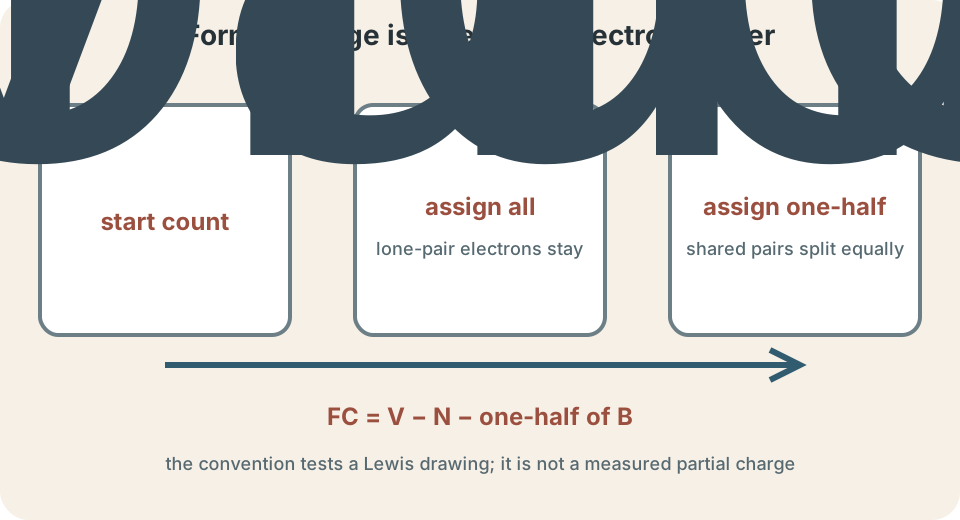
Formal charge is calculated with . The symbol means formal charge, is the atom’s valence-electron count as a neutral free atom, is the number of nonbonding electrons drawn on that atom, and is the number of bonding electrons around it. Dividing by two assigns half of every shared pair to each bonded atom. This equal split is a bookkeeping convention even when the physical bond is polar. Every term is an electron count, so the resulting formal charge is expressed in elementary-charge units.
The equation can also be written , where is the number of bond lines in an ordinary Lewis drawing. A single, double, and triple bond count as one, two, and three lines. This shortcut works because each bond line represents two bonding electrons and half of two is one. Lone-pair electrons are counted individually in , not as lone-pair groups. Defining the symbols prevents the common mistake of subtracting the number of dots rather than electrons.
Consider oxygen with two lone pairs and two single bonds. Oxygen has , the lone pairs contain nonbonding electrons, and the two bonds contain bonding electrons. Therefore . Using bond lines gives the same result, . Agreement between methods checks the counting.
The sum of formal charges must match total charge
For a neutral molecule, all atomic formal charges must sum to zero. For a polyatomic ion, they must sum to the ion’s written charge. This is a conservation check on electron bookkeeping. A nitrate drawing must total , whereas an ammonium drawing must total . A mismatch proves that the structure or arithmetic is wrong.
The sum check is necessary but not sufficient. Incorrect distributions can still add to the correct total. A structure might violate a second-period atom’s octet, omit electrons, or use an unreasonable charge separation. Every candidate must also satisfy the total valence-electron count and permitted bonding pattern. Multiple checks protect against different failure modes.
Brackets and charge labels communicate the system boundary for an ion. Enclose the entire polyatomic structure in brackets and place the net charge outside. Formal charges belong near their individual atoms when shown. The external charge is not an extra electron to add after drawing. It states how the total electron count differs from the neutral-atom sum.
Resonance contributors preserve atomic connectivity
Resonance contributors have the same atoms connected in the same order. Only electron placement changes. Lone pairs can become bonding pairs, and multiple-bond electrons can become lone pairs, provided electron counts and allowed valences remain valid. Moving an atomic nucleus creates a different constitutional isomer or another species. It is not resonance.
Curved arrows can describe the bookkeeping change between contributors. An arrow begins at an electron pair, shown as a lone pair or bond, and ends where that pair is placed. The arrow does not begin at a positive charge because a charge is not an electron source. It also does not describe the molecule physically oscillating between drawings. It records how one valid contributor is generated from another.
Contributors are linked with a double-headed resonance arrow, . This symbol differs from an equilibrium arrow, which describes distinct chemical species interconverting. It also differs from a reaction arrow, which points from reactants to products. Symbol choice carries mechanistic meaning. Calling resonance an equilibrium between structures creates a false physical picture.

The resonance hybrid is the actual structure
The real molecule or ion has one electron distribution for a given quantum state. Resonance contributors are components of a model used to approximate that state. The hybrid is not a rapid time average of classical structures. Electrons are delocalized across the relevant region. Measurements observe properties of the hybrid.
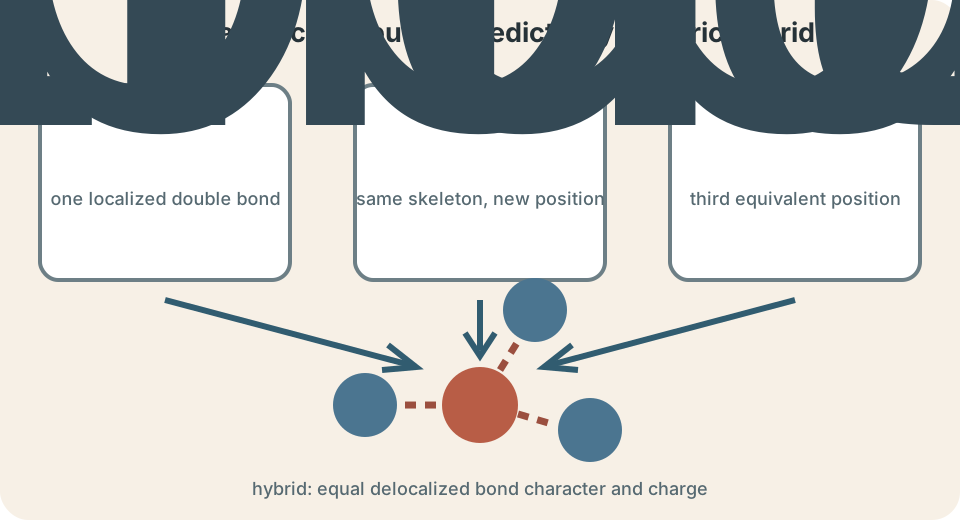
Equivalent contributors make equal contributions by symmetry. In carbonate, three common contributors place the carbon–oxygen double bond at three equivalent positions. Experiment finds three equal carbon–oxygen bond lengths rather than one short and two long bonds. Each bond has character intermediate between a localized single and double bond. The equality is structural evidence for delocalization.
Dashed or fractional bond lines are sometimes used to sketch the hybrid. Such marks summarize distributed bond order but are not additional bonds layered on top of contributors. Partial-charge symbols can likewise summarize distributed charge. A hybrid sketch should follow from the contributor set. It should not replace the electron-counting work that validates those contributors.
Equivalent contributors and average bond order
When equivalent contributors distribute identical localized bond units over equivalent positions, an average can summarize the hybrid. For carbonate, each contributor has one carbon–oxygen double bond and two single bonds. The total localized bond order in one contributor is . Distributed across three equal carbon–oxygen positions, the average bond order is . This value predicts bonds intermediate between single and double.
Average bond order is a model-derived descriptor, not a claim that a molecule spends one-third of its time in each drawing. The electron density is delocalized continuously. Equivalent contributors receive equal weight because symmetry makes their energies equal. Unequal contributors cannot be averaged by simple counting. Their weights depend on relative importance.
Bond length and bond strength often follow the average qualitatively. A bond with partial double-bond character is generally shorter and stronger than a comparable pure single bond. It is generally longer and weaker than a comparable localized double bond. Atomic identity and molecular environment must be held similar. Resonance trends complement rather than replace measurement.
Unequal contributors do not contribute equally
Some resonance contributors have lower formal-charge separation, more complete octets, or more favorable placement of charge. These usually contribute more strongly to the hybrid. A major contributor provides a better localized approximation to the electron distribution. A minor contributor can still influence reactivity and polarization. “Minor” does not mean physically absent.
For second-period elements, contributors that give carbon, nitrogen, oxygen, and fluorine complete octets are usually favored. A contributor with a sextet carbon is often less important than one giving carbon an octet, even if formal-charge separation changes. Hydrogen can hold only two electrons. These electron-capacity rules should be checked before charge preferences. A formally neat drawing that violates allowed valence is not rescued by low charge separation.
When other factors are comparable, smaller magnitudes and less separation of formal charge are favored. Negative formal charge is generally more plausible on a more electronegative atom, while positive charge is generally more plausible on a less electronegative atom. These are ranking criteria, not absolute laws. The full contributor must be evaluated as a package. State which criterion controls whenever two preferences conflict.
Formal charge differs from oxidation state and partial charge
Formal charge splits bonding electrons equally between bonded atoms. Oxidation state assigns them entirely to the more electronegative atom under an ionic bookkeeping convention. Partial charge describes an uneven physical electron distribution and often requires experimental inference or calculation. The three quantities answer different questions. Their numerical values need not agree.
In water, the usual Lewis structure gives formal charge zero to oxygen and both hydrogens. Oxidation-state bookkeeping assigns oxygen and each hydrogen . Physical electron density gives oxygen a partial negative charge and hydrogens partial positive charges whose magnitudes are less than full ionic units. None of these descriptions is automatically “the real charge” in every context. Each belongs to a defined model.
Confusing the quantities can reverse reasoning. A zero formal charge does not mean an atom has no local polarity. A negative oxidation state does not prove an isolated full anion exists inside a molecule. A computed partial charge depends on how continuous density is partitioned. Always name the charge model being used.
Worked example: nitrate ion
Nitrate, , has valence electrons. Nitrogen contributes five, three oxygens contribute eighteen, and the negative charge adds one. Place nitrogen centrally with three oxygen atoms attached. After completing oxygen octets, one lone pair must form an additional nitrogen–oxygen bond so nitrogen reaches an octet. The resulting contributor has one double bond and two single bonds.
In that contributor, nitrogen has formal charge . The double-bonded oxygen has formal charge zero, and each single-bonded oxygen has formal charge . Their sum is , matching the ion charge. Moving the double bond to either other oxygen produces two additional equivalent contributors. Atomic connectivity does not change.
The hybrid has three equivalent nitrogen–oxygen bonds. Their average bond order is . Negative charge is delocalized over the oxygen region rather than fixed permanently on two named atoms. Equivalent bond lengths support this model. Brackets and the external label remain necessary in every complete drawing.
Worked example: ozone
Ozone, , has valence electrons. Connect three oxygen atoms, distribute octets, and create one double bond so the central oxygen has an octet. One contributor contains a double bond on the left and a single bond on the right. A second equivalent contributor reverses those placements. The bent atomic skeleton remains unchanged.
The central oxygen has formal charge in each common contributor. The singly bonded terminal oxygen has formal charge , and the double-bonded terminal oxygen has formal charge zero. The charges sum to zero because ozone is neutral. Equivalent contributors distribute negative character across the terminal atoms. Both oxygen–oxygen bonds become equivalent in the hybrid.
The average bond order is . This predicts bond lengths between typical oxygen–oxygen single and double bonds. Ozone’s molecular geometry is bent, so its charge distribution also gives a molecular dipole. Resonance and geometry answer different parts of that conclusion. One explains delocalized bonding, and the other explains vector cancellation or reinforcement.
Resonance stabilizes through delocalization
Delocalization allows electron density to spread over a larger region. This can lower energy relative to a forced localized description. The stabilization is called resonance stabilization or delocalization energy. It is not an extra form of energy emitted because arrows were drawn. It describes the energetic advantage of the actual delocalized state.
Conjugation provides connected orbitals that can support delocalization. Adjacent p orbitals, lone pairs beside multiple bonds, and empty orbitals can participate when symmetry and energy permit. A curved-arrow pattern is useful only when suitable orbitals exist. Geometry can interrupt overlap. Structure determines whether formal resonance drawings correspond to meaningful delocalization.
Delocalization can change acidity, basicity, color, absorption spectra, and reaction pathways. A conjugate base stabilized by distributing negative charge is often easier to form. An electrophilic site may be revealed by a minor contributor carrying positive formal charge. These predictions require valid contributors and energy-aware weighting. Resonance is therefore a reasoning tool for reactivity, not merely a drawing exercise.
Common mistakes and repairs
One mistake is moving atoms when generating a contributor. If a hydrogen changes which heavy atom it is bonded to, the drawing represents proton transfer or isomerization. Return the nuclei to the same skeleton and move only electron pairs. Use curved arrows that begin at electrons. Check connectivity before formal charge.
Another mistake is drawing contributors that violate the total electron count. Count all dots and bond electrons after every move. A curved arrow relocates a pair; it does not create or destroy one. Verify octets for second-period atoms and duets for hydrogen. Then verify the formal-charge sum.
A third mistake is claiming the hybrid switches rapidly among contributors. Replace time-language with distribution-language. Say electron density and bond character are delocalized across specified atoms. Cite equivalent measured bond lengths when available. The contributors are representations, while the hybrid is the molecular model.
A reliable structure-selection workflow
First count total valence electrons, adjusting for net charge. Draw a plausible connected skeleton and distribute electrons to terminal atoms. Complete central-atom requirements using multiple bonds when permitted. Compute every formal charge explicitly. Confirm that the charges sum to the species charge.
Second, search for alternative electron placements without moving nuclei. Move lone pairs adjacent to multiple-bond positions or shift existing multiple-bond pairs while preserving electron count. Reject contributors that violate essential valence constraints. Connect valid drawings with resonance arrows. Identify symmetry-related equivalent contributors.
Third, rank unequal contributors. Favor allowed octets, limited charge magnitude and separation, and reasonable placement of negative charge on more electronegative atoms. Describe the hybrid rather than selecting one drawing as a literal structure. Connect the model to bond lengths, charge distribution, polarity, or reactivity that could be observed. This final evidence step turns a valid drawing into a scientific explanation.
Retrieval practice and synthesis
For the nitrite ion, , count valence electrons and draw its two major contributors. Explain why they are equivalent. Calculate every formal charge and verify the sum. Predict whether the two nitrogen–oxygen bond lengths are equal. State what the hybrid means without using switching language.
Compare formal charge and oxidation state for one atom in a polar molecule. Define how each model assigns bonding electrons. Then explain why neither necessarily equals a computed partial charge. Give one context where each bookkeeping method is useful. This comparison tests whether the word “charge” has been attached to a precise model.
Evaluate a proposed contributor by applying four checks. Confirm unchanged atomic connectivity, conserved total electrons, permitted valence, and correct total formal charge. Then rank it using charge separation and electronegativity. State one measurement that the complete resonance model predicts. A defensible resonance argument is both algebraically consistent and experimentally connected.