
Periodic trends are consequences of competing physical effects, not arrows that chemistry students must accept without explanation. The positively charged nucleus attracts electrons, while shielding, electron–electron repulsion, and the addition of principal energy levels can oppose that contraction. Atomic radius records the characteristic spatial extent of electron density, and ionization energy records how difficult it is to remove an electron. The two properties are closely related because an electron held nearer a strongly attracting nucleus is generally harder to remove. Their broad trends therefore tell one coherent story about electrostatic attraction and electron structure.
That story contains qualifications because atoms are quantum systems rather than miniature solar systems. Electron density has no sharp outer surface, orbital energies depend on penetration and occupancy, and paired electrons repel one another. A successful prediction begins with the broad direction and then checks configuration-specific effects. This lesson develops that process through diagrams, comparison routines, numerical energy units, and exceptions that test the model. By the end, trend arrows should function as conclusions you can reconstruct rather than facts you fear forgetting.
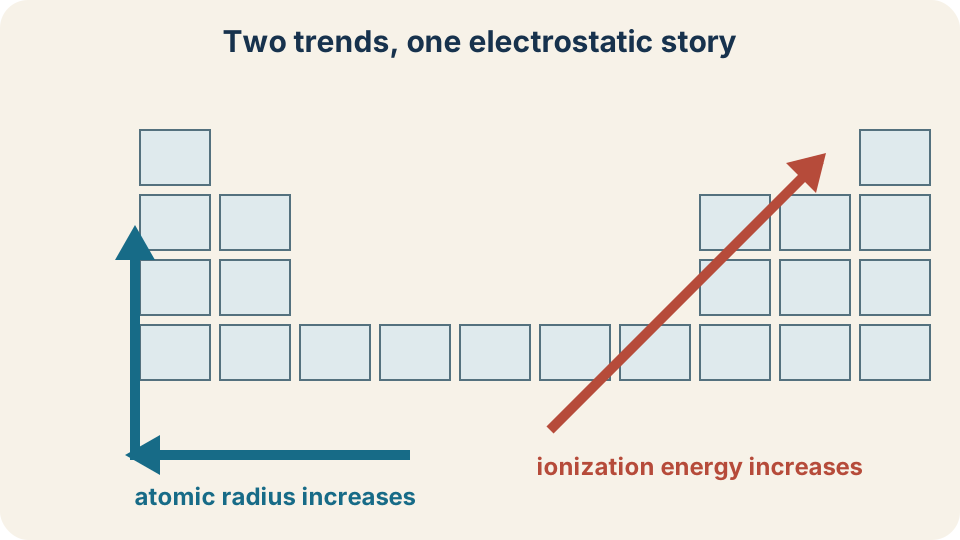
Atomic radius generally grows toward the lower left, while first ionization energy generally grows toward the upper right. These arrows summarize many comparisons, but they do not replace an explanation. Across a period, increasing effective nuclear attraction usually contracts the same principal shell. Down a group, newly occupied shells place valence density farther from the nucleus. Configuration effects create informative local exceptions.
Define atomic radius carefully
An isolated atom has no rigid boundary because its electron-density distribution fades gradually with distance. Consequently, “atomic radius” is not one directly observed edge-to-center distance. Chemists define operational radii from measurable separations between nuclei. A covalent radius is commonly half the internuclear distance between two identical covalently bonded atoms. A metallic radius is similarly related to neighboring nuclei in a metallic solid.
Van der Waals radius describes the closest typical approach of nonbonded atoms. Its value is usually larger than a covalent radius because nonbonded electron clouds remain farther apart. Different radius tables can therefore report different values for the same element without either table being wrong. Each value answers a different structural question. Meaningful comparisons should use radii defined by the same method.
Atomic radii are often reported in picometres, abbreviated . The prefix pico means , so . A quoted radius of equals . This scale is comparable to the dimensions of atoms and bonds. Units must accompany every numerical comparison because the number alone has no physical meaning.
Build the electrostatic model
The nucleus contains protons, where is the atomic number. A proton carries positive elementary charge , while an electron carries negative charge . Opposite charges attract according to Coulomb’s interaction. Increasing nuclear charge tends to strengthen electron attraction when other factors are held comparable. That tendency pulls electron density inward and makes electron removal harder.
Core electrons partially shield valence electrons from the full nuclear charge. The net attraction experienced by an electron is summarized by effective nuclear charge, written . A useful conceptual expression is , where represents a shielding contribution. This relation is a model rather than an exact subtraction using a fixed integer for every atom. Penetration and electron correlation make shielding depend on orbital type and electron configuration.
Distance also matters because electrostatic attraction weakens as separation grows. A valence electron in a higher principal shell is typically farther from the nucleus and more strongly shielded by inner shells. The principal quantum number labels these main energy levels. Moving from to normally expands the characteristic electron distribution. Periodic trends emerge from the competition between increasing and increasing shell number.
Explain the radius trend across a period
Moving left to right across a period adds one proton and generally one electron at each step. The added electrons enter the same principal shell rather than a completely new outer shell. Electrons within the same shell shield one another imperfectly. Nuclear charge therefore rises faster than same-shell shielding. The resulting increase in pulls the valence density inward.
For that reason, atomic radius generally decreases from left to right across a period. Lithium is larger than beryllium, and beryllium is generally larger than boron when comparable radius definitions are used. The statement is a trend rather than a promise of perfectly uniform numerical steps. Subshell structure, bonding environment, and measurement definition can alter individual values. The causal explanation remains increasing effective attraction within the same main shell.
A useful reasoning sentence has three linked parts. First identify that the atoms lie in the same period. Next state that the atom farther right has more protons while its added electrons remain in the same principal shell. Then conclude that the larger effective nuclear charge draws the electron density inward. This chain is stronger than saying only “radius decreases across.” It shows which comparison conditions support the prediction.
Explain the radius trend down a group
Moving down a group introduces a new occupied principal shell. The valence electrons therefore have a larger characteristic distance from the nucleus. Inner electrons also provide substantial shielding between the nucleus and the new valence shell. Nuclear charge increases, but the added distance and shielding usually dominate the size trend. Atomic radius consequently increases from top to bottom within a group.
Compare lithium and sodium. Lithium’s valence electron occupies the shell, while sodium’s valence electron occupies the shell. Sodium has more protons, but it also has a filled inner shell between its nucleus and valence electron. The added shell places much of its valence density farther out. Sodium is therefore larger than lithium under comparable definitions.
This comparison demonstrates why “more protons means smaller” is incomplete. That statement works most cleanly within an isoelectronic series or across a period where shell number is controlled. Down a group, several variables change simultaneously. A disciplined explanation identifies which effect dominates rather than mentioning one effect in isolation. Periodic reasoning is fundamentally controlled comparison.
Compare atoms, cations, and anions
A cation forms when a neutral atom loses one or more electrons. Cations are generally smaller than their parent atoms. Electron loss reduces electron–electron repulsion, and the remaining electrons experience greater attraction per electron. If all electrons in the highest occupied shell are removed, the outermost occupied principal level also decreases. That shell removal can create a particularly large contraction.
An anion forms when a neutral atom gains one or more electrons. Anions are generally larger than their parent atoms. The nuclear charge remains unchanged while added electrons increase repulsion within the valence shell. The electron density expands until attraction and repulsion reach a new balance. Thus is larger than neutral , whereas is smaller than neutral .
Do not compare ionic size by counting protons alone unless electron counts and shell structures are considered. A sodium cation has ten electrons rather than the neutral atom’s eleven. Losing the electron leaves the shell outermost. A chloride anion has eighteen electrons and retains an occupied shell. The identities of occupied shells explain much of the contrast between the compact cation and expanded anion.
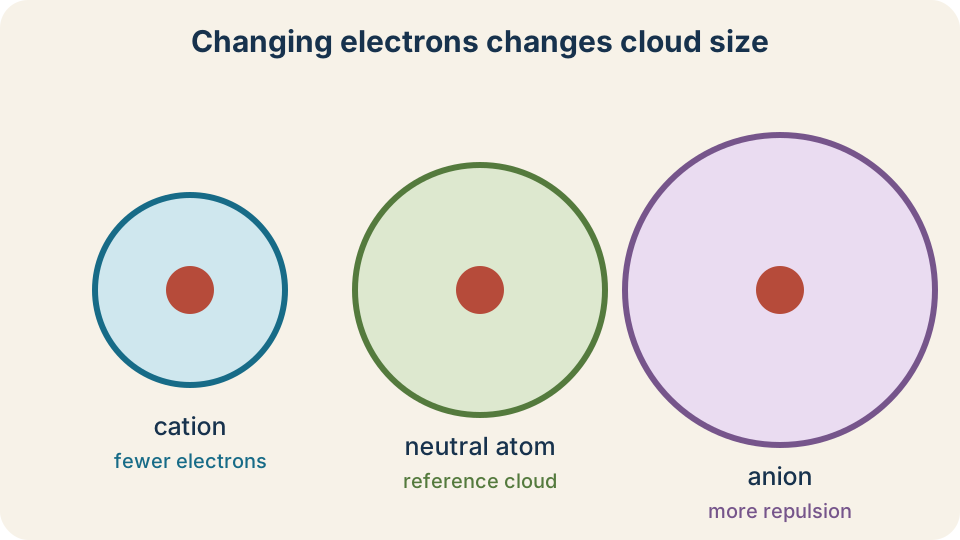
Removing an electron usually contracts the electron cloud, while adding an electron usually expands it. The nucleus does not change when an ion forms. A cation has less electron repulsion and may lose its outer shell. An anion has more repulsion within the valence shell. The balance of attraction and repulsion determines the new characteristic size. Electron count must therefore be included in every ionic-size explanation.
Order an isoelectronic series
Isoelectronic species contain the same number of electrons. Because electron count and occupied-shell pattern are held nearly constant, nuclear charge becomes the decisive variable. More protons produce a stronger attraction for the same-sized electron population. The electron cloud contracts as increases. Radius therefore decreases with increasing atomic number within an isoelectronic series.
Consider , , , , and . Every species contains ten electrons. Their proton counts are eight, nine, ten, eleven, and twelve, respectively. The increasing nuclear charge pulls the common electron configuration progressively inward. The radius order from largest to smallest is .
The reasoning procedure is reliable and compact. First verify that every species has the same electron count after accounting for charge. Then order the nuclei by proton number. Finally reverse that proton order to obtain the size order because stronger attraction means smaller radius. If electron counts differ, this shortcut no longer has the same force. The comparison must then return to shells, shielding, and effective nuclear charge.
Define first ionization energy
First ionization energy is the minimum energy required to remove the least tightly held electron from each atom in one mole of isolated gaseous atoms. The process is written . The symbol represents the element, specifies the gas phase, and represents the removed electron. The first ionization energy is positive because energy must be supplied. It is commonly reported in kilojoules per mole, written .
The gas-phase condition matters because bonding, crystal lattices, and solvation would introduce additional energy changes. Ionization energy is intended to isolate the atom’s hold on an electron. A value of means that must be supplied to ionize of those gaseous atoms. It does not mean one atom receives . On a per-particle basis, the molar energy would be divided by Avogadro’s constant.
Ionization energy reflects several factors. Higher effective nuclear charge generally binds electrons more strongly. Greater distance and shielding generally make removal easier. Subshell penetration changes how close electron density can approach the nucleus. Electron pairing and especially stable configurations can create exceptions to a smooth trend.
Derive the broad ionization-energy trends
Across a period, first ionization energy generally rises. The valence shell stays the same while effective nuclear charge increases. Electron density contracts, and the outer electron becomes more strongly attracted to the nucleus. More supplied energy is therefore required to separate it completely. This trend broadly opposes the atomic-radius trend.
Down a group, first ionization energy generally falls. The electron removed occupies a higher principal shell, lies farther from the nucleus, and experiences more shielding. Although nuclear charge increases, distance and shielding usually dominate. Less energy is needed to remove the outer electron. Alkali metals illustrate this decline especially clearly because each has one comparatively accessible valence electron.
The inverse connection between radius and ionization energy is useful but not absolute. A smaller atom often has a higher ionization energy because its valence electrons feel stronger attraction. However, orbital occupancy can make one electron unusually easy or difficult to remove. Predictions should therefore begin with the broad electrostatic trend and then inspect configuration. The exception is an opportunity to refine the model rather than abandon it.
Explain the boron and oxygen exceptions
Beryllium has configuration , while boron has . Across the period, one might expect boron’s first ionization energy to exceed beryllium’s. Instead, removing boron’s electron is slightly easier than removing a beryllium electron. The orbital is higher in energy and penetrates the inner electron region less effectively than . Subshell type therefore outweighs the broad increase in nuclear attraction for this local comparison.
Nitrogen has valence configuration , placing one electron in each of three orbitals. Oxygen has , so one orbital contains a pair. Repulsion within that paired orbital makes one oxygen electron somewhat easier to remove. Oxygen’s first ionization energy is consequently slightly lower than nitrogen’s. The half-filled arrangement is relatively stable.
These cases reveal a general comparison strategy. First locate the elements and state the expected periodic trend. Next write or inspect the relevant electron configurations. Then ask whether the electron removed changes subshell type, breaks a stable occupancy, or relieves pairing repulsion. A justified exception still begins from the general model. Configuration supplies the additional mechanism that explains the departure.
Read successive ionization energies
Second ionization energy removes an electron from a gaseous ion, and third ionization energy removes one from a gaseous ion. In general, the th process can be written . Each successive ionization energy is larger because the remaining electrons are held by an increasingly positive ion. The same nucleus attracts fewer electrons after each removal. Repulsion among the remaining electrons is also reduced.
A very large jump occurs when removal begins from a lower, core-like shell. Suppose idealized values are , , and for the first three removals. The jump after the second value is far larger than the earlier increase. It indicates that two relatively accessible valence electrons were removed before the third process entered a core shell. The element is therefore consistent with two valence electrons in its neutral ground state.
The position of the jump is more informative than merely noticing that all values increase. A jump after the first removal suggests one valence electron. A jump after the third suggests three relatively accessible valence electrons. This reasoning works best for representative elements where valence-shell patterns are straightforward. It links experimental energy data to electron configuration without requiring a direct picture of orbitals.
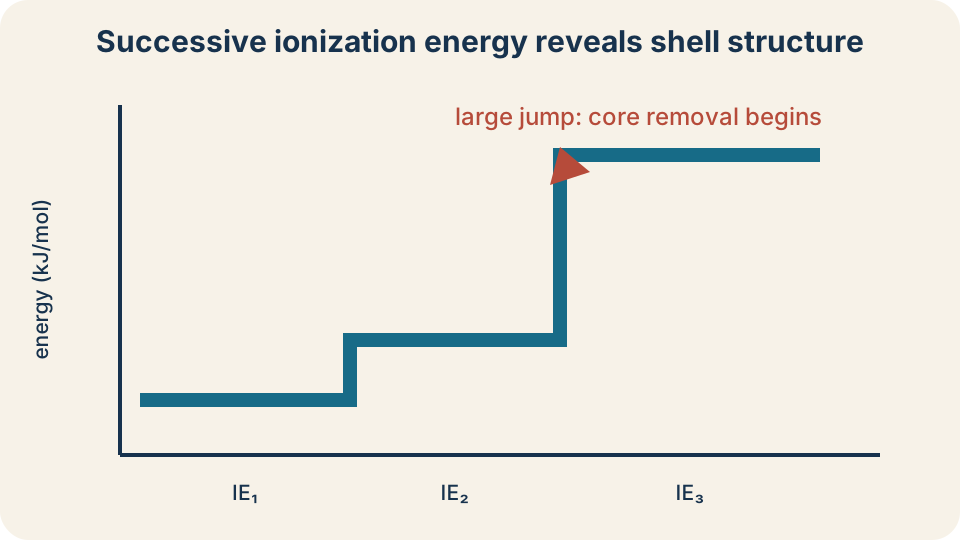
Successive ionization energies rise because each electron is removed from a more positively charged ion. A modest increase can occur while removals remain in the valence shell. A dramatic jump signals entry into a lower, core-like shell. The jump position estimates the number of readily removed valence electrons. The vertical scale uses energy per mole, not energy per single atom. The pattern matters more than any one isolated value.
Compare radius and energy without memorizing arrows
When asked which of two atoms is larger, begin by locating their periods and groups. If they are in the same period, compare effective nuclear attraction within the shared shell. If they are in the same group, compare the number of occupied shells. If they are ions, count electrons and determine whether a shell was gained or removed. This sequence prevents a trend arrow from being applied outside its strongest context.
When asked which has the higher first ionization energy, identify the electron being removed. Compare effective nuclear attraction, distance, shielding, and orbital type. If the broad trend predicts one result, check for filled subshells, half-filled subshells, or paired-electron repulsion. State both the dominant effect and any configuration effect. A complete answer explains why the electron is more or less difficult to separate.
Use evidence at an appropriate level of precision. A periodic-table position supports a broad prediction, whereas a close exception may require electron configurations or measured data. Do not claim that all atoms follow a perfectly smooth numerical line. Do not attribute every trend simply to “more protons.” Controlled comparison and explicit mechanisms make the conclusion scientifically defensible. When two effects oppose each other, say so directly before deciding which one dominates.
Practice with guided reasoning
Which is larger, or ? Neutral sodium has the configuration ending in , whereas has lost that outer electron. The ion’s outermost occupied shell is then rather than . It also contains less electron–electron repulsion. Therefore is larger than .
Which is larger, or ? Both species contain eighteen electrons, so they are isoelectronic. Sulfur has sixteen protons, whereas chlorine has seventeen. The chloride nucleus attracts the same number of electrons more strongly. Therefore is larger than .
Why is the first ionization energy of potassium lower than that of sodium? Potassium’s removed electron occupies the level, while sodium’s occupies . The potassium electron is farther from the nucleus and shielded by an additional occupied shell. Those effects outweigh potassium’s larger nuclear charge. Less energy per mole is therefore required to remove potassium’s valence electron.
Check misconceptions before moving forward
Atomic radius does not mean that an atom is a hard sphere with an exact edge. It is a model-dependent characteristic distance inferred from nuclear separations. Ionization energy also does not describe removing an electron from a bonded atom in a solid. Its standard definition uses isolated gaseous species. Keeping definitions tied to their measurement conditions prevents category errors.
Trend arrows are not causal explanations. Saying that radius decreases “because it moves right” only restates the observation. The explanation is that nuclear charge increases while added electrons enter the same principal shell and shield imperfectly. Likewise, ionization energy does not rise merely because radius falls. Both changes arise largely from a stronger effective nuclear attraction, with configuration-specific qualifications.
Charges must be handled algebraically when counting electrons. A charge means two electrons have been removed, while a charge means two have been added. Proton number never changes during ordinary ion formation. The nucleus determines element identity, and electron number determines charge. Accurate electron counting is the foundation of ionic and isoelectronic comparisons.
Connect the trends to chemical behavior
Atoms with low first ionization energies can lose valence electrons comparatively readily. This tendency helps explain why alkali metals commonly form ions. Atoms with high effective attraction and compact valence shells are less willing to lose electrons. Ionization energy alone does not determine bonding, but it supplies one major part of the energy accounting. Electron affinity, lattice energy, and bond formation contribute other parts.
Atomic size influences bond length and orbital overlap. Smaller atoms can often approach one another more closely, while larger valence orbitals extend over greater distances. Cation and anion sizes also help determine crystal structures and coordination patterns. These structural consequences connect periodic trends to observable material properties. The trend model therefore supports later reasoning about bonding rather than ending at the periodic table.
The most transferable habit is to reconstruct a comparison from physical causes. Identify shell number, effective nuclear attraction, shielding, electron repulsion, and orbital occupancy. Decide which factors are held approximately constant and which change. Use the dominant effect for the broad prediction, then inspect configuration for a local exception. That process turns periodic trends into a reusable explanatory framework.