
Every electron in an atom is attracted to the positively charged nucleus and repelled by other electrons. In hydrogen, only one electron is present, so the attraction can be described using the full nuclear charge without electron-electron shielding. In a multi-electron atom, each electron moves through a changing distribution of other electrons. Effective nuclear charge compresses that complicated interaction into an approximate net attraction. The concept is useful when its assumptions are stated and misleading when treated as an exact hidden charge.
Learning objectives
By the end of the lesson, you should be able to distinguish atomic number, nuclear charge, and effective nuclear charge. You should explain shielding as an electron-electron interaction rather than as complete cancellation of protons. You should explain orbital penetration through probability near the nucleus. You should compare the broad penetration ordering of , , , and orbitals within related shells. Every explanation should connect a verbal trend to electron configuration.
You will use as a qualitative model and interpret every symbol. You will estimate effective charge with a simplified shielding model while preserving the estimate’s limitations. You will connect effective attraction with atomic radius, ionization energy, subshell energy, and isoelectronic comparisons. You will also explain why moving across a period and moving down a group require different balances. These skills replace memorized trend arrows with causal reasoning.
Keep three influences separate throughout the lesson. Nuclear charge increases attraction, shielding reduces the attraction experienced by a selected electron, and distance weakens Coulomb interaction. Penetration changes how much time an electron distribution occupies regions close to the nucleus. No one factor should be treated as an automatic winner in every comparison. Periodic properties emerge from the competition among all of them.
Start with the nuclear charge
Atomic number is the number of protons in the nucleus. Each proton carries charge , so the total nuclear charge is . The elementary charge magnitude is . Changing changes the element’s identity. A carbon nucleus has , while a nitrogen nucleus has .
An electron carries charge and is attracted electrostatically to the nucleus. A simple Coulomb magnitude contains a factor proportional to and decreases with the square of separation in a point-charge picture. Greater strengthens attraction if every other feature is held fixed. Greater distance weakens it. Multi-electron atoms complicate the picture because other electrons also exert forces.
Nuclear charge is exact for a specified isotope’s element because proton number is an integer. Effective nuclear charge is not a replacement value for the actual nucleus. It is a model of the net attraction experienced by a selected electron in a particular state. Different electrons in the same atom can experience different effective attractions. The subscript “effective” signals this state-dependent interpretation.
Why other electrons matter
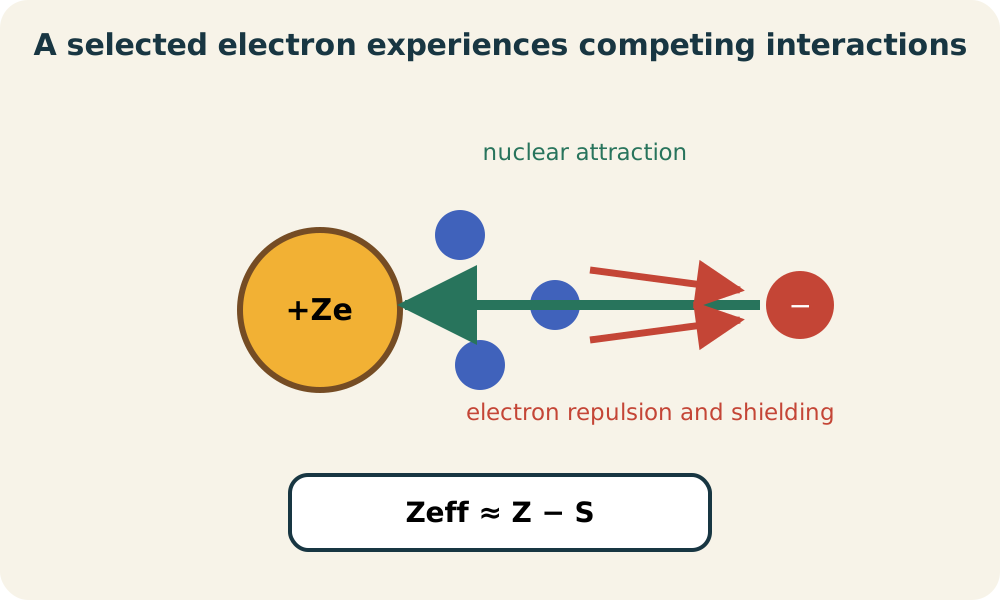
Electrons repel one another because they carry like charges. A selected outer electron is influenced by the nucleus and by the probability distributions of all other electrons. Electrons that spend much of their time between the selected electron and nucleus reduce its net inward attraction. This reduction is called shielding or screening. The selected electron does not experience the bare nucleus in isolation.
Shielding should not be pictured as a rigid inner shell blocking electric field like an opaque wall. Quantum orbitals are probability distributions that can overlap in space. Electron positions fluctuate, and interactions are averaged through a many-electron state. An outer electron can sometimes penetrate inside regions occupied by other electrons. Shielding is therefore incomplete and depends on orbital character.
Electrons in inner shells generally shield outer electrons more effectively than electrons in the same shell. Inner distributions spend more probability close to the nucleus and lie between the nucleus and outer region more often. Same-shell electrons repel one another but do not fully shield as effectively. This difference is central to across-period trends. Added electrons and added protons do not cancel each other one for one.
The effective-charge model
A common qualitative expression is . The symbol denotes effective nuclear charge in units of the elementary charge magnitude. The exact atomic number is proton count. The quantity is a shielding estimate. The approximation sign warns that the relation is a model rather than exact subtraction of fixed point charges.
If and a model estimates for a selected electron, then . This does not mean the nucleus has only charge. The actual sodium nucleus still has . The value describes an average net attraction in a one-electron-style representation. Another orbital in the same atom can receive a different shielding estimate.
Effective charge is sometimes expressed as a dimensionless multiplier and sometimes as an effective charge . State the convention in use. Because and are dimensionless counts in the simple formula, their difference is dimensionless. Multiplication by converts it to coulombs if an actual charge unit is needed. Clear notation prevents the model number from being confused with electric charge in coulombs.
Penetration changes shielding exposure
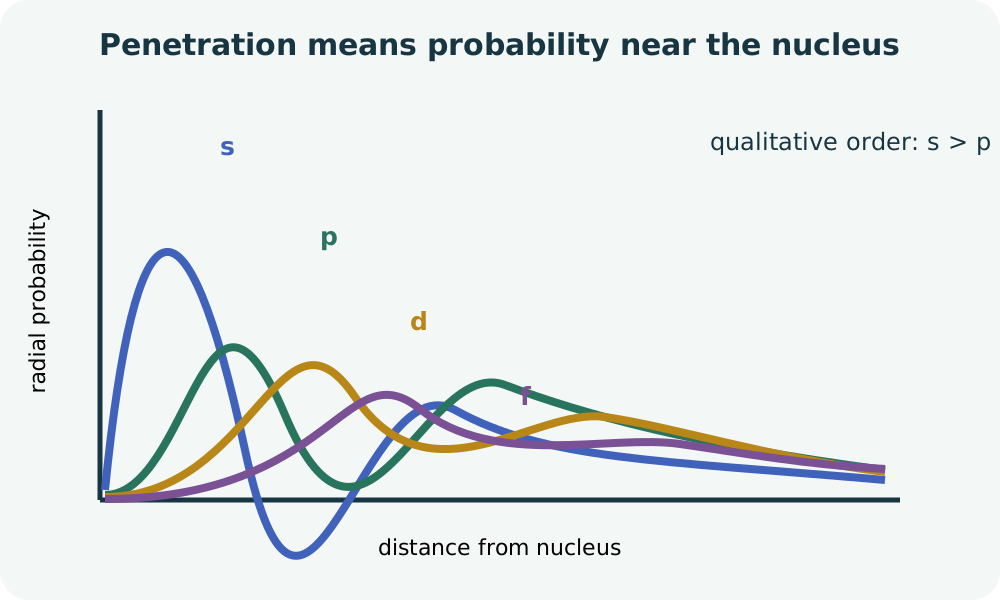
An orbital does not assign an electron to one fixed path. It describes a spatial probability distribution. Penetration refers to the extent that an orbital has probability density near the nucleus and inside regions occupied by other electrons. Greater penetration exposes the electron to less-shielded nuclear attraction. That electron generally experiences larger effective attraction.
Within a comparable principal shell, the broad penetration ordering is . An orbital has probability density close to the nucleus that higher-angular-momentum orbitals lack in the same way. A orbital penetrates more than a corresponding orbital. The ordering is qualitative and should be applied with the actual shell and configuration in mind. It helps explain subshell energy splitting in multi-electron atoms.
In hydrogen-like atoms, orbitals with the same principal quantum number can share energies under the ideal Coulomb model. In multi-electron atoms, shielding and penetration break that simple degeneracy. A penetrating electron can experience greater attraction than a electron. The subshell is therefore generally lower in energy. Electron-electron interactions connect orbital shape to energy ordering.
Core and valence electrons
Core electrons occupy filled inner shells and usually do not participate directly in ordinary main-group bonding. Valence electrons occupy the outer region most involved in chemical behavior. This distinction is a model based on configuration and purpose. In transition metals, electrons complicate a simple core-versus-valence division. The actual chemical environment can change which electrons participate.
Core electrons strongly shield outer electrons because their distributions lie close to the nucleus. Yet they do not cancel the nucleus completely. A valence electron in sodium is attracted enough to remain bound even though ten core electrons surround an eleven-proton nucleus. The remaining net attraction is more than a naive picture captures in every region. Penetration and incomplete shielding matter.
Valence electrons also shield one another. Same-shell shielding is weaker because electrons in the same general region do not consistently lie between one another and the nucleus. As electrons are added across a period, same-shell repulsion grows. Nuclear charge also rises with each added proton. The rise in nuclear attraction usually wins across a main-group period.
Across a period
Move from sodium to chlorine across period 3. Atomic number rises from to . Added electrons mainly enter the and valence shell rather than creating a new principal shell. Core structure remains broadly neon-like. Same-shell shielding increases, but it does not offset the six added protons completely.
Valence effective nuclear charge therefore generally increases across the period. Stronger net attraction pulls the electron distribution inward. Atomic radii generally decrease. Removing an electron generally requires more energy, so first ionization energy tends to increase. These are connected consequences rather than independent arrows.
The trends are not perfectly smooth. Subshell changes, electron pairing, and detailed configuration create local deviations. Magnesium to aluminum introduces a electron that is less penetrating and easier to remove than a electron. Phosphorus to sulfur introduces pairing within a orbital, increasing repulsion. Effective charge supplies the baseline while configuration explains deviations.
Down a group
Moving down a group increases atomic number and introduces new principal shells. A group-1 sequence moves from lithium’s outer electron to sodium’s and potassium’s . Each new shell lies farther from the nucleus on average. Additional core electrons provide substantial shielding. Distance and shell structure change at the same time as nuclear charge.
Valence effective charge does not simply rise by the full increase in proton count. New core electrons shield much of the added nuclear charge. The valence electron is also farther away, weakening electrostatic attraction. Atomic radius generally increases down a group. First ionization energy generally decreases because the outer electron is easier to remove.
It is incomplete to say only “there are more shells.” Shell number describes distance and radial structure, while shielding describes electron-electron effects. Both contribute to the trend. Nuclear charge still rises and must be included in the comparison. Effective charge alone also cannot explain size without distance. A correct explanation names the competing changes and identifies which dominate the property of interest.
A simplified shielding estimate
Slater’s rules provide one historical way to estimate shielding constants from electron configurations. They assign different weighting factors to electrons based on their shell and subshell relationship to the selected electron. The method is approximate and does not replace quantum calculations. It is useful for making the phrase “shielding is incomplete” quantitative. Different selected electrons require different groupings.
For a simplified main-group valence estimate, electrons in the same or group contribute less than one unit each, while electrons in the preceding shell contribute more strongly. Deeper electrons may contribute approximately one unit each. The exact Slater-rule coefficients depend on the specified convention. They should be provided before a numerical exercise. Memorizing coefficients without understanding their hierarchy adds little insight.
The main conceptual result survives changes in estimating scheme. Inner electrons shield strongly, same-shell electrons shield partially, and penetration changes exposure to the nucleus. Computed values are model-dependent. Trends are often more reliable than treating any estimate as an experimental observable. Effective charge organizes reasoning rather than serving as a uniquely measurable atomic label.
Illustrative estimate for sodium
Sodium has configuration . Select the outer electron. A very crude core-count estimate takes the ten inner electrons as shielding about ten units, giving . This captures that the valence electron feels far less than the bare nuclear charge. It does not capture penetration or incomplete core shielding accurately.
A Slater-style estimate assigns the eight electrons a contribution of about each and the two electrons about each for the selected electron. This gives . The estimate is . The selected electron has no same-group partner in neutral sodium. The result exceeds the crude value one because inner shielding is not modeled as perfect cancellation.
The numerical estimate should be interpreted cautiously. It is not a literal charge measured at one point. It is not guaranteed to match values from other methods. Its importance is that it makes incomplete shielding visible. The comparison also explains why a sodium valence electron remains attracted while being relatively easy to remove.
Isoelectronic comparisons
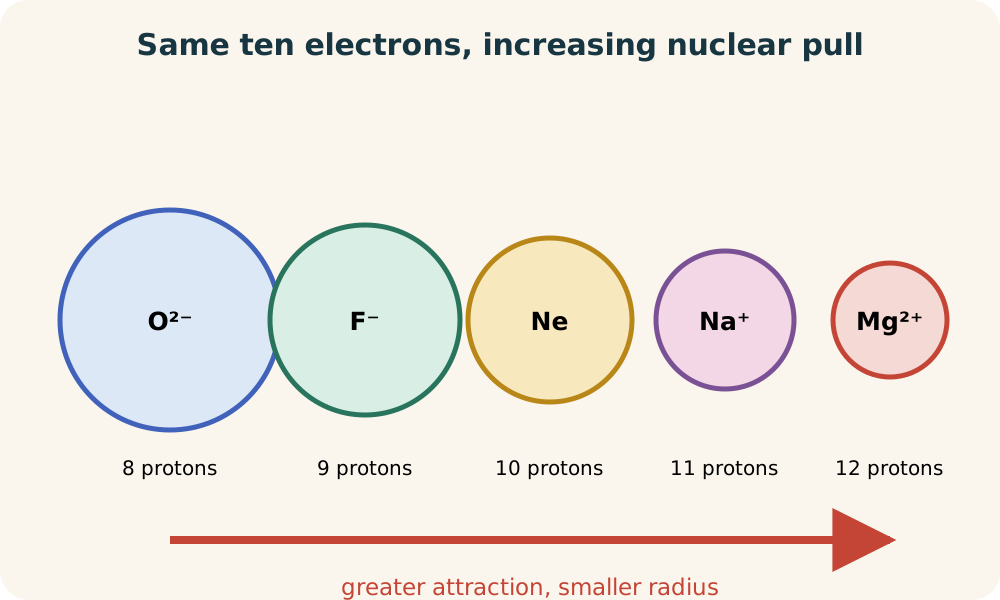
Isoelectronic species have the same number of electrons but different proton numbers. Examples include , , , , and . Each has ten electrons. Their nuclear charges increase from eight to twelve protons. Electron count alone therefore does not determine size.
With the same electron count and broadly similar shielding structure, larger creates greater effective attraction. The electron cloud is pulled inward more strongly. Thus radius generally decreases across the sequence from toward . The more positive species is smaller in this isoelectronic comparison. The more negative species is larger.
This rule should not be confused with a general statement that every cation is smaller than every anion. It applies within a carefully chosen isoelectronic family. Comparing unrelated species can involve different shells and configurations. State electron count and nuclear charge before using the shortcut. The strength of the comparison comes from holding electron number approximately controlled.
Atomic radius
Atomic radius is not a hard boundary because electron probability extends gradually through space. Several operational definitions exist, including covalent, metallic, and van der Waals radii. Effective nuclear attraction influences all of them. Stronger attraction generally contracts an electron distribution. Greater shell number generally expands it.
Across a period, rising usually contracts atomic radius. Down a group, added shells and greater distance usually expand radius despite rising nuclear charge. These patterns arise from different comparisons. The across-period comparison holds shell number broadly fixed. The down-group comparison changes the shell itself.
Ionic radius adds electron-count changes. Cations often shrink because electrons are removed, electron-electron repulsion decreases, and an outer shell may disappear. Anions often expand because added electrons increase repulsion in the valence region. Effective charge per electron and configuration both change. A complete explanation should not attribute ionic size to charge sign alone.
Ionization energy
First ionization energy is the energy required to remove one electron from each atom in a mole of gaseous atoms under defined conditions. Stronger effective attraction generally raises the required energy. Greater distance and shielding generally lower it. Across a period, ionization energy usually rises. Down a group, it usually falls.
Successive ionization energies remove additional electrons. A large jump appears when removal begins from a stable inner shell after valence electrons are gone. This jump provides evidence about valence count. Effective attraction rises for remaining electrons as electron-electron repulsion decreases. The ionization sequence therefore changes rather than repeating one constant cost.
Local exceptions require configuration reasoning. A newly occupied higher-energy subshell can make an electron easier to remove despite greater nuclear charge. Pairing within a degenerate subshell can also increase repulsion. These deviations do not invalidate effective nuclear charge. They show that attraction, subshell energy, and electron arrangement all contribute.
Subshell energy and chemical behavior
Penetration and shielding affect which subshells fill and which electrons are available for bonding. In multi-electron atoms, an subshell can lie below an subshell of the same principal number. Transition-region energies can be especially close. Ion formation may change their ordering. Simple arrows in a filling chart should not be mistaken for immutable energy ladders.
Valence effective attraction influences how readily atoms lose electrons, attract shared electron density, or stabilize particular charge states. Electronegativity trends reflect related attraction within bonds. Electron affinity involves an energy change upon adding an electron and is not identical to effective charge. Several periodic properties share causes while retaining distinct definitions. Precise language matters.
Chemical bonding also changes electron distributions from those of isolated atoms. Effective charge derived for an isolated atomic orbital is not automatically the same in a molecule. Oxidation state and formal charge are bookkeeping models rather than direct measurements. The concept remains useful for trends. It should not be stretched into a universal substitute for molecular electronic structure.
Common misconceptions
One misconception says each inner electron cancels exactly one proton. If this were exact everywhere, a sodium valence electron would feel only a bare center. Penetration shows that it sometimes occupies regions inside much of the shielding cloud. Inner electrons also have distributed rather than fixed positions. Shielding is partial and state-dependent.
Another misconception says effective nuclear charge is the same for every electron in an atom. Core electrons penetrate close to the nucleus and experience much stronger attraction than outer electrons. Different subshells have different radial distributions. An effective model must specify the selected electron or orbital. A single element-wide number hides important structure.
A third misconception uses increasing to predict every down-group property. Distance and new shells change dramatically down a group. The relevant Coulomb attraction depends on both charge and separation. Shielding also grows. Trend explanations should compare all three rather than recite one factor.
Practice and retrieval
Explain why a electron generally penetrates more strongly than a electron. Describe probability rather than drawing fixed planetary paths. Predict which electron experiences greater effective attraction in the same atom. Connect that prediction with relative subshell energy. State the limits of the comparison.
Order , , , , and from largest to smallest radius. First verify that each species has ten electrons. Then compare proton numbers. Explain the contraction through effective attraction. Do not use charge sign as the only reason.
Compare sodium and chlorine across period 3. State how , valence shell, shielding, radius, and ionization energy change. Then compare sodium and potassium down group 1. Identify why the down-group conclusion differs even though proton number rises. This task tests whether the correct variables are held fixed in each comparison.
Solutions and reasoning
The orbital has more probability close to the nucleus than the orbital. Greater penetration places the selected electron in less-shielded regions more often. It therefore experiences larger average effective attraction and is generally lower in energy. The comparison assumes the same atom and related configuration. Exact energies require a fuller many-electron calculation.
All listed species have ten electrons. Proton numbers rise from seven for nitrogen to eleven for sodium. Greater nuclear charge with comparable electron count pulls the distribution inward. The size order is . Charge notation correlates with the sequence because it reflects the changing proton-to-electron balance, but proton number supplies the causal comparison.
From sodium to chlorine, rises while electrons enter the same principal shell, so generally rises, radius falls, and ionization energy rises. From sodium to potassium, a new outer shell is added. Greater distance and shielding outweigh the added nuclear charge for the valence electron. Potassium is larger and has lower first ionization energy. The two movements compare different structural changes.
Connection forward
Effective nuclear charge supplies a causal foundation for periodic radius and ionization-energy trends. Those properties will be examined with definitions, data, and exceptions. Electronegativity and bonding tendencies also draw on related attraction arguments. The same concept helps interpret isoelectronic ions. It therefore connects atomic structure with observable chemistry.
The concept also prepares more advanced orbital reasoning. Hartree-Fock and other quantum methods replace a single shielding constant with self-consistent electron distributions and interactions. Orbital energies emerge from approximate many-electron calculations. Slater-style estimates can then be understood as historical compressed models. Their value lies in insight, not exactness.
Carry forward a disciplined explanation. State the selected electron, actual proton number, shell and subshell, shielding environment, and distance scale. Use as a summary after describing the mechanisms. Compare related species while controlling electron count or shell structure when possible. This approach turns periodic trends into reasoned predictions rather than arrows without causes.