
An electron configuration is a compact description of how electrons occupy orbitals in an atomic state. It is not a miniature planetary map of fixed electron paths. Orbitals are quantum states associated with probability distributions, energies, and angular behavior. Configuration notation records occupancy while leaving much of the full wavefunction unstated. Its power comes from connecting atomic structure to periodic chemical patterns.
Three ideas organize introductory ground-state configurations. Electrons tend to occupy lower-energy available orbitals, no two electrons in one atom share all four quantum numbers, and equal-energy orbitals fill singly before pairing. These are called the Aufbau principle, Pauli exclusion principle, and Hund’s rule. They work together rather than as unrelated slogans. Their domain and limitations must remain visible.
This lesson builds notation from shells, subshells, and orbitals. It then develops filling, orbital diagrams, noble-gas shorthand, ions, transition metals, exceptions, magnetism, and experimental evidence. Every superscript and symbol will be interpreted. Worked examples will include electron-count checks. The aim is to understand what a configuration claims and what it does not.
Learning goals and an opening pattern
You should translate among atomic number, electron count, configuration notation, and orbital diagrams. You should apply the three occupancy principles. You should identify core and valence electrons. You should write common monatomic-ion configurations. You should explain why important exceptions occur.
Look at lithium, sodium, and potassium in one periodic-table group. Each has one electron beyond a filled noble-gas core in the elementary model. Their outer configurations are , , and . That repeated pattern helps explain similar chemistry. The periodic table visually organizes recurring valence configurations.
Predict how oxygen differs from neon. Oxygen has two fewer electrons. Its subshell is partly filled rather than complete. Neon’s filled second shell is comparatively stable. Electron counting turns this qualitative prediction into a configuration.
Atomic number fixes neutral electron count
Atomic number equals the number of protons in the nucleus. A neutral atom has equal numbers of protons and electrons. Therefore neutral electron count equals . Isotopes of one element differ in neutron count but share the same neutral electron configuration under the usual electronic ground-state model. Nuclear mass does not change the basic electron count.
An ion changes electron number without changing proton number. A charge means two electrons have been removed relative to the neutral atom. A charge means one electron has been added. The useful relation is when the charge number carries its algebraic sign. Thus chloride with charge has electrons.
Before filling orbitals, write the target electron count. After writing a configuration, add all occupancy superscripts. The sum must equal that target. This check is independent of energy ordering. It catches missing, duplicated, and incorrectly removed electrons.
Shells, subshells, and orbitals
Principal quantum number identifies a shell and relates broadly to size and energy. Within a shell, angular momentum quantum number identifies subshell type. Values are labeled . Not every subshell exists for every . Allowed values satisfy through .
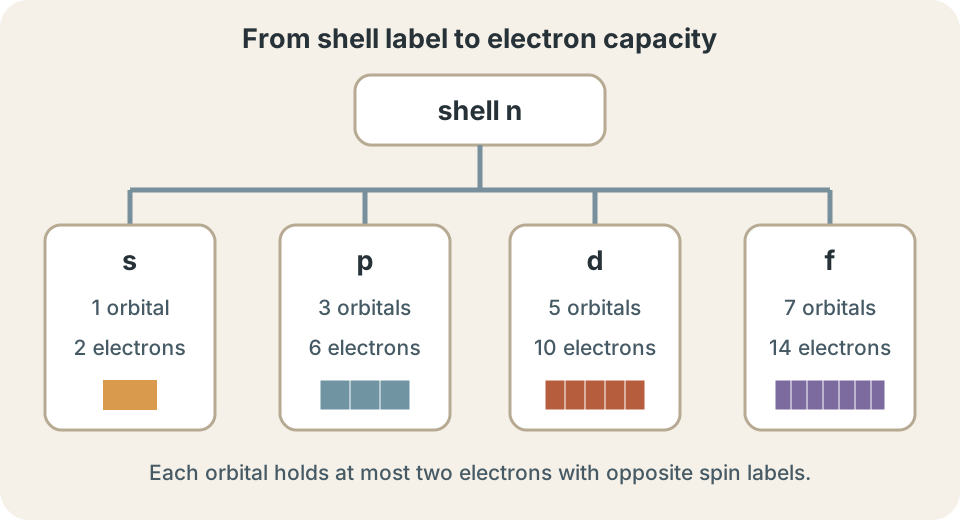
Each subshell contains orbitals distinguished by magnetic quantum number . An subshell has one orbital, has three, has five, and has seven. These counts follow from . Each orbital can hold at most two electrons. Therefore capacities are , , , and electrons.
Electron spin is represented by or . These two allowed projections let an orbital hold two electrons with opposite spin labels. Arrows in orbital diagrams represent spin states, not literal little rotating balls. Quantum terminology should not be forced into a classical picture. The notation predicts occupancy and magnetic behavior.
Reading configuration notation
The term contains three pieces of information. The number is the principal shell number . Letter names the subshell with . Superscript says four electrons occupy that subshell. It does not mean the subshell or energy is raised to the fourth power.
A full configuration such as lists occupied subshells in a conventional order. Spaces separate terms. Superscripts add to electrons. That count corresponds to neutral magnesium with . The notation does not specify individual orbital occupancy inside a partly filled subshell.
An orbital diagram adds boxes or lines for orbitals and arrows for electrons. One box represents one orbital. Paired opposite arrows represent two electrons in it. Separate boxes reveal whether electrons are paired or unpaired. Configuration notation and orbital diagrams answer related but different questions.
Aufbau is an energy-ordering model
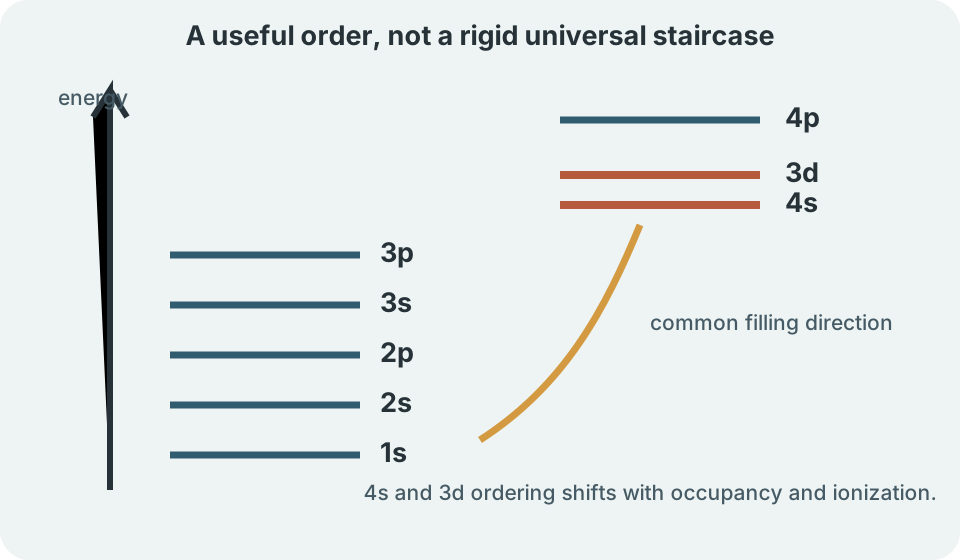
Aufbau means “building up.” In the elementary procedure, electrons are added to lower-energy available orbitals before higher-energy ones. A commonly used sequence begins . Commas here separate subshell labels. They do not imply equal spacing in energy. Each subshell is filled only up to its allowed capacity.
The order can be rationalized approximately with the rule. Lower tends to fill first. If two subshells tie, lower tends to fill first. Thus has while has , so is introduced first for neutral potassium and calcium. This is a mnemonic model, not a universal fundamental law.
Orbital energies depend on nuclear charge, electron shielding, penetration, and electron–electron interaction. Their relative ordering can shift as occupancy and ionization change. This is why transition-metal ion formation requires care. A diagonal filling chart is useful but not an explanation by itself. Evidence and more complete quantum calculations refine the pattern.
Pauli exclusion limits occupancy
The Pauli exclusion principle states that no two electrons in one atom have identical sets of all four quantum numbers. Two electrons in the same orbital already share , , and . They must therefore have opposite values. This produces the two-electron orbital capacity. A third electron cannot enter that same orbital.
In an orbital diagram, a valid filled orbital is shown as . Two upward arrows in one box would violate exclusion. One arrow is allowed and represents an unpaired electron. An empty box is also allowed. The principle applies to every orbital.
Pauli exclusion is deeper than electrostatic repulsion. It reflects the antisymmetric quantum state of electrons, which are fermions. Introductory configurations use its occupancy consequence. The principle helps generate shell structure and matter’s stability. It should not be reduced to “electrons dislike each other.” Its origin is quantum statistics rather than a classical pushing force.
Hund’s rule organizes equal-energy orbitals
Orbitals within an isolated subshell are degenerate in a simple atom model, meaning they have equal energy before interaction details are considered. Hund’s rule says electrons occupy separate degenerate orbitals with parallel spins before pairing. For a subshell, place one same-direction arrow in each of three orbitals. Pairing begins only with the fourth electron. This arrangement lowers energy under the relevant electron-interaction model.
For , an orbital diagram has one paired orbital and two singly occupied orbitals. Which particular box is paired is arbitrary when they are truly degenerate. The count of unpaired electrons is two. A configuration term alone does not display this fact. The orbital diagram makes Hund’s rule visible.
Hund’s rule does not permit electrons to skip into arbitrarily higher subshells. It applies within a set of equal-energy orbitals while Aufbau supplies the broader order. Pauli still limits each orbital to two opposite-spin electrons. The three principles constrain different parts of one construction. Apply them together.
Worked example: oxygen
Neutral oxygen has and therefore eight electrons. Fill and first, using four electrons. Four remain for . The configuration is . Superscripts sum to eight.
The subshell contains three orbitals. Place one electron in each with parallel spin before pairing the fourth in one orbital. A representative diagram is . It contains two unpaired electrons. Other choices of which box pairs are equivalent in the isolated-atom model.
Oxygen’s unpaired electrons help predict paramagnetism in an atomic picture. They also indicate that a simple “filled octet” has not yet been reached. Chemical bonding changes the relevant molecular orbitals, so atomic diagrams are not complete molecular descriptions. The configuration is a starting model. Its interpretation must match the system being studied.
Noble-gas shorthand
Long configurations can be compressed by replacing a filled inner configuration with the symbol of the preceding noble gas in brackets. Sodium is . Because neon is , sodium becomes . Brackets represent the entire core configuration. They are not multiplication symbols.
Choose the noble gas immediately before the element in atomic number. Using a later noble gas would include electrons the atom does not have. Expand the bracket when checking total count. For sodium, contributes ten electrons and contributes one. The total is eleven.
Shorthand emphasizes valence structure. Elements in one main-group column often share the same outer pattern. Chlorine is , while bromine is . Both end in . That recurrence supports periodic chemical similarities.
Core and valence electrons
Core electrons occupy inner filled levels and usually participate less directly in ordinary bonding. Valence electrons occupy the chemically active outer region. For main-group elements, they are commonly the electrons in the highest principal shell. Sodium’s electron is its single valence electron. The neon core contains ten core electrons.
Transition metals complicate a highest- shortcut. Their and electrons can be close in energy and participate in bonding or ion formation. Valence definitions may vary with context. State the convention being used. Do not erase electrons merely because their principal number is lower.
Periodic block labels identify the subshell receiving the distinguishing electron. The block spans two columns, block six, block ten, and block fourteen. Those widths match subshell capacities. Helium is placed with noble gases chemically despite its configuration. Periodic layout combines configuration and chemical behavior.
Forming main-group ions
To form a cation, remove electrons from the occupied level associated with the atom’s outermost electrons. Sodium loses its electron to form with configuration . Magnesium loses two electrons to form with . Electron counts are ten in both cases. Their positive charges record the missing negative electrons.
To form a main-group anion, add electrons to available valence orbitals while obeying Pauli and Hund. Chlorine gains one electron: becomes . Oxygen gains two: becomes . Charge accounting confirms the added electrons. Negative charge records that electrons outnumber protons.
Noble-gas configurations help explain common ion tendencies but are not magical requirements. Lattice energy, solvation, bonding, and other energetic factors determine whether ions form in a real process. An electron configuration describes endpoints. It does not by itself calculate reaction favorability. Avoid replacing energetics with an “octet desire.” Real stability belongs to the entire chemical system.
Transition-metal ions require a reversal
Neutral transition atoms are often written with before in the filling sequence. When cations form, the electrons are generally removed before electrons. For iron, a common neutral configuration is . Iron(II) is . Iron(III) is .
This removal order reflects energy changes after the subshell becomes occupied. The neutral filling mnemonic does not fix ionization order permanently. Write the neutral configuration first, then remove electrons from the largest principal shell number. For period-four transition metals, remove before . Recount after each removal.
Transition metals often support several oxidation states because relevant orbital energies are close. Configuration is one part of explaining this variety. Ligands and chemical environment alter energies further. Free-ion configurations are not complete coordination-compound electronic structures. Later lessons introduce crystal-field and molecular-orbital refinements.
Important ground-state exceptions
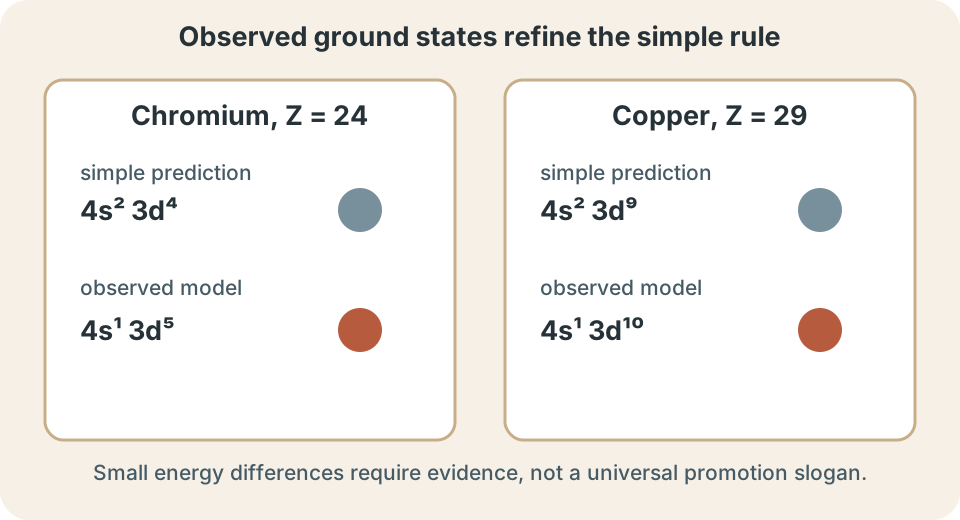
Chromium and copper are common exceptions to the simplest Aufbau prediction. Chromium is commonly represented as rather than . Copper is rather than . These observed ground states reflect small energy differences. Half-filled and filled subshell patterns are part of the explanation.
Do not turn those examples into a universal rule that always promotes an electron for a half-filled subshell. More complete energies include electron interaction, exchange, shielding, and relativistic contributions for heavier atoms. Several elements show patterns that a simple mnemonic does not predict cleanly. Data determine ground-state configurations. Rules summarize regularities.
An exception is evidence about model limits rather than a failure of chemistry. The Aufbau sequence remains useful for organizing many elements. Scientific models can be powerful without being exact in every case. Mark known exceptions and avoid inventing unsupported ones. Understanding the limitation is more rigorous than memorizing a longer list.
Unpaired electrons and magnetism
An atom or ion with one or more unpaired electrons is paramagnetic in the elementary classification. It is attracted into a magnetic field. A species with all electrons paired is diamagnetic. It is weakly repelled from a magnetic field. Orbital diagrams reveal the unpaired count.
Neutral nitrogen has . Hund’s rule gives three singly occupied orbitals. It is therefore predicted to have three unpaired electrons in the isolated-atom configuration. Neon has with all electrons paired. It is diamagnetic.
Molecular magnetism cannot always be predicted by simply combining isolated atomic configurations. Molecular orbital theory is needed for cases such as oxygen molecules. Experimental magnetic behavior helped reveal limits of elementary bonding models. Configuration-based predictions should identify their system. Evidence decides whether the model is adequate.
Excited states and ground states
A ground-state configuration is the lowest-energy arrangement under specified conditions. Absorbing energy can promote an electron to a higher orbital, creating an excited state. Electron count remains unchanged. Occupancy and energy change. The excited configuration can later relax and emit energy.
For hydrogen, ground state is . An excited state might be . The atom is still hydrogen because proton number remains one. The configuration describes state, not elemental identity. Spectral lines arise from energy differences between allowed states.
Introductory filling rules target ground states unless stated otherwise. An unusual occupancy is not automatically invalid if the problem specifies excitation. Check Pauli exclusion in every state. Hund and Aufbau describe energy preferences, not conservation laws preventing excitation. Context identifies which state is requested.
Experimental evidence and model scope
Atomic emission and absorption spectra reveal discrete energy differences. Photoelectron spectroscopy measures energies required to remove electrons and shows grouped subshell structure. Magnetic measurements reveal unpaired electrons. Periodic chemical trends provide additional indirect evidence. Configurations synthesize these observations.
Photoelectron spectra often display peaks whose areas relate to electron counts and whose positions relate to binding energies. Inner electrons have larger binding energies. Subshell splitting and many-electron effects complicate simple diagrams. The data are not merely illustrations of a predetermined rule. They test and refine the model.
An electron configuration does not specify exact electron trajectories. It also omits detailed coupling, correlation, and molecular environment. More advanced notation describes terms, spin–orbit effects, and many-electron states. Introductory configurations remain useful at their intended scale. State conclusions no more strongly than the model supports.
Common misconceptions and repairs
One misconception treats orbitals as circular paths. Orbitals are quantum states represented through probability distributions and mathematical functions. Box diagrams show occupancy, not location tracks. Replace orbit language with probability and state language. This repair matters when interpreting shapes and energies.
Another misconception pairs electrons too early. Hund’s rule requires single occupation across degenerate orbitals before pairing. Draw all boxes in the subshell first. Then place one parallel arrow in each. Only afterward add opposite-spin partners.
A third misconception removes electrons before from period-four transition-metal cations because appears later in some written configurations. Ionization order follows the occupied atom’s energies and outer shell. Remove first. Recount electrons and charge. Do not rely only on left-to-right notation.
A reliable construction routine
Write atomic number, charge, and target electron count. List the filling sequence only as far as needed. Fill subshells without exceeding capacities. For a partially filled subshell, draw orbitals and apply Hund and Pauli. Add superscripts to verify the total.
Compress with the preceding noble gas if shorthand is requested. For ions, construct the neutral atom before adding or removing electrons. Remove highest- electrons first for transition-metal cations. Check known ground-state exceptions. State whether the configuration is ground, excited, atomic, or ionic.
Interpret after constructing. Identify valence and core electrons under an explicit convention. Count unpaired electrons from an orbital diagram. Connect the ending pattern to periodic position. Avoid claiming that notation alone determines all chemistry. Configuration is evidence-based structure, not a complete reaction theory.
Practice and connection forward
Phosphorus has . Its configuration is or . Superscripts total fifteen. Hund’s rule gives three unpaired electrons. The atom is paramagnetic in this elementary prediction.
Calcium has . Calcium ion loses the two electrons and becomes . Neutral iron is commonly . Iron(III) removes two and one electron to give . Each configuration matches its target electron count.
Without looking back, explain every symbol in and derive the capacity. Draw under Hund and Pauli. Explain why fills before in the simple neutral sequence but is removed first in common cations. Periodic-table lessons will organize recurring valence patterns. Bonding lessons will show how atomic orbitals participate in shared molecular structures.