
The periodic table is not merely a chart to memorize before solving chemistry problems. It is a compressed map connecting atomic number, electron configuration, recurring chemical behavior, and broad material properties. Its rows and columns reveal patterns because electrons occupy quantized energy levels and subshells in recurring ways. Those patterns support useful predictions, but no single shortcut captures every element under every condition. This lesson develops a way to read the table while keeping both its predictive power and its limitations visible.
Learning objectives
By the end of this lesson, you should be able to locate periods, groups, families, and electron-configuration blocks. You should explain why atomic number, rather than atomic mass, determines the modern ordering. You should infer common main-group valence configurations from position. You should connect recurring valence structures with common ion charges and broad bonding behavior. Every inference should be presented as a model-based prediction rather than an unqualified command.
You will distinguish main-group elements from transition metals and inner-transition elements. You will explain why helium is placed with the noble gases despite its -block electron configuration. You will use a periodic-table position to build or check an electron configuration. You will also interpret the broad metal, metalloid, and nonmetal regions without treating their boundaries as exact. These skills turn the table into a reasoning tool rather than a lookup wall.
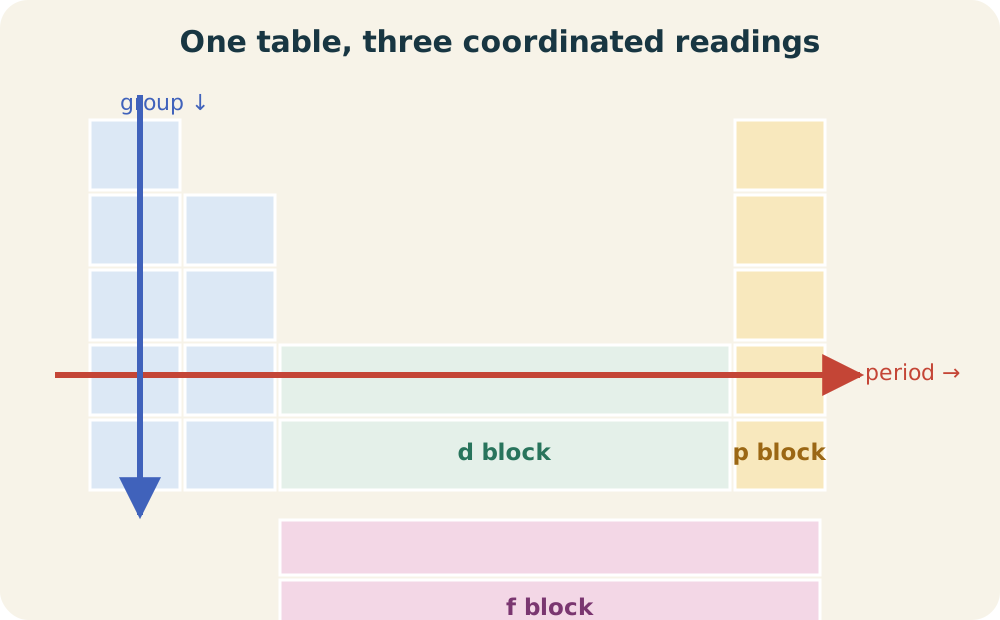
Use three coordinated readings throughout the lesson. Read left to right by increasing atomic number, read top to bottom by recurring valence patterns, and read by blocks according to the subshell receiving the differentiating electron. Each reading answers a different question. No single direction contains every useful relationship. Combining them produces a richer explanation than any isolated family label.
Atomic number provides the sequence
Each element is defined by its atomic number . The symbol represents the number of protons in an atom’s nucleus. A neutral atom also contains electrons, while an ion has gained or lost electrons without changing its proton count. Moving one position to the right in the modern table usually increases by one. Changing proton number changes the element’s identity.
Atomic mass does not provide the fundamental modern ordering. Isotopes of one element can have different masses while sharing the same atomic number and chemical identity. Historical arrangements based mainly on mass revealed periodic patterns but also created apparent ordering conflicts. Ordering by proton number resolves those conflicts. The table’s sequence is therefore tied to nuclear charge and electron count.
Atomic number controls the number of electrons in a neutral atom, and electron arrangement strongly influences chemistry. As increases, electrons fill available states according to quantum-mechanical rules and energetic competition. Similar outer-electron arrangements recur after characteristic intervals. Those recurrences produce periodicity. The table displays this deep connection between nuclear charge and electron structure.
Periods are horizontal rows
A period is a horizontal row. Elements in one period are filled through a related range of principal energy levels as atomic number increases. The principal quantum number is a positive integer that labels a shell. For main-group elements, the period number generally matches the highest occupied principal shell in the ground-state configuration. This rule is useful but should be read alongside the full configuration for transition elements.
Period 1 contains hydrogen and helium because only the subshell is being filled. Period 2 begins with lithium and develops through the and subshells. Period 3 similarly develops through and . Later periods become longer because and eventually subshells enter the filling sequence. Row lengths therefore reflect the capacities and energy ordering of subshells.
Moving across a period adds protons and electrons while keeping the highest main-group shell number broadly fixed. Effective nuclear charge generally increases across the row because added protons are not perfectly canceled by shielding. This changing attraction contributes to periodic trends in atomic radius, ionization energy, and electronegativity. The row is therefore more than a counting strip. It represents systematic change under a repeating electron-filling structure.
Groups are vertical columns
A group is a vertical column. Elements in a main-group column share recurring valence-electron configurations. Valence electrons are the outer electrons most directly involved in many ordinary bonds and ion-forming processes. Similar valence structures often create related chemistry. This is why groups are also called chemical families.
Modern group numbers run from 1 through 18. Group 1 includes the alkali metals below hydrogen, while group 2 contains alkaline-earth metals. Groups 13 through 18 make up the right-side main-group columns. Group 17 contains halogens, and group 18 contains noble gases. Transition metals occupy groups 3 through 12, where patterns require more care.
Family membership suggests behavior but does not dictate a single reaction. Conditions, bonding partners, oxidation states, and physical structures all matter. Hydrogen shares the pattern with group 1 but is a nonmetal with distinctive behavior. Elements lower in a group can access chemical possibilities unavailable to lighter members. A group trend should therefore begin an explanation rather than end it.
Blocks encode the differentiating subshell
The table is divided into , , , and blocks. A block identifies the type of subshell receiving the differentiating electron as atomic number advances through that region. The block is two columns wide because an subshell holds two electrons. The block is six columns wide because a subshell holds six electrons. The and blocks are ten and fourteen columns wide for the same capacity reason.
The left two columns form the block, with helium as a configurational member even though it is displayed at the far right. The right six columns form the block, excluding helium’s configuration. The central ten columns form the block of transition elements. The two detached rows usually shown below the main body form the block. Their detached placement keeps the printed table compact rather than indicating that they are chemically disconnected.
Block position helps reconstruct electron configurations. An element ending in belongs to the block and has three electrons in a subshell. An element ending broadly in belongs to the transition region. The block label describes a configuration pattern, not a claim that only that subshell matters. Filled inner and outer subshells jointly influence actual behavior.
Main-group valence patterns
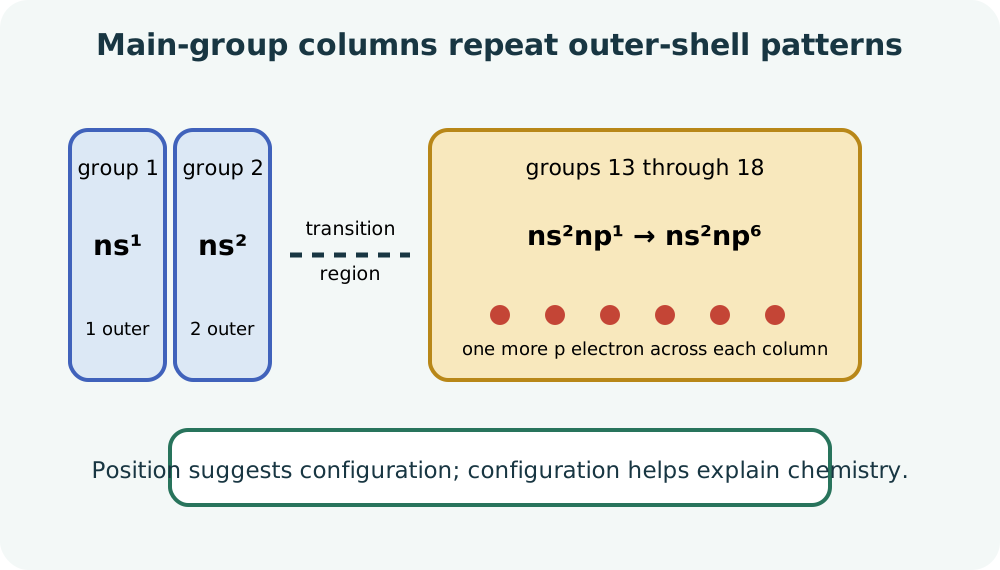
Main-group elements show especially clear valence patterns. Group 1 neutral atoms usually have an outer pattern , where is the period’s outer-shell number. Group 2 generally has . Groups 13 through 18 progress from through . The superscripts count electrons in each indicated subshell.
For example, a period-3 group-16 element has the outer pattern . The coefficient identifies the principal shell, while the letters identify subshell types. The superscripts show two electrons in and four in . This position corresponds to sulfur. Its six outer-shell electrons help explain many common bonding patterns.
The pattern is useful because a filled and valence shell often has comparatively low ordinary reactivity. Main-group atoms may gain, lose, or share electrons in ways that approach such stable arrangements. This “octet” language is a helpful introductory model, not a universal energy law. It predicts common patterns without calculating the energy of a real process. Electron deficiency, expanded bonding descriptions, radicals, transition-metal chemistry, and molecular orbital effects require richer accounts.
Helium teaches us to use more than one criterion
Helium has electron configuration . By differentiating-subshell logic, it belongs to the block. Its shell is completely filled with two electrons. Chemically, helium is exceptionally unreactive under ordinary conditions. That behavior aligns it with the noble-gas family.
The familiar table therefore places helium above neon in group 18. This location prioritizes chemical family behavior while preserving helium’s known configuration. It shows that blocks and groups encode overlapping but not identical organizing principles. A single rectangular position can communicate several relationships at once. No contradiction exists once the criteria are named.
Hydrogen provides another instructive case. Its configuration resembles group 1, yet hydrogen is a nonmetal and can participate in covalent bonding, form in some models, or form hydride in others. Different periodic-table designs sometimes highlight these multiple relationships. Such debates reveal the table’s role as a scientific representation. A useful representation organizes evidence without pretending every boundary is absolute.
Building a configuration from position
To build a ground-state configuration, begin with atomic number and place that many electrons into subshells according to an accepted filling order. Periodic-table blocks provide a visual route through that order. Each step across a block adds one electron to the differentiating subshell in the simplified construction. The superscripts cannot exceed the capacity of the subshell. The total superscripts must equal the electron count for a neutral atom.
Consider chlorine, atomic number , in period 3 and group 17. Its full configuration is . Adding the superscripts gives . Its valence configuration is . The group position and electron count agree.
Noble-gas notation shortens the same configuration as . The bracketed symbol represents neon’s filled configuration . This shorthand exposes the chemically relevant outer pattern while retaining the core implicitly. It should be expanded at least occasionally to ensure the bracket is understood. A shorthand is valuable only when its compressed information can be recovered.
From position to common ions
Main-group metals on the left often form cations by losing valence electrons. A sodium atom with outer configuration commonly loses one electron to form . The plus sign indicates one fewer electron than protons. Magnesium with commonly forms . These changes expose the filled neon-like core in simple ionic descriptions.
Nonmetals near the right often form anions in ionic compounds. Chlorine with can gain one electron to form with a filled subshell. Oxygen with commonly gains two electrons in simple ionic compounds to form . The negative charge indicates more electrons than protons. These patterns connect position, electron counting, and charge notation.
Common-ion rules are not universal commands. Carbon does not ordinarily form isolated or ions in simple chemistry merely because four electrons separate it from a filled shell. Sharing electrons in covalent structures is often more favorable. Transition metals commonly form multiple oxidation states because and energies are close. Energetics and environment decide what actually forms.
Transition metals require a broader view
Transition elements occupy the block. Their differentiating electrons enter a subshell whose principal number is commonly one less than the period number. A period-4 transition configuration often involves and electrons. These subshells are close in energy. Their competition contributes to variable oxidation states and rich chemistry.
Simple column-to-charge rules are less reliable here than for main-group metals. Iron commonly appears in both and forms. Copper commonly forms and . Compound identity, ligand environment, and reaction conditions influence which state is stable. Roman numerals in names communicate the oxidation state when ambiguity is possible.
Some neutral transition configurations also depart from the simplest predicted filling pattern. Half-filled or filled subshells and detailed electron interactions can shift relative energies. These cases should not be presented as arbitrary exceptions to memorize without context. They are evidence that the simplified filling-order rule approximates a more complex many-electron system. The periodic table remains useful, but the model must be applied at the appropriate resolution.
The inner-transition series
The lanthanides and actinides form the two -block series. They are normally displayed below the main table to avoid making the chart excessively wide. In a fully extended table, they fit into periods 6 and 7 after the early -block elements. Their detached appearance is therefore a formatting choice. It is not a gap in atomic-number sequence.
The subshell can hold fourteen electrons, which explains the width of each series. Differentiating electrons enter subshells that are relatively internal compared with the outermost shell. This arrangement can make chemical properties across a series resemble one another closely. Separating neighboring lanthanides is therefore technically challenging. Their magnetic, optical, and electronic properties remain highly valuable.
Many actinides are radioactive, and several beyond uranium are primarily produced artificially. Their chemistry involves nuclear stability as well as electron structure. Introductory family rules provide only a starting point. The block reminds us that the periodic table organizes nuclear identity and electron configuration simultaneously. It also demonstrates why the table’s physical layout is a designed visualization.
Metals, nonmetals, and metalloids
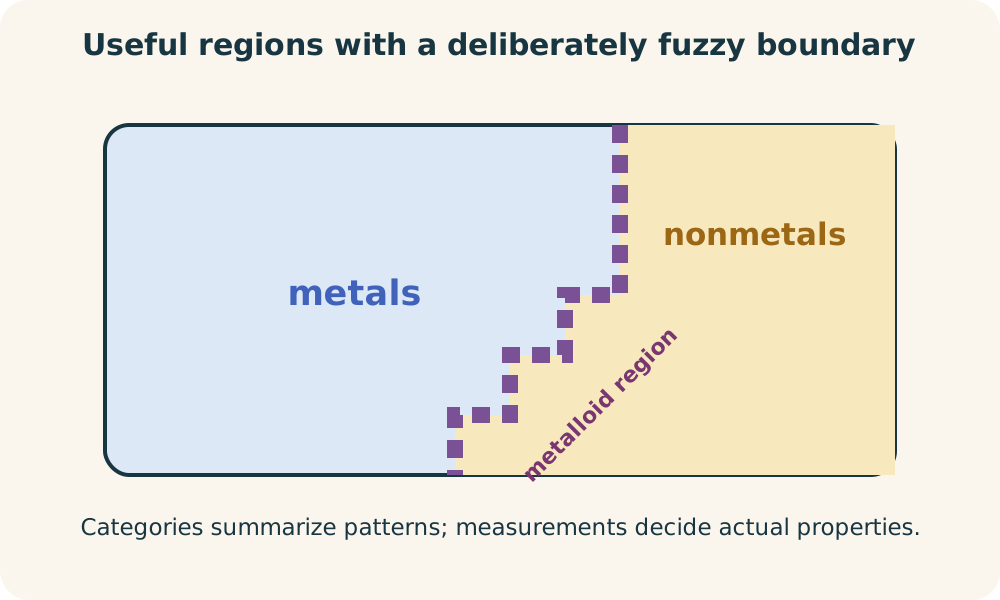
Metals occupy the left and center of the table. They commonly conduct electricity and heat, show luster, and can often be shaped without shattering under ordinary conditions. Atoms of many metals tend to form cations or participate in delocalized metallic bonding. These statements summarize broad tendencies. Physical form, temperature, purity, and crystal structure influence actual properties.
Nonmetals occupy the upper-right region along with hydrogen. They show diverse physical forms and often form covalent bonds or anions. Their electrical conductivities are generally lower than those of ordinary metals, although graphite and doped semiconductors complicate simple labels. Nonmetal does not mean chemically inactive. Oxygen, fluorine, and other nonmetals can be highly reactive.
Metalloids are often shown along a stair-step boundary between metals and nonmetals. Elements commonly labeled metalloids show intermediate or condition-dependent behavior useful in semiconductor contexts. Lists vary among sources because metalloid is a descriptive category without one universally sharp definition. The boundary should therefore be taught as a fuzzy region. A category supports prediction but does not replace measured properties.
Chemical families and responsible predictions
Alkali metals are the group-1 metals below hydrogen. Their outer pattern supports common formation of ions in simple compounds. They are generally reactive, and reactivity patterns vary down the group. Because they react readily with air or water, free elemental samples require controlled handling. Family behavior connects electron structure with observed chemistry.
Halogens occupy group 17 and have the main-group pattern . They commonly gain one electron in ionic compounds or share electrons in covalent bonds. Their elemental forms and physical states vary down the group. Fluorine is not simply a larger version of iodine because size, bond energies, polarizability, and other factors change. Shared valence count creates resemblance without erasing differences.
Noble gases occupy group 18 and have filled valence shells in the basic model. Their ordinary reactivity is low, but heavier noble gases can form compounds under suitable conditions. Saying “noble gases never react” turns a strong trend into a false absolute. A responsible prediction includes scope and conditions. Periodic families describe likelihoods grounded in structure, not unbreakable personality types.
Reading periodic trends from organization
Atomic radius generally decreases across a main-group period and increases down a group. Across a period, increasing effective nuclear charge pulls valence electrons more strongly while they remain in the same broad shell. Down a group, the highest occupied shell lies farther from the nucleus and shielding increases. These competing factors explain the directional pattern. The trend has details and definition-dependent variations, but its organizing logic is useful.
First ionization energy generally increases across a period and decreases down a group. It measures the energy required to remove an electron from a gaseous atom under defined conditions. Stronger nuclear attraction makes removal harder, while greater distance and shielding make it easier. Subshell structure creates local deviations from a perfectly smooth trend. The periodic table predicts a landscape rather than a straight ruler.
Electronegativity generally increases toward the upper right, excluding noble gases in many common scales. It describes an atom’s attraction for shared electron density within a bond. It is not the same as electron affinity or ionization energy. Those quantities have related trends but different operational meanings. Position supports predictions only when the property itself is clearly defined.
Worked table-reading example
Suppose an unknown main-group element lies in period 4 and group 15. Period 4 identifies the outer principal shell as . Group 15 gives the common valence pattern . Combining those clues produces . The element is arsenic, atomic number .
Its noble-gas configuration is . The filled portion lies between the argon core and the outer electrons in the filling sequence. Adding electron counts yields . This count checks the atomic number. The table position and configuration mutually validate one another.
Arsenic lies near the commonly drawn metalloid staircase. That placement suggests condition-dependent properties and substantial covalent chemistry. The pattern connects it with group-15 relatives, but it does not determine a single universal ion charge. Predictions should consider compound context and oxidation state. This example demonstrates how several table layers combine without collapsing into one rule.
Common interpretation errors
One error treats period number as the number of occupied shells in every possible ion or excited state. The period classification refers to the neutral ground-state organization of the element. Ion formation can remove the highest-shell electrons. Excitation can temporarily place electrons into higher states. State and context must be distinguished from table position.
Another error maps group number directly to valence-electron count for every element. The shortcut works in a specific way for main-group elements, but transition elements require -electron reasoning. Helium also demonstrates that chemical family and configuration block can point in different display directions. Write the actual valence pattern when precision matters. A verbal family rule cannot replace electron counting.
A third error presents trends as exceptionless. Real properties depend on subshell energies, electron pairing, shielding, relativistic effects, structures, and measurement definitions. The broad table pattern remains valuable because it organizes expectations. Deviations are opportunities to refine the model rather than reasons to abandon it. Good chemistry uses trends to form hypotheses and evidence to test them.
Practice and retrieval
Identify the period, group, and block for an element whose valence configuration ends in . Name the element and count its total electrons from a noble-gas configuration. Predict whether it lies in the broad metal, metalloid, or nonmetal region. State why that category should be treated as a summary rather than a complete description. Explain each superscript in the valence configuration.
Compare sodium, chlorine, and argon within period 3. State their main-group valence configurations. Predict their common behavior in simple ionic models and explain how each prediction relates to a filled shell. Then describe one reason the three elements have very different properties despite occupying the same period. Use atomic number and effective nuclear charge in the explanation.
Finally, explain why the block is displayed below most periodic tables. State where it belongs in the atomic-number sequence. Relate its fourteen-column width to subshell capacity. Explain why its elements are not detached chemically from the rest of the table. This task checks whether layout has been understood as designed compression.
Solutions and reasoning
The ending identifies period 4, group 15, and the block. The element is arsenic. Its configuration contains electrons. Arsenic is commonly classified as a metalloid. That label summarizes several properties but does not uniquely determine behavior in every compound or physical structure.
Sodium has valence pattern , chlorine has , and argon has . Sodium commonly loses one electron, chlorine commonly gains one electron in simple ionic compounds, and argon already has a filled valence shell. Atomic number increases across the period. Increasing effective nuclear charge and changing valence occupancy produce different sizes, ionization energies, and chemical behaviors. Shared period does not imply shared family chemistry.
The block is placed below the main body to keep the table compact. The lanthanides belong within period 6, and the actinides belong within period 7. An subshell holds fourteen electrons, producing fourteen differentiating positions. The atomic-number sequence continues through those rows without interruption. Their detached display is typographic rather than a claim of chemical isolation.
Connection forward
The organization developed here provides the map on which periodic trends are interpreted. Effective nuclear charge explains why attraction changes across periods. Shielding and principal-shell size explain much of the change down groups. Ionization energy, electron affinity, atomic radius, and electronegativity then become connected predictions rather than separate arrows to memorize. Each trend still requires a precise definition and attention to deviations.
Periodic position also supports bonding models. Common valence patterns help predict electron sharing, ion formation, Lewis structures, and bond polarity. Transition-metal and metalloid cases remind us when those introductory models need extension. The table does not directly output a molecule’s structure or reaction pathway. It supplies structured evidence that must be combined with bonding and energetic reasoning.
Carry forward a layered reading routine. Identify atomic number, period, group, and block. Write the likely valence configuration and check electron count. Use family and material-region labels to form conditional predictions, then state limitations. The periodic table becomes most powerful when treated as a map to reason with rather than a list to recite.