
Atoms do not form bonds because they possess intentions, seek octets, or simply prefer company. A bond forms when an interacting arrangement is energetically favorable relative to an appropriately chosen separated reference and when a stable structure is available. Electron–nucleus attractions can lower energy as atoms approach, while repulsions and quantum restrictions prevent unlimited collapse. The balance produces a characteristic separation and a potential-energy well. This lesson develops that energy-based account before introducing common bonding models.
Learning objectives
By the end of the lesson, you should be able to identify the attractive and repulsive interactions that shape a bond potential-energy curve. You should connect force with the slope of potential energy. You should explain equilibrium bond length as a minimum rather than as a point where interactions vanish. You should distinguish bond formation from bond breaking using consistent energy signs. Every explanation should state the system and reference state.
You will compare ionic and covalent descriptions as useful limiting models of electron redistribution. You will explain why lattice formation or solvation can make ion formation favorable even when isolated electron transfer costs energy. You will use orbital overlap and the Pauli principle qualitatively. You will also distinguish bond energy from total reaction enthalpy and free-energy favorability. These distinctions replace slogans with a transferable physical model.
Keep three questions separate throughout the lesson. What interactions change as nuclei move, what reference defines the energy comparison, and where does released energy go? Bonding answers the first through a potential curve. Thermochemical accounting answers the second and third. A complete explanation connects all three.
Energy needs a reference
Potential energy is defined relative to a chosen reference. For a diatomic model, widely separated neutral atoms are often assigned . Negative potential energy then means the interacting arrangement lies below that reference. Positive energy means it lies above it. Only energy differences have direct physical significance.
The reference must match the process being discussed. Separating a gas-phase molecule into neutral gas-phase atoms differs from separating ions in a crystal. Dissolving an ionic solid introduces solvent interactions. A bond dissociation enthalpy includes specified thermodynamic conditions. Quoting one number without its reference can produce false comparisons.
A stable bond corresponds to a local minimum on the relevant energy landscape. Local means nearby distortions raise energy. It does not necessarily mean the structure is the lowest possible energy among every conceivable product. A metastable molecule can persist behind an activation barrier. Stability and reaction rate are related but distinct concepts.
Four electrostatic interactions appear
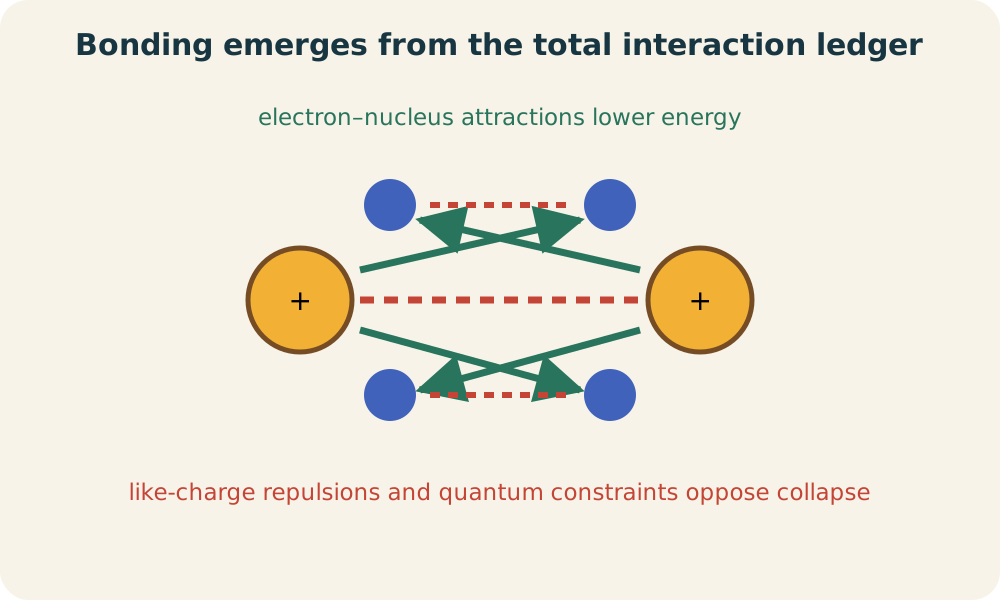
When two atoms approach, each positively charged nucleus attracts electrons. Cross-attractions between one nucleus and the other atom’s electron density can lower potential energy. Each nucleus also continues attracting its own electrons. Electron density can redistribute across the combined system. Bonding cannot be understood by considering only one pair of charges.
The positively charged nuclei repel one another. Electrons also repel one another. These repulsions raise energy as charged particles are brought into unfavorable proximity. At long range, cross-interactions are weak. At short range, repulsion becomes increasingly important.
Electrostatics alone is still incomplete because electrons are quantum particles. Their allowed wavefunctions, kinetic energy, spin, and antisymmetry constraints matter. The Pauli exclusion principle prevents identical electrons from occupying the same one-electron state. Compressing electron density into too small a region raises kinetic and exchange-related energy costs. Short-range resistance to collapse therefore has quantum as well as electrostatic origins.
Reading a bond potential-energy curve
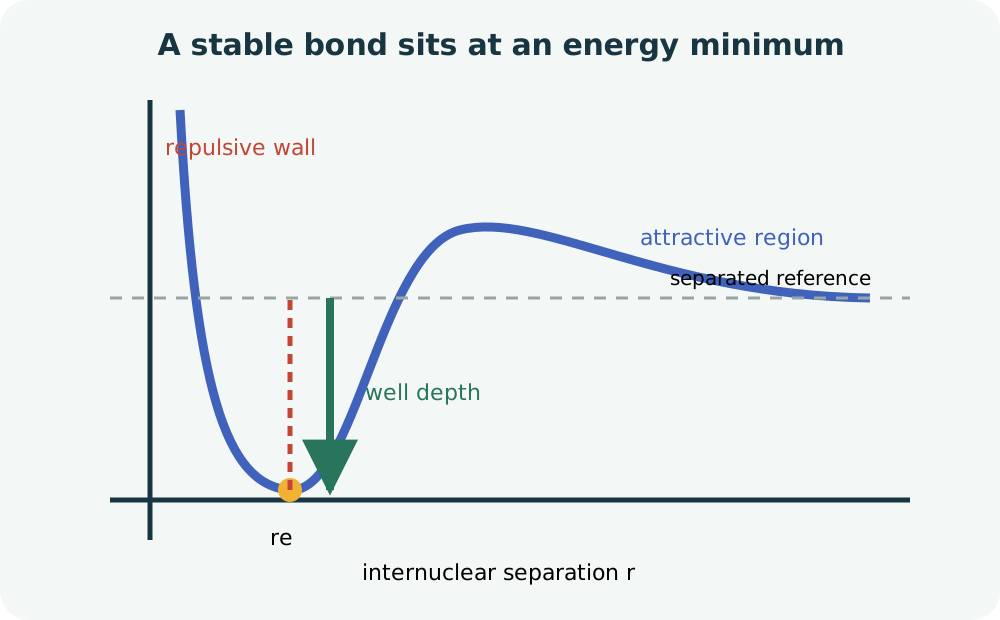
Plot potential energy vertically against internuclear separation horizontally. At very large , interaction energy approaches the separated-atom reference. As atoms approach from far apart, attractive interactions can lower . The curve descends into a well. The well indicates that some intermediate separations are energetically favored.
At very short separation, the curve rises steeply. Nuclear repulsion, electron repulsion, and quantum confinement dominate. The minimum occurs at equilibrium separation . This distance is the model’s equilibrium bond length. It is not the distance where all interactions individually become zero.
The well depth relative to the separated reference is related to dissociation energy. A deeper well generally represents a stronger bond under comparable definitions. The curvature near the minimum relates to vibrational stiffness. A narrow steep well corresponds to a larger local force constant than a broad shallow well. One curve therefore encodes length, strength, and vibration information.
Force comes from the energy slope
Radial force and potential energy satisfy . The derivative is the slope of the energy curve with respect to separation. The minus sign means force points toward decreasing potential energy. A positive slope produces a negative radial force, while a negative slope produces a positive radial force under the chosen coordinate. Sign interpretation requires a declared positive direction.
At the minimum, . Net radial force is zero there. For a stable minimum, the second derivative is positive, so . A small displacement to either side creates a restoring tendency. The atoms oscillate about the equilibrium rather than remaining motionless in a classical picture.
For on the attractive side, the force tends to pull nuclei together. For on the repulsive wall, the force tends to push them apart. The minimum balances these tendencies. Calling the bond “attraction” alone omits the repulsion that fixes its length. Stable structure requires competition.
Local harmonic approximation
Near the minimum, a smooth potential can be approximated by . The linear term vanishes because the slope is zero at equilibrium. The coefficient is an effective bond force constant in newtons per meter. The displacement measures stretching from equilibrium. This is a Taylor expansion truncated after the quadratic term.
Differentiating the approximation gives . This is Hooke’s-law form. The bond behaves approximately like a spring for small vibrations. The approximation becomes less accurate for large stretches because the real potential is asymmetric. Compression rises steeply, while extension eventually approaches dissociation.
Vibrational frequency depends on force constant and participating masses. Stronger curvature generally produces higher frequency for comparable masses. Heavier atoms vibrate more slowly for comparable force constants. Spectroscopy can therefore reveal bonding information. The spring picture is locally useful without implying that a chemical bond is a literal mechanical coil.
Forming a bond releases energy
Suppose separated atoms at the chosen reference move into a bonded minimum below zero. The system’s potential energy decreases. Energy conservation requires the difference to appear in other accounts. It can become molecular translation, rotation, vibration, emitted radiation, or energy transferred to surrounding particles. Without a pathway to remove energy, a newly approaching pair may not remain bound.
Bond formation is therefore exothermic relative to the corresponding separation process under the same reference and conditions. If is required to dissociate one mole of specified bonds, forming those bonds releases approximately the same magnitude in the reverse idealized process. The sign changes with process direction. The system must transfer that released energy to another account. The positive tabulated dissociation energy reports required input.
The phrase “bond energy is negative” can be ambiguous. The bonded state’s potential energy may be negative relative to separated atoms. A bond dissociation energy is conventionally reported as a positive energy requirement. State whether a number describes state energy, energy change, or required separation input. Sign conventions become clear when initial and final states are written.
Breaking a bond requires energy
Moving nuclei from the potential minimum toward large separation climbs out of the well. External energy must be supplied. This statement applies to breaking the specified bond considered by itself. The required energy may come from light, heat, collisions, electrical work, or coupled chemical changes. Bond breaking is not intrinsically an energy-releasing event.
Some reactions release energy overall even though reactant bonds break. Energy is required to break those bonds. New product interactions then form and release energy. If formation releases more than breaking consumes, the net reaction enthalpy is negative. The complete accounting includes both directions.
The slogan “breaking bonds releases energy” confuses the trigger with the full reaction. Explosive materials can release large net energy after activation begins, but initial bond disruption still costs energy. Product formation and expansion of hot gases can dominate the net outcome. The reaction must be evaluated from its complete initial state to its complete final state. A stepwise energy ledger prevents this misconception.
Covalent bonding and shared density
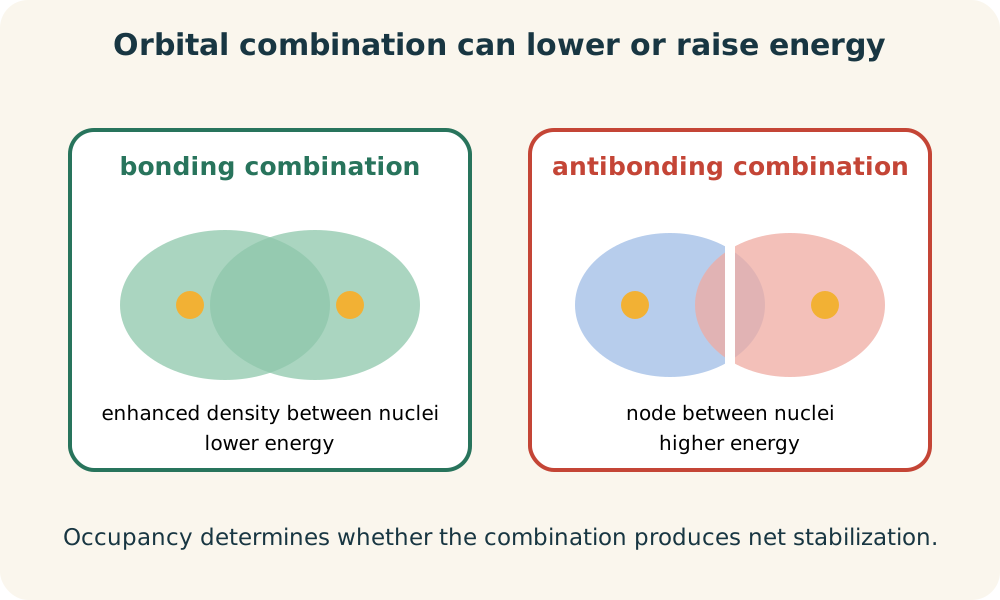
A covalent model emphasizes electron density shared between nuclei. When atomic orbitals combine constructively, a bonding molecular orbital can place enhanced electron probability in the internuclear region. That density is attracted to both nuclei. Occupying a bonding orbital can lower total energy relative to separated atomic orbitals. The energy change includes both electron potential and kinetic contributions.
An antibonding combination has a node or reduced density between nuclei and is generally higher in energy. Electrons occupying antibonding orbitals offset bonding stabilization. Bond order in a simple molecular-orbital model compares bonding and antibonding occupancy. More bonding than antibonding occupancy supports a net bond. The orbital model explains cases that octet drawings alone cannot.
Shared density need not be shared equally. Differences in electronegativity polarize a bond toward one atom. The bond can retain covalent character while carrying partial charges. Ionic and covalent are not mutually exclusive boxes for every real bond. Electron-density distribution forms a continuum influenced by atoms and environment.
Ionic bonding and extended structures
An ionic model emphasizes attraction between oppositely charged ions. In a crystal, each ion interacts with many neighbors. The structure is an extended lattice rather than a collection of isolated ion pairs. Opposite-charge attractions lower electrostatic energy, while same-charge repulsions and short-range effects influence arrangement. Lattice geometry matters.
Creating isolated gas-phase ions can require substantial energy. Removing an electron costs ionization energy. Adding an electron may release or require energy depending on the species and definition. Ion formation becomes favorable in an ionic solid when lattice stabilization and other energy terms outweigh the costs. “One atom gives an electron because both want octets” omits this accounting.
In solution, solvation changes the balance. Polar solvent molecules stabilize ions through ion-dipole interactions. Breaking the crystal lattice costs energy, while hydration or solvation releases energy. Entropy also contributes to free-energy favorability. The same compound can behave differently in gas, crystal, and solution contexts.
The octet rule is a pattern summary
The octet rule notes that many main-group atoms form structures associated with eight valence-shell electrons. This pattern reflects common stability of filled and valence subshells. It is useful for constructing introductory Lewis structures. It is not the fundamental force that pulls atoms together. Energy and quantum mechanics supply the underlying explanation.
Hydrogen often follows a duet pattern because the shell holds two electrons. Boron and beryllium can form electron-deficient compounds. Odd-electron species cannot give every atom an octet. Elements in later periods can require descriptions that do not fit a strict octet count. Transition-metal bonding has additional complexity.
A good rule is used within its domain and tested against evidence. The octet rule predicts many common formulas and electron counts. It does not calculate bond length, energy, polarity, or reaction rate. When it fails, the response is to refine the model rather than invent intentions for atoms. Pattern recognition and physical explanation should remain distinct.
Bond length and bond strength
Bond length is the equilibrium average separation between bonded nuclei under specified conditions. Bond strength can refer to dissociation energy, force constant, or another measure. These quantities often correlate but are not identical. A shorter bond is frequently stronger within a related family. Comparisons across unrelated bonds require caution.
Multiple bonds often have greater electron density between nuclei than corresponding single bonds. They are commonly shorter and have larger dissociation energies. However, total molecular context, resonance, polarity, and orbital participation matter. A double bond is not simply two independent single bonds. Its components have different symmetry and rotational consequences.
Bond length also changes with vibrational state and environment. Molecules are not static sticks. Reported lengths are averages or equilibrium parameters derived from measurements and models. Temperature and electronic state can alter distributions. A structural drawing is a compact representation of a dynamic quantum system.
Reaction energy requires a full ledger
A reaction enthalpy can be estimated using average bond enthalpies. Add energy required to break reactant bonds. Subtract energy released when product bonds form. The approximate relationship is . Each is a positive bond dissociation enthalpy.
Suppose breaking bonds requires and forming new bonds releases . Then . The negative sign means the product state is lower in enthalpy under the comparison. Energy was required during bond breaking. Greater energy release during formation creates the net exothermic result.
Average bond enthalpies are approximate because bond energy depends on molecular environment. Phase changes, solvation, ionic lattices, and noncovalent interactions may also matter. Enthalpy alone does not determine spontaneity because entropy contributes through Gibbs free energy. A complete reaction claim requires the appropriate thermodynamic quantity. Bond energies are one part of the ledger.
Energy favorability and activation barriers
A lower-energy product arrangement can be thermodynamically favored while forming very slowly. The reaction pathway may pass through a high-energy transition region. The energy required to reach it is related to activation energy. Existing bonds may need distortion or partial breaking. Molecular orientation and collisions also matter.
Catalysts provide alternative pathways with lower activation barriers. They do not change the initial and final state energy difference. They accelerate forward and reverse processes by changing kinetics. A catalyst does not make an energetically unfavorable product favorable by altering equilibrium thermodynamics. It changes access, not destination energies.
This distinction explains why oxygen and fuel can coexist before ignition. Lower-energy products may be available, but a barrier prevents rapid conversion. A spark supplies activation energy to some molecules. Subsequent exothermic steps can propagate the reaction. Bonding energetics and reaction kinetics answer different questions.
Intermolecular attractions are also energetic
Not every attractive interaction is classified as an intramolecular chemical bond. Molecules can attract through dispersion, dipole-dipole, hydrogen-bonding, and ion-dipole interactions. These interactions also correspond to energy lowering at suitable separations. They influence boiling points, solubility, structure, and biological recognition. Their strengths span a broad range.
The boundary between bond and intermolecular interaction can depend on context and convention. Hydrogen bonding can be strong and directional. Coordination interactions can have mixed descriptions. The energy-landscape framework remains applicable even when labels vary. Stable separations emerge from competing attractions and repulsions.
Phase behavior depends on collective interactions among many particles. Vaporizing a liquid requires overcoming enough attractions to separate molecules, not breaking the covalent bonds within each molecule. Melting rearranges interactions without necessarily destroying molecular identity. Distinguishing intra- and intermolecular changes prevents large energy-accounting errors. The word bond should be qualified when ambiguity matters.
Environmental context changes bonding
Pressure can favor structures with different volumes. Temperature changes the importance of entropy and accessible states. Solvents stabilize charge distributions differently. Electric fields and surfaces can polarize electron density. A bond energy measured in one context is not automatically transferable unchanged to another.
Acid-base reactions illustrate environmental dependence. Proton transfer can replace one set of bonds and solvation interactions with another. The favored direction depends on the complete free-energy difference. Isolated gas-phase acidity can differ dramatically from solution acidity. The solvent is an active part of the system.
Biological molecules use many individually moderate interactions cooperatively. Folding and binding depend on hydrogen bonds, ionic interactions, dispersion, solvent reorganization, and entropy. No single bond tells the whole story. The same energy-accounting principles scale to complex systems. The challenge is selecting an appropriate model resolution.
Common misconceptions and repairs
One misconception says atoms bond to become stable without defining stability. Replace the phrase with a comparison: the bonded arrangement has lower relevant energy or free energy than specified alternatives under stated conditions. Another misconception says octets cause bonds. Use octets as an electron-counting pattern after describing the energetic mechanism. Avoid intentional language such as atoms wanting electrons.
A second misconception says attractive forces disappear at equilibrium. Net force is zero, but individual attractions and repulsions remain. Their contributions balance in the derivative of total potential energy. Disturbing the bond changes that balance and creates a restoring force. Equilibrium is dynamic balance, not absence of interaction.
A third misconception says all bonds fit purely ionic or purely covalent categories. Real electron densities can be polarized and delocalized. Ionic crystals can have covalent contributions, and polar covalent bonds have partial ionic character. Models highlight different limiting features. Use evidence and purpose to choose the model.
Practice and retrieval
Sketch a qualitative potential-energy curve for two atoms. Label the separated reference, attractive region, minimum, equilibrium length, repulsive wall, and dissociation energy. State the force direction on each side of the minimum using . Explain why the minimum is stable. Distinguish well depth from curve slope.
A reaction requires to break specified reactant bonds and releases when product bonds form. Estimate with units. Explain why bond breaking remains endothermic. Identify the source of the net energy release. State one limitation of the average-bond-enthalpy estimate.
Compare a gas-phase isolated ion-pair story with formation of an ionic crystal. Identify ionization, electron attachment, lattice, and repulsive contributions. Explain why octet completion alone cannot determine favorability. Then describe how a polar solvent changes the energy ledger. This task tests whether system boundaries and references remain explicit.
Solutions and reasoning
The curve approaches the separated reference at large , descends through the attractive region, reaches a minimum at , and rises steeply at short distance. To the right of the minimum, the slope is positive as increases, so force points toward smaller separation. To the left, the slope is negative as increases, so force points toward larger separation. At the minimum, slope is zero and curvature is positive. Well depth measures separation energy, while slope determines force.
The estimate is . Breaking consumes . Forming product bonds releases a greater . Their difference produces the net negative enthalpy. Average bond values neglect exact molecular environment and other phase or interaction effects.
Gas-phase ion creation includes an ionization cost and an electron-attachment energy change before ion-pair attraction is considered. A crystal adds interactions with many oppositely and similarly charged neighbors plus short-range repulsion. Lattice stabilization can outweigh earlier costs. Octet counting does not quantify any of these terms. A polar solvent stabilizes separated ions through solvation and changes both enthalpy and entropy contributions.
Connection forward
Ionic bonding lessons develop lattice structure, charge, and extended electrostatic stabilization. Covalent bonding lessons develop orbital overlap, shared density, bond order, and molecular structure. Bond polarity connects the two limiting descriptions. Lewis structures provide useful bookkeeping while molecular orbital theory supplies a deeper electronic model. Each framework answers a different level of question.
Thermochemistry extends the energy ledger to reactions, phases, and measurable state functions. Kinetics explains barriers and mechanisms. Equilibrium and free energy determine favored compositions under specified conditions. Bond formation sits at the intersection of these subjects. No single slogan can replace their coordinated reasoning.
Carry forward a disciplined explanation. Choose a reference, identify attractions and repulsions, locate the energy minimum, and trace where energy transfers during formation or breaking. Treat octets and bond categories as models rather than causes. Include environmental interactions when the system demands them. Chemical bonds form because the complete interacting system can occupy a lower-energy stable arrangement—not because atoms follow a rule by intention.