
Every ordinary chemical substance is built from atoms, yet the word “atom” hides several layers of structure. Protons and neutrons occupy a tiny nucleus, while electrons occupy a much larger region described by quantum states. The number of protons fixes elemental identity, the number of neutrons selects an isotope, and the number of electrons determines ionic charge for a given nucleus. Keeping these roles separate makes atomic notation predictable. It also connects periodic-table information to measurable mass and chemical behavior.
You will interpret nuclide notation, calculate proton, neutron, and electron counts, distinguish isotopes from ions, and compute abundance-weighted atomic mass. You will connect cation and anion formation to electron transfer without implying that ordinary chemical reactions alter the nucleus. You will also interpret simplified mass spectra and distinguish mass number from measured isotopic mass. Every superscript, subscript, sign, and weighted fraction will be explained. The goal is to move fluently among symbols, particle inventories, and experimental evidence.
Begin every atomic-structure problem by identifying which number controls identity, nuclear composition, or charge. Write proton count first because it anchors the element. Use mass number to find neutrons and charge to find electrons. Check that all particle counts are nonnegative whole numbers. For average-mass problems, convert percent abundance to fractional abundance and verify that the fractions sum to one.
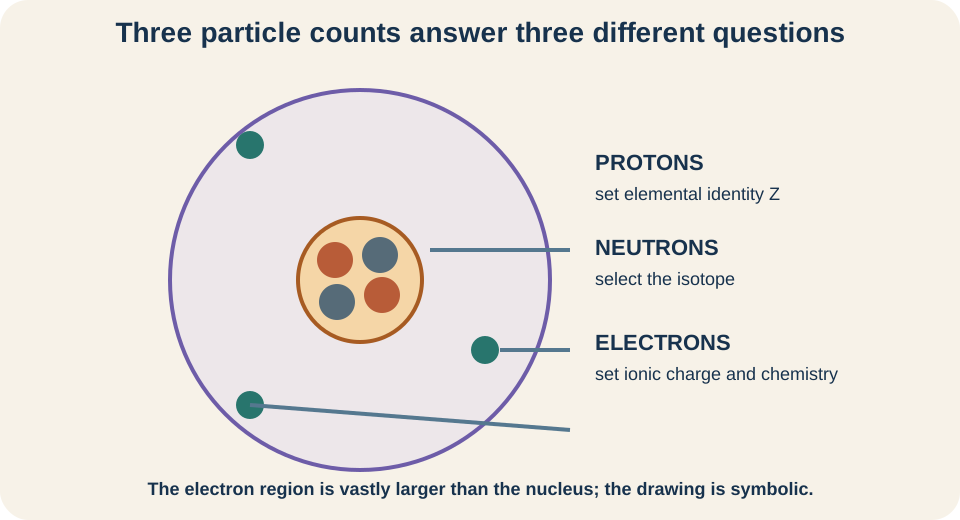
Protons, neutrons, and electrons have different roles
A proton carries one positive elementary charge and resides in the nucleus. The proton count determines the element: every carbon nucleus has six protons, every oxygen nucleus has eight, and every chlorine nucleus has seventeen. Changing proton number changes elemental identity. Ordinary chemical reactions do not do this because they rearrange electrons and atoms rather than transmuting nuclei. The periodic table records this identity through atomic number.
A neutron has approximately the same mass scale as a proton but carries no net electric charge. Neutrons also reside in the nucleus and contribute to mass number and nuclear stability. Atoms of the same element can contain different neutron counts. Those variants are isotopes. Neutron changes belong to nuclear processes rather than ordinary ion formation.
An electron carries one negative elementary charge and has far less mass than a proton or neutron. Electrons occupy quantum-mechanical regions around the nucleus rather than miniature planetary orbits. Valence electrons participate most directly in bonding and ordinary chemical reactions. Gaining or losing electrons produces ions while leaving the nucleus unchanged. Electron arrangement explains chemistry more directly than neutron count in most nonnuclear contexts.
Atomic number fixes elemental identity
The atomic number equals the number of protons in a nucleus. The symbol is an integer and appears on the periodic table for each element. If , the element is magnesium because every magnesium nucleus contains twelve protons. No neutral or ionic charge changes that identity. Element names are proton-count categories.
For a neutral atom, proton and electron counts are equal because positive and negative elementary charges cancel. A neutral magnesium atom therefore has twelve electrons as well as twelve protons. Neutrality is a charge condition, not part of the definition of magnesium. A magnesium ion can have a different electron count while retaining . This distinction explains why an element can form multiple charged species.
Atomic number also orders the modern periodic table. Moving from one element to the next increases proton count by one. Periodic chemical patterns arise mainly from how electron configurations change with this increasing nuclear charge. Neutron count can vary without changing the element’s position. The table’s ordering is therefore nuclear in definition but electronic in much of its chemical consequence.
Mass number counts nuclear particles
The mass number equals the total number of protons and neutrons in one nucleus. These nuclear particles are collectively called nucleons. If is proton count and is neutron count, then . Because , neutron count is . Every quantity in this count relation is a whole number.
For chlorine-37, and . The neutron count is . This nucleus therefore contains seventeen protons and twenty neutrons. The name chlorine comes from proton count, while the number thirty-seven identifies the isotope’s nucleon total. A different chlorine isotope retains seventeen protons but has a different neutron count.
Mass number is not the same as an isotope’s exact measured mass in unified atomic mass units. Proton and neutron masses are not exactly one unit each, electron masses contribute slightly, and nuclear binding changes the mass through mass–energy equivalence. Thus chlorine-37 has mass number exactly thirty-seven but an isotopic mass not exactly . The integer is a count, while the measured mass is an experimental quantity. Mixing those concepts causes average-mass errors.
Nuclide notation compresses identity, isotope, and charge
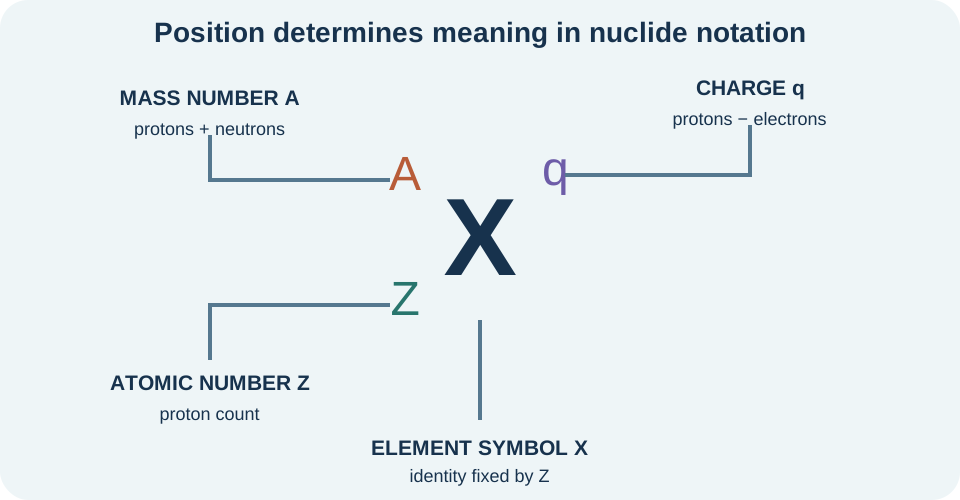
Nuclide notation can be written , where is the element symbol, is mass number, is atomic number, and is ionic charge. The upper-left superscript labels total nucleons. The lower-left subscript labels protons. The upper-right superscript labels net charge. Each position carries a different meaning.
For , the element symbol and both identify chlorine. Mass number gives neutrons through . Charge means one more electron than proton, so the ion contains eighteen electrons. The minus sign belongs to charge, not neutron count. A neutral chlorine-37 atom would omit the right superscript and contain seventeen electrons.
Some notation omits because the element symbol already determines it, writing or chlorine-37. This abbreviation remains unambiguous if the periodic table is available. Chemical ion notation may omit mass number when isotope identity is irrelevant, writing . Choose notation according to the information needed. Do not interpret omitted data as zero.
Ionic charge follows proton and electron imbalance
When charge is measured in elementary-charge units, . Here is proton count and is electron count. A positive result means fewer electrons than protons and describes a cation. A negative result means more electrons than protons and describes an anion. Neutral atoms give zero.
Rearranging gives . The signed value of must be preserved. For , electron count is . For , electron count is . Subtracting a negative charge correctly adds an electron.
Ion formation in ordinary chemistry changes electrons, not protons. A magnesium atom forming loses two electrons. It does not gain two protons, because that would produce a different element and require a nuclear process. A chloride ion forms when chlorine gains one electron. The nucleus and isotope remain the same through these electron transfers.
Cations and anions have different electron counts and sizes
A cation has positive net charge because it contains fewer electrons than protons. Metals commonly form cations by losing valence electrons, though the detailed tendency depends on electronic structure and chemical environment. Removing electrons can reduce electron–electron repulsion and sometimes remove an entire occupied shell. Consequently, a simple cation is often smaller than its neutral atom. Size is an electron-cloud property rather than a literal hard-sphere edge.
An anion has negative net charge because it contains more electrons than protons. Nonmetals commonly form anions by gaining valence electrons. Added electron–electron repulsion expands the electron distribution, so a simple anion is often larger than its neutral atom. The nuclear charge has not increased to pull the added electrons more strongly. These trends support ionic-radius comparisons.
Isoelectronic species contain the same number of electrons but different proton counts. , , , , and each have ten electrons. Across this series, greater proton count generally pulls the same electron population inward more strongly. Radius therefore decreases as nuclear charge increases. Electron count equality does not imply equal size or identity.
Isotopes share proton number and differ in neutrons
Isotopes are nuclides of the same element with different neutron counts. Carbon-12, carbon-13, and carbon-14 all have six protons. They contain six, seven, and eight neutrons respectively. Their neutral atoms each contain six electrons. Elemental identity and broad electron structure remain carbon-like despite nuclear mass differences.
Isotopes can differ in nuclear stability. Some are stable on observational timescales, while others are radioactive and transform through nuclear decay. Carbon-14 is radioactive, whereas carbon-12 and carbon-13 are stable. Radioactivity does not mean the substance ceases to follow chemical bonding principles before decay. It means the nucleus has a nonzero probability of transformation over time.
Chemical isotope effects arise because different nuclear masses slightly alter vibrational motion and reaction dynamics, even when electron counts match. Hydrogen and deuterium can show especially noticeable differences because doubling a very small nuclear mass changes vibrational behavior substantially. Most introductory chemistry treats isotopes as chemically similar, which is a useful first approximation. Precision work may need the differences. A model can be broadly accurate without erasing all isotope effects.
Average atomic mass is an abundance-weighted mean
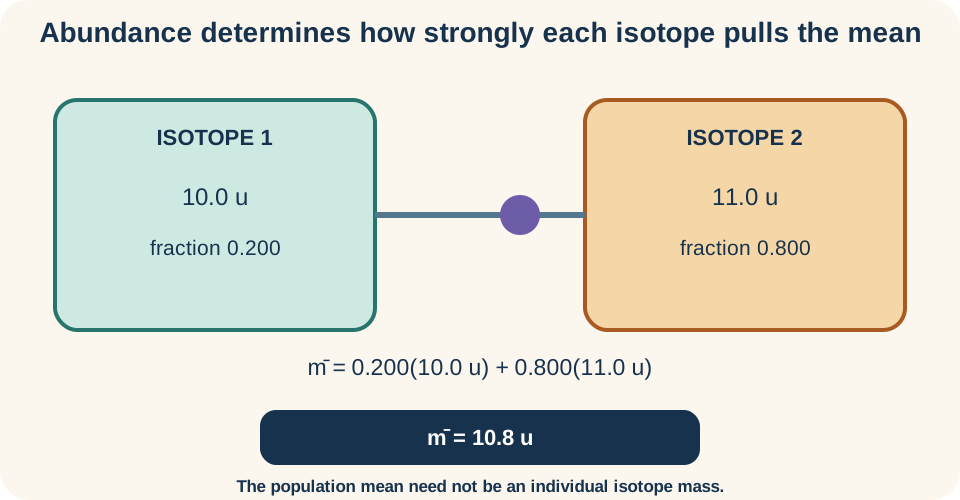
The periodic-table atomic mass is generally a weighted mean over naturally occurring isotopes in a specified reference composition. Write . The bar over denotes a mean, the sigma means sum over isotopes, is fractional abundance, and is isotopic mass. Fractions satisfy . Each isotope contributes in proportion to its prevalence.
Percent abundance must be divided by one hundred before use as a fraction. An abundance of becomes . If an element has two isotopes with masses and at fractions and , the mean is . The units remain unified atomic mass units. The result lies between the two isotope masses.
A weighted mean need not equal the mass of any individual isotope. No atom in the example necessarily has mass . The value describes a population average useful for converting bulk samples between atom count and mass. Its decimal nature is not evidence of fractional protons or neutrons. Particle counts remain whole for each atom.
Work an abundance calculation with checks
Suppose a hypothetical element has isotope X-20 with mass and abundance , plus X-22 with mass and abundance . Convert abundances to and . The weighted mean is . Evaluating gives . The more abundant lighter isotope keeps the mean closer to .
Three checks validate the result. Fractions sum to , the average lies between the two isotope masses, and it lies closer to the more abundant isotope. If the calculated mean were , at least one arithmetic or abundance error would exist. If percent values were entered as and without conversion, the result would be one hundred times too large. Magnitude checks catch common mistakes.
An inverse problem may give the average mass and ask for abundance. For two isotopes, let be the fractional abundance of the first and the abundance of the second. Write and solve for . The solution must lie from zero to one. Substitution should reproduce the stated mean.
Mass spectra provide isotope evidence
A mass spectrum separates ions according to mass-to-charge behavior and displays signal intensity against a mass-related horizontal axis. For singly charged atomic ions, peak positions often correspond closely to isotopic masses. Relative peak areas or intensities can estimate abundances after appropriate calibration. Multiple peaks for one element therefore reveal an isotope distribution. The instrument measures ions, not neutral atoms directly during analysis.
Charge state matters because the measured quantity often involves , mass divided by charge number. A doubly charged ion can appear at roughly half the mass-to-charge value of a singly charged ion of the same mass. Molecular fragmentation and chemical adducts can add peaks. Interpreting a spectrum requires more than reading every peak as a different isotope. Instrument resolution and calibration affect assignments.
The weighted-average calculation connects peak evidence to periodic-table mass. Multiply each assigned isotopic mass by its normalized abundance and sum. Natural isotope composition can vary slightly among samples, so published standard atomic weights may appear as intervals or carefully defined values for some elements. Classroom problems usually provide fixed abundances. The experimental origin of those numbers should remain visible.
Nuclear notation and chemical formulas answer different questions
Nuclide notation describes one nuclear species and optional ionic charge. A chemical formula describes the elemental composition and ratio of a molecule or formula unit. identifies a sodium-23 ion, while identifies a compound ratio. Isotope labels can be embedded in formulas for tracer work, but they are normally omitted when natural composition is acceptable. Do not treat a mass-number superscript as a stoichiometric coefficient.
Chemical subscripts count atoms within a formula. In , the subscript two means two hydrogen atoms per molecule. In , the upper-left two is a mass number identifying deuterium. The positions and contexts differ. A coefficient such as scales the number of water molecules. Precise placement is mathematical grammar.
Ionic charge is also distinct from oxidation state. The charge on a monatomic ion equals its oxidation state, but atoms in covalent molecules can have assigned oxidation states without carrying that full isolated ionic charge. Formal charge is another bookkeeping model. These quantities can share signed notation while answering different questions. State which one the symbol represents.
Simple atomic pictures have limits
A common introductory picture shows electrons orbiting a nucleus like planets. It communicates the nucleus–electron scale separation but misrepresents quantum behavior. Electrons occupy orbitals described by probability amplitudes and allowed energy states. They do not follow ordinary classical circular paths with simultaneously definite positions and velocities. Later electronic-structure models replace the orbit picture.
The nucleus is also not a featureless cluster. Protons repel electrically, nuclear forces act at short range, and quantum shell effects influence stability. The simple proton-plus-neutron inventory correctly counts composition but does not predict every stable isotope. Nuclear mass includes binding-energy effects. Nuclear physics develops those structures beyond foundational chemistry.
Models should be judged by task. Counting protons, neutrons, and electrons needs only integer relationships. Predicting spectra, bonding, or isotope stability requires deeper models. Using a simple model within its domain is not a mistake. Forgetting its assumptions or treating its picture literally is.
Common errors and corrective habits
One common error subtracts atomic number from charge to find neutrons. Neutrons come from , while electrons come from . Write the three roles before calculating. Another error interprets a positive ion as having gained positive particles. Ordinary cations form through electron loss. The nucleus remains unchanged.
A second error treats average atomic mass as mass number. Mass number is a whole-number nucleon count for one isotope, whereas average atomic mass is a weighted population mean. Use exact or provided isotopic masses in the weighted calculation rather than substituting mass numbers when precision matters. A third error leaves percent abundances unconverted. Verify fractions sum to one.
Notation errors can change meaning. Upper-left is mass number, lower-left is atomic number, upper-right is charge, and a coefficient before a formula scales amount. Annotate a template before filling values if positions are uncertain. Then check element identity against the periodic table. Redundant clues should agree.
Guided practice and retrieval
For , proton count is , neutron count is , and electron count is . The ion is magnesium because proton count is twelve. It is magnesium-24 because the nucleus contains twenty-four nucleons. Its positive charge comes from losing two electrons relative to the neutral atom. No proton count changed during ionization.
For , proton count is , neutron count is , and electron count is . This species and neutral chlorine-37 are isotopes of the same element because their neutron counts differ while proton count matches. Chloride and neutral chlorine-35 are different charge states of the same isotope. Isotope and ion comparisons therefore use different particle columns. State which particle count changed.
Suppose isotopes of masses and have abundances and . The mean is . It lies between the isotope masses and closer to the more abundant heavy isotope. Neither individual atom must have mass . The result describes the population.
Connection forward
Reconstruct the complete particle inventory method. Define , , and , then derive proton, neutron, and electron counts. Explain the difference between isotope and ion using which particle changes. Distinguish mass number, isotopic mass, and average atomic mass. Finally, explain why a decimal periodic-table mass does not imply a fractional nucleus.
The mole and molar-mass lesson will scale population-average atomic masses into laboratory quantities. Electronic structure will explain why electron configurations determine periodic chemical behavior. Nuclear lessons will examine stability, decay, binding energy, and mass defect. Mass spectrometry will provide richer experimental interpretation of isotopic and molecular ions. Stoichiometry will use element identities and formula counts while usually averaging over natural isotopic composition.
The enduring insight is role separation. Protons determine the element, neutrons determine the isotope, and electrons determine charge for a chosen nucleus. Nuclide notation stores all three relationships in distinct positions. Weighted means connect isotope populations to bulk mass without changing individual particle counts. With these roles explicit, atomic symbols become compact, testable inventories rather than codes to memorize.