
A vibrating ruler, a cart attached to a spring, and a gently swinging pendulum can all repeat their motion. Repetition alone, however, does not make the motion simple harmonic. Simple harmonic motion, abbreviated SHM, occurs when the acceleration is proportional to displacement from equilibrium and points in the opposite direction. That restoring relationship produces sinusoidal position as a function of time. It also creates a continuous exchange between kinetic and potential energy.
The adjective “simple” refers to the mathematical structure, not to the difficulty of reasoning about it. Position, velocity, and acceleration reach their extreme values at different phases of the cycle. The same symbol can represent ordinary frequency, angular frequency, or phase if notation is used carelessly. Units provide an essential defense against confusion. A strong model therefore keeps definitions, diagrams, signs, and units aligned.
This lesson builds SHM through several connected representations. A free-body diagram will produce the differential equation, a rotating-vector picture will explain the sinusoid, and an energy graph will explain changing speed. Worked examples will test predictions before calculation. Real oscillators will then show where the ideal assumptions break down. The goal is to understand why the equations fit, not simply to recognize their appearance.
Learning objectives and a prediction
After this lesson, you should identify the equilibrium position and define signed displacement from it. You should derive the SHM equation for an ideal mass–spring oscillator and interpret its negative sign. You should explain amplitude, period, frequency, angular frequency, and phase constant. You should derive velocity and acceleration from position and connect those functions to energy. You should also recognize damping, large-angle behavior, and nonlinear restoring forces as limits of the ideal model.
Imagine an ideal horizontal spring with a cart pulled to the right and released from rest. Predict the directions of velocity and acceleration immediately after release. The velocity initially points left because the cart begins moving toward equilibrium. The acceleration also points left because the stretched spring pulls opposite the positive displacement. Later, after the cart passes equilibrium, velocity remains left briefly while acceleration reverses right.
That prediction separates velocity from acceleration. Velocity tells how position is changing, while acceleration tells how velocity is changing. An object can move left while accelerating right, which means its leftward speed decreases. At equilibrium the cart moves fastest even though its acceleration is zero. At a turning point its velocity is zero even though acceleration magnitude is greatest.
Equilibrium and signed displacement
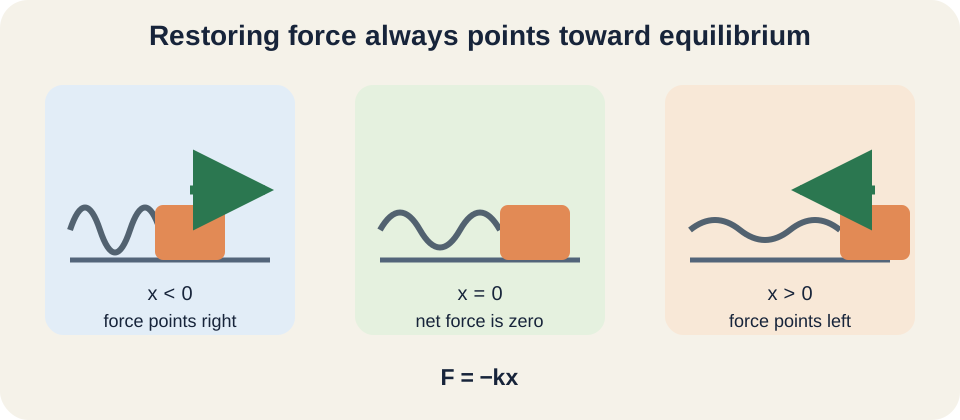
Equilibrium is the position at which the net force is zero. Choose that position as , where denotes signed displacement in meters. A positive value lies on the chosen positive side and a negative value lies on the opposite side. The choice of positive direction is arbitrary but must remain consistent. Displacement is measured from equilibrium, not necessarily from the spring’s unstretched length in every setup.
For a horizontal ideal spring with no other horizontal forces, Hooke’s law is . The symbol denotes the spring-force component, is the spring constant in , and is displacement in meters. The negative sign means force points opposite displacement. It does not mean the force magnitude is physically negative. Multiplying by gives newtons because .
A vertical hanging spring requires more care. Gravity shifts the equilibrium position until the upward spring force balances weight. If is then measured from that shifted equilibrium, the constant gravitational contribution cancels from the motion equation. The oscillator can still obey about equilibrium. Measuring from an inappropriate origin can make a correct model look unnecessarily complicated.
Derive the governing differential equation
Apply Newton’s second law to the horizontal spring cart. With and , the equation becomes . The second derivative describes how position curves with time. Divide by mass to obtain . The acceleration is therefore proportional to displacement and oppositely directed.
Define angular frequency by . The lowercase Greek omega, , has units radians per second. Because one newton is , the ratio has units . Taking its square root gives , consistent with radians being dimensionless in SI algebra. The equation becomes .
This differential equation is a rule connecting a function to its second derivative. Any valid position function must return its negative, multiplied by , after two time derivatives. Sine and cosine have exactly this property. Exponential growth does not, because its second derivative points with rather than against the function. The equation’s structure predicts oscillation before a particular initial condition is chosen.
The sinusoidal solution and its symbols
A general position solution is . The function gives displacement at time , and is the nonnegative amplitude in meters. The argument is the phase in radians. The constant , lowercase Greek phi, is the phase constant set by initial conditions. Cosine is a convenient choice, while an equivalent sine form can describe the same motion.
Amplitude is the maximum magnitude of displacement, so the cart remains between and in the ideal model. Doubling doubles the extreme displacement but does not change the period of an ideal Hooke’s-law oscillator. The phase determines where in the cycle the oscillator begins. If and the cart is released from rest, then is a simple choice. If while it moves positive, a different phase is required.
Verify the solution by differentiating twice. The first derivative is , and the second is . Because , acceleration becomes . Substituting into the differential equation gives zero on the left side. Verification turns a memorized formula into a tested solution.
Period, frequency, and angular frequency
The cosine function repeats when its phase increases by radians. During one period , the phase change is . Therefore . The period is the time for one cycle and is measured in seconds. Greater mass increases period, while a stiffer spring decreases it.
Ordinary frequency is and is measured in hertz, where . Angular frequency is related by . Frequency counts cycles per second, while angular frequency counts radians of phase per second. They are connected but should not be substituted without the factor . Units and the word “angular” signal which quantity is being used.
Suppose mass becomes four times larger while stays fixed. Because , the new period is multiplied by . Frequency is therefore divided by two. The dependence is a square root, not a direct proportion. A ratio approach reveals the scaling without repeating the entire numerical calculation.
Circular motion provides a geometric model
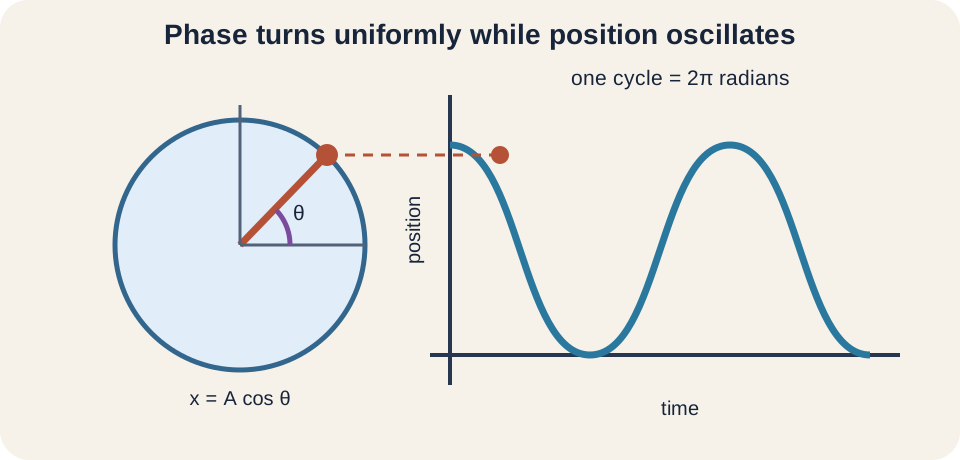
Imagine a point moving uniformly around a circle of radius with angular speed . Its horizontal projection is , where . As the point completes one revolution, the projection travels from one turning point to the other and back. The projection therefore performs SHM. This construction explains why phase is naturally measured as an angle.
The rotating point is a mathematical model, not a hidden physical object inside the spring. It helps track phase relationships among position, velocity, and acceleration. When horizontal projection is greatest, its instantaneous horizontal speed is zero. One quarter-cycle later, projection is zero and horizontal speed magnitude is greatest. Acceleration always points toward the projection’s center.
The phase model also makes time shifts visible. Two oscillators with the same amplitude and frequency but different values follow identical shapes shifted in time. A phase difference of radians places them on opposite sides of equilibrium at every instant. A difference of radians corresponds to one quarter of a cycle. Phase comparison is meaningful only when the frequencies are the same or when a particular time is specified.
Velocity and acceleration through the cycle
Velocity is . Its maximum magnitude is , which occurs at equilibrium where . The negative sign reflects the derivative of cosine and the phase relationship, not a permanently negative direction. Velocity changes sign at each turning point. Its units are meters per second because amplitude in meters multiplies angular frequency in inverse seconds.
Acceleration is . Its maximum magnitude is , occurring at the turning points. At equilibrium, acceleration is zero because restoring force is zero. The acceleration does not remain zero there because the cart has nonzero velocity and immediately crosses to the other side. Once displacement changes sign, restoring acceleration changes sign as well.
Use a four-landmark cycle to organize the relationships. At , velocity is zero and acceleration is maximally negative. At moving left, velocity is maximally negative and acceleration is zero. At , velocity is zero and acceleration is maximally positive. Returning through , velocity is maximally positive and acceleration is zero.
Energy exchange explains changing speed
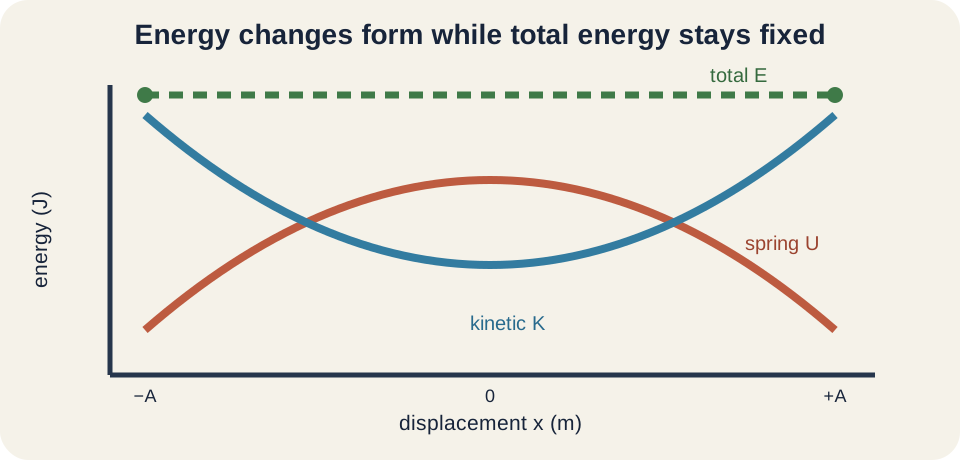
For an ideal isolated mass–spring oscillator, mechanical energy is . Translational kinetic energy is , and spring potential energy is . Both terms use joules. With no dissipative transfer, their sum remains constant. Energy changes form while the total ledger remains balanced.
At a turning point, and . Therefore . At equilibrium, and all mechanical energy is kinetic, so . Equating the expressions gives . The energy model independently confirms the derivative result.
At any intermediate position, . Solving gives . The plus or minus sign cannot be determined from position alone because the oscillator passes most positions twice per cycle. One passage moves positive and the other negative. A phase, direction statement, or time is needed to select the sign.
Worked example: period and state
A cart attaches to a spring with . Angular frequency is . The units reduce because . Period is . Frequency is .
Suppose the cart is released from rest at . Then and fits the initial state. The position model is . Maximum speed is . Maximum acceleration is .
One quarter-period after release, . The phase has advanced by radians, so position is zero. Velocity is , with the negative sign indicating motion left. Acceleration is zero at that instant. The state agrees with the earlier qualitative prediction.
A pendulum is approximately simple harmonic
For a simple pendulum of length , the restoring torque produces the exact equation . Here is angular displacement in radians, is gravitational acceleration in , and is length in meters. The sine makes the equation nonlinear. It is not exactly the same as . A mathematical approximation is needed.
For small angles measured in radians, . The equation then becomes , which has SHM form with . The approximate period is . Mass does not appear because both gravitational restoring effect and inertia scale with mass. The approximation becomes less accurate as amplitude grows.
“Small” is set by acceptable error rather than one universal angle. At , converting to radians gives about , and sine differs only slightly from the angle. At larger angles, the true period increases with amplitude. A real pendulum also experiences air drag and pivot friction. Experimental precision determines whether those deviations matter.
Real oscillators and model limitations
An ideal mass–spring model assumes Hooke’s law remains linear. Real springs may become nonlinear at large deformation, retain permanent distortion, or have non-negligible mass. Friction and air resistance transfer mechanical energy to thermal energy. The amplitude then decreases with time. The motion is damped rather than perfectly repeating.
Damping can be weak, critical, or strong depending on its size relative to inertia and stiffness. Weak damping produces oscillations with a shrinking envelope. Critical damping returns the system toward equilibrium rapidly without oscillating under the ideal linear model. Stronger overdamping returns more slowly without crossing equilibrium. These behaviors require an additional velocity-dependent term in the differential equation.
External periodic forcing adds another layer. A system driven near its natural frequency can develop a large steady response called resonance. Damping limits that response and changes the phase relationship between drive and motion. Bridges, vehicle suspensions, instruments, and sensors all rely on these ideas. SHM is the foundation from which the more realistic models are built.
Common misconceptions and repairs
The first misconception is that every periodic motion is SHM. Uniform circular motion is periodic but is not one-dimensional SHM, although one component of it is. A bouncing ball is periodic in an idealized sense but its acceleration is not proportional to displacement throughout the cycle. Test the restoring relation . Repetition is necessary for ideal SHM but not sufficient.
The second misconception is that acceleration is greatest at equilibrium because speed is greatest there. Acceleration and velocity describe different derivatives. At equilibrium the spring’s net restoring force is zero, so acceleration is zero. Speed is greatest because potential energy has been converted to kinetic energy. At turning points the reverse pattern holds.
The third misconception is that amplitude controls an ideal spring’s period. The formula contains mass and stiffness but not amplitude. Large amplitude can matter when the spring leaves its linear regime. Pendulum period also becomes amplitude-dependent beyond the small-angle approximation. Always ask whether the assumptions behind an amplitude-independent period remain valid.
Practice with guided feedback
First, state the directions of velocity and acceleration when an oscillator is left of equilibrium and moving farther left. Second, determine how period changes if spring constant becomes nine times larger. Third, find the maximum speed for and . Fourth, explain why position alone cannot determine the sign of velocity. Predict each answer verbally before calculating.
In the first case, velocity is negative while acceleration is positive because the oscillator moves left but is pulled right. If increases by a factor of nine, period is multiplied by . Maximum speed is . Position cannot fix velocity sign because most positions occur once on each travel direction. A time, phase, or direction statement resolves the ambiguity.
Check the scaling physically. A stiffer spring produces a stronger restoring force at the same displacement, so the cart reverses more quickly. Greater mass resists acceleration more strongly, so motion takes longer. Greater amplitude increases speed and total energy but preserves the ideal period. These qualitative checks make algebraic errors easier to detect.
Retrieval and connection forward
Without looking back, write the SHM condition in words and as . Explain the negative sign and define every symbol with units. Derive the mass–spring angular frequency from Newton’s second law and Hooke’s law. Sketch position, velocity, and acceleration across one cycle with their phase offsets. Then use energy to explain why speed peaks at equilibrium.
The next oscillation lessons add damping and external forcing. Wave motion will extend local oscillators across space, linking frequency, wavelength, and propagation speed. Rotational systems will use analogous angular variables and torques. Quantum mechanics will reveal a harmonic oscillator with discrete energy levels. The mathematical structure is powerful because proportional restoring behavior appears near many stable equilibria.
Keep one organizing story: displacement creates an oppositely directed restoring acceleration, which bends the motion back toward equilibrium. Inertia carries the object through equilibrium, so the restoring direction reverses and the cycle continues. Sine and cosine encode that repeated geometry, while energy moves between kinetic and potential stores. Period describes cycle time, frequency describes cycles per second, and angular frequency describes phase rate. The ideal model is valuable precisely because its assumptions and limitations can be stated clearly.