
A traveling wave carries a pattern, energy, and information from one region to another. The material supporting a mechanical wave usually oscillates near equilibrium rather than traveling with the pattern over long distances. This distinction makes it possible for a stadium wave to circle an arena while individual spectators remain near their seats, or for a pulse to cross a rope while marked rope segments move mainly up and down. Wave speed, frequency, wavelength, period, phase, and amplitude describe different aspects of that coordinated motion. This lesson builds their relationships from observations and representations instead of presenting as an isolated formula.
Separate particle motion from wave motion
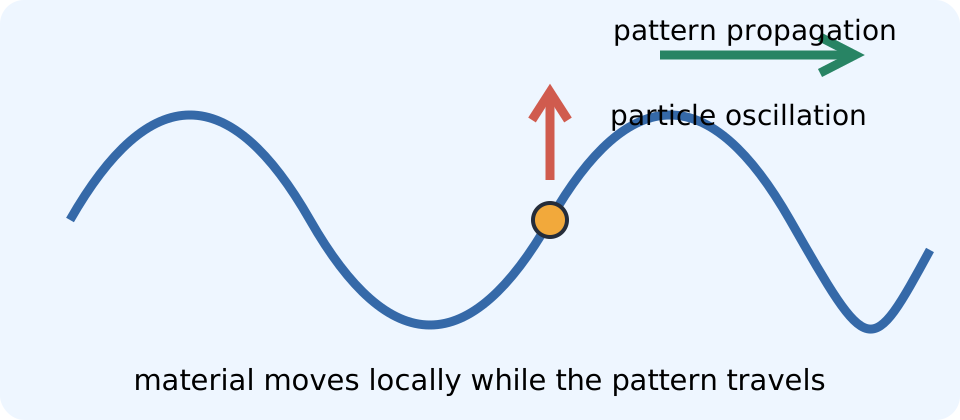
Imagine creating a pulse by moving one end of a stretched rope upward and then downward. A visible disturbance travels along the rope, but a small mark on the rope moves locally as the pulse passes. The mark does not travel from the source to the far end. Neighboring rope elements exert forces on one another and pass the disturbance along. The propagation of the pattern and the motion of material particles are therefore distinct.
Wave velocity describes how fast and in what direction a recognizable phase point, pulse, or signal propagates. Particle velocity describes how fast a particular medium element moves as it oscillates. These velocities can point in different directions and have different time dependences. In a transverse rope wave traveling right, a rope element may move upward or downward. Using the same symbol without specifying which velocity is meant produces conceptual errors.
Mechanical waves require a material medium whose inertia and restoring interactions support propagation. Sound uses compression and expansion of matter, surface water waves use gravity and fluid motion, and string waves use tension and linear mass density. Electromagnetic waves do not require a material medium, although they still have frequency, wavelength, and propagation speed. This lesson’s fundamental periodic relationships apply broadly, but the physical mechanism determining speed depends on the wave type. Always identify the medium and the disturbance before selecting a speed model.
Define amplitude and equilibrium
Displacement describes how far a medium element lies from its equilibrium position in a chosen direction. Amplitude is the maximum magnitude of that displacement for a sinusoidal wave. If the equilibrium line is and crests reach , then . Amplitude is nonnegative even though instantaneous displacement can be positive or negative. It measures disturbance size rather than propagation speed.
Greater amplitude often means greater transmitted energy, but the exact energy dependence depends on the wave model. In many linear waves, average power is proportional to , so doubling amplitude can multiply power by four. Amplitude does not generally determine frequency because the source’s timing controls the repetition rate. Nor does amplitude by itself determine wavelength. Keeping these roles separate prevents every visible feature of a wave from being attributed to one variable.
Equilibrium is the state around which medium elements oscillate. A crest is a region of maximum positive transverse displacement, and a trough is a region of maximum negative transverse displacement. For a longitudinal wave, compressions and rarefactions replace crests and troughs as the most visible features. The mathematical displacement can still be sinusoidal even when a drawing uses density or pressure instead. A representation must be interpreted according to what its vertical axis actually measures.
Measure wavelength as a spatial cycle
Wavelength is written with the lowercase Greek letter lambda, . It is the shortest spatial distance between points in the same phase of a repeating wave at one instant. Crest to adjacent crest is one wavelength, as is trough to adjacent trough. An upward equilibrium crossing to the next upward equilibrium crossing is also one wavelength. Crest to adjacent trough is only one half wavelength because those points have opposite phase.
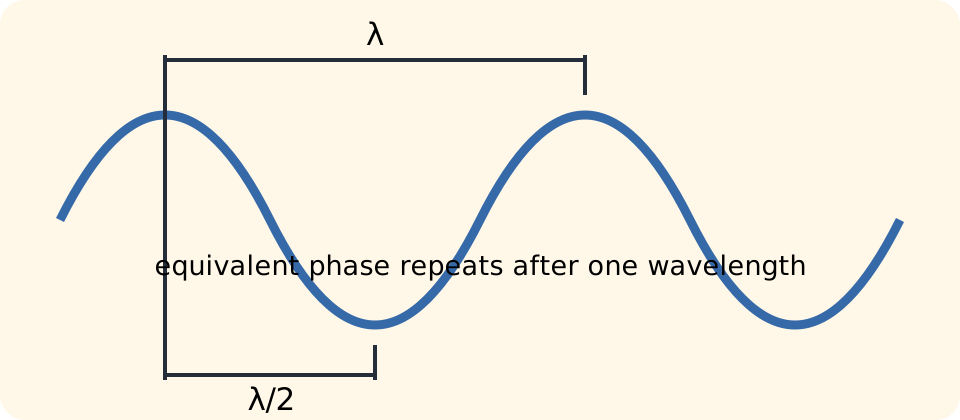
Wavelength is measured in metres or another unit of length. On a snapshot graph versus , read along the horizontal position axis rather than the displacement axis. If four complete cycles occupy , then . Counting intervals rather than visible extrema avoids off-by-one errors. Five crests span four crest-to-crest wavelengths, not five.
Phase tells where a point lies within a cycle. Points separated by have phase difference and therefore oscillate identically. Points separated by differ by and are opposite in phase. Points separated by differ by . These correspondences connect spatial diagrams to sinusoidal equations.
Measure period and frequency as temporal cycles
Period is the time required for one complete oscillation at a fixed position. It is measured in seconds. On a graph of displacement versus time , the period is the time between equivalent phase points such as successive maxima. Frequency is the number of cycles completed per unit time. Its SI unit is the hertz, where .
Frequency and period are reciprocals: and . A frequency of means five cycles occur each second, so each cycle takes . A longer period corresponds to a lower frequency. Their product represents one complete cycle as a dimensionless count. The reciprocal relationship should be checked qualitatively before calculator use.
Frequency is often set by the source. If a driver completes oscillations each second, it launches disturbances at . Every point reached by a steady wave oscillates at that same frequency in an ordinary stationary medium. The medium influences how rapidly the disturbance propagates and therefore how far successive cycles are spaced. This source-versus-medium distinction organizes what changes at a boundary.
Derive the wave-speed relationship
During one period , a steady wave pattern advances by one wavelength . Speed is distance divided by time, so . Using gives . Here is propagation-speed magnitude, is spatial length per cycle, and is cycles per second. Multiplying metres per cycle by cycles per second leaves metres per second.
The equation can be rearranged as or . Rearrangement does not change which quantities are determined physically. In many mechanical settings the medium determines available wave speed while the source fixes frequency. Wavelength then adjusts to satisfy the relationship. Treating , , and as three freely selectable independent controls ignores that constraint.
Suppose a source vibrates at and produces wavelength . The speed is . The units show that cycles cancel conceptually even though the cycle is dimensionless. If medium conditions increase speed to while the source remains at , wavelength becomes . A larger speed at fixed frequency creates wider spatial spacing.
Distinguish transverse and longitudinal waves
In a transverse wave, local material displacement is perpendicular to propagation direction. A horizontally stretched string with elements moving vertically provides a common example. The drawn curve resembles the physical shape of the string at an instant. Crests and troughs label extreme displacements. Polarization is possible because transverse displacement can have different perpendicular orientations.
In a longitudinal wave, local particle displacement is parallel to propagation direction. Sound in a gas produces moving compressions, where density and pressure are relatively high, and rarefactions, where they are relatively low. A sinusoidal pressure-versus-position graph is an abstract plot rather than a literal sideways shape of air. Wavelength can be measured compression to compression or rarefaction to rarefaction. The relation remains valid because periodicity, not transverse geometry, produced it.
Some waves combine transverse and longitudinal motion. Surface water particles often follow approximately circular or elliptical paths while the visible pattern travels horizontally. Seismic surface waves can also exhibit mixed motion. Classification refers to particle displacement relative to propagation, not merely how a photograph looks. Sketching arrows for both directions makes the definition operational.
Decode a sinusoidal traveling-wave equation
A sinusoidal wave traveling in the positive direction can be written . The function gives displacement at position and time . Amplitude is , wave number is , angular frequency is , and phase constant is . The cosine argument must be dimensionless, so each phase term is measured in radians. Changing or changes the phase and therefore the displacement.
Wave number is and has units . Angular frequency is and has units . Dividing them gives . The factors of convert cycles to radians. Wave number measures spatial phase change per metre, while angular frequency measures temporal phase change per second.
To determine propagation direction, follow a point of constant phase. For , increasing time requires increasing , so the pattern travels in the positive direction. For , increasing time requires decreasing , so the pattern travels in the negative direction. This reasoning is safer than memorizing a sign without knowing why. The sign describes pattern propagation and does not tell whether a medium element is moving up or down at a particular instant.
Read snapshots and history graphs
A snapshot graph plots displacement against position at one fixed time. It reveals wavelength, spatial phase, and instantaneous shape. A history graph plots displacement against time at one fixed position. It reveals period, frequency, and temporal phase. The two graphs can look sinusoidal while their horizontal axes represent different physical quantities. Reading a period from a position axis or a wavelength from a time axis is dimensionally impossible.
Suppose a snapshot shows crest spacing and a history graph shows crest spacing . Then , , and . The wave speed is . This calculation combines information from two complementary views. Labels and units determine what each spacing means.
Animation adds propagation direction that a single snapshot cannot uniquely provide. The same spatial curve could be moving right, moving left, or participating in a standing wave. A second time frame, a traveling-wave equation, or local motion information is needed. Never infer direction solely from which way a crest appears to lean. A still image contains spatial structure but not automatically temporal evolution.
Explain medium-dependent wave speed
For an ideal stretched string, transverse wave speed is . The tension magnitude is measured in newtons, and linear mass density is measured in . Greater tension strengthens the restoring effect and increases speed. Greater linear density increases inertia and decreases speed. Unit analysis gives .
For sound, speed depends on the medium’s stiffness and density. A schematic form is , where is a bulk elastic modulus and is mass density. Stiffer materials transmit disturbances more rapidly, while greater inertia tends to slow the response. Temperature affects sound speed in gases because it changes microscopic motion and thermodynamic properties. The casual statement that sound is always faster in denser materials is therefore incomplete.
Speed can depend on frequency in a dispersive medium. When different frequency components propagate at different speeds, a wave packet changes shape as it travels. Phase velocity describes the motion of a single-frequency phase pattern, while group velocity often describes envelope and energy transport. The elementary equation still holds for each sinusoidal component using its corresponding phase speed. What changes is the assumption that one speed applies to every frequency.
Track a wave across a boundary
When a wave reaches a boundary between media, part may reflect and part may transmit. The boundary is driven at the same temporal rate as the incoming wave, so reflected and transmitted frequencies equal the incident frequency for a stationary linear boundary. Wave speed may change because medium properties change. Consequently wavelength changes according to . Frequency continuity is the key bridge between the two regions.
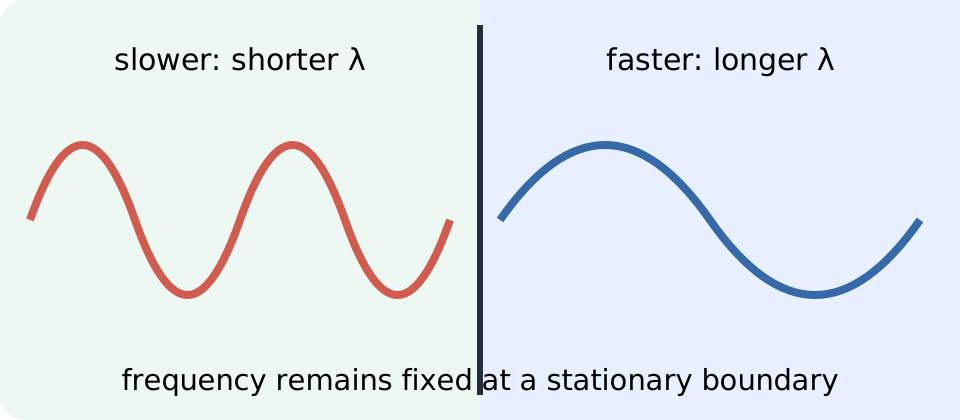
Suppose a sound wave travels at in one medium. Its wavelength is . If it enters a medium where speed is , frequency remains and wavelength becomes . The wider spacing does not mean the source slowed. It reflects faster propagation between disturbances launched at the same temporal rate.
Amplitude can also change at a boundary because energy divides between reflection and transmission. A larger transmitted amplitude is not guaranteed by a larger speed, because impedance and energy flux matter. Phase can reverse on reflection depending on boundary conditions. The basic speed-frequency-wavelength account should not be stretched to predict every boundary feature. Each new observable needs an appropriate physical relation.
Repair common misconceptions
A common error is saying that wave speed equals the speed of medium particles. The pattern can travel steadily while particles oscillate and repeatedly reverse direction. Mark one medium element and one crest in a diagram to track them separately. Their trajectories answer different questions. The crest’s motion determines propagation speed, while the mark’s motion determines local particle velocity.
Another error is assuming that higher frequency always means faster waves. In a nondispersive medium with fixed conditions, wave speed remains fixed and higher frequency produces shorter wavelength. The inverse relation is . In a dispersive medium, speed may vary with frequency, but that dependence comes from the medium rather than from alone. State the medium model before claiming a speed trend.
A third error is measuring crest-to-trough distance as one wavelength. Those features are separated by half a cycle, so their distance is . Another frequent error is reporting frequency in seconds rather than hertz or period in hertz rather than seconds. Axis labels and unit checks expose both mistakes. A diagram should be read by phase equivalence, not by counting every visible turning point as a full cycle.
Practice with multiple representations
A wave has speed and frequency . Its wavelength is . Its period is . Draw a snapshot spanning two wavelengths and label equivalent phase points. Then draw a history graph spanning two periods without claiming the two horizontal scales are interchangeable.
For , amplitude is . Wave number is , angular frequency is , and speed is . Wavelength is , and frequency is . The cosine argument remains dimensionless because each coefficient cancels the unit of its variable. The minus sign indicates propagation in the positive direction.
A string’s tension is increased by a factor of four while its linear density and driving frequency remain fixed. Since , speed doubles. Since and is fixed, wavelength also doubles. Particle amplitude need not double because it is controlled by separate source and boundary conditions. Explain each conclusion from a physical relationship rather than from visual intuition alone.
Consolidate the wave model
Wavelength is a spatial cycle, period is time per cycle, and frequency is cycles per time. A traveling pattern moves one wavelength during one period, giving . Amplitude describes maximum local displacement and is not interchangeable with speed. Phase connects positions and times within repeating cycles. Each quantity has its own definition, unit, and representation.
The source commonly fixes frequency, while medium properties determine speed. Wavelength then adjusts when the wave enters a region with a different speed. Traveling-wave notation packages amplitude, spatial phase rate, temporal phase rate, phase offset, and direction. The relationships and recover . Symbols become useful when every one is connected to an observable feature.
Strong wave reasoning distinguishes particle motion from pattern motion and snapshot graphs from history graphs. It preserves units, identifies phase-equivalent points, states the medium model, and predicts changes before calculating. Those habits prepare the way for superposition, interference, standing waves, reflection, refraction, sound, and electromagnetic waves. The fundamental equation is short, but its correct use rests on a rich conceptual structure. Learning that structure makes later wave phenomena easier to see and explain.