
A magnetic field does not simply push every nearby object toward a magnet. It exerts a direction-sensitive force on moving electric charge, and the geometry of that motion matters as much as the field strength. The force is perpendicular to both the velocity and the field, so it often turns a particle without changing its speed. That unusual behavior connects magnetism to circular motion, current-carrying wires, motors, mass spectrometers, and particle detectors. This lesson develops those connections from vectors and physical reasoning rather than from right-hand-rule memorization alone.
Learning objectives
By the end of this lesson, you should be able to interpret a magnetic field as a vector quantity with magnitude and direction. You should calculate magnetic-force magnitude on a moving charge and determine its direction. You should explain how charge sign changes the result and why a stationary charge experiences no magnetic force. You should identify when velocity components produce circular, helical, or undeflected motion. Every calculation should include units and an explicit geometry statement.
You will connect magnetic force with centripetal acceleration without calling centripetal force an additional physical force. You will derive the path radius and period for motion perpendicular to a uniform magnetic field. You will also move from individual charges to the force on a current-carrying wire. The lesson will explain why a magnetic field does no direct work on an ideal point charge even though magnetic devices can transfer energy. These distinctions prevent several common conceptual contradictions.
Use a repeatable process throughout the lesson. First identify the charge, velocity, field, and angle between the velocity and field. Next compute magnitude with absolute charge and determine the positive-charge direction with a right-hand rule. Reverse that direction only if the actual charge is negative. Finally check the result against limiting cases, units, and the requirement that magnetic force be perpendicular to instantaneous velocity.
What a magnetic field tells you
The magnetic field is represented by the vector . Its SI unit is the tesla, abbreviated . Field direction at a point is defined through the direction of force it would help produce on a moving positive test charge. Unlike an electric field, a magnetic field requires velocity information before force can be determined. The field alone therefore does not specify a unique force direction.
Diagram conventions make three-dimensional fields readable on a page. A dot inside a circle represents an arrow tip coming out of the page toward the reader. A cross inside a circle represents arrow feathers moving into the page away from the reader. Parallel arrows represent a field lying in the page. These symbols describe direction, while spacing or labels communicate magnitude.
The tesla can be unpacked as . Multiplying teslas by charge in coulombs and speed in meters per second produces newtons. This unit identity anticipates the magnetic-force equation. It also provides a diagnostic when a calculation mistakenly omits velocity or charge. A valid force result must reduce to newtons.
The magnetic part of the Lorentz force
For a point charge moving in a magnetic field, the magnetic force is . The symbol is signed charge in coulombs, is velocity in meters per second, and is magnetic field in teslas. The cross denotes a vector cross product rather than ordinary multiplication. The result is perpendicular to the plane containing and . The subscript distinguishes this magnetic contribution from other forces.
Its magnitude is . The absolute value keeps magnitude nonnegative, while charge sign is handled when determining direction. The angle is the smaller angle between velocity and magnetic field. Only the velocity component perpendicular to the field contributes. The equivalent form makes that component explicit.
Several limiting cases should be understood before numbers are substituted. If the charge is stationary, then and magnetic force is zero. If velocity is parallel or antiparallel to the field, then and force is again zero. If velocity is perpendicular to the field, then and force magnitude is greatest for fixed , , and . These cases give quick checks on both algebra and diagrams.
Direction without guesswork
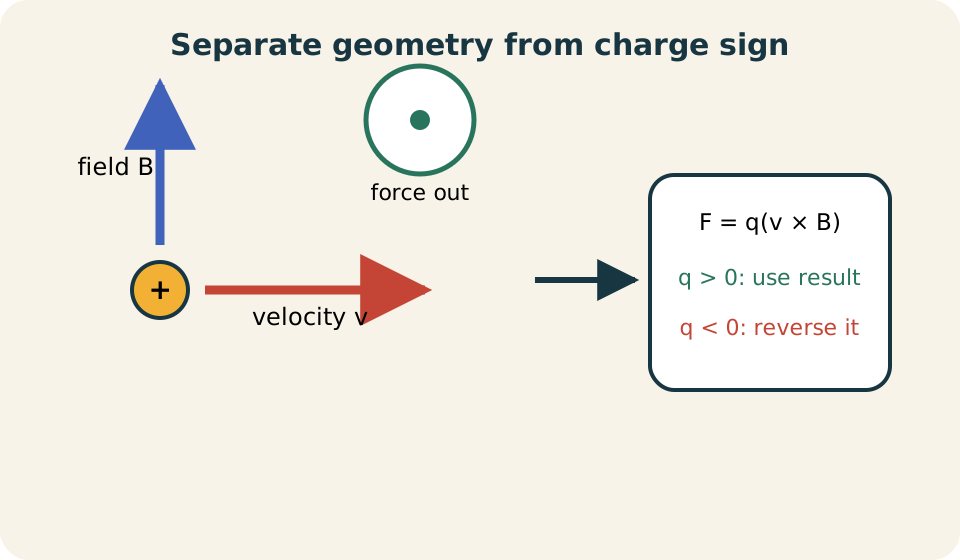
Begin direction analysis as though the moving charge were positive. Point the fingers of your right hand along the velocity vector . Curl them toward the magnetic-field vector through the smaller angle. Your thumb gives the direction of . For a positive charge, magnetic force points along that thumb direction.
For a negative charge, reverse the direction obtained for a positive charge. This reversal follows from multiplication by negative in . It is safer to perform the cross product first and apply charge sign second. Trying to invent a separate left-hand rule often creates inconsistent habits. The two-step method keeps vector geometry and charge sign conceptually distinct.
After using the rule, perform a perpendicularity check. The force must be perpendicular to both velocity and magnetic field. If your proposed force lies partly along either vector, the direction is wrong. Then make a qualitative sketch of the next small piece of trajectory. This local sketch often reveals whether the path bends in the expected clockwise or counterclockwise direction.
Worked direction examples
Suppose a proton moves east through a magnetic field directed north. Point right-hand fingers east and curl them north. The thumb points upward, so the positive proton experiences an upward force. An electron with the same velocity in the same field experiences a downward force because its charge is negative. Both forces have equal magnitude if the speeds and charge magnitudes are equal.
Now suppose a positive ion moves north while the magnetic field points into the page. Fingers point north and curl into the page. The thumb points west, giving a westward force. Because the force is west while velocity is north, the particle begins curving toward the west. The result satisfies the perpendicularity check.
Finally suppose a negative ion moves directly opposite a field. The cross-product magnitude is zero because the vectors are antiparallel. Charge sign cannot reverse a zero vector into a nonzero force. The ion continues without magnetic deflection unless another force acts. This example shows why magnitude should be checked before applying any hand rule.
Why magnetic force does no direct work
Instantaneous mechanical power delivered by a force is . The dot product selects the component of force parallel to velocity. Magnetic force is perpendicular to velocity, so . A static magnetic field therefore does no direct work on an ideal point charge. It can change the direction of velocity without changing speed.
Kinetic energy depends on speed rather than velocity direction. Since magnetic force does not change speed, it does not change kinetic energy in the point-particle model. The particle can accelerate because acceleration includes any change in velocity, including direction. Zero work does not imply zero acceleration. Circular motion provides a familiar example of acceleration at constant speed.
Magnetic devices can nevertheless participate in energy transfer. In a motor, an electric source establishes current and supplies energy while magnetic forces redirect the carrier interactions into forces on the conductor. In induction, changing magnetic conditions create electric fields that can do work on charges. At the microscopic level, the conductor lattice and source must be included in the energy account. Saying that magnetic force does no work on a point charge is therefore precise, not a claim that magnetic technology cannot exchange energy.
Uniform circular motion
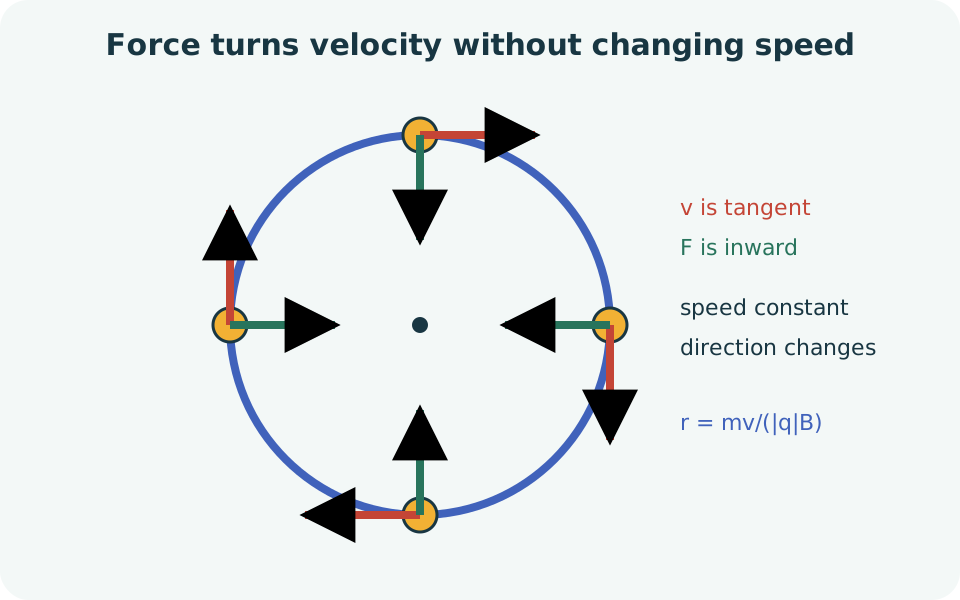
When velocity is perpendicular to a uniform field, magnetic force has constant magnitude and remains perpendicular to velocity. That geometry matches the centripetal requirement for uniform circular motion. The magnetic force is the physical force producing inward acceleration; centripetal force is not an extra force added to it. Equating magnitudes gives . The symbol is the circular path radius in meters.
Canceling one factor of speed and solving gives . Larger mass or speed produces a larger radius because the particle is harder to turn. Larger charge magnitude or field strength produces a smaller radius because the magnetic interaction is stronger. Charge sign changes the direction of curvature but not the radius magnitude. These trends should be predicted before numerical evaluation.
The diagram below shows that the force changes direction continuously. At every point, force points toward the center while velocity remains tangent to the path. The field is perpendicular to the orbital plane. Reversing charge sign reverses curvature, and reversing the field does the same. Reversing both charge sign and field restores the original curvature.
Particle radius example
A proton has mass and charge magnitude . It moves perpendicular to a field at . Substitution gives . The result is . This equals .
The unit reduction deserves attention. A coulomb-tesla equals a newton-second per meter. Dividing kilogram-meters per second by that quantity leaves meters. The calculated path is therefore a length as required. If the result had units of speed or force, the formula or substitution would need correction.
An electron at the same speed in the same field would have a much smaller radius because electron mass is much smaller. Its curvature direction would also reverse because its charge is negative. The comparison shows how magnetic fields separate particles by mass-to-charge ratio. This principle supports mass spectrometers and many charged-particle instruments. The field is functioning as a geometry-sensitive selector rather than as a speed-increasing accelerator.
Period and cyclotron frequency
The period of circular motion is circumference divided by speed, so . Substituting gives . Speed cancels in the nonrelativistic model. The corresponding angular frequency is . This quantity is called the cyclotron angular frequency.
Speed independence can seem surprising because faster particles travel around larger circles. A faster particle covers a greater circumference during each orbit. The increased distance exactly balances the increased speed in the ideal model. Thus particles with the same mass-to-charge ratio share a period in the same field. At speeds approaching the speed of light, relativistic effects modify this simple result.
The period has units of seconds. In , kilograms divided by coulomb-teslas reduces to seconds. The angular frequency has reciprocal-second units, conventionally radians per second. Dimensional checks again reinforce meaning. They also separate period, frequency, speed, and path radius, which are easy to confuse.
Helical paths from velocity components
If velocity is neither parallel nor perpendicular to the field, split it into and . The parallel component produces no magnetic force and remains unchanged. The perpendicular component produces circular motion around a field line. Combining the two motions creates a helix. The helix axis follows the magnetic-field direction or its opposite depending on the parallel velocity.
The circular radius is . The distance advanced along the field during one turn is called the pitch. It is , where is the cyclotron period. This pitch symbol is unrelated to linear momentum even though both are sometimes written with . Clear labels and units prevent that notation from becoming ambiguous.
If , the helix collapses into a circle. If , the radius becomes zero and the particle travels straight along the field. Between those limits, changing the component ratio alters pitch and radius independently. This component view is more informative than applying the magnitude equation once. It predicts the entire qualitative shape of the path.
From charges to current-carrying wires
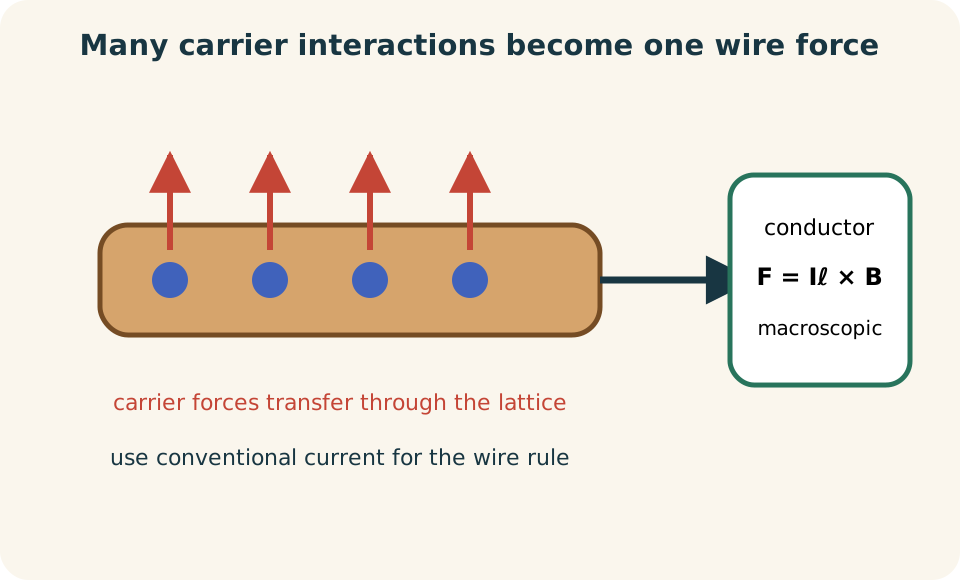
Electric current represents organized motion of charge. In a straight wire segment placed in a magnetic field, individual charge carriers experience magnetic forces. Interactions with the conductor lattice transfer the collective effect to the wire. The macroscopic result is . Here is conventional current in amperes and points along conventional current with magnitude equal to segment length.
The force magnitude is . The angle lies between the wire’s current direction and the magnetic field. A segment parallel to the field experiences zero net magnetic force in this ideal expression. A perpendicular segment experiences maximum force for fixed current, length, and field. The right-hand rule uses conventional current, even when the mobile carriers are negative electrons.
Unit analysis gives amperes times meters times teslas. Since one ampere is one coulomb per second, the product becomes coulombs per second times meters times newton-seconds per coulomb-meter. All factors cancel except newtons. This confirms that the equation returns force. It also explains one operational relationship among teslas, current, length, and force.
Wire-force example and motor connection
A wire segment carries east through a uniform field directed north. Because current and field are perpendicular, the magnitude is . East crossed with north points upward. The wire therefore experiences a upward force. A support or circuit connection may supply other forces not included in this magnetic calculation.
A rectangular current loop can experience opposite forces on two sides. If those forces act along different lines, they create a torque even when their vector sum is zero. That torque tends to rotate the loop relative to the field. Electric motors exploit this interaction while a current source supplies energy. The magnetic field organizes force direction and converts electrical input into mechanical motion through the complete circuit system.
Current direction must be conventional in the wire formula. In a metal, electrons drift opposite conventional current. Each electron’s negative charge reverses the direction obtained from its velocity cross field, yielding the same macroscopic force direction predicted with conventional current. Mixing electron drift direction with the conventional-current formula reverses the answer incorrectly. State which description is being used before applying a hand rule.
Combined electric and magnetic fields
The full Lorentz force is . The electric field contributes force even when the charge is stationary. Electric force can have a component along velocity and can therefore change kinetic energy. Magnetic force remains perpendicular to velocity. The two contributions must be added as vectors.
Crossed electric and magnetic fields can select particles by speed. Suppose electric and magnetic forces point in opposite directions for a positive charge. An undeflected particle satisfies , so . Charge magnitude cancels, although the geometry and signs must still be correct. Particles with other speeds bend because the two force magnitudes do not balance.
The unit reduces to meters per second. Electric-field units are newtons per coulomb, while teslas are newton-seconds per coulomb-meter. Dividing cancels newtons and coulombs and leaves meters per second. This selector does not determine mass. A following magnetic-curvature region can then separate the selected particles by mass-to-charge ratio.
Common reasoning failures
A common error is using without checking the angle. This expression assumes perpendicular velocity and field. Parallel motion produces zero magnetic force even when , , and are all nonzero. Write or identify before calculating. The missing sine factor is a geometric mistake, not a minor algebraic omission.
Another error is reversing the right-hand rule inconsistently for electrons. Determine for a positive charge first. Reverse once if . Then verify that the answer is perpendicular to both input vectors. This routine is more dependable than manipulating the hand rule differently for each problem.
A third error is claiming that zero work means zero force or zero acceleration. Magnetic force can continually change velocity direction while leaving speed and kinetic energy constant. Another error is adding a separate centripetal force to the magnetic force. The magnetic force itself supplies the centripetal net force in the ideal circular-motion case. A free-body diagram should include physical interactions, not motion labels as extra forces.
Practice and retrieval
A charge of magnitude moves at perpendicular to a field. Calculate magnetic-force magnitude with units. State how the result changes if the speed doubles. State how direction changes if the charge becomes negative. Explain what happens if velocity rotates until it is parallel to the field.
A particle of mass and charge magnitude travels perpendicular to a field at . Calculate its circular radius. Predict the effect of doubling the field before recalculating. Identify whether charge sign affects radius magnitude. Describe how sign affects curvature direction.
Finally, explain how a magnetic field can bend a particle without increasing its kinetic energy. Connect the force direction to the dot-product definition of power. Then explain why a motor can still transfer energy to a mechanical load. Your explanation should name the source and conductor rather than attributing all energy to the field alone. This retrieval task tests whether the point-particle statement has been placed in a complete system account.
Solutions and reasoning
The first force is . Doubling speed doubles force magnitude because the relationship is linear. Reversing charge sign reverses force direction. Parallel motion makes the sine factor zero. The magnetic force then vanishes.
The path radius is . Doubling field halves the radius to . Charge sign does not affect radius magnitude because appears. It does reverse the force direction. The particle therefore curves the opposite way.
Magnetic force is perpendicular to velocity, so . The force changes direction rather than speed. In a motor, a source maintains current and transfers electrical energy through the circuit. Magnetic interactions produce forces on the conductor and torque on the rotor. Energy accounting must include the source, charges, field interactions, and mechanical load.
Connection forward
Magnetic force describes how an existing field acts on moving charge. The next question is how magnetic fields are produced and how changing magnetic conditions create electric effects. Currents generate magnetic fields, and changing magnetic flux produces electromotive force. Those ideas lead toward electromagnetic induction. They also reveal that electric and magnetic phenomena are parts of a coupled field theory.
The tools in this lesson transfer directly to that work. Vector direction, right-hand rules, unit analysis, and system boundaries remain essential. Circular-motion reasoning supports charged-particle instrumentation, while wire-force reasoning supports motors and measuring devices. The no-direct-work result clarifies the different roles of magnetic and induced electric fields. Each connection becomes easier when force geometry is understood rather than memorized.
Carry forward a compact checklist. Identify , , , and their angle before calculating. Use absolute charge for magnitude, a positive-charge cross product for direction, and one reversal for negative charge. Confirm that magnetic force is perpendicular to velocity and field. Then use units and limiting cases to decide whether the result is physically coherent.