Three-dimensional geometry becomes systematic when positions, displacements, directions, and orientations are represented by vectors. Coordinates describe where a point is, while vectors describe directed changes that can be translated without changing their components. Dot products measure alignment, and cross products construct perpendicular directions and oriented areas. Parametric equations describe lines and curves, while normal equations describe planes. This lesson joins algebraic calculations with geometric meaning so each formula can be reconstructed rather than merely recalled.
Distinguish points, position vectors, and free vectors
A point identifies a location in a chosen Cartesian coordinate system. Its coordinates are ordered, so changing their order generally changes the location. A position vector points from the origin to . Bold lowercase notation indicates a vector, while an uppercase letter commonly names a point. The identification between a point and its position vector is convenient but should not erase their conceptual difference.
A free vector represents magnitude and direction without requiring one fixed starting point. The vector can be drawn from many locations. Translating the arrow without rotating or stretching it preserves the same vector. Its components tell how far to move along the coordinate axes. Unlike a point, a free vector naturally represents velocity, force, displacement, or a direction.
The standard basis vectors are , , and . Any vector can be written . Each scalar coefficient specifies the contribution in one coordinate direction. This basis expansion and the angle-bracket form contain the same information. Moving between them prepares the reader for componentwise calculations.
Form displacement and calculate length
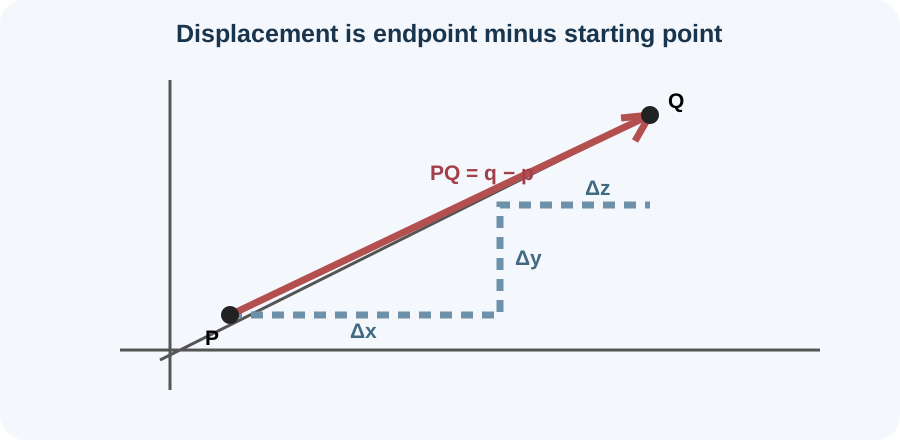
The displacement from point to point is . The order matters because the arrow begins at and ends at . Reversing the endpoints gives . Subtraction occurs component by component. A quick check is that .
For and , the displacement is . The first component records four units of positive movement. The second records three units of positive movement. The third records four units in the negative direction. Keeping subtraction parentheses around negative coordinates prevents sign errors.
The magnitude of is . Double bars denote vector length rather than absolute value of a scalar. For the displacement above, the distance is coordinate units. Squaring makes every component contribute nonnegatively. The formula is the three-dimensional Pythagorean theorem.
Normalize a vector to preserve direction
A unit vector has magnitude one. For nonzero , its normalized form is . The hat marks a unit direction. Dividing every component by the same positive length preserves direction. Normalization removes magnitude while retaining orientation.
For , the unit vector is . Its squared magnitude is . That calculation verifies normalization. The negative sign belongs to the third component and indicates orientation. A zero vector cannot be normalized because its length is zero.
Unit vectors separate a direction from a chosen scale. A velocity can be written as speed multiplied by a unit direction. A line can use any nonzero scalar multiple of its direction vector without changing the set of points. Directional derivatives require a unit vector so the result is a rate per unit distance. Asking whether normalization is needed depends on how the vector will be used.
Use the dot product to measure alignment
The component definition of the dot product is . The centered dot denotes multiplication-and-summation rather than an ordinary product of vector objects. The result is a scalar. Matching components are multiplied, and their products are added. This construction makes the dot product symmetric, so .
Geometrically, , where is the smaller angle between nonzero vectors. A positive dot product corresponds to an acute angle. A negative value corresponds to an obtuse angle. A zero value corresponds to perpendicular vectors. The formula converts between components and angular geometry.
For and , the dot product is . Both magnitudes equal . Thus , so radians. The angle is degrees, which agrees with a positive dot product. Substitution into both definitions confirms the same geometric relationship.
Construct scalar and vector projections
The scalar component of along nonzero is . It measures signed length in the direction. A negative result means the component points opposite . A zero result means the vectors are perpendicular. This quantity is scalar and therefore contains no complete direction vector.
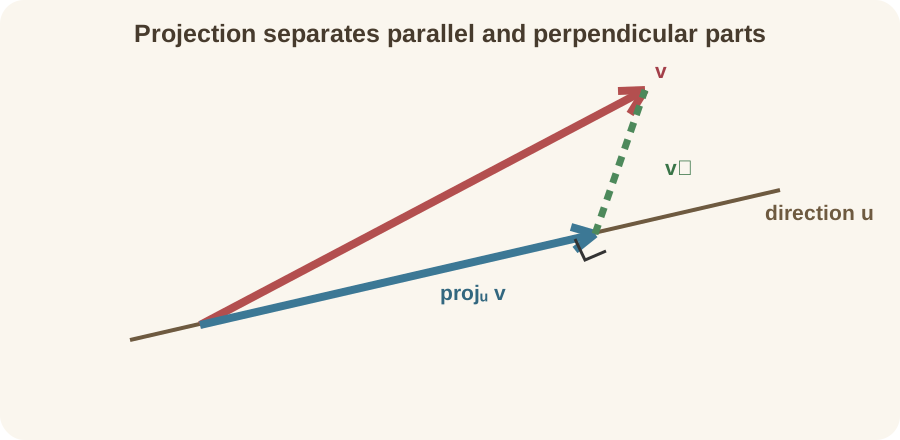
The vector projection is . The fraction supplies the scaling applied to . Since , the formula automatically accounts for a nonunit direction. The projected vector is parallel to . Subtracting it from leaves a component perpendicular to .
Projection supports geometric decomposition. Write , where . Then . Checking verifies the decomposition. Work, force components, least squares, and distance calculations all reuse this same idea.
Build perpendicular directions with the cross product
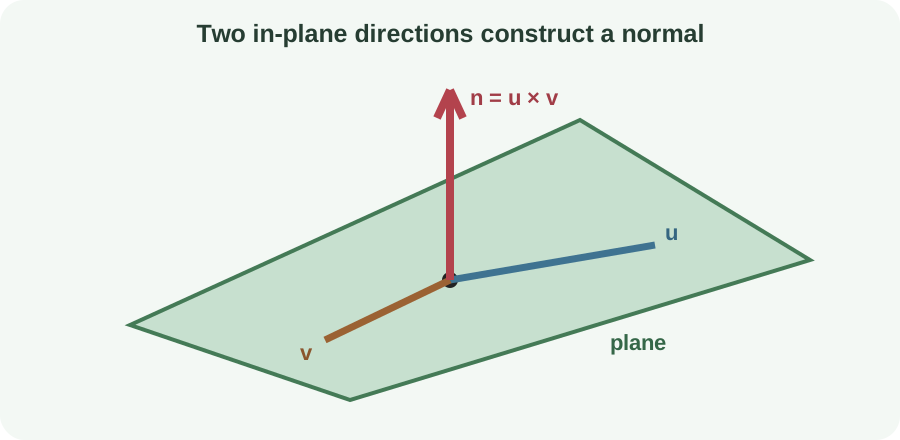
For vectors in , the cross product is perpendicular to both inputs. Its magnitude is . Unlike the dot product, its result is a vector. Reversing order reverses direction, so . The right-hand rule selects the orientation.
In components, . The alternating signs encode orientation. A determinant mnemonic can organize the calculation, but the component result should still be checked. Dotting the answer with each input must give zero. These orthogonality checks catch many sign mistakes.
The magnitude equals the area of the parallelogram spanned by the two vectors. Half that magnitude gives the area of the corresponding triangle. Parallel vectors have sine zero and therefore a zero cross product. Perpendicular vectors maximize the area for fixed lengths. The cross product thus combines a normal direction with an oriented area scale.
Parameterize a line in space
A line through position with nonzero direction is . The parameter ranges over real numbers. At , the expression gives the base point. Increasing moves in the direction of . Negative values move in the opposite direction along the same line.
Through parallel to , the line is . Component equations are , , and . These equations describe the same set of points. The constant coordinate reflects the zero second component of the direction vector. Setting verifies that the parameterization contains the required point.
Many parameterizations represent the same line. Changing the base point to another point on the line preserves the geometric set. Multiplying the direction by any nonzero scalar also preserves it while changing parameter speed or orientation. Two lines are parallel when their direction vectors are scalar multiples. Equality of formulas is less important than equality of represented point sets.
Describe a plane with a normal vector
A plane through with nonzero normal satisfies . The difference is a displacement lying within the plane. Its dot product with the normal is zero because they are perpendicular. This equation encodes infinitely many in-plane displacement vectors at once. A direction vector alone cannot define a unique plane.
For point and normal , the equation is . Expanding gives . The coefficients of , , and are the normal components. Substituting the known point gives , verifying incidence. Multiplying the entire equation by a nonzero constant describes the same plane.
A plane can also be constructed from two nonparallel in-plane directions and . Their cross product provides a normal . If the cross product is zero, the directions are parallel and do not determine a unique plane. Once a normal and a point are known, the normal equation completes the construction. This workflow makes the role of every vector explicit.
Measure distances to lines and planes
Distance is the length of the shortest connecting displacement. From point to a plane , project the point’s signed displacement onto the normal. The distance is . Absolute value removes orientation because geometric distance is nonnegative. Dividing by normal length makes the result independent of how the plane equation was scaled.
For plane and point , the numerator is . The normal length is . Therefore the distance is coordinate units. Substitution keeps every sign visible. A result with units squared would reveal a missing square root or normalization.
Distance from a point to a line can be found through a perpendicular component. If the line passes through with direction , form displacement . Remove its projection along . The residual is perpendicular to the line. Its magnitude is the shortest distance.
Find intersections and diagnose relative position
To intersect a line with a plane, substitute the line parameterization into the plane equation. The resulting scalar equation determines the parameter value. One solution gives one intersection point. No solution indicates that the line is parallel and separate. An identity indicates that the entire line lies in the plane.
Two planes with nonparallel normals intersect in a line. A direction for that line is the cross product of their normals. One point on the line can be found by solving both plane equations together with a convenient coordinate choice. Parallel normals indicate parallel or coincident planes. Comparing their constants after consistent scaling distinguishes those cases.
Two lines in three-dimensional space may intersect, be parallel, or be skew. Skew lines are neither parallel nor intersecting. Solving their three component equations with two parameters tests consistency. Agreement in only two coordinates is insufficient. Three-dimensional visualization becomes reliable when supported by this algebraic test.
Represent curves with vector-valued functions
A vector-valued function traces a curve as changes. The parameter may represent time, but it can represent any ordered progression. Differentiation occurs componentwise. Thus . When is time, this derivative is velocity.
Speed is the magnitude . Velocity retains direction, while speed is a nonnegative scalar. Acceleration is . A particle can maintain constant speed while its velocity changes direction. Uniform circular motion provides the standard example because its acceleration points inward.
The arc length from to is . The integrand is speed with respect to the parameter. Multiplying it by a small parameter interval estimates a small traveled distance. Integration accumulates those distances along the curve. The magnitude prevents opposite component changes from canceling traveled length.
Analyze a helix as a complete example
Consider , where and are positive constants. The first two coordinates trace a circle of radius . The third coordinate rises linearly. Together they form a helix around the -axis. The parameter is dimensionless when used as an angle in radians.
Velocity is . Speed is . The identity makes the speed constant. Constant speed does not imply constant velocity because the first two components rotate. Acceleration is .
Over , the arc length is . One revolution travels both around the cylinder and upward. When , the result reduces to the circumference . That limiting case checks the formula. Geometric interpretation and algebra therefore reinforce one another.
Diagnose common vector-geometry errors
One error is subtracting endpoints in the wrong order. Another is confusing a line direction with a plane normal. A third is forgetting that cross-product order controls orientation. A fourth is calling velocity magnitude “velocity” rather than speed. Naming the role of each vector before calculating prevents these substitutions.
Formula checks should be geometric as well as algebraic. A proposed cross product should dot to zero with both input vectors. A proposed plane should contain its stated point. A proposed unit vector should have magnitude one. A distance must be nonnegative and unchanged when a plane equation is rescaled.
Notation can also cause errors. Parentheses commonly denote point coordinates, while angle brackets denote vectors. Double bars denote magnitude, and a dot or cross specifies a different product. A parameter is a scalar even when it generates a vector-valued curve. Reading every symbol aloud exposes many category mistakes before they reach arithmetic.
Practice deliberately and connect forward
First find the angle between and . Compute the dot product and both magnitudes before solving for the angle. Next project onto . Verify that the residual is perpendicular to the projection direction. Explain the difference between the scalar component and vector projection.
Then parameterize the line through parallel to . Find its intersection with the plane . Substitute the resulting parameter into every component. Check the point in the plane equation. If no consistent parameter exists, describe the geometric alternative rather than forcing a point.
These tools support the next stages of multivariable calculus. Partial derivatives use coordinate directions and gradients normal to level surfaces. Multiple integrals describe regions with spatial coordinates and transformed bases. Flux integrals combine oriented area vectors with vector fields. A firm distinction among points, directions, tangents, and normals makes those later constructions intelligible.