
A vector is often introduced as an arrow, but the arrow is only one useful picture of a much broader idea. Vectors can represent displacements, forces, velocities, data records, polynomial coefficients, signals, or any objects that obey compatible rules for addition and scaling. Linear algebra begins by asking what can be built from a collection of such objects. Linear combinations answer that question by allowing each vector to be scaled and then added. This lesson develops the geometric picture and algebraic structure together so that neither becomes an empty procedure.
Learning objectives and the central construction
By the end of this lesson, you will compute vector sums, scalar multiples, magnitudes, and component forms while explaining what each operation means. You will construct and interpret linear combinations and determine whether a target vector lies in a span. You will translate span questions into systems of linear equations and connect the solution set to geometry. You will test linear independence, identify redundancy, and explain why a basis provides unique coordinates. You will also preserve units and verify vector reasoning through diagrams, components, and substitution.
The central construction is . Each bold symbol denotes a vector, each scalar is an ordinary number, and the subscript labels which vector or coefficient is being referenced. Multiplication scales a vector, and addition combines the scaled results. The expression is called a linear combination because it uses only scalar multiplication and vector addition. The set of every possible output from this construction is the span of the listed vectors.
Linear combinations turn several questions into one common form. Can a force be resolved along chosen directions, can a data record be reconstructed from features, or can a polynomial be expressed in a given basis? Each question asks whether coefficients exist that produce a target. If coefficients exist, their values describe how to assemble it. If no coefficients exist, the chosen vectors do not reach that target.
Understand a vector as magnitude and direction
In the plane, a vector can be pictured as a directed line segment with a tail and a head. Its length represents magnitude, and its orientation represents direction. Translating the arrow without rotating or resizing it does not change the vector. This freedom distinguishes a vector from a fixed point. A point names a location, while a vector describes a directed change that can be applied from many locations.
The vector from point to point is . Subtracting initial coordinates from final coordinates records the horizontal and vertical changes. Reversing the order gives . The negative sign reverses direction while preserving magnitude. This endpoint-minus-starting-point convention should be stated before arithmetic.
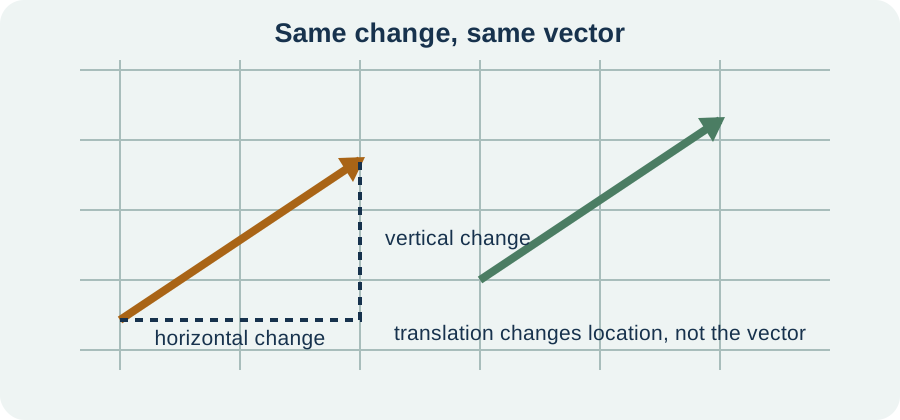
In applications, vector meaning includes units. A displacement might be , while a velocity might be . Their coordinate numbers look alike, but the quantities are not interchangeable. Both components of one physical vector must be expressed in compatible units. Units help distinguish geometry from the modeled phenomenon.
Read coordinate vectors in arbitrary dimensions
In , a vector has the form . The symbol denotes the real numbers, and the superscript indicates an ordered list of real components. The subscript on labels a component rather than a power. Order matters because and usually represent different vectors. Equality requires corresponding components to be equal.
The coordinate list depends on a chosen coordinate system or basis. In ordinary Cartesian coordinates, means three units along the first axis and four along the second. In a different basis, the same underlying geometric vector may have different coordinates. Coordinates are therefore a description relative to reference directions. The vector is the object being described, not merely the printed list.
Higher-dimensional vectors may have no convenient arrow picture, yet their operations remain meaningful. A vector in can represent one hundred measurements for an observation. A polynomial such as can be associated with coefficient vector relative to the basis . A sampled sound can be represented by a long vector of amplitudes. Abstraction preserves the rules that these examples share.
Add vectors and multiply them by scalars
Vector addition acts componentwise: if and , then . Only matching components are added. Geometrically, place the tail of at the head of and draw the result from the original tail to the final head. The parallelogram rule gives the same result. Addition combines directed changes in sequence.
Scalar multiplication also acts componentwise: . If , the magnitude increases while direction stays the same. If , the vector shortens without reversing. If , the vector reverses and its magnitude is multiplied by . If , every vector collapses to the zero vector .
For and , the combination equals . Componentwise scaling gives . Subtraction means adding the opposite, so the result is . Substitute the result back into the original component expression to verify both coordinates. The ordered pair remains a vector because each operation is defined componentwise.
Build linear combinations geometrically
A linear combination of vectors is any vector formed with scalar coefficients. The coefficients may be positive, negative, zero, fractional, or irrational unless a problem imposes restrictions. Each coefficient controls motion along one generator direction. Addition combines those motions into a final vector. Varying the coefficients produces a geometric set of reachable points.
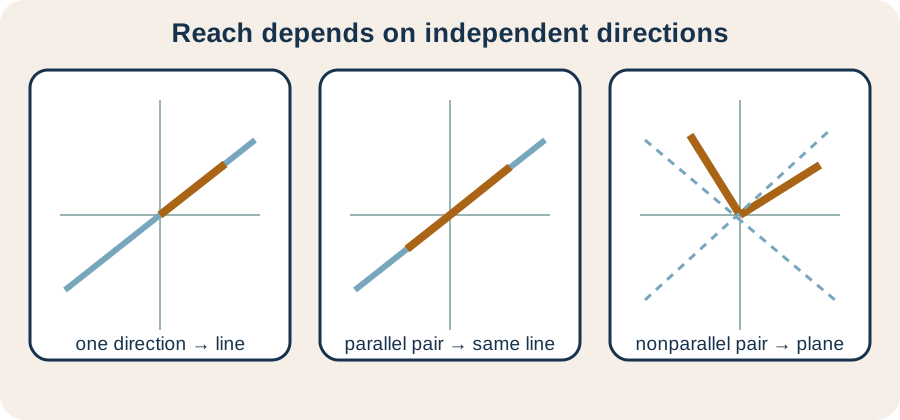
With one nonzero vector in , the combinations fill the line through the origin in direction . The line includes both directions because may be positive or negative. It includes the origin because is allowed. A shifted line not passing through the origin is not the span of a single vector. Span always contains the zero vector.
With two nonparallel vectors in the plane, independent scaling reaches every point in . One coefficient moves along the first direction and the other supplies the remaining direction. If the vectors are parallel, both coefficients move along the same line and cannot reach the whole plane. The diagram below contrasts these cases. Geometry predicts whether a coefficient system should have one solution, infinitely many solutions, or none.
Define span as all reachable combinations
The span of is the set . The colon inside the braces means that the expression is subject to the condition that follows it. The condition says every coefficient may be any real number. Span is an infinite set in most nontrivial cases, not merely the finite list of generators. The generators are instructions for producing the set. Every such span necessarily contains the zero vector.
To test whether a target lies in the span, solve . Vector equality is equivalent to equality of corresponding components. An equation in therefore becomes a system of scalar equations in the unknown coefficients. A consistent system proves membership because its solution supplies a construction. An inconsistent system proves the target cannot be reached from the chosen generators.
Consider whether lies in the span of and . Setting produces and . Subtracting the second equation from the first gives , so . Then . Substitution reconstructs and verifies span membership.
Translate vector equations into matrix systems
Place the generator vectors as columns of a matrix . Place the coefficients into a column vector , where the superscript indicates transposition into a column. Then the linear combination equation becomes . Matrix multiplication forms the same weighted sum of columns. Span membership is therefore exactly a question of system consistency.
For the preceding example, the matrix equation is . The first matrix stores the two generator vectors as columns. Multiplying its first row by the coefficient column yields , while the second row yields . Row reduction solves for the coefficients without changing the underlying solution set. The matrix is an organized representation of the vector question.
The shape of the coefficient solution contains geometric information. No solution means the target lies outside the span. One solution means the target has a unique representation using those generators. Infinitely many solutions mean the target is reachable but the generator list contains redundancy. Linear algebra links these algebraic outcomes to span and independence.
Test linear independence as uniqueness of construction
Vectors are linearly independent when the equation has only the trivial solution . The word “trivial” labels the all-zero coefficient choice, which always produces the zero vector. If a nonzero coefficient choice also produces zero, the vectors are dependent. Dependence means at least one generator can be constructed from the others. That vector adds no new direction to the span.
For and , the second vector equals three times the first. The relation uses coefficients that are not both zero. The pair is therefore dependent. Their span is only a line, even though two vectors were listed. Counting vectors without checking their directions cannot establish independence.
In , two nonzero vectors are independent exactly when they are not parallel. In , three vectors are independent when they do not lie in a common plane through the origin. More generally, no set containing more than vectors can be independent in . These geometric statements are consequences of available dimensions. Row reduction provides the dependable computational test when geometry is difficult to see.
Connect independence, span, and basis
A basis for a vector space is a set that both spans the space and is linearly independent. Spanning ensures that every vector can be constructed from the basis vectors. Independence ensures that each construction has only one coefficient list. Both properties are necessary. A spanning set with redundant vectors is not a basis, and an independent set that misses directions is not a basis for the whole space.
The standard basis for is and . Every vector has the unique representation . The coefficients and are its standard coordinates. Another pair of nonparallel vectors can also form a basis. Coordinates change with the basis even though the underlying vector does not.
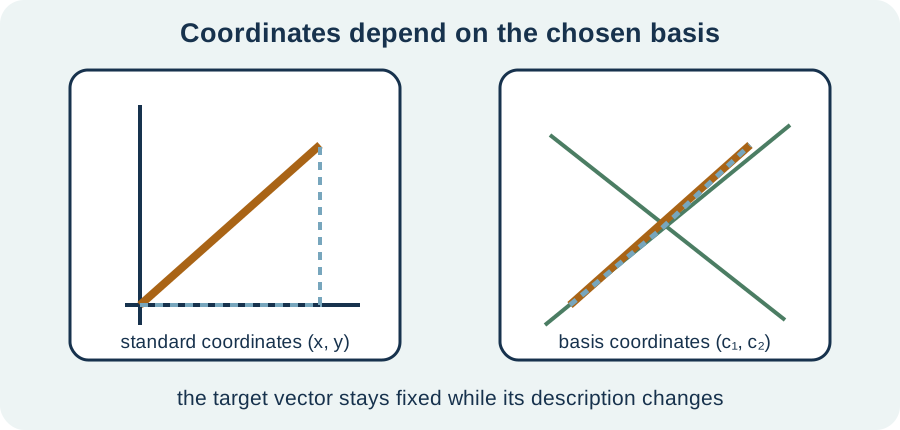
For example, let and . To express in this basis, solve . The equations and give and . Thus the vector’s coordinates relative to the new basis are . The standard coordinates and basis coordinates describe the same object through different reference directions.
Measure magnitude and direction with the dot product
The Euclidean magnitude of is . The double vertical bars denote norm, a generalized notion of length. Squaring components makes each contribution nonnegative, addition combines perpendicular contributions, and the square root restores the original unit. For , the magnitude is . If the components are measured in newtons, the magnitude is .
The dot product is . The centered dot denotes a scalar-producing operation, not ordinary componentwise multiplication as a final vector. Geometrically, , where is the angle between nonzero vectors. A positive dot product indicates an acute angle, a negative value indicates an obtuse angle, and zero indicates perpendicularity. The sigma form emphasizes that matching components are multiplied and then accumulated.
A unit vector has magnitude one and represents direction without scale. For nonzero , normalize it by . The horizontal fraction means every component of is divided by the scalar magnitude. Multiplying the unit direction by the original magnitude reconstructs the vector. Normalization is undefined for the zero vector because its magnitude is zero.
Preserve units in physical linear combinations
Vectors can be added only when they represent compatible physical quantities in a common coordinate system. A force vector in newtons cannot be added directly to a velocity vector in meters per second. Two force vectors may be added because their corresponding components share units. Scalar coefficients may be dimensionless, or they may carry units that convert the scaled vector into the required quantity. Dimensional analysis belongs inside vector reasoning.
Suppose and . The net force is . Its magnitude is . Squared units appear inside the radical and return to newtons after the square root. Dropping units would hide whether the combination was physically meaningful.
Coordinate axes must also be declared. The pair could mean east and north components, horizontal and vertical components, or components along rotated basis vectors. A change of basis alters the coordinates while preserving the physical force. Mixing components from different bases produces an invalid sum even if units match. State both the unit and coordinate convention when interpreting a physical vector.
Apply linear combinations to data and models
In mechanics, a force can be decomposed into components along convenient directions. On an inclined plane, gravity is often written as a combination of unit vectors parallel and perpendicular to the surface. The coefficients reveal how much of the force acts in each direction. Because those unit vectors form a basis for the plane of motion, the decomposition is unique. Choosing a basis adapted to the geometry simplifies the equations.
In data analysis, each observation can be treated as a vector of features. A linear model combines feature vectors with fitted coefficients to predict a response. Principal component methods construct new directions as linear combinations of original variables. The span describes which data patterns can be reconstructed from selected components. Dependence reveals redundant information among features.
In function spaces, vectors may be functions rather than coordinate arrows. A polynomial can be expressed as a combination of basis functions, and a signal can be approximated by combinations of waves. The same questions return: which objects span the desired space, are they independent, and what coefficients represent the target? Coordinate calculations are finite-dimensional examples of this broader structure. Linear algebra earns its power by transferring one pattern of reasoning across many domains.
Verify span and independence systematically
Begin with a meaning check. Identify the target, generators, unknown coefficients, units, and coordinate system. Predict the likely span from geometry when possible. Then write one vector equation before splitting it into components. This preserves the connection between the algebra and the original question.
Next, solve the corresponding system carefully. Use elimination or row reduction, record whether the system is consistent, and distinguish free variables from pivot variables. For an independence test, set the target to the zero vector and ask whether any nontrivial coefficient solution exists. For a span-membership test, use the stated target and ask whether at least one solution exists. The same matrix can answer different questions depending on its right-hand side.
Finally, substitute the coefficients into the original linear combination. Check every component and preserve units. Compare the algebraic conclusion with the geometric prediction and with the number of available dimensions. If those checks disagree, revisit the setup rather than forcing an interpretation. Verification closes the loop from object to coordinates and back to object.
Diagnose common misconceptions
A vector is not automatically a point, although a position vector may represent a point relative to an origin. Confusing the two makes translations seem to change a vector when they do not. Likewise, the span is not the visible collection of generator arrows. It contains every real-scaled combination of them. Always distinguish an object, its representation, and the set generated from it.
Independence does not mean that vectors are unequal or perpendicular. Unequal parallel vectors are dependent, while many nonperpendicular pairs are independent. Orthogonality is a particularly convenient form of independence for nonzero vectors, but it is not required. The definition depends on whether the zero vector has a nontrivial representation. Use that definition when intuition is uncertain.
Another misconception is that adding more generators must enlarge the span. A new vector already inside the existing span adds redundancy but no new reachable points. It may create infinitely many coefficient representations for targets that were previously unique. Redundancy can be useful in applications, but it prevents the list from being a basis. Track both reach and uniqueness rather than counting vectors alone.
Practice construction, interpretation, and proof
Express as a linear combination of and . Write the vector equation, convert it into two component equations, and solve for both coefficients. Verify the result by substitution. Then explain geometrically why the representation is unique. Identify which property of the two generators guarantees uniqueness.
Determine whether and are linearly independent. Produce a nontrivial linear combination equal to the zero vector. Describe their span geometrically and identify a target in that does not lie in that span. Explain why listing two vectors in a two-dimensional space is not sufficient to form a basis. Use both definition and geometry.
Let , , and . Decide whether lies in the span of the two generators. Solve for coefficients and verify all three components. Then determine whether the representation is unique. Interpret the third component equation as a consistency check on the first two.
Solutions and reasoning
For the first problem, set . The second component gives , and the first gives , so . Substitution yields . The generators are nonparallel and therefore independent. Independence makes the representation unique.
For the second problem, is a nontrivial relation, so the vectors are dependent. Their span is the line through the origin. A vector such as is not on that line and cannot be produced. Two vectors can form a basis of only if they are independent. Parallel generators supply only one direction.
For the third problem, the first two components require and . The third component then gives , which is satisfied. Thus . The two generators are independent because neither is a scalar multiple of the other and the homogeneous component equations force both coefficients to zero. The representation is therefore unique within their two-dimensional span.
Connect vectors to matrices and transformations
The next lesson treats a matrix as a linear transformation rather than only as a rectangular array. Its columns show where basis vectors are sent, so multiplying by a coordinate vector forms a linear combination of those columns. The column space is precisely their span. Matrix rank counts the number of independent directions produced. The ideas in this lesson therefore become the conceptual engine of matrix algebra.
Linear transformations preserve vector addition and scalar multiplication. If is linear, then . This property means knowing the transformation of basis vectors determines its action on every vector in the space. Coordinates provide the coefficients needed for reconstruction. Basis, span, and linear combination are not separate vocabulary items but parts of one mechanism.
The durable question is always constructive. What vectors are available, what coefficients are allowed, and what targets can their combinations reach? Then ask whether the construction is unique and how a change of basis changes its coordinates. Use geometry for intuition, systems for computation, and substitution for proof. That coordinated reasoning is the foundation on which the rest of linear algebra is built.