
Formula reference. Apply the Chain Rule to every differentiable inner function.
Derivative rules
Also: where defined. Preserve all original domain restrictions.
Derivative rules are compressed results of the limit definition. They make calculation efficient, but method choice still begins with meaning and structure. Imagine a temperature controller whose output is . A derivative tells how quickly the temperature is changing at an instant; a correct rule must match how the model was assembled.
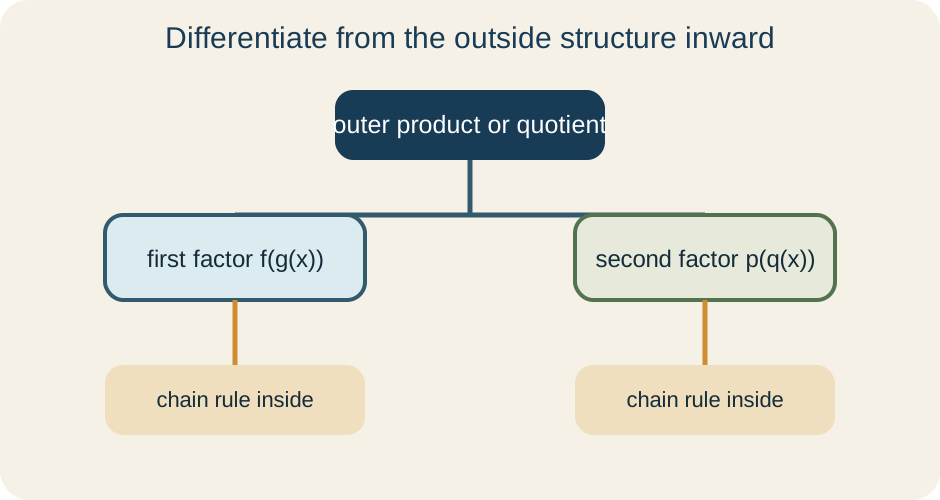
Before touching symbols, circle the outermost operation. Is the expression a sum, a product, a quotient, a named function applied to an inner expression, or a composition of several layers? This visual parse prevents the common error of using a rule because a familiar symbol appears somewhere inside. The derivative is determined by the whole expression, not its most noticeable fragment.
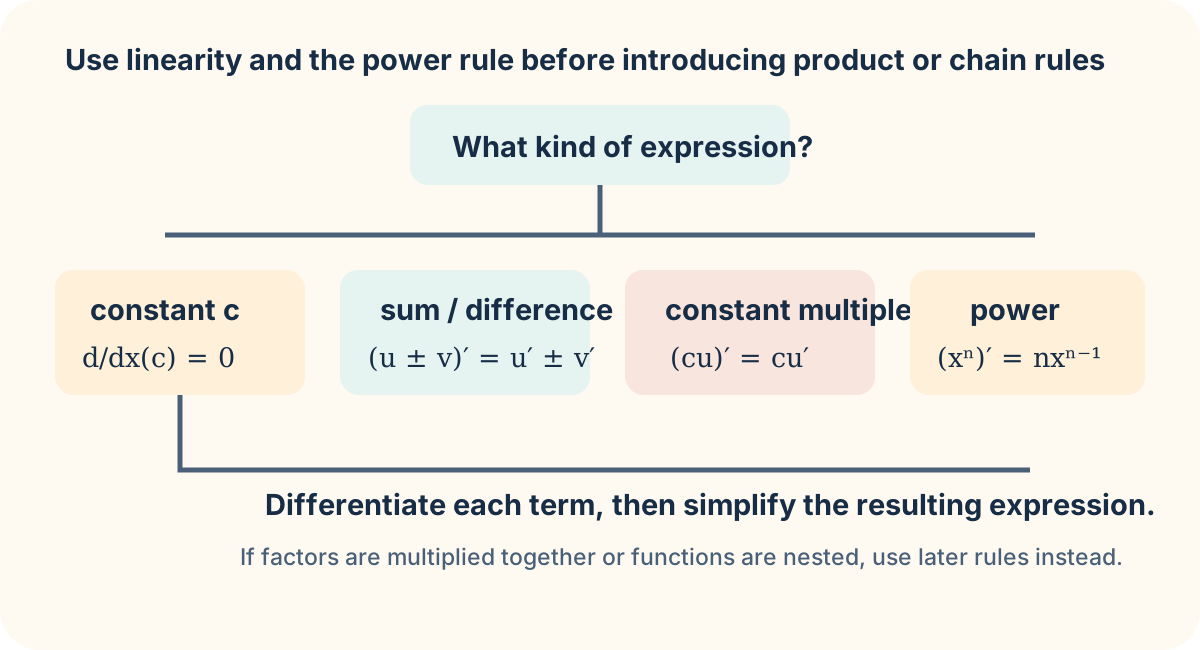
Start with linearity and powers
Constants differentiate to zero because they do not change. Sums and constant multiples may be differentiated term by term: . The Power Rule, , applies to a power of the independent variable after algebraic rewriting has exposed it.
For the controller, a background temperature of contributes zero rate, while a term contributes if time is seconds. Units remind us that differentiating changes the output units. The calculation and interpretation should remain together.
Follow dependency through products and compositions
For , both factors may change, so . For with , the Quotient Rule keeps the denominator squared: . These rules are not interchangeable with the Power Rule merely because an exponent occurs somewhere in the expression.
The Chain Rule describes a dependency: if , then . Read from outside inward, then multiply by the rate at which the inner quantity changes. If the controller uses , the sine changes with its angle and the angle changes at radians per second, so .
Recognize named derivative families
Key formulas include , for , , and . With an inner function, each needs the Chain Rule. The statement also requires in its real-valued form.
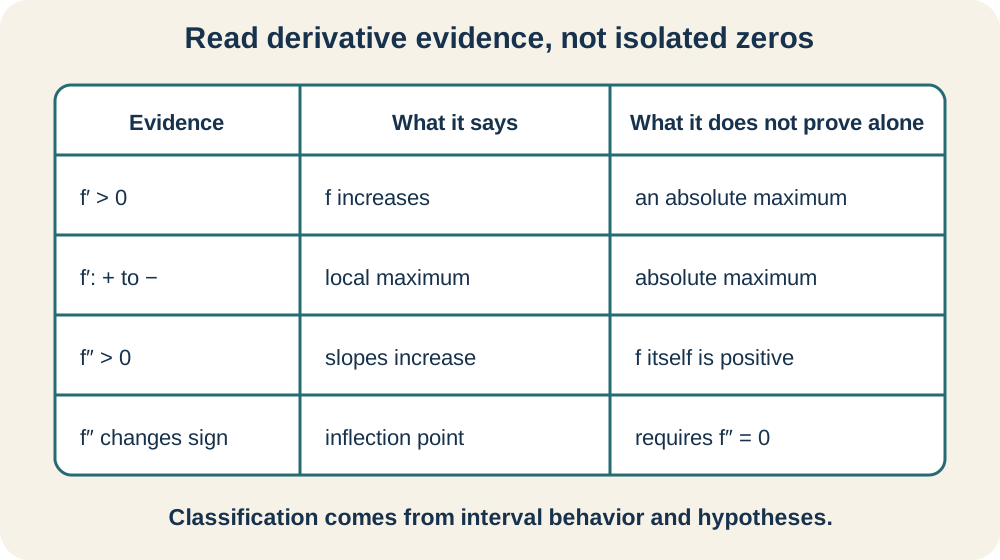
After differentiating, test the result against the original model. A positive derivative should match an increasing graph locally, and units should be output units divided by input units. This check catches missing chain factors, reversed quotient terms, and signs that no amount of repeated symbolic copying will reveal.
Narrative challenge: diagnose the controller model
The controller model is , with in seconds. Before looking below, identify the outer structure and differentiate. Explain why differentiating it as is incomplete.
Show a solution path
This is a product of and . The Product Rule and Chain Rule give . The incomplete answer differentiates the power factor but ignores that the exponential factor also changes with time.