
Formula reference. Differentiate any proposed antiderivative to check it. Each formula holds on an interval where its integrand is defined.
Common antiderivatives
An antiderivative is best remembered as a function whose derivative returns the integrand. That definition turns every reference entry into something you can check. If you claim that an expression is an antiderivative of , differentiate your claim. The check is quick, local, and more reliable than recall alone.
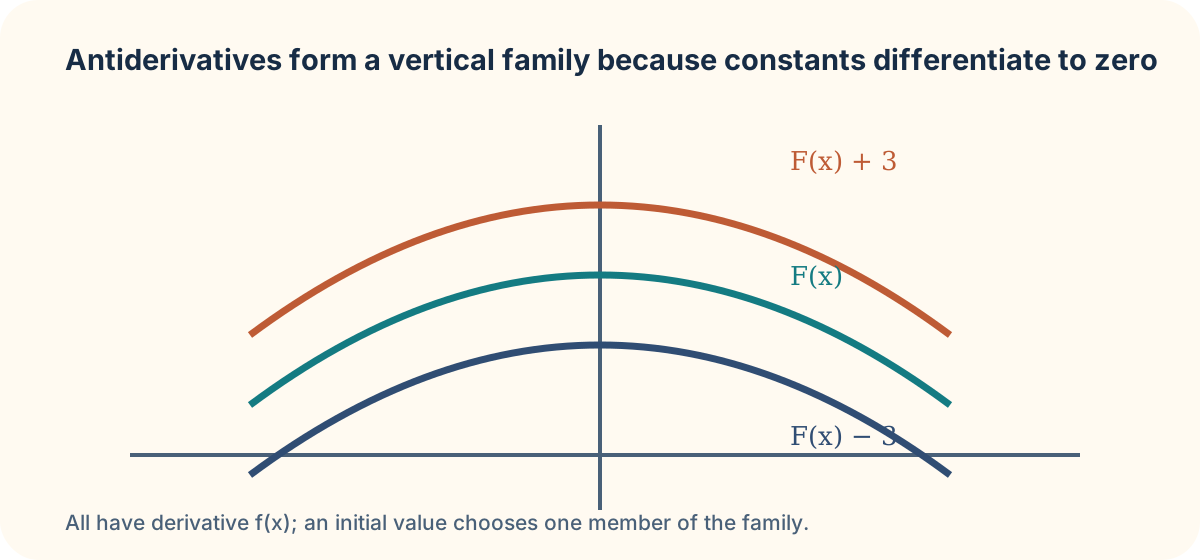
Imagine reconstructing a train’s position from a recorded velocity. Many position functions can have the same velocity because adding a constant vertical shift does not change a derivative. The initial position selects one member of that family. This story explains why indefinite integrals require and why a definite integral does not.
Recover powers, exponentials, and logarithms
For , . Differentiate to see the coefficient and exponent cancel correctly. The exception is on intervals that avoid zero. The absolute value is needed because both positive and negative nonzero inputs have derivative after the logarithmic form is interpreted on its interval.
Exponential families reverse cleanly: , while for and . The denominator appears because . A missing is a derivative-check failure, not a minor formatting error.
Recover trigonometric functions with signs
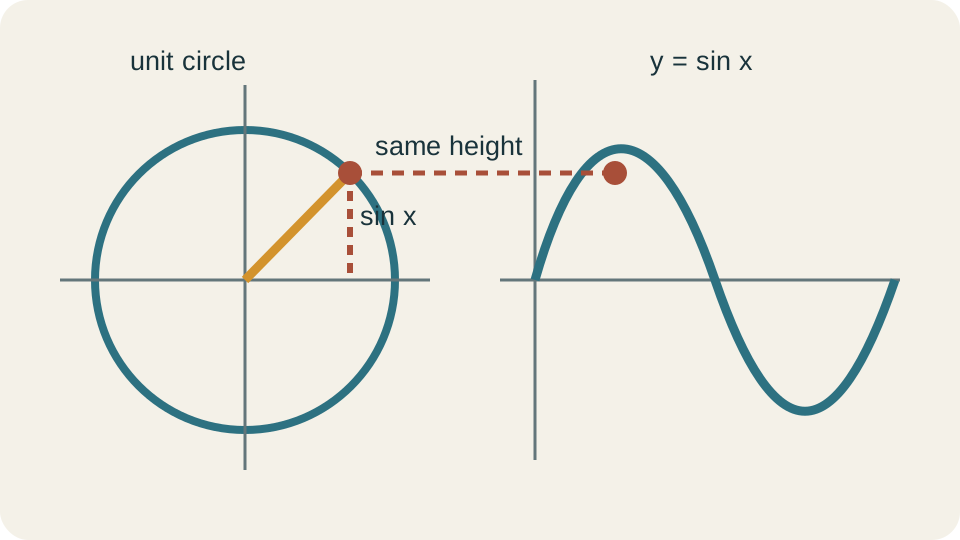
Because , . Because , . The minus sign is a consequence of differentiation, and it is worth checking rather than memorizing as an exception.
For secant-squared and cosecant-squared, and on intervals where the expressions are defined. These statements inherit the trig functions’ discontinuities. Choose an interval before treating one antiderivative family as a global formula.
Connect the reference to a model
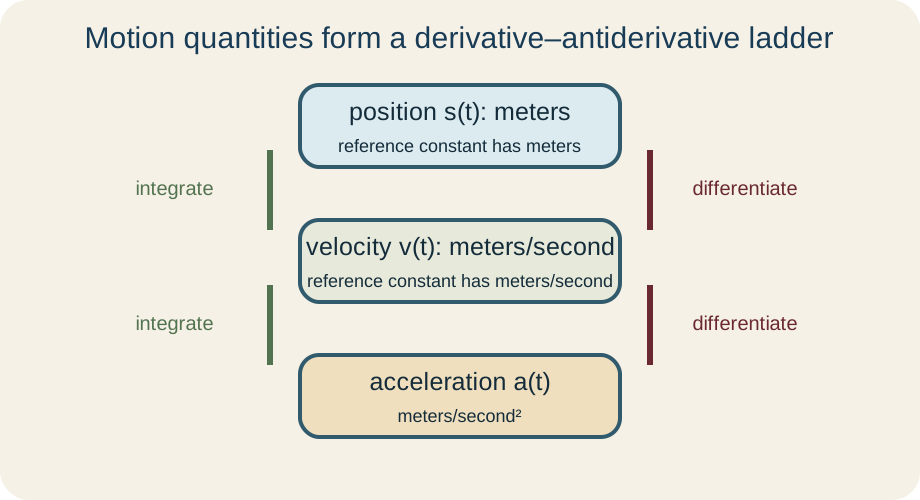
If a train has velocity , then an antiderivative is meters. The units are consistent because integrating velocity with respect to seconds yields meters. Given , the constant is , producing a particular position model.
Do not confuse that antiderivative with distance traveled. The difference gives displacement, which may cancel when velocity changes sign. Total distance requires integrating or splitting at sign changes. A reference table provides forms; the model determines what the form means.
Narrative challenge: reconstruct the train position
A train has velocity and position . Before opening the solution, find a position function and explain why the constant cannot be omitted. Then identify the time at which velocity is zero and state why that time may matter for distance.
Show a solution path
An antiderivative is . The initial condition gives , so meters. Velocity is zero when , or . A sign change there would make it a necessary split point when computing total distance.