
Formula reference. Use for indefinite integrals; do not add it to an evaluated definite integral.
Integration rules
For total distance use ; for displacement use .
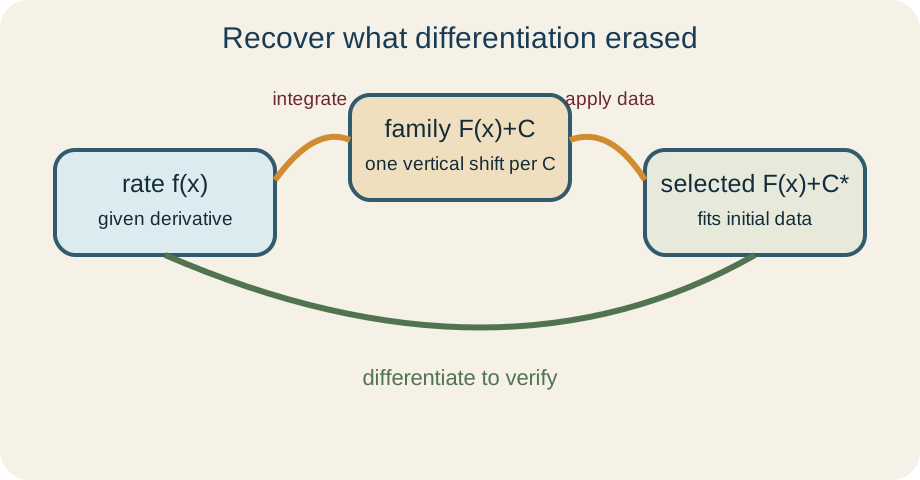
Integration accumulates contributions, and an antiderivative reverses differentiation. Those two ideas meet in the Fundamental Theorem of Calculus, but they answer different questions. An indefinite integral asks for a family of functions whose derivative is the integrand. A definite integral asks for total signed accumulation over an interval. Keeping the question visible prevents a missing constant or a mistaken interpretation.
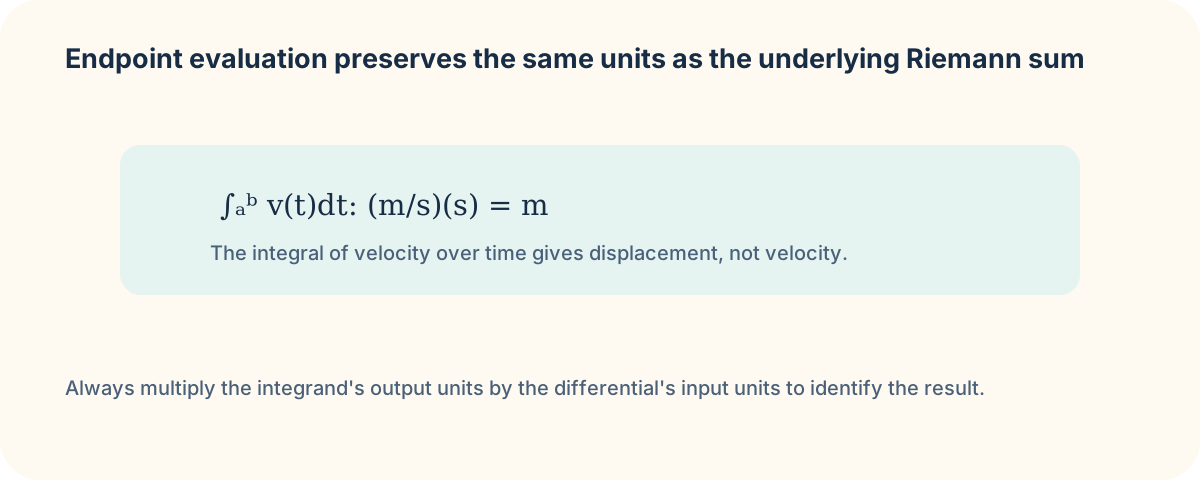
Imagine a water-treatment tank with a net flow rate in . The quantity has liters as its units and describes net change in water volume. It is not automatically the total water present, because that additionally requires an initial volume. The narrative gives a reason to care about bounds, signs, and units before applying a rule.
Use linearity and the power rule
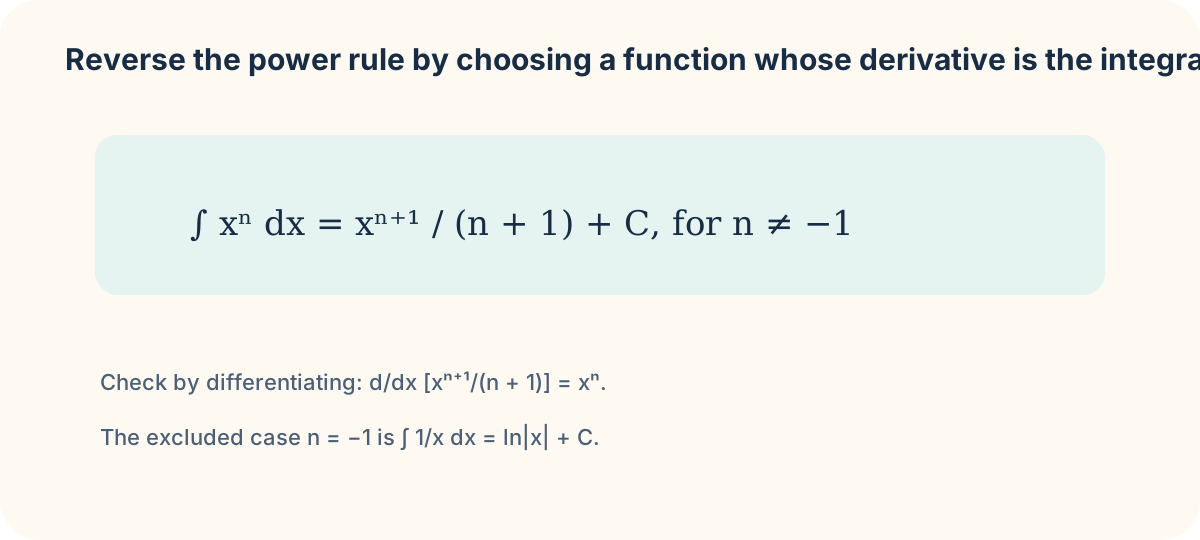
Integration respects sums and constant multiples: . This lets a polynomial be integrated term by term. For , the reverse-power rule is . The represents all vertical shifts with the same derivative.
The excluded case is important: , not division by zero in the power formula. The absolute value preserves both positive and negative parts of the nonzero domain. This exception is a structural signal that a logarithm, not a power, is the appropriate antiderivative.
Recognize reverse Chain Rule structure
Substitution is useful when the integrand contains a function and, up to a constant, its derivative. If and , then . It is a change of variable that follows the same dependency structure as the Chain Rule.
For the tank, an inflow model such as contains the inner quantity and its derivative . Set , integrate , then return to . Do not use substitution just because parentheses appear; identify the matched derivative explicitly.
Evaluate definite integrals with meaning
If , then . Apply the upper input and subtract the lower input; the order reflects accumulated change from to . Negative portions of a rate graph subtract from net change, so a result of zero can describe genuine movement in both directions.
Return to the tank: . If the problem asks for total inflow rather than net volume change, negative outflow portions must be handled separately or with an absolute-value model. Interpretation comes after evaluation, but it should guide setup from the beginning.
Narrative challenge: update the tank
A tank starts with and has net rate for . Write, but do not initially evaluate, an expression for the final volume. Then decide whether the integral is net change or total inflow.
Show a solution path
The final volume is . The integral measures net volume change because is signed. On this interval the rate remains positive, so it also happens to equal total inflow, but that conclusion comes from checking the rate rather than from the word “integral.”