
Formula reference. Identities hold only on the common domain of both sides.
Core identities
The quotient and reciprocal identities require nonzero denominators. Do not cancel individual terms across a sum.
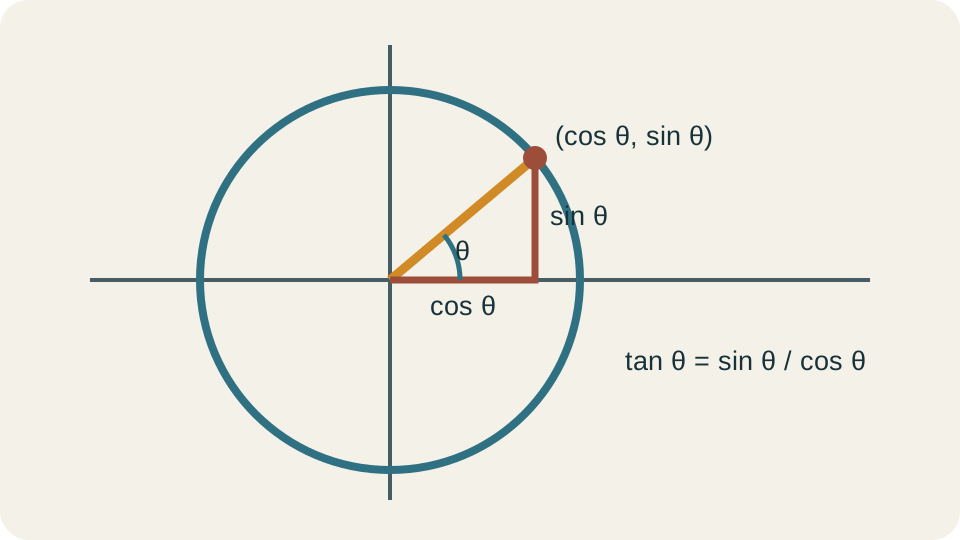
An identity is an equation true for every input in the shared domain, not an equation that is solved for one value. The identity comes from the unit circle: a point lies one unit from the origin, so the Pythagorean theorem gives the equation. That origin makes the formula something to reason from rather than something to chant.
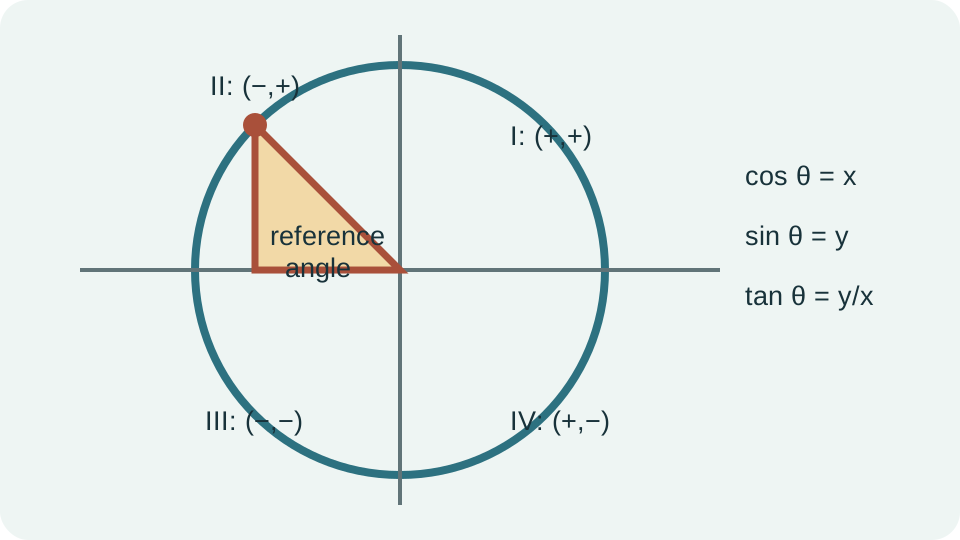
Imagine a navigation display that knows a vehicle’s eastward and northward unit-direction components. If the display reports one component, the Pythagorean identity constrains the other, but it does not choose its sign. The quadrant and the motion context still matter. This is the useful story behind identities: relationships carry information, while domains and signs complete the interpretation.
Build the core relationships
Dividing by where cosine is nonzero yields . Dividing instead by where sine is nonzero yields . The restrictions are part of the statements because the division used to derive them would otherwise be illegal.
The quotient identities are and . Reciprocal identities such as name the same structural relationship. Do not cancel across sums: separates into , but it cannot become .
Use symmetry before algebra
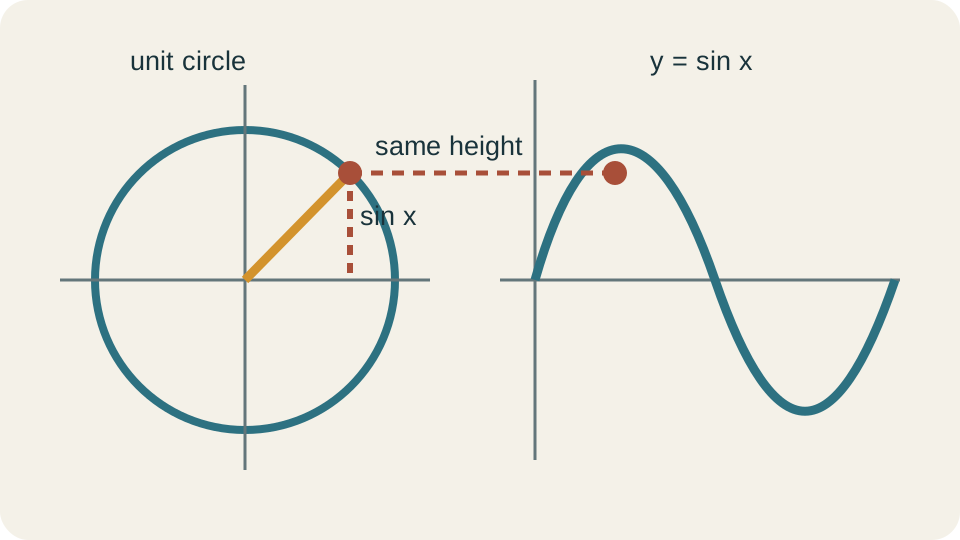
The unit circle also explains symmetry. Sine is odd: ; cosine is even: . A negative angle reflects a point across the horizontal axis, which reverses its vertical coordinate but not its horizontal coordinate. Periodicity then gives and the matching cosine statement.
In the navigation display, reversing the turn angle reverses the northward component while preserving the eastward component. This is a geometric prediction that can be checked numerically. A sketch is often faster and safer than a long symbolic derivation.
Verify instead of merely transforming
To verify an identity, transform one side toward the other using valid steps. For example, start with , replace with , then simplify to where the original denominator is nonzero. Writing the original domain protects the argument from claiming more than it proves.
Identities matter in calculus because a substitution or derivative may expose a form that is equivalent but more useful. The goal is not maximum manipulation. The goal is to choose a form that reveals a cancellation, a standard limit, or a known derivative while preserving where the expression is defined.
Narrative challenge: recover a direction component
A navigation display reports while the vehicle is known to be in Quadrant II. Find and before opening the solution. Explain why the positive square root is not the correct cosine value.
Show a solution path
The identity gives , so . Quadrant II makes cosine negative, hence and . The identity determines magnitude; the quadrant determines sign.