
Buoyancy is the net result of fluid pressure acting over an object’s surface. In a fluid at rest under gravity, pressure generally increases with depth, so the lower parts of a submerged object experience greater pressure than the upper parts. Those unequal surface forces combine into a net upward force. Archimedes’ principle summarizes the result as the weight of displaced fluid. This lesson builds that principle from pressure and then uses it as a force-modeling tool.
Learning objectives
By the end of the lesson, you should be able to explain why static-fluid pressure produces a net buoyant force. You should calculate buoyant-force magnitude with explicit units. You should distinguish submerged volume, displaced-fluid volume, and total object volume. You should analyze floating, rising, sinking, and supported equilibrium with a free-body diagram. Every conclusion should identify the system and surrounding fluid.
You will derive the submerged fraction for a floating uniform object. You will connect apparent weight with a scale or tension reading. You will explain how hollow ships and balloons float even when some of their materials are denser than the surrounding fluid. You will also examine stability, layered fluids, acceleration, and model limitations. These extensions show that buoyancy is more than a single substitution formula.
Use a repeatable process throughout the lesson. Draw the object and identify which portion contacts the fluid. Write weight, buoyant force, tension, drag, and contact forces as appropriate. Apply Newton’s second law in a declared positive direction. Then check density trends, limiting cases, and units before accepting the result.
Pressure acts in every direction
Pressure is normal force per unit area in the continuum model. A static fluid pushes perpendicular to every part of an immersed surface. It does not push only upward. Side forces can cancel by symmetry, while vertical contributions generally do not cancel because pressure varies with depth. Buoyancy is the vector sum of all those pressure forces.
In a fluid of approximately constant density , hydrostatic pressure changes with depth according to . The symbol is pressure at a reference surface, is gravitational acceleration in meters per second squared, and is depth in meters. The subscript reminds us that this is fluid density. Greater depth produces greater pressure. That pressure gradient is the immediate cause of ordinary buoyancy.
Atmospheric pressure often acts on the exposed fluid surface and on other exposed parts of an experimental setup. It may cancel from a gauge-pressure calculation when applied consistently. Omitting it from one surface while retaining it on another creates an artificial imbalance. Gauge pressure measures pressure relative to atmosphere. Absolute and gauge descriptions produce the same net force when used consistently.
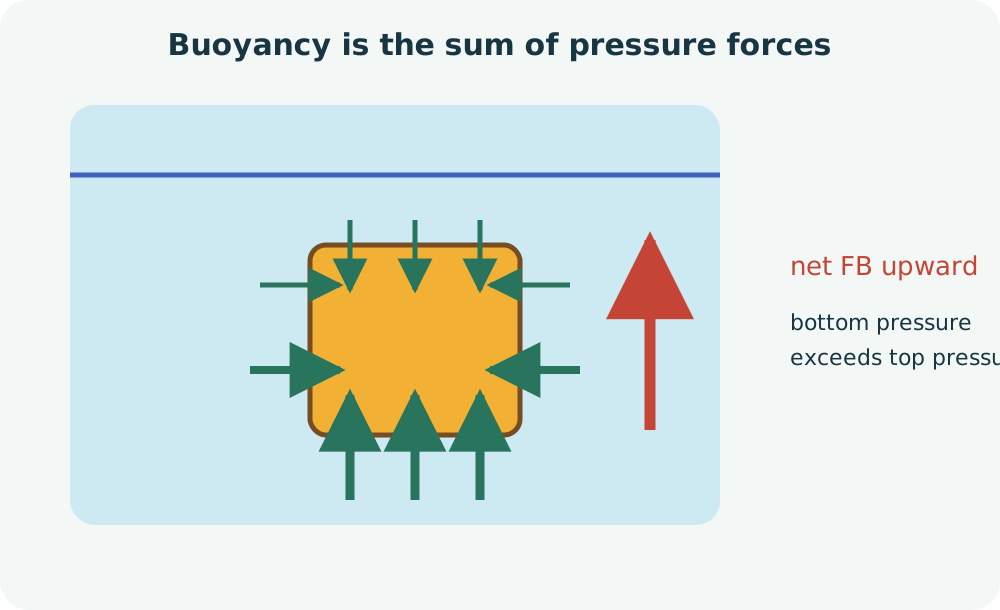
Deriving buoyancy for a rectangular block
Consider a fully submerged rectangular block with horizontal top and bottom surfaces of area . Let the top lie at depth and the bottom at depth . The fluid force on the top points downward with magnitude . The fluid force on the bottom points upward with magnitude . Since , the bottom pressure is greater.
Taking upward as positive, the net vertical pressure force is . Substituting hydrostatic pressure gives . Reference pressure cancels. Factoring gives . The product is the block’s submerged volume.
Therefore . The symbol is the volume of fluid displaced by the object. Fluid mass that would occupy that volume is . Its weight is . The net upward pressure force equals the weight of displaced fluid.
Archimedes’ principle
Archimedes’ principle states that the buoyant force on an immersed object equals the weight of the displaced fluid. Its magnitude is . The force points opposite the effective gravitational direction in an ordinary static-fluid setting. It acts through the center of buoyancy, the centroid of the displaced-fluid volume for uniform fluid density. Its line of action matters for rotational stability.
The principle applies to fully or partially submerged objects. For a completely submerged object, displaced volume equals total external volume. For a floating object, displaced volume equals only the submerged portion. Cavities open to the surrounding fluid may fill and cease to exclude fluid. The correct displaced volume is the volume from which the surrounding fluid is actually excluded.
The expression depends directly on fluid density, gravitational acceleration, and displaced volume. Object mass does not appear directly. Object mass affects the motion through weight and may determine how deeply a floating object settles. Two equal-volume fully submerged objects in the same uniform fluid experience equal buoyant-force magnitude even if their masses differ. Their net forces can still differ because their weights differ.
Units and limiting cases
Fluid density has units kilograms per cubic meter. Multiplying by in meters per second squared and volume in cubic meters leaves kilogram-meters per second squared. That unit is the newton. The expression therefore has the correct dimensions for force. Retaining units through substitution exposes incorrect uses of area or total volume.
If fluid density approaches zero, buoyant force approaches zero. This explains why ordinary air buoyancy is often small compared with water buoyancy, though it is not always negligible. If displaced volume doubles in the same fluid, buoyant force doubles. If effective gravity vanishes in an ideal freely falling frame, the ordinary hydrostatic gradient and buoyant force vanish. These limits agree with the pressure-gradient origin.
If a fully submerged rigid object moves deeper in an incompressible fluid of constant density, its displaced volume and buoyant force remain approximately constant. Absolute pressure increases, but the pressure difference from bottom to top remains set by object height. This result can surprise students who associate deeper pressure with greater buoyancy. Compressible fluids, compressible objects, or changing density can alter that conclusion. The assumptions must accompany the statement.
A free-body diagram decides motion
For an unsupported object in a fluid, the two simplest vertical forces are buoyancy upward and weight downward. Weight magnitude is , where is object mass. Taking upward as positive gives . The symbol is vertical acceleration. The sign of the force difference predicts initial acceleration.
If , the object initially accelerates upward. If , it initially accelerates downward. If the forces are equal, vertical acceleration is zero, though the object could still move at constant velocity in an ideal no-drag model. Real moving fluids exert drag, and transient motion may approach terminal speed. Buoyancy alone does not determine the entire motion history.
An object resting on a bottom has an additional upward normal force from the surface. An object held by a string has tension, whose direction depends on attachment geometry. A tethered balloon may have downward tension, while a submerged dense object lifted by a string may have upward tension. Never force every problem into a two-force diagram. List actual interactions before applying Archimedes’ principle.
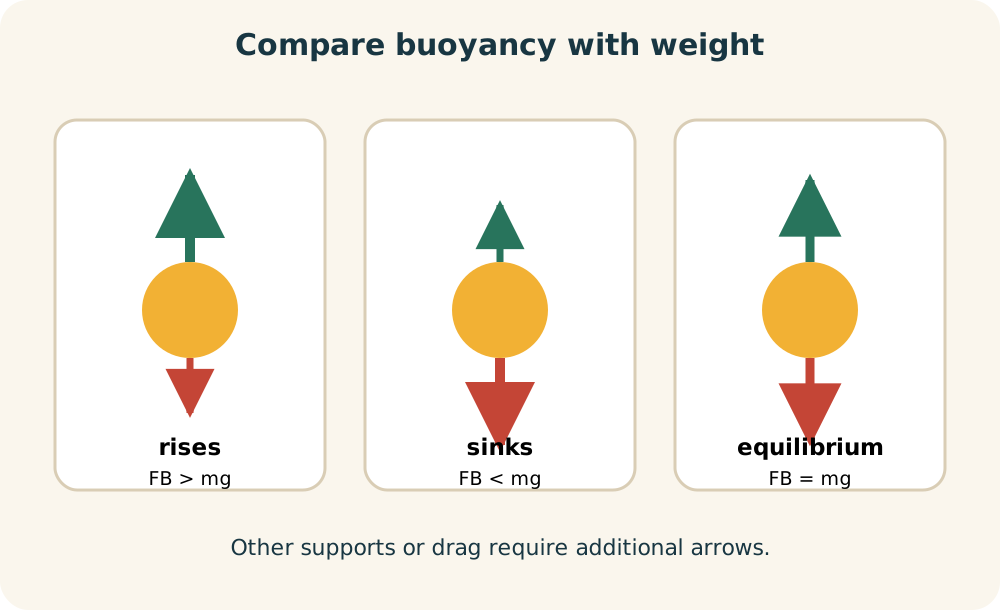
Density comparison for fully submerged objects
For a uniform fully submerged object, its mass is , where is average object density and is external displaced volume. Weight is , while buoyancy is . Their difference is . The common volume and gravitational factors make density comparison decisive. A less-dense object accelerates upward initially, while a denser one accelerates downward.
If , buoyancy and weight are equal when fully submerged. The object is neutrally buoyant in the simplified uniform-fluid model. It can remain at a chosen depth if initially at rest and undisturbed. Submarines and aquatic organisms adjust effective average density to approach this condition. Real stability and control involve additional forces and density gradients.
Average density includes the complete object volume and total mass. A hollow structure can have low average density even if its solid shell material is dense. Trapped air adds volume with little mass compared with the surrounding water. If water enters the cavity, total mass may rise without an equal increase in excluded volume. The object can then lose its ability to float.
Floating equilibrium and submerged fraction
A freely floating object at rest has zero net vertical force. Therefore . For a uniform object, write buoyancy as and weight as . Canceling gives . Solving gives .
The left side is the submerged fraction, a dimensionless number between zero and one for ordinary floating. The right side is the ratio of average object density to fluid density. An object with density half that of the fluid floats with half its volume submerged under the stated assumptions. A density ratio near one produces nearly complete submersion. A ratio greater than one cannot describe ordinary partial floating without another support force.
This equation applies to uniform density or to an object whose average density is used consistently. Shape affects how the waterline maps onto volume and whether the orientation is stable. The formula determines submerged volume, not necessarily submerged height. A tapered hull does not have height fraction equal to volume fraction. Geometry must be used after the force balance.
Floating-block example
A uniform block has density and floats in water of density . Its submerged fraction is . The density units cancel. Therefore of the volume is submerged. The remaining lies above the waterline.
If the block has total volume , the submerged volume is . Buoyant force is . The block’s mass is . Its weight is also . Equal upward and downward forces confirm the resting condition.
The two calculation paths verify equilibrium. If an additional small mass is placed on top, the block must displace more water until the increased buoyant force balances increased total weight. If the required displaced volume exceeds the block’s total volume, the block cannot maintain partial floating. It will become fully submerged and may sink unless another force intervenes. The original density ratio is therefore tied to the original system mass.
Why steel ships float
Solid steel is denser than water, so an unsupported solid steel block usually sinks. A ship is not a solid block. Its hull encloses a large volume containing air and excludes water from that volume. The total mass divided by the external displaced volume can be less than water density. That lower average density permits floating equilibrium.
As cargo is added, total weight increases. The hull settles deeper and displaces more water. Buoyant force rises until it matches the new weight. Load lines mark safe immersion limits under specified water conditions. Exceeding them can reduce freeboard and stability even before simple full-submersion reasoning applies.
Flooding changes the system profoundly. Water entering a compartment adds mass, and a cavity that fills may no longer contribute the same excluded volume. The ship settles lower, potentially allowing further flooding. Compartmentalization helps limit this progression. “Steel floats” is therefore shorthand for a designed average-density and stability problem, not a violation of density reasoning.
Apparent weight and scale readings
Suppose a fully submerged object hangs at rest from a scale. Forces are tension upward, buoyancy upward, and weight downward. Equilibrium gives . Solving yields . The scale reads tension, not gravitational force directly.
The object’s actual mass and gravitational weight have not changed. The fluid supplies part of the support, so the scale supplies less. The difference between weight in air and submerged scale reading can determine buoyant force. With known fluid density, displaced volume can then be inferred. This procedure underlies hydrostatic weighing and density measurements.
If the object rests on the bottom, the analysis may differ because fluid may not act beneath the entire lower surface. A normal force appears, and trapped-fluid conditions matter. Blindly applying the full displaced-fluid formula without checking contact can fail. Likewise, a scale platform immersed with the object changes the system and calibration. The force diagram must match the actual support arrangement.
Apparent-weight example
A object of volume is fully submerged in water. Its weight is . Its buoyant force is . The values are kept separate before force balance. Both are measured in newtons.
At rest, the supporting tension is . This is the apparent-weight reading. It is smaller than the true gravitational weight by exactly the buoyant force under the model. If submerged in a denser fluid, the scale reading would fall further. If fluid density were small, it would approach the in-air reading.
Average object density is . This exceeds water density, so the unsupported object would accelerate downward initially. The string is therefore necessary to maintain its position. Apparent weight and sinking tendency agree. Cross-checking density and force balance strengthens confidence in the result.
Buoyancy in gases and balloons
Air is a fluid, so objects in the atmosphere also experience buoyancy. The force equals the weight of displaced air, . For compact dense objects, air buoyancy is often small relative to weight. For large low-density systems, it can be decisive. Balloons exploit this regime.
A balloon system includes envelope, payload, lifting gas, and displaced surrounding air. It rises initially when the weight of displaced air exceeds total system weight. Helium and heated air can provide lift because their densities are lower than ambient air density. The gas inside still contributes mass and weight. Ignoring envelope and payload mass overestimates lift.
Air density changes with altitude, temperature, and pressure. As a balloon rises, external density generally decreases, reducing buoyant force for a fixed volume. Flexible balloons can also expand, changing displaced volume. Thermal exchange alters hot-air density. A realistic ascent therefore requires more than a constant-density formula, though Archimedes’ principle remains the organizing principle.
Stability requires torque reasoning
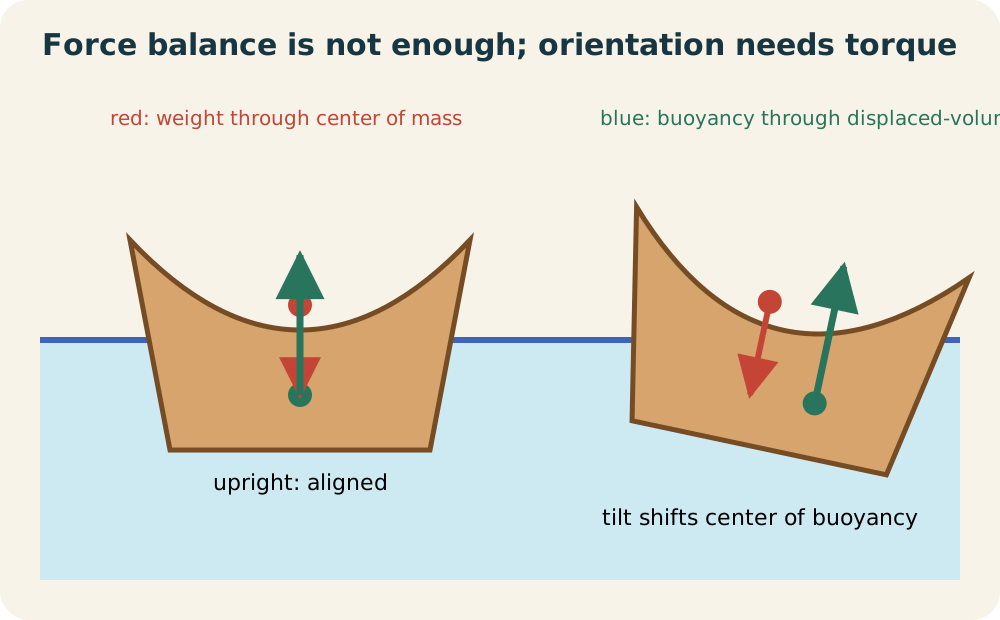
Vertical force balance is necessary for floating equilibrium but does not guarantee stable orientation. Weight acts through the center of mass. Buoyant force acts through the center of buoyancy. If the object tilts, the displaced-volume shape changes and the center of buoyancy can shift. The resulting lines of action may create a restoring or overturning torque.
A stable floating object tends to return after a small tilt. A low center of mass and hull geometry that shifts buoyancy appropriately can enhance stability. An unstable object tilts farther after a disturbance. Neutral stability produces no restoring preference over a range of orientations. Ship design therefore considers mass distribution and hull form as well as average density.
Moving cargo upward can raise the center of mass and reduce stability without changing total mass. Water sloshing in partially filled tanks can also shift the effective mass distribution. Ballast placed low can improve restoring behavior. The statement “buoyant force equals weight” cannot answer these rotational questions alone. Torque and center-of-mass analysis must join the vertical force balance.
Layered and changing-density fluids
In a layered fluid, an object may displace more than one density. Total buoyant force equals the sum of contributions associated with each displaced fluid region under suitable static conditions. A portion in oil contributes according to oil density, while a portion in water contributes according to water density. The interface position becomes part of the geometry. One average fluid density can hide important information.
In a continuously varying atmosphere or ocean, density changes with position. The general pressure-force integral remains valid. A simple expression uses local or effectively uniform density over the object. Large objects or strong stratification may require integration. Density gradients can also support stable vertical positioning.
Temperature and salinity change water density. A vessel can sit at a different draft in fresh water and seawater. Warmer or less salty water is often less dense, requiring greater displaced volume for the same weight. Load-line practice accounts for environmental variation. Density values should therefore include context and units rather than be treated as universal constants.
Accelerating frames and effective gravity
Buoyancy depends on the pressure gradient, not directly on gravity as an isolated symbol. In an accelerating container, the fluid can develop a pressure gradient aligned with an effective gravitational field. The buoyant force points opposite that effective field. This explains apparently sideways buoyancy in accelerating systems. The familiar upward result is one special orientation.
In a freely falling sealed container, fluid and objects accelerate together under gravity. The ordinary hydrostatic pressure gradient can largely disappear. Without that gradient, ordinary gravitational buoyancy vanishes in the ideal limit. An air bubble does not rise in the usual way. Microgravity fluid behavior is dominated by other effects such as surface tension.
In a rotating fluid, effective acceleration can vary with position. Pressure and buoyancy respond to the combined effective field. Centrifuges exploit this behavior to separate materials of different densities. The simple formula can be adapted only after the relevant acceleration field is identified. “Upward” should be replaced by “opposite the effective acceleration” in the more general statement.
Common reasoning failures
One error uses total object volume when only part is submerged. Archimedes’ principle uses displaced-fluid volume. For a floating body, this equals submerged external volume. For a fully submerged solid object, it often equals total external volume. Draw the fluid boundary before selecting .
Another error compares object density with fluid density and skips other forces. A tether, bottom support, acceleration, or drag can change motion. Density comparison works directly for an unsupported uniform fully submerged object in a simple static fluid. Outside that setting, write Newton’s second law. A useful shortcut should never replace the force diagram that justifies it.
A third error says pressure at depth automatically means greater buoyancy deeper down. In a uniform incompressible fluid, absolute pressure rises while the pressure difference across a fixed-height fully submerged rigid object remains constant. Another error says floating requires most of an object to lie above water. The submerged fraction is set by the density ratio. An object nearly as dense as water can float almost completely submerged.
Practice and retrieval
Find the buoyant force on fully submerged in water of density using . Compare that force with the weight of displaced water. State whether object mass is needed for the buoyant-force calculation. Explain what additional information is needed to predict vertical acceleration. Include every unit.
A uniform object of density floats in a liquid of density . Calculate its submerged-volume fraction. Predict whether it sits higher or lower than it would in water of density . Explain the prediction through required displaced fluid weight. Do not equate volume fraction with height fraction unless shape justifies it.
Finally, a metal sample weighs in air and has a steady submerged scale reading of in water. Find buoyant force and displaced volume. State the assumptions behind using the reading difference. Explain why actual gravitational weight remains in the model. Describe what changes if the sample touches the container bottom.
Solutions and reasoning
Buoyant force is . The displaced water has mass and weight . Object mass is not needed for buoyancy alone. It is needed to calculate weight and net force. Acceleration also requires total mass and any other forces.
The submerged fraction is . About of the object’s volume is submerged. In denser water, a smaller displaced volume supplies the same buoyant force, so the object sits higher. The water fraction would be . Converting volume fraction to height fraction would require a shape with constant horizontal area.
The reading difference gives . Displaced volume is . The method assumes full submersion, static equilibrium, correct scale calibration, and no bottom contact. Gravity on the mass is unchanged; fluid supplies an additional upward force. Bottom contact introduces a normal force and may alter fluid pressure beneath the object.
Connection forward
Buoyancy completes the basic static-fluid force account. Moving-fluid problems add continuity, pressure changes, kinetic-energy terms, and drag. Bernoulli-type models relate pressure, height, and flow speed along appropriate streamlines. They do not replace Archimedes’ principle indiscriminately. Model selection depends on whether the fluid is static, moving steadily, viscous, or strongly compressible.
The lesson also connects back to Newton’s laws and torque. Buoyant force belongs on a free-body diagram like any other external force. Floating equilibrium requires zero net force, while stable orientation requires appropriate torque response. Density provides a useful shortcut only after those mechanics are understood. Fluids do not suspend the laws of motion; they supply distributed pressure interactions.
Carry forward four questions. What fluid is displaced, what volume is excluded, what pressure gradient exists, and what other forces act? Calculate only after answering them. Compare buoyancy with weight to predict translation, and compare their lines of action to discuss stability. This approach makes floating and sinking consequences of a model rather than isolated rules.